
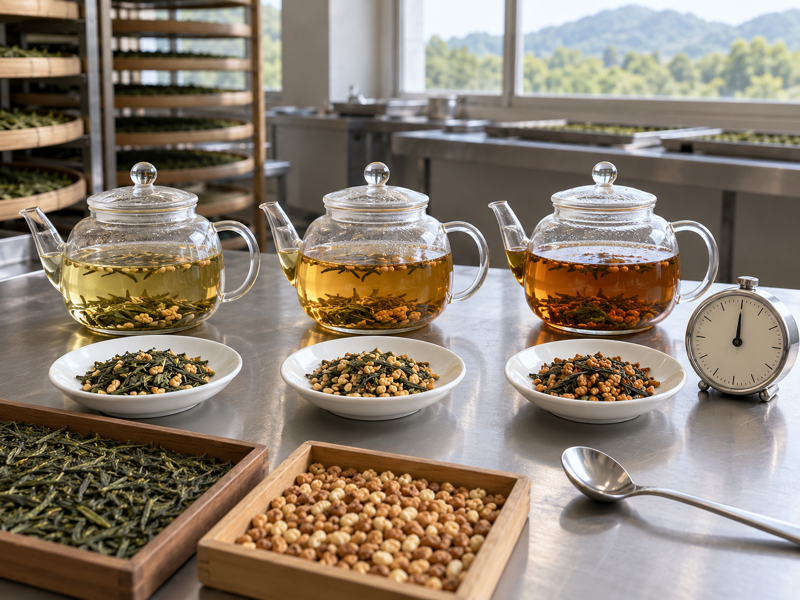
How long to steep genmaicha depends on the blend, temperature, dose, and final drink. Japan's agriculture ministry suggests about 30 seconds to one minute for a hot genmaicha cup at 90–100°C in its public brewing guide. That is a useful starting trial. A café concentrate, iced drink, or different leaf-and-rice blend may need a different recipe. Commercial teams should set a time by tasting representative samples under controlled conditions, then write a procedure staff can actually follow.
Contents
- 1. What is the starting steep time for a hot cup?
- 2. Why is steep time alone an incomplete instruction?
- 3. How do you find the endpoint without over-extracting?
- 4. Should temperature change the steeping time?
- 5. How long should a genmaicha base steep for iced drinks?
- 6. Can genmaicha be steeped more than once?
- 7. How do matcha-added blends change timing?
- 8. How can staff repeat the chosen steep time?
- 9. What should a buyer request from a supplier?
- 10. How long to steep genmaicha on a finished recipe card?
1. What is the starting steep time for a hot cup?
Begin with 30–60 seconds when using hot water near the ministry's recommended range. An earlier ministry guide gives roughly 30 seconds for ordinary bancha, genmaicha, and hojicha with boiling water. These recommendations aim to bring out roasted aroma promptly. They are not a promise that every commercial blend reaches its best flavor at exactly 30 seconds.
Make the first comparison simple. Brew the same weighed tea dose in the same water volume and vessel, then strain separate samples at 30, 45, and 60 seconds. Cool them to a similar tasting temperature before scoring. A hotter sample often seems more aromatic merely because warm vapor carries aroma, so tasting temperature should not decide the winner by accident. Record rice aroma, tea character, bitterness, and finish. If none has sufficient strength, consider dose before extending the steep into a harsh range. For a brand, the appropriate endpoint is the one that gives a consistent cup using equipment customers or store staff will really have.
| Hot-brew trial | Fixed inputs | What to compare |
|---|---|---|
| 30 seconds | Tea, water, vessel, temperature | Roast aroma and lightness |
| 45 seconds | Same inputs | Balance of tea and rice |
| 60 seconds | Same inputs | Strength and bitterness |
2. Why is steep time alone an incomplete instruction?
Time does not tell a brewer how much tea entered the pot or how hot the water was. A large tea dose steeped briefly may taste stronger than a small dose steeped longer. Broken leaves may extract faster than intact leaves. A pot that holds water against the leaves while staff pour multiple cups keeps steeping after the timer sounds. A recipe saying “one minute” without a straining endpoint therefore invites inconsistent service.
Write the full brew ratio, water temperature, start point, and end point. State whether the vessel should be preheated and whether the tea is strained completely. When comparing suppliers, use identical conditions before judging flavor. If a supplier has a recommended recipe, test it as a separate method rather than silently switching conditions for one sample. A practical record also includes final liquid yield because tea and rice absorb water. Cost per cup depends on that yield, not just the dry grams placed in the pot. Better instructions reduce waste and make complaints easier to investigate.
3. How do you find the endpoint without over-extracting?
Run a time series rather than tasting continuously from one pot. Repeated sampling changes the liquid-to-leaf ratio and temperature, which can blur the result. Prepare separate small batches under equal conditions and strain each fully at its assigned time. Score them blind if possible. An acceptable endpoint should have the desired roasted aroma and enough tea body without a coarse, drying finish. One sample may be strongest while another is more pleasant; choose according to the intended product, not sheer intensity.
If a milk drink requires a stronger base, first compare a higher tea dose at the approved time against a longer steep at the original dose. More leaf can preserve aroma without adding as much over-steeped character, though this must be tasted rather than assumed. If a loose blend settles unevenly in a large bag, mix and sample it properly before conducting the trial. Otherwise differing tea-to-rice ratios may look like a time effect. Repeat the winning method with another lot before printing it on retail packaging.
| Observation | Possible cause | Next controlled test |
|---|---|---|
| Weak roast note | Short time or low dose | Increase dose at same time |
| Bitter finish | Long time or leaf material | Shorten time at same dose |
| Inconsistent cups | Uneven mix or timing | Standardize sampling and straining |
| Cloudy result | Fine leaf or powder | Test filter and pour method |
4. Should temperature change the steeping time?
Yes, but change one factor at a time during development. Hotter water can produce a stronger cup in a shorter time, while cooler water may require a longer contact period for similar perceived strength. The sensory result is not a simple exchange rate: doubling time does not necessarily recreate the aroma of a hotter, shorter brew. Roasted rice and green tea contribute different notes, and the balance shifts with the process.
For buyers comparing roasted teas, genmaicha versus hojicha helps separate the ingredients before copying a brew schedule. Start with the 90–100°C ministry range for conventional hot service. If a blend tastes too bitter at 60 seconds, try 30 seconds at the same temperature before cooling the water. If the roast is absent, test the higher end of the range with the same time. Use a thermometer at the point of contact, especially in unheated ceramic pots. Once a practical temperature is chosen, lock it while refining time. This makes the source of a flavor difference clear and lets a store reproduce the result.
5. How long should a genmaicha base steep for iced drinks?
There is no universal iced-tea time. An iced drink often starts with a concentrated brew because melting ice dilutes it. A longer steep may increase strength, but it may also add bitterness. Increase dry tea dose or reduce brew water as alternate methods and compare all variants in the actual iced serving. Taste at handoff and after a realistic wait. A base that tastes perfect before ice may be too thin after ten minutes in a cup.
For a chain, a small pilot should record tea mass, water volume, contact temperature, time, final strained yield, ice mass, and cup size. The operation must set cooling, storage, and discard controls under its food safety plan; tasting does not establish safe hold time. Measure how the toasted aroma survives the expected hold. If a concentrated base sits for hours before serving, its sensory quality can differ from a freshly brewed test cup. Brew time is therefore only one part of an iced-drink standard.
| Iced-drink variable | Record | Reason |
|---|---|---|
| Brew time | Seconds from contact to full strain | Controls extraction |
| Brew yield | mL after straining | Sets dilution ratio |
| Ice mass | Grams per cup | Sets melt contribution |
| Hold time | Minutes under approved storage | Checks aroma retention |
6. Can genmaicha be steeped more than once?
Yes, loose tea can be brewed again, but subsequent infusions differ from the first. The rice aroma may become weaker while remaining leaf flavor changes. A second brew is a sensory choice, not a guaranteed way to extract an identical cup at lower cost. Test it under its own recipe, including fresh water temperature and time, and decide whether customers will receive it separately or as part of a blended batch.
Commercial kitchens should be cautious about using repeated infusions solely to improve apparent yield. If a second steep tastes thin, mixing it into the first can reduce the overall roast profile. If it tastes good as a lighter tea-room service, document that as a different experience. Avoid treating a longer second steep as proof of reduced caffeine; the amount in each infusion depends on the product and method. A numerical caffeine statement requires testing of the served beverage. Keep the time between infusions within your operation's food handling procedure, and do not leave wet leaves unattended for an undefined period.
7. How do matcha-added blends change timing?
Matcha-iri genmaicha contains fine tea powder as well as loose tea and rice. Some powder may pass through a strainer and remain in the cup. A bright green appearance can develop quickly, so color alone does not prove that the roasted rice and leaf have extracted enough. Powder settling can also change the last pour from a batch pot. The exact behavior depends on formulation and filter size.
Test a matcha-added SKU from scratch rather than transferring the plain genmaicha recipe. Compare short hot steeps, note aroma and bitterness, and observe the drink after the normal service hold. Stir or agitate according to the intended procedure before filling multiple cups. If a packaged product is planned, validate how fine particles behave during processing and shelf life. A supplier may recommend a different method for powder-format material; ask whether it is meant to be steeped, dispersed, or extracted. The word “genmaicha” on both products does not make their timing interchangeable.
| Format | Timing concern | Service check |
|---|---|---|
| Plain loose genmaicha | Leaf and rice extraction | Strain fully at endpoint |
| Matcha-iri loose blend | Powder enters cup | Agitate and watch settling |
| Genmaicha powder | May disperse, not steep | Follow SKU-specific directions |
| Liquid extract | Dilution rather than steep | Validate finished drink |
8. How can staff repeat the chosen steep time?
Give them a recipe card with a visible timer start and stop event. “Start when all water touches tea” and “remove the basket at the timer signal” are clearer than “brew for one minute.” Use scales or pre-portioned packs to control dose. Train staff on full straining, especially when a large batch is divided among several pitchers. In a factory, record the point when water contacts the blend and the point when filtration separates it from the liquid.
An observed store trial often reveals delays hidden in a lab recipe. A barista may start the timer before filling a large urn, or leave the basket immersed while preparing milk. A nominal 45-second recipe then becomes much longer. Measure the real process and adapt the instruction or equipment. Taste across shifts using a retained reference sample. When a new lot arrives, compare it under the same method before changing the timer. A change to the blend should prompt review of time, not an undocumented adjustment by individual employees.
9. What should a buyer request from a supplier?
Request a product specification, ingredient statement, recommended preparation, lot identification, shelf-life and storage advice, and notification of material changes. The supplier's brew suggestion is useful as a trial input, but your final service standard must reflect your water, equipment, and application. Keep representative samples and sensory records linked to each lot. If a brand plans to print “ready in 30 seconds,” test that statement with ordinary customer equipment rather than an ideal laboratory setup.
Matcha Village states that genmaicha powder is among its product categories. Powder may need a dispersion protocol rather than a loose-leaf steep, so confirm the exact item and preparation before writing instructions. Ask for documents specific to the quoted SKU; broad company certification or capacity statements do not establish the composition of a blend. For importer or private-label work, approve the tea and the user instructions together. A product that tastes excellent under a hidden laboratory recipe can disappoint when the retail packet provides only a vague time range.
| Approval item | Evidence | Owner |
|---|---|---|
| Exact SKU | Current specification | Procurement |
| Brew time | Repeated sensory trial | Product development |
| Customer instruction | Usability test | Marketing and operations |
| Lot consistency | Retained sample comparison | Quality team |
10. How long to steep genmaicha on a finished recipe card?
Put the tested time there, accompanied by dose, water volume, temperature, vessel, and straining endpoint. For an ordinary hot cup, 30–60 seconds is a defensible starting trial drawn from Japanese public guidance. The final instruction may differ if your exact blend, cup size, or application requires it. Make sure the recipe works with the equipment used by customers or staff and not only at a development bench.
Before launch, repeat the chosen process with a second production lot and an operator who did not design the recipe. Compare the served drink with an approved control, then record any correction. Request representative supplier samples, test them under one method, and choose based on the finished cup. That is a stronger basis for purchasing than an unqualified answer to “how long?”
Frequently asked questions
Q1: Is 30 seconds enough for genmaicha? It can be for a hot cup, but test the exact blend and dose.
Q2: Can I steep genmaicha for several minutes? You can test it, though bitterness may rise; do not assume a long steep is better.
Q3: Should iced genmaicha steep longer? A stronger base is needed, but a higher dose may work better than a longer steep.
Q4: Can I reuse the leaves? Yes, if a second infusion meets your flavor and food handling standards.
Q5: When should the timer start? Start when brewing water contacts the tea, and stop by fully separating tea from liquid.