
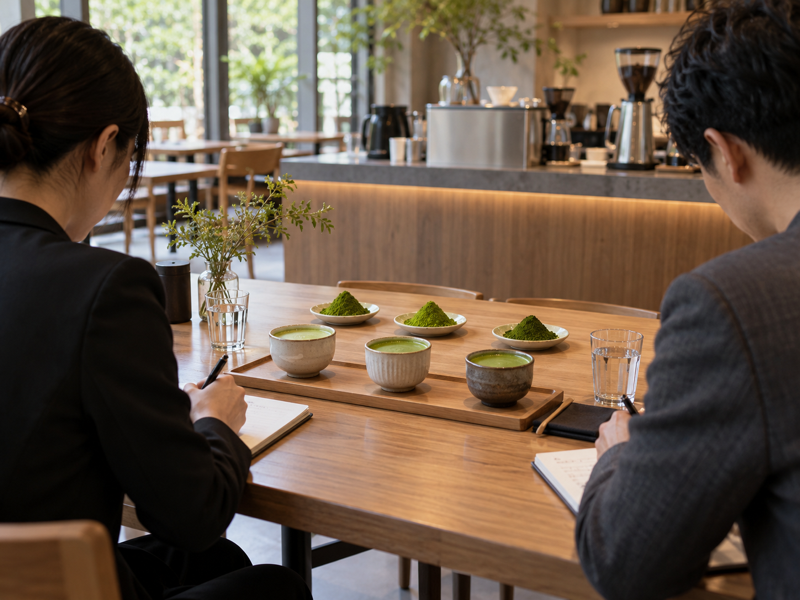
The search for the best matcha for coffee shop service should end with a finished-cup trial. The best matcha for a coffee shop is the powder that produces the intended cup with the shop's milk, bar equipment, price, and staff. A delicate straight-tea sample can vanish in a sweet iced latte. A low-cost powder can need a larger dose or create remakes. Coffee shop buyers should compare candidates in the actual menu, then check supply documents and operating cost. This guide offers a selection test for a mixed coffee and matcha bar rather than a universal ranking of brands.
Contents
- 1. What does a coffee shop need from matcha?
- 2. How should candidates be shortlisted?
- 3. How should a blind latte test work?
- 4. How should dose affect the buying decision?
- 5. Are grade labels useful?
- 6. How should the powder fit the coffee bar?
- 7. What supplier documents should be reviewed?
- 8. How should total cost be compared?
- 9. How can consistency be checked after buying?
- 10. When is a powder approved for the menu?
1. What does a coffee shop need from matcha?
A coffee shop often adds matcha to an existing service line. The powder must work alongside espresso, milk steaming, ice, and a busy point-of-sale system. It should have a clear tea flavor in the drink customers order, be easy to dose and disperse, and arrive reliably from a supplier. The bar also needs a way to store powder away from steam and coffee residue.
Write the use brief before sampling. State whether the shop will sell straight tea, plain hot and iced lattes, or flavored drinks. Include cup sizes, milk SKUs, sweetness, expected volume, and price. A shop selling only sweet iced lattes may choose differently from one offering a serious unsweetened tea service. The “best” product has no meaning until that job is defined.
| Menu use | Main sensory need | Bar constraint |
|---|---|---|
| Straight matcha | Clean tea flavor | Water control |
| Hot latte | Tea through steamed milk | Foam and temperature |
| Iced latte | Flavor after ice | Dilution and appearance |
| Flavored drink | Tea remains identifiable | Syrup balance |
| Batch service | Stable concentration | Hold and traceability |
2. How should candidates be shortlisted?
Ask suppliers for samples chosen for the exact menu use, plus ingredient information, pack size, lot identification, storage guidance, and price. Include more than one price point so the test can show whether an expensive product earns its cost. Avoid judging a product by color on the dry spoon alone. Color, aroma, and smoothness must be assessed after preparation.
Reduce the list to candidates the shop can actually buy at its volume. A rare sample with an unsuitable minimum order or long lead time may be a poor operational choice. Check whether the supplier can provide the same specification over time and explain how quality concerns are handled. Keep the sample codes anonymous during tasting so a familiar origin or grade label does not decide the result in advance.
3. How should a blind latte test work?
Prepare each candidate at the same powder weight, water amount, milk SKU, finished volume, and sweetener level. Use the same mixing tool and timing. Ask tasters to score tea presence, bitterness, texture, color, and willingness to reorder. Taste an unsweetened version before flavored versions. Otherwise syrup can cover differences that will matter once the shop changes a menu item.
Run the test more than once and include a regular barista, not only the buyer. A powder that an expert can whisk beautifully may clump during a Saturday rush. Look at the cup after a short wait and after ice melts. Record preparation time and cleaning effort. The result should be a shortlist of viable products, not a single subjective winner from one tasting.
| Test stage | Fixed variable | Record |
|---|---|---|
| Water cup | Dose, temperature, vessel | Aroma and finish |
| Dairy latte | Exact milk and volume | Tea through milk |
| Plant latte | Exact plant milk | Texture and balance |
| Iced hold | Ice weight and wait | Dilution and sediment |
| Mock shift | Staff and station | Speed and remakes |
4. How should dose affect the buying decision?
After a fair same-dose comparison, adjust each finalist to the lowest dose that meets the house flavor target. That is the useful cost comparison. A powder that tastes weaker at the baseline may still become excellent with a modest adjustment; another may turn bitter as dose rises. Record both the accepted dose and any change to water or milk. Do not compare one candidate in a small cup with another in a large one.
Weigh staff doses during service. A spoon can vary, and a busy worker may overfill it to make the drink taste stronger. Include normal waste in the calculation. If a powder requires sifting or a longer mixing step, count that labor too. Buying decisions should reflect the sellable cup, not the invoice price of an unopened kilogram.
5. Are grade labels useful?
Words such as “ceremonial” and “culinary” can help start a conversation, but suppliers may apply them differently. Ask for a product specification and taste the powder in the intended drink. A delicate tea can be worth the cost for straight service and still be a poor fit for a sweet 16-ounce latte. A powder selected for baking may work in a flavored drink but taste rough in water.
Choose by use and documentation. If the coffee shop offers straight matcha and several milk drinks, it might carry two approved powders. That adds stock and training, so label containers clearly and model the cost. One product may be enough if it passes every use. The goal is not a prestige term on the menu; it is a cup customers can recognize and buy again.
6. How should the powder fit the coffee bar?
Watch the actual preparation path. Where will the barista weigh powder while espresso is being pulled? Can the mixing vessel be cleaned without delaying milk steaming? Is powder stored in a dry area away from steam? A matcha recipe that needs an extra counter and sink may not fit a compact coffee bar even if it tastes excellent in the development kitchen.
Test service with mixed orders, not a matcha-only queue. Place espresso, cappuccino, and iced matcha tickets together. Time them and note collisions around the milk fridge, ice bin, and handoff shelf. A slightly different tool or sequence may solve the problem without changing powder. Do not attribute every slow ticket to matcha itself.
| Bar issue | Observation | Possible change |
|---|---|---|
| Powder near steam | Clumping or damp pack | Move storage |
| Shared milk station | Queue at pitcher | Split tasks |
| Shared sink | Dirty tools accumulate | Duplicate tools |
| Long mix step | Matcha tickets lag | Test method |
| Unclear modifier | Wrong milk | POS and card update |
7. What supplier documents should be reviewed?
Request current composition, lot information, storage guidance, packaging options, and documents required for the market. Ask how new lots are checked against the approved sample. If the product is a sweetened blend, review the full ingredient statement and menu claim. For a coffee shop that sells retail pouches, confirm retail labeling separately.
Check lead time, minimum order, delivered cost, and available support if a shipment is late or wrong. A backup source should be tasted and documented before it is needed. Keep a retained sample from the approved lot so a later complaint can be investigated. Matcha Village offers B2B matcha products, but the shop must still approve the exact material, recipe, and local compliance documents for its own operation.
8. How should total cost be compared?
Calculate matcha cost as approved dose multiplied by delivered cost per gram. Add milk, syrup, cup, lid, normal waste, and labor time. Compare candidate powders at the dose that produces an acceptable cup. If one mixes faster but costs more, measure whether the time saving matters at peak. If another costs less but produces more remakes, include those cups.
Use a simple scenario table. Model expected sales mix and a shift toward iced large drinks, then check powder use and profit. A bag quote can change; save its date and terms. Retest the price plan when a supplier, milk, cup, or recipe changes. The best powder for a coffee shop should support both the sensory promise and the actual margin.
| Cost component | Source | Common blind spot |
|---|---|---|
| Matcha | Approved dose and invoice | Overdosing |
| Milk | Actual pour | Alternate milk |
| Packaging | Cup and lid | Large size |
| Waste | Stock and remake log | Spills |
| Labor | Timed mixed-order shift | Cleaning |
9. How can consistency be checked after buying?
Set a reference cup and a short opening check. Staff confirm powder code and lot, storage condition, scale, milk SKU, and clean tools. When a new lot arrives, prepare it against a retained sample in the same recipe. Record any difference in flavor, color, or dispersion. A product can vary, but so can water, milk, dose, and equipment. Check those variables before drawing a conclusion.
Train more than one barista. Ask them to make the same hot and iced drink without coaching. Compare cup weight, taste, appearance, and ticket time. A recipe that works only for the lead barista is not ready for routine service. Keep a defined remake rule for clumps, wrong milk, and weak tea. Consistency is visible in the cup and in the stock count.
10. When is a powder approved for the menu?
Approve it when it passes straight and milk tests required by the menu, meets cost and speed targets, comes with suitable documents, and can be supplied in the needed quantity. Record the approved product code, dose, method, milk, and reference cup. Then run a paid pilot at the intended price. Customer repeat interest is a stronger signal than a free tasting.
If two powders perform similarly, choose based on supply reliability, documentation, and the simpler bar workflow. If no sample passes, revise the use brief or ask suppliers for another candidate. A forced choice can lock the shop into a weak product and a menu full of syrup to cover it. The buying test should protect the customer experience before the first large order.
For a final purchasing trial, give two baristas coded samples from the finalists and one ordinary mixed-order shift. Ask each person to make a straight tea and the shop's highest-selling milk drink without extra coaching. Save the drink weights, ticket times, remake reasons, and their brief notes on handling. Then let customers buy the finalists at the same price on separate days, with the same menu description.
The comparison is imperfect because traffic changes, but it can reveal whether one powder causes repeated questions or a weaker cup. Review the supplier documents only after the sensory and service record is complete, so a polished brochure does not influence tasting. If the preferred powder needs a different dose, revise the cost sheet and staff card before the purchase order. This final trial can also show whether the coffee bar has room for matcha tools during peak espresso service.
Keep rejected samples in the trial record with the reason they failed. A buyer revisiting the category six months later can see whether the problem was taste, cost, supply, or a preparation method that has since changed. That record prevents a familiar sales pitch from restarting the same incomplete comparison.
| Approval gate | Pass condition | Record |
|---|---|---|
| Cup | Tea tastes clear in menu drinks | Blind trial |
| Bar | Regular staff make it on time | Mock shift |
| Cost | Approved dose fits price | Cost sheet |
| Supply | Terms and documents fit | Buyer file |
FAQ
Q1: Is the most expensive matcha best for a coffee shop?
No. Compare the finished cup, accepted dose, service time, and delivered cost.
Q2: Can one powder serve straight tea and lattes?
Yes if it passes both tests. Some shops may need separate products for distinct uses.
Q3: Should a shop choose by powder color?
Color matters, but taste, texture, supplier consistency, and cost also need testing.
Q4: How should a new lot be checked?
Prepare it with the same recipe and compare it with a retained approved sample.
Q5: What should a supplier sample request include?
Menu formats, cup sizes, milk SKUs, sweetness, volume, destination market, and required documents.
Related reading: best matcha for lattes and Matcha at your Local Cafe? Where to Find Real Matcha.