
Matcha wholesale cost is more than the price on a supplier’s kilogram quote. A café can buy the cheapest powder and still pay more per accepted drink if it needs a heavier dose, extra syrup, or frequent remakes. A retail brand also carries freight, packaging, testing, and inventory that may sit for months. This guide builds a cost model around a sellable unit, then shows how to compare grades and order sizes without losing the sensory standard. It is written for buyers who have to explain a supplier decision to finance and operations. Matcha Village can quote product options, but the buyer’s own recipe, route, and waste records determine the commercial answer.
1. What should matcha wholesale cost measure?
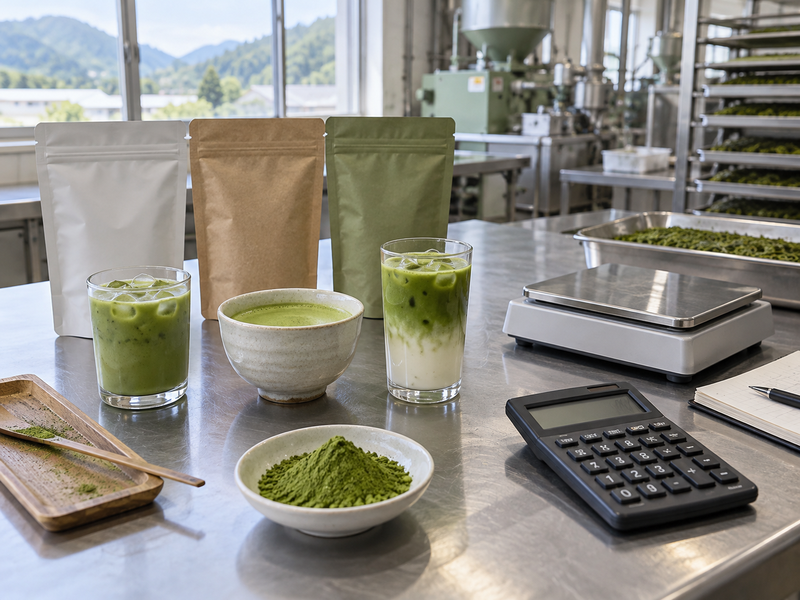
Choose the unit that earns revenue. For a café, that is usually an accepted served cup. For a bakery, it might be a sellable cake or batch of cookies. For a retail brand, it is a packed unit that reaches a customer after returns and shrinkage. The supplier’s price per kilogram is one input. Divide the total relevant cost by units that pass quality and are actually sold. That denominator prevents a low quote from looking good when a powder causes more rejects or requires a stronger dose.
Set a product standard before filling the spreadsheet. The accepted cup should meet agreed flavor, appearance, and preparation-time targets. If one candidate is evaluated in a larger or sweeter recipe, the cost comparison loses meaning. Record each supplier sample code, pack size, quote date, shipping terms, currency, and volume tier. A buyer should be able to reproduce the calculation when the next quote arrives. The model is a decision aid, not a promise that a listed price will stay fixed through a harvest or freight change.
| Business model | Useful cost unit | Quality floor |
|---|---|---|
| Café | Accepted cup | Standard recipe taste and appearance |
| Bakery | Sellable baked unit | Color and flavor after process |
| Retail powder | Delivered consumer pack | Pack and shelf-life acceptance |
2. Why do two kilogram quotes differ?
A quote may cover different grades, crop or production lots, packaging, certification, minimum order quantities, and delivery terms. One supplier may price ex works in a bulk bag; another may include export packing and freight to a port. Neither quote is directly comparable until those terms are aligned. Request a written product specification with the quote. Ask whether sample material represents the commercial code and whether the quoted grade will remain available at the forecast volume.
Record currency and quote validity. A buyer operating in dollars can see the landed cost move when exchange rates change, even if the supplier’s local price does not. Do not solve that uncertainty by inventing a universal wholesale price band. Use current quotes from actual candidates and define the comparison date. If the supplier offers a volume break, price the planned quantity as well as a smaller trial. The lowest tier may tie cash into stock that the business cannot use within the product’s validated quality period.
3. How is landed cost calculated?
Add the costs required to bring acceptable matcha to the receiving location. Depending on the agreed delivery term, this may include origin transport, export handling, main freight, insurance, duties, brokerage, local delivery, and receiving or inspection. Keep recoverable taxes separate from true cost according to the company’s accounting rules. Divide by the usable kilograms received. Short shipments, damaged cartons, or rejected lots change that denominator, so record actual receipts after the pilot rather than relying only on the purchase order.
Build the model with explicit fields and a note for who owns each charge. Do not count freight twice when comparing an all-in delivered quote with a factory quote. Ask the logistics team to validate route assumptions for the order size and destination. Small air shipments are often a poor proxy for regular sea freight, while a large sea quote can hide warehouse carrying cost. A pilot and a steady-state order should be modeled separately. That distinction helps procurement explain why a sample’s landed cost is not the recurring product cost.
| Cost field | Source | Check |
|---|---|---|
| Tea and export pack | Supplier quote | Same product code and quantity |
| Freight and insurance | Forwarder quote | Same route and service |
| Entry and delivery | Broker and carrier | Destination charges included |
| Usable received weight | Receiving record | Rejects removed from denominator |
4. How does matcha dose change the economics?
Multiply landed cost per gram by the grams used in one accepted recipe. That is the ingredient contribution, but the dose must come from a blind product trial. A cheaper tea may need more grams to reach the target flavor, or it may remain harsh no matter how much is used. A more expensive tea may give the desired cup at a smaller dose. Keep milk, sweetener, water, ice, and cup constant when comparing grades. Record the recipe that tasters approved, not the first one that a supplier suggested.
For blended products, count every ingredient separately. A premixed matcha latte powder may reduce station steps while carrying sweetener or creamer in the supplier price. Compare it with a made-from-scratch formula on cost per accepted cup and labor, not tea weight alone. If the product is for a bakery, measure retention after baking rather than judging a cold batter. The cost model should follow the use case. A gram of matcha on a specification sheet does not have the same value in every finished product.
5. Where does waste enter the model?
Separate process loss from quality rejection. Powder left in a bag, spilled at a bar, or trapped in a mixer is process loss. Drinks remade because they clump or taste wrong are quality loss. Expired open packs and damaged shipments are inventory loss. Each has a different remedy. Track them over a limited pilot with the actual pack and equipment. A buyer who applies one vague waste percentage to every supplier may miss a packaging problem that is easy to fix.
Calculate effective cost from the material that reaches sellable units. If a case contains usable tea but staff discard part of it after opening, the cost per served gram rises. Use weighed beginning and ending stock during the pilot and reconcile it with recorded servings. Keep training waste separate from steady-state waste; a launch week may overstate recurring loss. The goal is a fair comparison, not a perfect forecast. A simple, auditable loss log is better than a confident percentage nobody can explain.
| Loss type | How to measure | Likely action |
|---|---|---|
| Spill and residue | Weigh pack and usable output | Change pack or dosing tool |
| Recipe remakes | Count rejected cups | Improve dispersion method |
| Open-stock expiry | Record discarded grams | Use smaller working packs |
6. Should preparation labor be included?
Yes when alternatives change the time or skill needed to make the product. Time several operators making the same number of drinks under normal station conditions. Include weighing, pre-dispersion, pouring, cleaning, and a realistic share of batch setup. A powder that costs less but demands an extra whisking step can slow peak service. A preblend may cost more per kilogram yet free staff time. Keep wage assumptions with the model so finance can change them without rebuilding the recipe analysis.
Do not overstate labor savings from a perfect demonstration. Run the test during a short queue and record errors as well as time. The slower method may also produce better flavor and a higher selling price; the model can hold both facts. For central manufacturing, labor may appear in mixing, filling, quality checks, and rework rather than bar time. Make the labor boundary explicit. Otherwise one department’s quote can look cheaper because another department’s work has been left outside the calculation.
7. What changes for retail or private-label products?
Retail economics include more than ingredient and fill cost. Add primary and secondary packaging, design and label review, line setup, minimum production run, testing, storage, distribution, channel fees, returns, and unsold inventory. A custom tin may support a premium shelf position but also increase freight and working capital. Model the unit at the realistic production run, not only the supplier’s largest volume tier. If the brand changes artwork, leftover printed packaging may become waste.
Private-label quotes need a clear bill of materials and responsibility map. Ask who buys the pack, who owns defects, who performs release testing, and whether quoted price includes finished-goods storage. Compare the full delivered unit. If two suppliers use different grams of matcha per pouch, price per pouch alone conceals a product difference. Consumer trust also depends on a consistent sensory result; keep that acceptance standard in the costing file. A cheap pack that customers return is a poor unit-cost win.
8. Which assumptions deserve sensitivity tests?
Test the variables that can change the decision: dose, freight, exchange rate, waste, forecast volume, and shelf-life losses. Show a base case and a plausible high-cost case for each supplier. Avoid treating an illustrative scenario as a market forecast. The purpose is to see whether a supplier remains attractive when one assumption moves. If a quote wins only when every optimistic assumption holds, the buyer should know that before signing a long-term commitment.
Use the same assumptions across suppliers unless a difference is supported by trial data. For example, one tea may have a measured lower dose and another may use a lighter pack. Those can differ in the model. Freight can also differ if the origins or shipment sizes differ, but document the route. A one-page sensitivity table often makes a decision clearer than a crowded workbook. Ask operations and finance to challenge the two or three inputs that move cost per sellable unit most.
| Variable | Why it moves cost | Evidence to update it |
|---|---|---|
| Tea dose | Grams per unit | Approved recipe trial |
| Waste | Usable output | Pilot stock reconciliation |
| Freight | Landed cost | Current route quote |
| Volume | Price tier and carrying cost | Sales forecast and reorder plan |
9. How should a supplier tender be compared?
Send identical specifications and volume scenarios to each candidate. Ask for product code, grade description, lot sample, packing format, minimum order quantity, lead time, delivery term, quote validity, and required quality documents. Build a comparison sheet that shows price per kilogram, landed cost, dose-adjusted tea cost, and final cost per sellable unit. Keep the sensory score beside the cost rather than on a separate presentation slide. Procurement should see the trade-off without searching for it.
Do not average unlike quotations into a false benchmark. A certified product, a different application grade, and a different delivery term may all be legitimately priced differently. Explain the specification difference in the tender result. If two candidates are close, pilot the one with a better operational fit or negotiate a trial quantity before a large commitment. The model helps the team ask the next question. It should not make a supplier decision appear more precise than the underlying forecast.
| Tender column | Purpose | Common mistake |
|---|---|---|
| Quote and delivery term | Normalize supplier basis | Comparing factory with delivered price |
| Approved dose | Convert tea cost to serving | Using one dose for unequal grades |
| Waste and labor | Capture operating difference | Assuming all powders behave alike |
10. What decision should the cost model support?
The final decision should name the chosen product, accepted recipe, expected purchase quantity, landed route, quality documents, and financial assumptions. Set a review trigger for material changes: a new matcha lot outside the reference standard, a freight shift, a different pack size, or a menu recipe change. Those events can alter cost per unit even if the supplier’s kilogram price remains fixed. Give finance the model and operations the recipe sheet so both work from the same version.
Matcha Village offers multiple grades, blends, and pack formats through its website. A useful quote request includes the cup or product brief and a forecast range, not only “best wholesale price.” Matcha wholesale cost becomes actionable when a buyer can connect the quote to a tested serving and explain what happens if dose, waste, or volume changes. That is the basis for a purchase the business can defend six months later.
Frequently asked questions
Q1: Is the lowest price per kilogram the cheapest matcha? Only if dose, waste, freight, and accepted quality are comparable.
Q2: Should sample freight be used for regular pricing? Model pilot freight separately from the planned recurring route.
Q3: How should a café compare a latte mix with pure matcha? Compare complete accepted cups, including other ingredients and labor.
Q4: What is the most useful cost metric? Cost per sellable unit under a documented recipe and quality standard.
Q5: When should the model be refreshed? Recalculate when quotes, routes, recipes, waste, or forecast volumes materially change.
Put the approved cup beside the matcha wholesale cost sheet. If the numbers and tasted result describe the same item, the team can negotiate and reorder with fewer surprises.