
Buyers often receive a brown tea sample described as “roasted green tea” with little detail about what was roasted or how the next lot will match it. Asking how is hojicha made opens a practical discussion about leaf input, roast control, cooling, milling, and records. Those steps shape the flavor a café serves and the powder a food manufacturer adds to a formula. This guide explains what to ask at each stage and where a buyer should test the finished tea. It does not assume a particular origin or process for every supplier; the actual product specification and lot file must answer those questions.
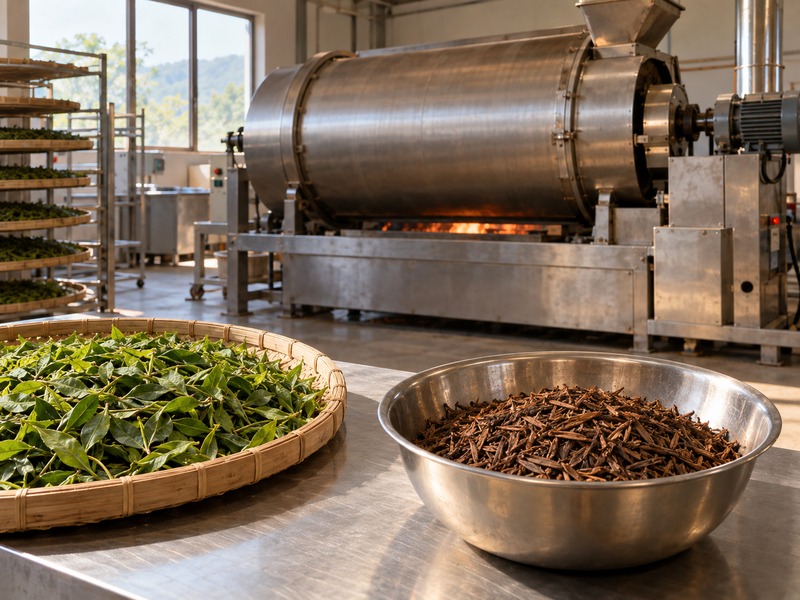
Contents: input · sorting · roasting · cooling · grinding · color · quality · traceability · application · approval
1. Which tea material becomes hojicha?
Identify the actual leaf or stem input
Hojicha is a roasted tea style. Suppliers may start with different green-tea leaf grades, stem material, or blends, and those choices change the cup before the roaster is switched on. A leaf-heavy input can bring a different body from a stem-heavy one. Age, storage, and moisture of the starting material also matter. Ask the supplier for a plain description of the input and whether it is fixed by specification. A claim such as “premium leaves” tells the buyer less than an item code, defined material, and sensory reference.
Start before the roast. Compare two input lots at the same roasting target if the factory can provide them. That isolates leaf variation from process variation. For a brand using geographic or cultivation claims, request documentation that supports those words for the actual lot. A tea can follow a hojicha method outside Japan; the manufacturing style alone does not prove Japanese origin. Keep origin, cultivar, and organic claims separate from the description of roasted flavor. The buyer’s job is to understand what is in the pack and how the supplier keeps it consistent.
2. Why do sorting and preparation matter?
Make the roaster's feed as even as possible
Before roasting, a producer may sort or blend the tea input so the equipment receives material with a workable range of particle size and moisture. Uneven feed can roast unevenly: thin pieces darken quickly while larger leaves or stems lag behind. The result may contain both smoky fragments and underdeveloped pieces. Ask what the factory checks before a batch starts, whether foreign material is removed, and how a planned blend is recorded. The exact equipment varies; the important question is whether the process has controls a second operator can repeat.
Look for a defined starting point. If a supplier changes the base tea because a harvest or inventory changes, the roasted result needs a fresh comparison against the approved reference. A buyer need not prescribe every factory setting, but should know which input changes trigger notice. For a powder that will be milled later, uniformity matters even more because the ground blend hides visible leaf differences. The cup and application test should still expose flavor drift. Ask to see a process flow or product specification that connects incoming tea, roast batch, and packed lot.
| Input question | What it reveals | Follow-up |
|---|---|---|
| Leaf or stem proportion | Likely flavor and body | Compare finished cups |
| Input grade | Material consistency | Request specification |
| Sorting method | Roast evenness | Review defect controls |
| Blend change rule | Future lot risk | Set notice requirement |
3. What happens during roasting?
Heat creates the recognizable roasted character
Roasting changes a green tea's aroma, appearance, and taste. Different heat profiles can produce a gentle toasted note, a pronounced grain-like roast, or an unpleasant burnt edge. No single temperature or time is right for every machine and leaf input, so a buyer should be wary of a universal number printed without context. Ask the factory how it controls batch size, heat, movement, and endpoint, then taste samples from the resulting range. An even roast should be judged by the prepared tea and the intended application, not dry color alone.
Smell after the first steam clears. Freshly roasted tea can have a strong immediate aroma that changes after packing. Compare the cup at a consistent rest period. Record positive and negative sensory words in ordinary language that staff can use: toasted cereal, cocoa-like warmth, smoke, ash, stale oil, or sharp bitterness. These are sensory descriptors, not promises that the tea contains cocoa or grain. A darker roast may work in sweet dairy while overwhelming a plain brew. If a supplier offers several roasts, label their use cases and test each at a fixed dose.
4. Why does cooling deserve its own control?
Stop the roast where the batch was approved
Tea continues to carry heat after it leaves a roaster. If it is piled, sealed, or milled while too warm, the finished aroma and handling can change. Ask how the producer cools a batch, how long it waits before packing or grinding, and how it protects the tea from contamination during that interval. The buyer does not need a theatrical view of glowing equipment; the useful evidence is a repeatable endpoint and a clean path from hot tea to packed material.
Compare early and late material. Sample across a production batch when feasible. If the first and last portions smell different, the issue may be roast loading, cooling, or blending rather than the leaf alone. For a brand selling loose leaf, visually inspect the cooled tea for uneven color and broken pieces. For a powder buyer, prepare a standard cup from separate packed units. A batch number should link those units to the same production record. A clear cooling rule also helps a supplier explain why a small laboratory roast and a full production roast may not taste identical.
| Stage | Buyer-visible evidence | Concern |
|---|---|---|
| Roast endpoint | Reference cup | Burnt or weak note |
| Cooling | Written process and sample | Continuing heat effect |
| Holding | Clean protected material | Off odor or contamination |
| Packing | Traceable lot | Mixed batches |
5. When does roasted leaf become powder?
Grinding is a separate choice
Loose-leaf hojicha and hojicha powder share a roasted-tea starting point, but milling changes how the ingredient behaves. A fine powder disperses differently in milk, dough, or ice cream from a coarse grind. It also exposes more surface area during storage. Ask whether the factory mills after roasting, whether the grind is controlled to an application target, and how heat during milling is managed. A particle-size number can help, but the real acceptance test remains the finished product: does a latte leave grit, does a dry blend separate, and does a cake taste of tea after baking?
Do not treat milling as roasting. A dark powder may come from a darker roast, finer grind, or both. Test those variables separately if possible. If a supplier uses a different grinding method for foodservice and retail packs, request samples from the actual production route. Cleanability and cross-contact controls matter when equipment processes other ingredients. The buyer should ask which documents describe the milling site and whether the lot code still traces back to the tea input. For more detailed milling questions, the existing powder-production guide covers that separate stage.
6. Can color prove that a hojicha lot is right?
Use color as one check, then brew
Hojicha shades can range from warm amber infusions to deeper brown powder. Lighting, grind size, milk, and a camera can change the apparent color. A buyer may reasonably set a visual range for a bottled beverage or bakery product, but a color match does not guarantee a clean roast. Compare samples in the same vessel under the same light, then taste them at a fixed concentration. If a lot looks right but tastes smoky or flat, investigate it rather than signing it off because the photograph matches.
Inspect the application color. The powder that looks rich in a dry bowl may turn dull in oat milk or darken a cake too much. Set color acceptance in the served cup or baked slice, where the customer sees it. Keep photographs as supporting records with lighting and recipe notes. If a brand claims “natural color,” the formulation and labeling team should review the actual ingredient and market rules. A sensory reference plus an application sample gives procurement a stronger approval tool than an isolated color swatch.
| Check | Useful for | Cannot prove |
|---|---|---|
| Dry leaf or powder shade | Gross lot comparison | Good flavor |
| Plain infusion | Roast and clarity | Performance in milk |
| Finished product color | Consumer appearance | Safety or origin |
| Reference photograph | Visual record | Exact chemistry |
7. Which tests support quality and food safety?
Match the test plan to the product and market
For a commercial ingredient, request a current specification and lot certificate of analysis. The relevant test list can include microbiological, pesticide, heavy-metal, moisture, or other checks according to the buyer's market and use. Do not assume every tea or destination uses the same limits. A powder for direct use in a cold beverage may raise different process questions from a powder baked into a cookie, though both need safe, lawful ingredients. Ask the supplier which tests are performed routinely, which are commissioned for a market, and how a failed result is handled.
Check the lot number twice. The sample in a tasting room, the COA, and the cartons delivered to the warehouse should connect through traceable identifiers. A generic test report from another product cannot establish the status of the purchased lot. Certifications in a company profile need their own scope review. Matcha Village describes quality and export support in its company materials; a buyer should still request the exact current file for the proposed item. Put any missing document on a hold list before printing labels or booking a full order.
8. How can the process remain traceable?
Follow one lot from input to pack
Ask the supplier to show how an incoming tea lot becomes a roast batch, a powder lot if milled, and a packed carton. The record need not be glamorous. It needs to let a quality team identify affected material if a complaint arrives. Clarify whether batches are blended and how that is recorded. A product code, production date, and lot identifier should travel with the specification, COA, packing list, and internal receiving record. If a distributor repacks the tea, that step needs a traceable link too.
Practice a small recall question. Select one hypothetical finished-drink batch and ask which powder lot it used, then trace that powder back through the supply file. This is an exercise, not evidence of a real safety event. It reveals missing handoffs before scale. The same record also helps diagnose a flavor complaint. If one store reports smoke and others do not, lot tracking can show whether they received different tea or whether the local recipe changed. Good process records support both safety work and product consistency.
| Record link | Question it should answer |
|---|---|
| Incoming tea to roast | Which material entered this batch? |
| Roast to mill | Which roast became this powder? |
| Mill to pack | Which cartons carry this lot? |
| Pack to buyer | Which stores or products used it? |
9. Where should the finished tea be tested?
Test the ordinary service method
A buyer can admire a factory tasting and still receive a weak café cup. Prepare the tea by the method staff or customers will actually use. For loose leaf, use the planned leaf mass, water, steep time, filter, and serving interval. For powder, use the real whisk, frother, mixer, or production line. If the product contains milk, sugar, fat, or acid, include those ingredients in the trial. Record sensory comments after a realistic hold. The goal is to learn whether the roasted character survives the journey from factory sample to final purchase.
Change one variable at a time. If a cup is too sharp, test a lower dose before demanding a different roast; if it is weak in milk, compare a stronger roast at the same dose. Keep a control sample beside each change. Blind tasting with a small group of intended users can reveal whether the team can name the tea flavor without seeing the label. For a chain, repeat the approved method at another location. This catches water, equipment, and training differences that a headquarters bench test misses.
10. What makes a production lot ready for approval?
Join process evidence to a finished-product pass
An approved lot should have a linked input and production record, the documents required for the market, and a sensory result against the reference application. Define these checks before the shipment arrives. At receiving, inspect seals, cartons, lot codes, and appearance, then prepare the standard cup or food sample. A lot that differs from reference should be held while the supplier and buyer compare evidence. Quietly changing the recipe to hide drift can create a second uncontrolled product.
Write the acceptance card while the sample is fresh. Include the dose, equipment, water or milk, preparation time, desirable flavor, reject notes, and the people authorized to release a lot. This card converts the question “How is hojicha made?” into a practical purchasing standard. Buyers can ask Matcha Village for a roast sample and the corresponding product file, then trial it in their intended application. The supplier should know what “pass” means before shipping the next order.
| Approval item | Pass evidence | Action if missing |
|---|---|---|
| Input and roast link | Lot record | Hold release |
| Product file | Current specification and COA | Request correction |
| Sensory match | Standard cup or food trial | Investigate drift |
| Pack trace | Readable carton code | Reconcile shipment |
Final recommendation
Judge hojicha by its defined input, controlled roast, traceable lot, and performance in the product you sell. Keep a reference cup and a written preparation method for every approved grade.
FAQ
Q1: Is hojicha always made from the same tea leaves?
No. Suppliers may use different leaf grades, stems, or blends; the product specification should identify the actual input.
Q2: Does a darker brown color mean stronger flavor?
It can suggest a different roast, but grind and lighting also affect appearance. Taste a standardized cup.
Q3: Is hojicha powder roasted after grinding?
Production routes vary. Ask the supplier for the process flow and test a sample from the commercial route.
Q4: Can a buyer approve a lot from a photograph?
No. Use a controlled application test and current lot documents alongside visual checks.
Q5: What is the most useful question for the factory?
Ask how the approved roast and application result are repeated and documented for the next lot.