
Grinding roasted tea leaves sounds straightforward. Commercial hojicha powder is harder: the producer must choose tea material, roast it consistently, reduce it to a useful particle size, control heat and contamination, and protect aroma after packing. A café can experiment with a small grinder, but a B2B buyer needs a powder that behaves the same way in every latte or food batch. This guide explains how to make hojicha powder that meets those production and qualification requirements.
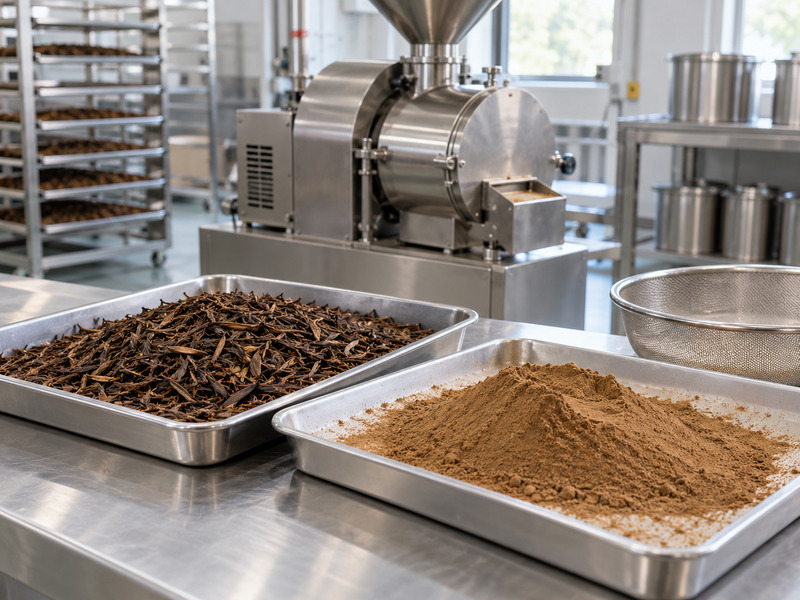
Contents: definition · tea material · roasting · cooling · milling · sieving · quality · packaging · home versus factory · buying
1. What exactly is hojicha powder?
Distinguish ground tea from instant mix
Pure hojicha powder is roasted tea material that has been milled into particles for use in drinks or foods. It is not necessarily soluble: the tea remains suspended and may settle. An instant latte mix can include sugar, creamer, flavor, or other ingredients and should be specified separately. Read the ingredient statement. The name “powder” does not reveal leaf source, roast, particle distribution, or intended application. A bakery may tolerate a slightly coarser grind that a café latte customer would notice. A ready-to-drink manufacturer may need still tighter controls and process validation. Ask the supplier whether the powder is meant for direct consumption in a drink, for baking, or for extraction. The best production route depends on the end use. Japan’s agriculture ministry describes hojicha as tea made by roasting processed green tea, which establishes the broad category; the commercial powder adds milling and packaging requirements beyond the traditional brewed leaf.
| Product | Tea remains in drink? | Main application question |
|---|---|---|
| Pure hojicha powder | Usually yes | Grind and suspension |
| Brewed hojicha | Leaves are strained | Extraction |
| Instant latte mix | Formula dependent | Ingredients and preparation |
2. Which tea material should a producer select?
Set a raw-material specification
The starting tea affects aroma, color, and milling behavior. MAFF describes hojicha in the Uji tea tradition as tea made by roasting sencha or kawayanagi; regional roasted teas can also emphasize stems. A producer may choose leaf, stem, or a controlled blend according to the desired cup. Sort before roasting. Excess dust, foreign material, or highly uneven pieces can make heat treatment less consistent. Record supplier, origin, harvest or processing information where available, incoming lot, and storage condition. Taste a reference brew of the unroasted or previously processed material when relevant, then evaluate after roasting. For a powder intended for milk drinks, decide whether the raw material can produce enough roast aroma without excessive bitterness. A low-cost leaf that requires harsh roasting to become noticeable may not make the best powder. The producer should know what variation in material is allowed without changing the finished product’s sensory range.
3. How does roasting create the target flavor?
Control a process, not just a color
Roasting develops the characteristic toasted aroma and changes the tea’s appearance. Equipment can vary: MAFF’s Kaga bocha account describes heated rotating drums, sand roasting, and far-infrared methods for that regional style. Those examples show that heat reaches tea in different ways; they are not a universal recipe for all hojicha powder. Record the endpoint. A producer should define batch mass, equipment, heat profile, time or other process indicators, cooling method, and sensory acceptance. A dark color alone cannot distinguish pleasant toast from burnt flavor. Compare roasted batches in a standard brew or latte base. Test aroma as the tea cools, when smoke or harshness may appear. A change in raw leaf moisture or piece size can alter the roast, so the process should include incoming checks. A supplier need not disclose a proprietary exact profile to every buyer, but it should be able to explain how consistency is controlled and how a nonconforming batch is handled.
| Roast control | Why track it | Finished-powder signal |
|---|---|---|
| Material and batch mass | Heat exposure | Uneven color |
| Equipment and profile | Repeatability | Aroma drift |
| Endpoint check | Avoid under- or over-roast | Green or burnt notes |
| Cooling | Stop further heating | Harsh finish |
4. Why does cooling after roasting matter?
Stop the roast before milling
Roasted material can continue changing if it remains hot in a deep pile. Cooling also affects how quickly the batch can be milled and packed without trapping heat or moisture. Check the whole batch. A surface sample may feel cool while the center remains warm. The producer should use a defined transfer and cooling method that protects the tea from contamination and foreign odors. Record batch identity through the step so a later powder lot can be traced back to its roast. Taste a cooled sample before milling; if the roast is already outside the target, grinding will not repair it. A café buyer may never see this stage, but it helps explain why two powders from similar leaf material can differ. When visiting or auditing a supplier, ask how long material waits between roasting and milling, how it is stored, and whether aroma changes during that interval. Those answers are more useful than a vague claim that the tea is “freshly roasted.”
5. How is the tea milled?
Match grind to the application
Milling reduces roasted tea to particles, but equipment, feed rate, heat, and target distribution affect flavor and mouthfeel. A coarse powder can feel sandy in a latte; an extremely fine one can dust during handling and still settle because tea is not a true soluble extract. Test the served product. Ask for particle-size information if available, then prepare the powder with the buyer’s actual whisk, mixer, or bakery process. Look for clumps, sediment, and uneven color. Milling heat can affect aroma, so compare the finished powder with the roasted leaf reference. A producer should clean and inspect equipment, manage foreign-material hazards, and retain lot traceability. The buyer does not need to select a mill model, but should specify a performance target: smooth enough for a 12-ounce milk drink after a defined mixing method, for instance. “Fine powder” is less meaningful than a cup that passes a measurable test.
| Application | Grind concern | Performance test |
|---|---|---|
| Latte | Mouthfeel and settling | Ten-minute milk cup |
| Baking | Distribution in dry mix | Baked crumb inspection |
| Dessert cream | Grit and color | Chilled filling sample |
| Bottled drink | Stability and process fit | Formal formulation study |
6. What happens after milling?
Sieve, inspect, and keep the lot clean
A producer may sieve or classify powder to remove oversized particles and keep the final distribution within a target. It also needs appropriate foreign-material controls and hygienic handling. Follow the lot. The powder should remain traceable from incoming tea through roast, mill, and packed unit. Ask what happens to out-of-spec material: is it reworked, sold for another application, or discarded? Rework practices should be controlled and documented. Sampling must represent the batch, not only the easiest scoop from the top. A fine product can still contain occasional coarse fragments that customers notice in a drink. For a buyer, the most useful approval package combines specification data with a retained sample and practical application test. If a producer changes a sieve or mill setup, check whether the powder still performs the same way. A visible clump in a finished latte can point to particle distribution, moisture pickup, or poor mixing; diagnose it rather than assuming all faults come from grinding.
7. Which quality checks should a buyer expect?
Link lab records with sensory performance
The appropriate quality program depends on the producer, market, and application. Buyers commonly request an ingredient specification, lot code, microbiological and contaminant controls where relevant, storage and shelf-life data, and a certificate of analysis or equivalent records. Ask for the current product. A certificate for another tea or an old lot is not evidence for the shipment being qualified. Sensory checks should include dry aroma, color, and a standard cup or food application. If the powder will carry an origin, organic, or precise caffeine claim, request the documents that support that exact statement. A small test kitchen cannot replace formal quality and food-safety controls at a commercial plant. Conversely, a clean lab report cannot prove that the powder tastes good in milk. Both kinds of evidence belong in the approval file. Define acceptance and rejection steps before the first large order.
8. How should the powder be packed?
Protect aroma and flow through actual use
Packaging should limit moisture pickup and foreign odors, preserve aroma, and carry a readable lot code. A 20-kilogram bag used in production and a small café pouch face different opening patterns. Test the open pack. A sealed shelf-life result says little about a pouch repeatedly opened beside a steam wand. Check clumping and aroma early and near the end of the planned use period. Keep scoops clean and dry and follow the supplier’s storage guidance. If a private-label retail pack is planned, validate the chosen material and fill weight with the exact powder. A product can pass at the factory and fail because a beautiful pouch has poor sealing or because fine powder contaminates the seal during filling. Do not invent a shelf life from a different tea or pack. Retain samples from the commercial run and monitor them under planned distribution conditions.
| Pack choice | Main benefit | Check |
|---|---|---|
| Small pouch | Lower open-pack exposure | Cost per unit |
| Bulk bag | Efficient production use | Repeated opening |
| Single-serve sachet | Portion control | Seal and fill uniformity |
9. Can a café make its own powder?
Understand the limit of a kitchen experiment
A café can grind roasted tea to test a flavor concept, but a kitchen grinder may produce uneven particles, heat the tea, and leave residue that makes a latte gritty. Home or café experiments are useful for deciding whether a menu idea deserves supplier sampling. They are not automatically suitable for a commercial product or packaged sale. Test the end use. Compare the kitchen-ground powder with a supplier-made sample in the same milk or batter. Measure dose, mixing time, sediment, and flavor. If the kitchen method requires sieving every serving or leaves a lot of unusable coarse material, factor that labor and waste into the decision. Commercial production also needs food-safety, traceability, and labeling controls appropriate to the business. The right choice depends on volume and application; a small experimental dessert may be feasible with a controlled kitchen process, while a multi-store latte program usually needs a repeatable ingredient supply.
10. What should a buyer put in a powder brief?
Specify the cup or food, not only the shade of brown
State the intended application, target roast character, milk or recipe system, expected dose range, texture tolerance, pack size, monthly volume, market, and required documents. Ask for a current lot sample and a second-lot comparison if scale is planned. Write a pass test. For example, a powder should disperse within a defined time using the available station tool and remain acceptable in a milk drink after ten minutes. That is clearer than “premium, fine, dark.” Review the supplier’s ingredient and origin records before printing claims. Matcha Village can provide B2B hojicha powder samples for this evaluation, but the buyer should verify the current SKU and lot information. A strong brief lets the supplier recommend the right material and gives the buyer a defensible way to approve or reject it.
A buyer’s approval test should be written so another team can repeat it. Specify cup or food recipe, tea dose, mixing tool, hold time, and the defects that cause rejection. Pair that application test with lot records and a retained sample. If a later batch passes a particle-size number but fails in milk, the served cup should trigger an investigation rather than be waved through by the laboratory sheet.
| Final check | Pass evidence | If it fails |
|---|---|---|
| Roast | Matches reference aroma | Investigate batch |
| Grind | Passes application texture | Review milling |
| Lot file | Traceable and current | Hold purchase |
Final recommendation
Commercial hojicha powder is the result of controlled tea selection, roasting, milling, checking, and packing. Judge the process by the repeatable drink or food it enables.
FAQ
Q1: Is hojicha powder soluble?
Pure ground tea is generally a suspension rather than a soluble extract. Test settling in the intended product.
Q2: Can roasted leaves be ground at home?
Yes for experimentation, but particle uniformity and commercial controls may be limited.
Q3: Does darker powder mean stronger flavor?
Not necessarily. Roast and dose can create pleasant toast or harsh bitterness. Taste the finished application.
Q4: Is hojicha powder the same as matcha?
No. Both can be tea powders, but hojicha uses roasted tea material and has a different flavor and processing route.
Q5: What matters most in a supplier sample?
Its performance in the buyer’s actual recipe, together with traceable, current product documentation.
Sources: Japan MAFF, Uji tea types; Japan MAFF, Kaga bocha production; FDA, water activity and food stability.