
Hojicha vs sencha looks like a simple tea comparison until a buyer has to choose one for a bottled drink, café menu, or retail shelf. Japan’s Ministry of Agriculture, Forestry and Fisheries describes sencha as steamed, rolled, and dried green tea, while hojicha is tea roasted from sencha or another suitable base. Processing shapes color and flavor, but the exact product still needs a sample test. This guide keeps the comparison tied to purchasing and formulation decisions. Tea buyers should request two coded samples of each type where possible, since variation within a type can affect taste as much as the category name. The trial should end with a product choice, not an abstract winner.
1. What do the names hojicha and sencha describe?
One is a roasted result; the other is a processed base tea
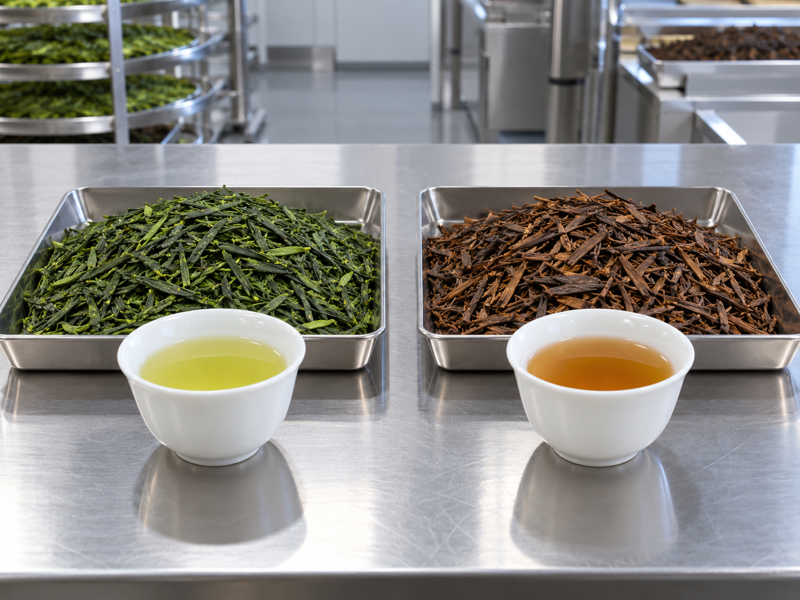
Sencha is a Japanese green tea made by steaming, rolling, and drying new shoots, as Japan’s agriculture ministry explains. Hojicha is created by roasting prepared tea such as sencha or kawayanagi. The names are therefore not parallel plant varieties. Start with the specification.
A supplier offering hojicha should identify the input tea and roast profile rather than implying that “hojicha” describes one fixed material. A supplier offering sencha should state origin, grade or material standard, and intended use. Either tea can be sold loose or further processed for a commercial application, but format must be stated separately. A bag of sencha leaves and a jar of hojicha powder are not a fair sensory or cost comparison. Choose equivalent formats or define the finished product each will serve. Japan’s agriculture ministry provides the process definitions used for this comparison.
| Question | Sencha | Hojicha |
|---|---|---|
| Core process | Steam, roll, dry | Roast prepared tea |
| Typical dry color | Green | Brown |
| Typical cup profile | Vegetal, brisk | Toasted, mellow |
| What varies | Origin and processing | Base tea and roast |
2. How does processing create the difference?
Roasting adds another transformation
Sencha production fixes and shapes leaf through steaming, rolling, and drying. Hojicha starts with processed tea material and applies heat to roast it. The added stage changes aroma and appearance, while the outcome depends on raw material and roast conditions. Ask about both stages.
For a roasted sample, learn what tea went into the roaster, whether leaf and stems were blended, and how a producer controls batch consistency. For sencha, ask about leaf cut, handling, and storage. A photograph of a dark tea does not establish its base material, and a green cup does not guarantee one specific grade. Keep material and process claims separate in retail language. If a manufacturer outside Japan supplies roasted tea, describe its geographic origin accurately. In a buyer’s tasting, the process description should explain observed flavor, not replace it. Two hojichas from different inputs can differ more than one hojicha and one mild sencha.
3. How do flavor profiles compare in a cup?
Use a blind test under controlled preparation
Sencha often reads as green, vegetal, or brisk, while hojicha commonly reads as roasted, nutty, or cereal-like. These are useful starting descriptors, not promises about every SKU. Make two fair cups.
Brew each candidate under a recipe suited to its format, record water, mass, time, and temperature, then taste without brand names. Rate aroma, bitterness, astringency, body, and finish. For a café, repeat in the actual menu formula; milk can hide delicate sencha notes while harmonizing with a deeper roasted tea, but a strong sencha may work well in a clear cold brew. Taste after cooling too. A consumer who wants a familiar coffee-adjacent aroma may prefer hojicha, while a customer seeking green-tea freshness may prefer sencha. The product team should validate these preferences with its audience rather than turning them into a universal ranking.
| Sensory axis | Ask the panel |
|---|---|
| Dry aroma | Green leaf or toast? |
| Warm cup | Which note dominates? |
| Cold cup | What fades or sharpens? |
| Aftertaste | Clean, dry, bitter, or smoky? |
4. Why do color and appearance matter commercially?
Expectations begin before the sip
Loose sencha is visibly green; hojicha is usually brown after roasting. In an infusion, the contrast can guide shelf grouping and menu photography. It can also create confusion: a customer may assume a brown roasted-tea latte contains coffee. Name the ingredient plainly.
A simple descriptor such as “roasted green tea” tells the story better than a vague “brown matcha” label. In a packaged clear bottle, hue and haze must stay stable through the intended shelf life. For a powder drink, sediment and ring staining influence perceived quality. Set a photographic reference under controlled lighting and keep an approved physical sample. Roasted tea powder color can vary with base material and roast, so do not demand one shade without tasting whether the target is attainable. Sencha’s green tone can also shift under processing and storage. The buyer needs an appearance tolerance based on the sold product, not a beauty contest between dry leaves.
5. Should the teas be brewed the same way?
Build recipes for each product, then compare servings
A fixed brewing protocol helps a narrow laboratory comparison, but it may not be the best serving recipe for both teas. Start with supplier guidance, then tune dose, temperature, and time to the menu objective. Measure the output.
Record grams of tea, water input, liquor yield after filtration, and final cup size. Over-extraction may exaggerate bitterness in one candidate; under-extraction may make another seem bland. If a tea will be served iced, include melting ice in the trial. If it will be bottled, use the actual heat and filtration route. A service chain should test sachets, infusers, or batch brewers that stores really own. One teaspoon of loose sencha can weigh differently from a teaspoon of roasted leaf, so switch to grams. Compare cost per sellable serving only after each tea has a recipe that meets the target flavor.
| Recipe variable | Record for each tea |
|---|---|
| Tea mass | Grams |
| Water | Volume and temperature |
| Contact | Time and agitation |
| Yield | Filtered serving volume |
6. Does hojicha always contain less caffeine?
Do not infer a finished-serving figure from tea color
Dark roast color does not show caffeine content. Raw material, dose, extraction, and serving size all affect the amount a customer receives. A stem-heavy hojicha may differ from a leaf-heavy one, while a sencha concentrate may differ from a lighter infusion. Test the sold recipe.
If a café wants to print an exact caffeine comparison, it should analyze representative finished drinks or use a defensible validated calculation based on its own materials. General green-tea reference values are context, not product-specific assays. A powder drink retains tea solids differently from filtered brewed tea, so the preparation method matters. Avoid “caffeine free” or claims about sleep and health unless evidence and local rules support them. Staff can describe hojicha as roasted tea and sencha as steamed green tea without making a medical or quantitative promise. A clear answer to customers should include uncertainty when exact data are unavailable.
7. Which applications favor each tea?
Choose by target flavor and process fit
Hojicha may be attractive in milk drinks, chocolate, bakery fillings, and roasted-flavor desserts. Sencha may suit clear brewed tea, sparkling tea, and products that want a fresh green note. These are development routes, not rigid limits. Try the finished formula.
Sencha in a lightly sweetened bottled tea may show clean green character, but heat or storage can change it. Hojicha in a latte may taste round, yet a light roast could disappear under milk. A restaurant might sell both: sencha as a bright lunch tea and hojicha as a toasted dessert pairing. Different menu jobs help avoid internal competition. For a distributor, assortment should reflect buyers’ equipment and customer expectations, not simply two tea names on a price list. Test both ingredients at their realistic dose and serving temperature, then gather consumer feedback on the product descriptions as well as the taste.
| Commercial use | Likely trial candidate | Proof needed |
|---|---|---|
| Clear tea | Sencha and light hojicha | Flavor and clarity |
| Milk latte | Hojicha and suitable sencha | Tea note after milk |
| Bakery | Hojicha powder | Flavor after baking |
| Retail loose leaf | Both | Origin and lot consistency |
8. Which supplier documents differ?
The core quality file is similar, but claims vary
For either tea, request a clear product specification, origin and composition statement, lot identification, packaging details, shelf life, and relevant test records for the destination market. Hojicha additionally needs clarity on base tea and roast standard; sencha needs clarity on leaf material and processing grade. Match the sample to the file.
The certificate of analysis should cover the lot offered, not an unrelated showroom sample. If organic or geographic claims appear in sales copy, verify certificate scope and origin records. A powder may require particle-size or dispersion criteria, while a loose leaf may need cut and foreign-material standards. Ask suppliers to notify the buyer about raw-material and process changes. Matcha Village offers hojicha powder among its tea ingredients; buyers should request current SKU-level documents rather than applying claims from another product in its portfolio. Quality and regulatory teams should approve the specific tea that purchasing orders.
9. How should a buyer compare cost and positioning?
Look at finished-unit margin and audience fit
Loose-leaf price per kilogram can mislead because dose, brew yield, and waste differ. Powder price must be paired with grams per drink and mixing time. Calculate the sold cup.
Add delivered ingredient cost, packaging, labor, and any loss to a realistic selling price. A sencha positioned as a premium clear tea may command a different retail story from a hojicha latte, but willingness to pay must be tested with the intended audience. Do not price a product on a generic “Japanese tea” premium if its origin or specification does not support that story. For a retail tea box, include pack fill weight and distribution cost. For a café, include training and remake risk. A smaller menu with well-defined roles for each tea often performs better operationally than several near-identical drinks. The comparison should end with a product decision, not a statement that one tea is universally superior.
| Cost driver | Sencha example | Hojicha example |
|---|---|---|
| Dose | Grams per brew | Grams per brew or latte |
| Yield | Filtered liquor | Infusion or powder use |
| Labor | Brew and strain | Brew or disperse |
| Waste | Spent leaf | Spent leaf or residue |
10. How should a brand decide hojicha vs sencha?
Run a short product-specific selection test
State the intended use and audience, obtain coded samples of both tea types, and make each in a recipe suited to the final format. Score flavor, appearance, process behavior, and cost without looking at supplier names. Keep the decision traceable.
Record which candidate passed, why, and where a rejected sample fell short. Have quality review lot documents and regulatory review any origin or caffeine wording before launch. Request a second lot of the winner and repeat the application test. If hojicha powder is shortlisted, use our powder selection checklist for dispersion and supplier documents. If both pass different jobs, keep both with clear menu descriptions: steamed green sencha for a fresh tea profile and roasted hojicha for a toasted one. If neither meets the brief, change the ingredient target rather than stretching a weak recipe into a launch. The result should be a specification and service card that another team can use without relying on the original taster’s memory.
Hojicha and sencha are both tea options with distinct processing and common but variable sensory profiles. Select against a finished-product brief, document the chosen lot, and make geographic or caffeine claims only with suitable evidence.
FAQ
Q1: Is hojicha made from sencha?
It can be. Japan’s agriculture ministry also describes other suitable tea material for roasting.
Q2: Does brown hojicha contain coffee?
No. Its brown appearance can result from roasting tea.
Q3: Which tea is better for a latte?
Test candidates in the intended milk; a roasted profile may suit some formulas, but no type wins every recipe.
Q4: Can both teas be sold as powder?
Yes, but specify composition, grind, dispersion, and intended application for each powder.
Q5: Does color prove caffeine content?
No. A finished-serving test is needed for a quantitative claim.
Sources: Japan MAFF, types of green tea; Japan MAFF, Uji Tea definitions; Japan Hojicha Association, hojicha terminology.