
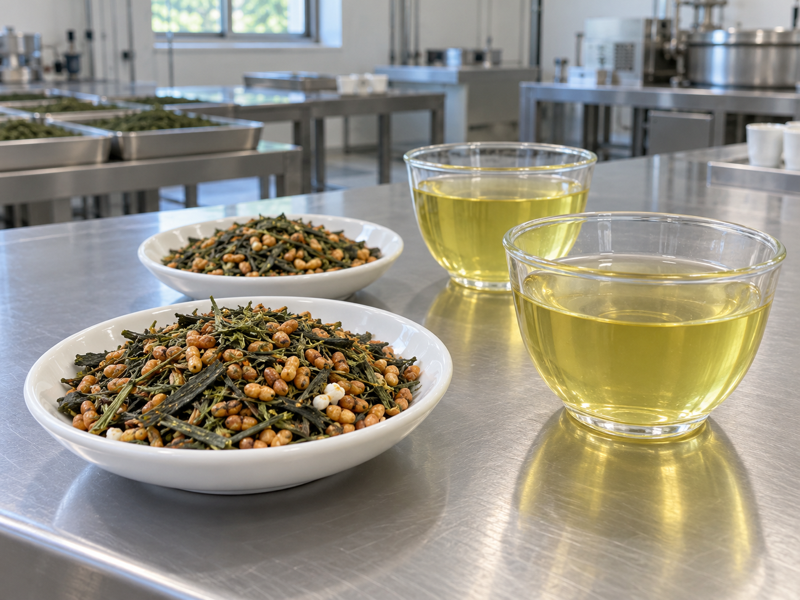
The genmaicha vs green tea choice becomes difficult when a buyer is selecting a drink base or a food ingredient rather than ordering a familiar cup of tea. Genmaicha is a green-tea blend with roasted rice; “green tea” alone covers several leaf styles and processes. The rice changes aroma, flavor, appearance, and formulation behavior. This guide compares the two from a B2B perspective, with test criteria that a product team can use before committing to a specification.
Contents
- 1. What exactly does each name describe?
- 2. How do genmaicha vs green tea flavors differ?
- 3. How does the rice affect composition?
- 4. Which brew is more suitable for a menu?
- 5. How do powder formats behave in food?
- 6. What can buyers say about caffeine?
- 7. How should cost and yield be compared?
- 8. What quality documents should suppliers provide?
- 9. How can a fair side-by-side test be run?
- 10. Which option fits each product brief?
1. What exactly does each name describe?
Green tea refers to tea made from Camellia sinensis leaves that have been processed to limit oxidation. The phrase still leaves plenty unknown: a tender Japanese sencha, a mature-leaf bancha, and another region's green tea will not taste identical. Genmaicha names a more specific blend. Japan's Ministry of Agriculture, Forestry and Fisheries describes it as roasted rice mixed with bancha, gyokuro, or sencha, and notes that some rice used is roasted cooked white rice. This makes “brown rice tea” a familiar English label, but buyers should read the actual ingredient declaration instead of relying on a translation.
Some commercial products add matcha or use a powder or extract. Those variants may suit an application, yet they should be identified separately in a request for quotation. Ask the supplier for the composition of the specific item being offered. A food brand that asks only for “genmaicha” may receive loose leaf, milled blend, or a soluble premix, each with a different dosage and label consequence.
| Term on brief | What it may contain | Clarification to request |
|---|---|---|
| Green tea | Processed tea leaf | Leaf style, origin, grade, format |
| Genmaicha | Green tea plus roasted rice | Tea type, rice type, blend ratio |
| Matcha genmaicha | Genmaicha plus matcha | Added matcha level and purpose |
| Genmaicha powder | Milled blend or blended powders | Exact composition and particle size |
2. How do genmaicha vs green tea flavors differ?
Plain green tea usually puts the leaf at the center of the cup. Depending on the leaf, that may mean vegetal, grassy, marine, floral, or lightly sweet notes, followed by bitterness or astringency at high extraction. Genmaicha brings a toasted cereal aroma that often softens the perceived sharpness of green tea. It does not erase the tea base; a high-quality, strong leaf can still make a firm brew. Roasting also changes aroma from lot to lot, so a generic profile will not substitute for tasting the actual material.
Describe both options with the same sensory vocabulary. For an RTD drink, judge aroma after pasteurization or the intended process and after storage. For a latte, judge the tea through milk or plant base. For a bakery, taste the baked product instead of a powder-water slurry alone. A buyer who needs a vivid green color and strong leaf identity may favor matcha or a green-tea powder. A concept built around a nutty, approachable tea note may favor genmaicha.
| Attribute | Plain green tea | Genmaicha |
|---|---|---|
| Leading aroma | Leaf-derived notes | Toasted rice plus tea |
| Typical visual cue | Leaves or green liquor | Rice grains in loose blend |
| Main formulation risk | Bitterness or astringency | Roast note loss or sediment |
| Best comparison | Same dosage and method | Same dosage and method |
3. How does the rice affect composition?
Rice changes the ingredient mix, not merely the aroma. A fixed gram of genmaicha contains less tea leaf than the same gram of a pure-leaf green tea if the blend has a meaningful rice proportion. But the exact proportion varies, and some products include matcha. Extraction from roasted rice and tea also differs. For that reason, do not infer caffeine, polyphenols, or nutrition numbers from a product name. Obtain lot-specific or product-specific data when those values matter to a claim or a label.
For loose tea, inspect the blend physically. Count visible rice and leaf fractions in a representative sample, while recognizing that particles can segregate during shipping and scooping. For powder, ask how the mill and blender control uniformity. A supplier may offer a reference ratio, but manufacturing tolerances and sampling method are just as relevant for a chain that wants the same cup across many outlets. If an application needs a particular tea note, write a sensory specification alongside any composition range.
4. Which brew is more suitable for a menu?
Genmaicha can suit an accessible hot tea, a lightly sweetened iced drink, or a milk beverage where the roasted note remains recognizable. Plain green tea can suit a cleaner, leaf-forward position. Menu language should set the correct expectation: describe roasted rice when it is prominent, and avoid implying that all green tea tastes alike. A café can offer both without making one the “better” choice. Each meets a different customer preference and meal occasion.
Test service temperature and hold time. A cup tasted immediately after brewing may feel balanced, while tea held in a hot urn may grow bitter or lose aroma. Chilled service can mute the roasted note; the team may need a different brew strength for iced dilution. Use a written brew card and a measured cup size during pilot service. If milk, sweetener, or yuzu is added, evaluate the finished menu drink at the same dilution that staff will serve. A tasting made with concentrate alone will overstate intensity.
| Menu format | Useful question | Trial observation |
|---|---|---|
| Hot unsweetened | Is the roast note pleasant? | Taste at service temperature |
| Iced tea | Does ice dilute flavor too far? | Taste after normal hold |
| Milk drink | Does tea remain identifiable? | Test chosen milk or plant base |
| RTD | Does flavor survive processing? | Evaluate finished packed sample |
5. How do powder formats behave in food?
The comparison changes when the ingredient is milled. Fine green-tea powder can color a cake or drink while delivering a leaf-forward taste. Genmaicha powder carries tea and roasted-rice material, which may give a warmer color and more cereal-like flavor. Neither should be assumed to dissolve fully. Whole powders disperse; extracts dissolve more readily. That distinction affects sediment, mouthfeel, and cleaning in beverage equipment. Ask whether the sample is a true soluble extract, a milled blend, or a premix.
In bakery trials, check color after baking, aroma after cooling, and grit in the crumb. In dairy or plant beverages, check settling, ring formation, and behavior after the intended heat treatment. In ice cream, check how cold temperature suppresses aroma. Use the same finished-product base for each option. A neat powder tasting may favor one material that performs worse after processing. Document the dose as grams per batch and percent of finished product so later cost and label reviews have a stable basis.
6. What can buyers say about caffeine?
Both options can contain caffeine because both use tea leaf. A genmaicha blend may use less leaf per gram of dry material, but that observation cannot establish caffeine in a served cup. Leaf type, blend ratio, dose, water temperature, time, and serving volume all affect the result. Japan's agriculture ministry publishes an example value for a particular genmaicha infusion prepared under specified conditions. It should not be transferred to a different supplier's powder, a strong café concentrate, or a bottled beverage.
If a customer needs a caffeine statement, commission analysis on the final drink or use a defensible calculation supported by measured inputs and local labeling rules. Avoid claiming “caffeine free.” A low-caffeine position also needs evidence and market review. For sales training, use language such as “contains green tea and therefore may contain caffeine” until the specific product has been assessed. Procurement should ask whether the supplier has analytical data for the offered item, including test method and sample basis.
7. How should cost and yield be compared?
Price per kilogram says little about beverage economics when dosage and extraction differ. Compare cost per finished serving at a sensory target. A cheaper powder that needs more material or creates more process loss may not be cheaper in use. For loose tea, include spent-leaf yield and filtration losses. For ready-to-drink production, include the impact of suspended solids, process time, and rejected batches during scale-up. A beverage chain also needs to consider staff dosing and training, not just ingredient cost.
Use a simple common base: same cup size, sweetener, ice, and service target. Set a minimum acceptable roast or leaf note, then find the lowest repeatable dose that achieves it. Record all changes. A genmaicha powder may add both tea and rice in one SKU, while separate powders allow more control but create another inventory line. Neither structure wins automatically. The right choice depends on volume, tolerance, product positioning, and supplier reliability.
| Cost input | Measure for both options | Common blind spot |
|---|---|---|
| Ingredient price | Delivered cost per kg | Freight and duty |
| Dosage | Grams per serving | Over-strong bench samples |
| Process loss | Filter or sediment waste | Yield below recipe target |
| Labor | Preparation steps | Multiple manual additions |
8. What quality documents should suppliers provide?
Request a current product specification, ingredient composition, storage and packaging instructions, lot identification, and available certificates or testing records relevant to your market. For loose blends, consider rice quality, foreign-material controls, and blend uniformity. For powders, consider particle size, moisture, microbiological controls, and flow behavior. The exact test list belongs in a risk-based purchasing specification agreed by quality and regulatory teams. A general brochure is useful for discovery but cannot replace a current lot document.
Confirm whether “organic,” “gluten free,” or similar claims apply to the specific material and target market before putting them on packaging. Roasted rice does not, by itself, prove a finished product's allergen or cross-contact status. If switching suppliers, obtain a representative sample from the proposed production grade. Matching a marketing photo is not enough. Matcha Village can discuss genmaicha powder alongside green tea and matcha ingredient options, but every proposed item should still pass the customer's own specification and application trial.
9. How can a fair side-by-side test be run?
Use blind-coded samples and repeat the comparison on a different day or lot when possible. Fix brew method, water quality, dose, serving temperature, and cup size. For powders, standardize mixing energy and hold time. Present both products at the same initial dose, then allow each a separate optimized trial so you can see both direct comparability and best achievable performance. A single head-to-head brew may unfairly penalize an ingredient designed for a different method.
Record several scores rather than a single “favorite”: tea identity, roast identity, bitterness, astringency, color, sediment, and fit with the intended application. Invite R&D and operations as well as commercial staff. A chain may prefer the version that tolerates a small brewing error; a premium retail brand may prefer the one with a more distinctive aroma. Make the decision rule explicit before tasting. That prevents the loudest opinion in the room from replacing the original product brief.
| Test condition | Keep fixed | Record separately |
|---|---|---|
| Brew | Water, time, temperature, dose | Aroma and taste |
| Milk application | Base, sweetener, ice | Separation and tea recognition |
| Powder dispersion | Mixing method, hold | Sediment and mouthfeel |
| Repeat | Same method on new lot | Lot consistency |
10. Which option fits each product brief?
Choose genmaicha when roasted cereal aroma is part of the product promise and the team can manage blend consistency. Choose plain green tea when leaf character, clarity, or a specific green-tea style is the point. Use matcha or a matcha-containing blend only if its suspended powder behavior and flavor meet the brief. Keep the consumer-facing name aligned with what is actually in the product. A roasted-rice tea latte is easier to understand when the menu says so.
For a buying decision, ask suppliers for two or three application-ready samples and run the same tests on each. Compare composition, sensory performance, dose, documentation, lead time, and delivered cost. Finish with a short approved specification and a retained reference sample. Further reading includes Japan MAFF's genmaicha description and its caffeine source table. A related comparison of roasted tea styles is available in our genmaicha vs hojicha guide.
FAQ
Q1: Is genmaicha a type of green tea? Yes. It is a blend that includes green tea and roasted rice; the tea base can vary.
Q2: Does genmaicha always contain brown rice? Not necessarily. Some production uses roasted cooked white rice, so verify the supplier's ingredient declaration.
Q3: Is genmaicha always lower in caffeine than green tea? No fixed comparison applies to every product or brew. Test the finished serving if caffeine data matters.
Q4: Can genmaicha powder replace matcha gram for gram? Usually it needs a new trial. Flavor, color, rice content, and dispersion differ.
Q5: Which is better for a latte? Genmaicha suits a toasted note; green tea suits a clearer leaf note. Taste both in the chosen milk base at the planned serving dose.