
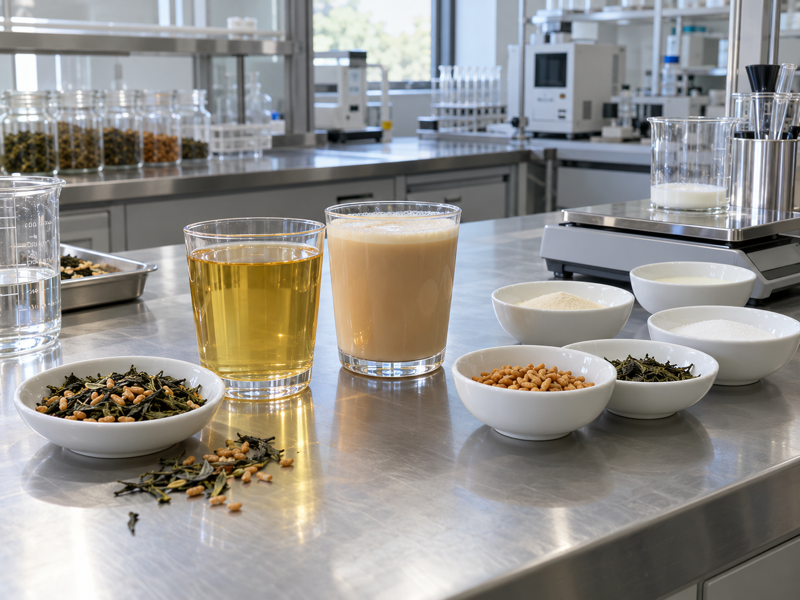
Genmaicha tea calories are easy to misstate when a team moves from a plain brewed cup to a sweetened latte, powder mix, or bottled drink. The tea name does not determine the finished serving's energy. Ingredients, extraction, portion size, and the way a powder is used all matter. This guide gives beverage brands and foodservice teams a calculation workflow, points out common mistakes, and explains where testing or regulatory review is needed before a number appears on a label or menu.
Contents
- 1. What counts toward genmaicha tea calories?
- 2. Why does a latte have a different calorie profile?
- 3. How should a recipe be calculated?
- 4. What changes when powder is consumed?
- 5. Which ingredient records should be collected?
- 6. How do portion sizes change a claim?
- 7. What should an RTD team test?
- 8. How should menu and pack copy be reviewed?
- 9. How can a low-sugar version be developed?
- 10. What should a supplier confirm?
1. What counts toward genmaicha tea calories?
Traditional genmaicha mixes green tea with roasted rice. Brewing extracts flavor and some soluble material into water; the leaves and rice are usually removed. A plain unsweetened infusion will generally contribute very little energy compared with a sweetened milk drink, but “zero calories” is a regulated statement in many markets and should not be assumed from the ingredient name. The amount of extractable material varies with blend, dosage, brewing conditions, and whether fine particles remain in the cup.
Separate the dry ingredient from the beverage. Roasted rice contains energy as a food ingredient; that does not mean all of its energy moves into an infusion. Conversely, a beverage made by whisking whole genmaicha powder into water contains consumed solids rather than only an extract. If a brand needs a precise declaration, use a product-specific calculation supported by ingredient data or appropriate finished-product analysis. The method should match the actual preparation customers use.
| Product form | What the consumer takes in | Calculation starting point |
|---|---|---|
| Strained infusion | Extracted compounds in water | Finished beverage data |
| Tea bag infusion | Extracted compounds in water | Finished beverage data |
| Suspended whole powder | Tea and rice particles | Powder nutrition plus other inputs |
| Sweetened premix | Powder, sugar, possible milk solids | Full premix formula |
2. Why does a latte have a different calorie profile?
A latte adds milk or a plant drink and may add sugar, syrup, cream, or topping. Those additions often account for most of its energy. The same tea base can therefore support several very different finished products. A 250 mL unsweetened hot tea and a 450 mL sweetened oat-based latte should never share a calorie figure merely because both are called genmaicha. Even two milks sold under the same broad name can have different nutrient profiles and added-sugar content.
Build the calculation from the actual brand and grade of each component. Record the amount poured, not merely the amount prepared. For example, a café might make a strong tea concentrate, then use only part of it in one drink. If the calculator attributes the entire concentrate batch to every cup, the number will be inflated. On the other hand, ignoring a flavored syrup because it is “only a pump” understates the result. Weigh or measure that pump during a real service trial.
| Latte component | Variable to capture | Common mistake |
|---|---|---|
| Tea concentrate | Volume per serving | Counting full brew batch |
| Milk or plant base | Actual brand and volume | Using generic milk data |
| Syrup or sugar | Grams per serving | Assuming pump size |
| Foam or topping | Applied weight | Omitting garnish |
3. How should a recipe be calculated?
Create a recipe sheet with every input, its purchased form, supplier nutrition information, amount used in a batch, and finished yield. Multiply each nutrient value by its use amount, sum the contributions, then divide by the number of servings or by finished weight. Account for water added and process loss. Water changes concentration and serving weight even though it adds no energy. If a product is baked or concentrated, the finished weight may differ from the ingredient total, and a per-100-g declaration must use the correct denominator.
Keep a version number on the sheet. A switch from unsweetened to sweetened oat drink, or a new syrup dose, invalidates the old calculation. Have someone independent review units and arithmetic; confusion between milliliters, grams, and “one scoop” is common. For U.S. packaged foods, the FDA explains that Nutrition Facts are tied to a stated serving size and product-specific information. Other markets have their own formats and rounding rules, so regulatory staff should sign off before publication.
| Calculation field | Example entry type | Why it matters |
|---|---|---|
| Ingredient | Specific supplier SKU | Nutrition values vary |
| Use rate | Measured g or mL | Reproducibility |
| Nutrient basis | Per 100 g or per unit | Correct conversion |
| Finished yield | Total g or mL | Loss and dilution |
| Serving size | Actual sale portion | Label and menu accuracy |
4. What changes when powder is consumed?
Powdered genmaicha can mean finely milled tea and rice, a soluble extract, or a premix containing other ingredients. Each has a different nutrition basis. A whole-blend powder stirred into milk contributes its solids to the drink, including any rice portion. A soluble extract may have a different solids profile. A sweetened latte premix may contain sugar and milk ingredients at levels far above the tea fraction. Ask for a complete ingredient statement and nutrition specification before making comparisons.
Do not apply a dry powder's calories per 100 g directly to a prepared beverage. The beverage needs a dose and final volume. If 8 g of a mix goes into one cup, calculate from 8 g plus all other additions, then check any label serving definition. Also assess whether all powder is consumed: sediment left in a bottle or cup can complicate simple assumptions. For a commercial product, formulation calculations may need confirmation through laboratory analysis, especially when a claim sits close to a regulatory threshold.
5. Which ingredient records should be collected?
Procurement and R&D need the same source data. Keep the current specification for tea powder or extract, nutrition panels for milk and plant bases, product sheets for syrups, and formula records for toppings. Capture supplier name, SKU, revision date, and the market for which the data was prepared. If a supplier revises a formulation, the beverage brand needs a process that flags the change. Otherwise a menu board can keep displaying a value based on an ingredient that is no longer used.
Ask whether nutrition values were calculated or analytically measured and on what basis. This is especially relevant for a custom premix. A certificate for contaminants does not automatically provide reliable calorie data. Equally, a nutritional panel from another country's retail pack may use different serving conventions. Document conversions instead of copying a number into a spreadsheet without its units. During vendor qualification, request the documents that the specific finished-product calculation actually needs.
| Record | Owner | Review trigger |
|---|---|---|
| Tea ingredient specification | Supplier / procurement | New lot or formulation |
| Milk and sweetener data | R&D | Brand or SKU switch |
| Recipe master | Operations | Menu change |
| Finished yield | Production | Equipment or process change |
| Label calculation | Regulatory | Any input revision |
6. How do portion sizes change a claim?
Calories must be tied to a quantity. “Per serving” means little if a small cup and a large cup carry the same description. Document vessel volume and actual fill, including ice. An iced latte can have less liquid than its nominal cup capacity, but staff variation can still be wide. Measure several real pours during a service simulation. For packaged products, confirm the legally appropriate serving size and whether the container represents one or multiple servings under the destination market's rules.
Do not compare a per-100-mL bottled tea value with a per-cup café value without converting to a common basis. Marketing teams sometimes choose the smaller number while leaving the unit obscure. A clear comparison table helps: show energy per 100 mL and per sale unit internally, then choose the required public format. The FDA's Nutrition Facts label guide stresses that serving size affects how consumers read calorie and nutrient figures. Follow the rules where the product will be sold.
7. What should an RTD team test?
Ready-to-drink tea can change during extraction, filtration, heat treatment, and storage. Measure finished yield and solids, then check whether the planned nutrition calculation still describes the packed product. If syrup is injected after brewing, verify dosing at line speed and during start-up. If particles settle, assess whether the drink is intended to be shaken and whether the measured sample represents the full container. A clear brew and a suspended-powder beverage may require different sampling plans.
Keep nutrition verification separate from microbiological and sensory release. A bottle can meet a calorie target yet fail on flavor or stability. Evaluate sweetness and roasted aroma after the actual process and at the planned shelf-life points. If reformulation removes sugar, consider how that changes mouthfeel and tea bitterness; adding more genmaicha to compensate may create sediment. Run pilot lots at the intended pack size. Bench calculations are a starting estimate, while a finalized commercial label should rely on the method accepted by regulatory counsel in each market.
| RTD checkpoint | Question | Evidence |
|---|---|---|
| Extraction | What reaches the brew? | Yield and solids record |
| Sweetener dosing | Is addition accurate? | Line measurements |
| Filtration | Are solids removed? | Before/after comparison |
| Filled pack | Is volume consistent? | Fill-weight data |
| Storage | Does product remain uniform? | Retained samples |
8. How should menu and pack copy be reviewed?
Separate a descriptive product name from a nutrition claim. “Unsweetened genmaicha” describes absence of added sweetener only when the recipe supports it; it does not automatically prove “zero calories” or “sugar free” under every local rule. “Light” and “low calorie” can have defined thresholds. Ask regulatory reviewers to assess those phrases in the target market. Never derive a health message from tea tradition or from the roasted-rice ingredient alone.
For U.S. products, the FDA distinguishes total sugars from added sugars and explains how those values appear on labels. A milk-based latte can contain naturally occurring sugars even if the brand adds no sucrose. Plant drinks may contain added sweeteners before they reach the café. Review FDA guidance on added sugars when building U.S. copy, and obtain local advice elsewhere. Keep substantiation files, recipe revisions, and artwork approvals together so a later formula change prompts a label check.
9. How can a low-sugar version be developed?
Begin with a blind comparison of the current drink and a reduced-sweetener version at the same serving temperature. Record sweetness, roasted-rice aroma, tea bitterness, body, and aftertaste. A sugar reduction can reveal astringency that the original recipe concealed. Adjust the tea concentration or milk base only after identifying which attribute changed. If alternative sweeteners are considered, test their own taste and regulatory status rather than assuming equal performance at a matching sweetness target.
The goal should be a drink customers will repeat-buy, with a defensible nutrition calculation. Create a dose range rather than chasing one bench sample. Café recipes must tolerate normal staff measurement; RTD formulas must tolerate production variation. Compare cost per finished serving and stability as well as calories. If the lower-sugar version needs a new tea powder or extract, request fresh specifications and update the calculation sheet. A label claim should be the last step after the product and its evidence are settled.
10. What should a supplier confirm?
Tell a genmaicha supplier whether you need a strained brew ingredient, a whole powder, a soluble extract, or a prepared mix. Request its full composition and nutritional basis, then explain the intended use rate, target market, and finished-product format. Ask for representative samples from the proposed commercial grade. A supplier may help with a stable flavor profile and application trials, but the brand owns its finished-recipe calculation and public claims. Matcha Village offers genmaicha powder; buyers should confirm the exact offered item and documents before using its data in a label model.
The practical next step is a recipe audit. Weigh each ingredient, calculate against the actual sale unit, test the finished product when needed, and have market-specific copy reviewed. That workflow protects both a genuinely light unsweetened tea and a more indulgent latte from misleading numbers. For the ingredient definition, see Japan MAFF's genmaicha overview. For labeling, start with the FDA Nutrition Facts guide.
For another tea ingredient comparison, our genmaicha vs matcha guide explains how the formats differ.
FAQ
Q1: Does plain brewed genmaicha contain calories? A plain infusion generally contributes little energy, but a precise or “zero” declaration needs product-specific evidence and local rule review.
Q2: Are genmaicha tea calories the same as green tea calories? No universal number applies. Preparation, blend, serving size, and added ingredients determine the result.
Q3: Does roasted rice make a brewed cup high in calories? The dry rice contains energy, but most rice is usually removed after brewing. Do not transfer dry-ingredient values to the infusion.
Q4: How should a café calculate a latte? Measure tea concentrate, milk, sweetener, and toppings per real serving, then use current ingredient nutrition data.
Q5: Can a powder mix be labeled using a brewed-tea value? No. Powder composition and consumption differ; calculate or test the prepared mix in its intended serving.