
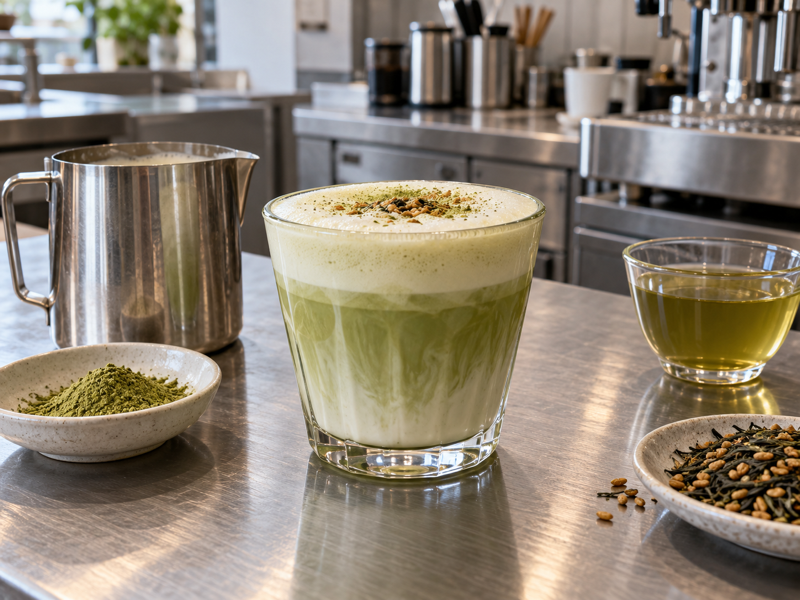
A genmaicha latte combines green tea and roasted-rice flavor with milk or a plant base. In a café, the hot version also depends on milk temperature, foam, and the order of preparation. A pleasant test cup can fail once staff use a different milk, overheat it, or let a tea concentrate sit too long. This guide focuses on a repeatable café drink, including its iced variation. The ratios below are exploratory starting points; approve a final formula through sensory and operational trials.
Contents
- 1. What defines a genmaicha latte?
- 2. Which tea format works best?
- 3. How should milk be selected?
- 4. What pilot ratio should a café test?
- 5. How can the roasted note survive sweetness?
- 6. How should hot and iced service differ?
- 7. What operational checks matter at scale?
- 8. How should foam and cup presentation be specified?
- 9. What should suppliers document?
- 10. How can a product team approve the drink?
1. What defines a genmaicha latte?
Genmaicha is a blend of green tea and roasted rice. Japan's agriculture ministry describes tea bases that can include bancha, sencha, or gyokuro. A latte adds milk or a plant drink, creating a softer texture and different flavor balance. The resulting product should still taste recognizably of the tea blend. If a customer identifies only sweet milk and vague cereal, the recipe may need a stronger tea base or a different genmaicha ingredient.
Set a concise brief before testing: target serving size, desired roast intensity, sweetness, milk type, hot or iced service, and price position. Decide whether the drink is meant to look green, beige, or cream-colored. Appearance expectations affect ingredient selection, especially if a powder contains visible rice particles. A matcha-containing genmaicha can look greener than a standard loose-leaf infusion, but it is a different formulation. The menu name and ingredient declaration should reflect what is actually used.
| Brief element | Example choice | Consequence |
|---|---|---|
| Tea identity | Roasted rice forward | Need aroma through milk |
| Milk base | Dairy or oat | Different sweetness and body |
| Service | Hot or iced | Different dilution |
| Format | Hot café cup or iced café cup | Different milk and dilution checks |
2. Which tea format works best?
Loose genmaicha can be brewed into a concentrate, strained, and combined with milk. It offers familiar tea preparation and low visible sediment, but extraction depends on staff measurement and timing. Fine genmaicha powder can be dosed rapidly and may give stronger body; it can also leave particles or a ring on the cup. A soluble extract may simplify handling while producing a different flavor profile. A premix can reduce steps but must be assessed for sugar, milk solids, and label fit.
Run a side-by-side test in the chosen milk, not only water. Record grams of ingredient per serving, preparation time, cleaning effort, and flavor after a normal hold. Ask whether a powder is milled whole tea and rice, a blend of separate powders, or a spray-dried extract. Those differences explain much of the mouthfeel and cost. Use the supplier's specific composition rather than making assumptions from the word “powder.”
| Format | Operational strength | Watch point |
|---|---|---|
| Loose-leaf concentrate | Clearer drink after straining | Brew and hold control |
| Milled blend | Fast dosing, fuller body | Sediment and clumping |
| Soluble extract | Easy dissolution | Roast and tea authenticity |
| Sweetened premix | Few service steps | Sugar level and flexibility |
3. How should milk be selected?
Milk changes more than texture. Dairy adds its own sweetness and proteins; oat drinks can amplify the cereal note; soy may bring a stronger bean flavor; coconut can dominate a delicate tea blend. Different brands within one category may also behave differently under heat and acidity. Choose a specific SKU for the pilot, record it, and retest when the purchasing team changes suppliers. A “plant milk” placeholder is not a repeatable recipe.
Taste the tea concentrate and each milk separately, then taste the finished latte. Check whether milk masks the roasted-rice aroma or makes it richer. For hot service, assess foam and separation at the intended temperature. For iced service, assess flavor after several minutes with ice. If the drink includes citrus, test curdling and flavor interaction rather than adding it directly to a milk recipe based on a successful tea-only sample. Nutrition and allergen records must follow the exact milk product used, including its existing added sugar.
4. What pilot ratio should a café test?
Build a small matrix rather than declaring one universal ratio. Start with a measured tea concentrate or powder dose and a fixed 250 mL finished hot drink, then vary tea strength at three levels while keeping milk and sweetener constant. Next, choose the best tea level and test sweetness. An iced version needs its own matrix because ice replaces part of the liquid and melts during service. The purpose of the matrix is to learn where the tea becomes too weak, too bitter, or too dusty.
The table is a trial design, not a finished recipe. Use the supplier's preparation advice as an initial reference and document the actual grams, water volume, temperature, time, and milk weight. If an existing café machine doses by scoop, weigh several scoops; they may vary enough to obscure a fine flavor comparison. Capture both the amount made and the amount poured into each cup.
| Trial | Tea strength | Milk and sweetener | Question |
|---|---|---|---|
| Control | Low | Fixed | Is tea still identifiable? |
| A | Medium | Fixed | Is roast balanced? |
| B | High | Fixed | Does bitterness appear? |
| C | Selected | Less sweetener | Does tea become sharper? |
| D | Selected | Alternate milk | Does flavor hold? |
5. How can the roasted note survive sweetness?
Sweetness can soften bitter edges, yet too much syrup can flatten tea and make the drink taste like flavored milk. Begin with the tea note you want customers to recognize and add sweetener in measured increments. Compare each sample at the temperature in which it will be served. Warm drinks release aroma differently from cold drinks, so a sweetener level that seems balanced hot may feel dull iced. Keep the sweetener type stable during early trials; switching from granulated sugar to a flavored syrup introduces another aroma variable.
If roast intensity is missing, changing the tea ingredient or extraction may work better than simply doubling the dose. A high dose can raise bitterness and create settling while the roasted note remains short-lived. Ask the tea supplier for samples with different roast profiles or composition if available. Record sensory scores for tea, roast, sweetness, bitterness, and aftertaste separately. The team can then explain why it prefers one candidate rather than calling it “more premium.”
6. How should hot and iced service differ?
Hot preparation can use a freshly brewed concentrate and steamed milk. Iced preparation usually needs a stronger or smaller-volume tea base so melting ice does not erase the flavor. Avoid using a hot recipe unchanged in an iced cup. Fix the ice weight during trials and taste at first pour and after normal customer wait time. If a powder is used, disperse it in a small amount of water before adding a cold milk base; test whether the process fits service speed and whether particles remain.
Write separate recipe cards. The hot card should include brew and milk temperatures, amounts, sequence, and hold limit. The iced card should include concentrate volume, ice weight, mixing order, and whether the drink must be stirred before serving. These are operational controls, not decorative details. A chain can lose consistency if different stores infer their own dilution. Train against a reference cup and measure actual preparation time during a busy period.
| Service format | Main risk | Trial control |
|---|---|---|
| Hot | Over-extracted tea or scorched milk | Time and temperature |
| Iced | Dilution from melting ice | Ice weight and hold time |
| Powder hot | Clumps | Mixing order |
| Powder iced | Sediment | Dispersion method |
7. What operational checks matter at scale?
Evaluate the recipe on the equipment stores already use. A concentrate that tastes fine when a development chef brews one cup may be hard to reproduce in a large urn. Test batch size, brew timing, filtration, holding vessel, and discard rule. Check milk steaming temperature and foam texture across baristas and machines. If the menu uses powder, test scoop accuracy, dusting, storage near steam, and cleaning of whisks or shakers. Measure waste and ingredients per sold cup so purchasing can compare realistic costs.
Observe new staff preparing the drink from a written card. If they ask the same question repeatedly, the card needs revision. Record the final cup weight, preparation time, and sensory result across multiple operators. Package design matters too: a clear cup reveals sediment more readily than an opaque cup, while a lid may trap or mute aroma. A launch candidate should succeed through an ordinary service shift, not only during a quiet tasting session.
8. How should foam and cup presentation be specified?
For a hot genmaicha latte, the steamed milk should support tea aroma rather than arrive as a scalding, thick cap. Test the exact milk SKU and steam setting on the machine used in stores. Measure drink temperature at handoff, observe foam texture, and taste after a normal customer wait. Plant drinks differ in foaming behavior, so a dairy recipe may need a separate preparation card rather than a simple ingredient swap. Powdered tea can leave specks on foam; decide whether that is an intended visual cue or a defect.
Set a clear cup standard without relying on a stylized photograph. Specify cup size, fill weight, approximate foam depth, and whether any powder or roasted-rice garnish is used. Test the garnish for texture and consistency; visible dry rice grains should not be added merely for a picture. A lid may flatten foam or mute aroma, so evaluate dine-in and takeaway versions. If a brand later develops a packaged latte, that becomes a separate manufacturing project with process, shelf-life, and nutrition validation. The café card cannot serve as its production specification.
| Café presentation point | Check during trial | Owner |
|---|---|---|
| Milk temperature | Taste and measured handoff temperature | Barista trainer |
| Foam | Texture after pour and short hold | Beverage R&D |
| Surface finish | Specks or garnish fit | Brand / quality |
| Takeaway cup | Lid contact and aroma | Operations |
9. What should suppliers document?
Ask a genmaicha supplier for composition, ingredient declaration, particle size or solubility information, storage conditions, lot identification, and relevant test documents. Request samples from the grade intended for commercial supply. For a café chain, ask whether powder performance is stable across lots and whether packaging protects aroma after opening. For a packaged drink, request technical discussion on process behavior, then verify all claims through your own trial and quality system.
The supply brief should state application, planned dose range, milk type, target market, expected volume, and the roast profile you want. Ask whether the material includes matcha, sugar, flavor, or carrier ingredients. Those details affect menu naming and labeling. Matcha Village offers genmaicha powder and related tea ingredients; procurement should qualify the actual offered specification rather than treat a portfolio description as proof of a particular grade, certification, or test result.
10. How can a product team approve the drink?
Agree on acceptance criteria before the final tasting: tea and roast scores, sweetness range, visible sediment, foam texture for the hot cup, preparation time, cost per cup, and acceptable performance after a normal hold. Then run the candidate through at least one repeat trial and one operational simulation. Include a control or existing menu drink to anchor the tasting. If a recipe wins only because it was sweeter, decide whether that supports the product position or simply disguises weak tea.
Once approved, issue a controlled recipe card with supplier SKU, grams, equipment settings, cup size, and revision date. Keep a retained sensory reference and specify when reapproval is needed, such as a new tea grade or milk supplier. For ingredient background, see Japan MAFF's genmaicha description. A team ready to source can send a concise brief and request application samples that match its service format rather than a generic tea sampler.
Teams deciding between rice tea and pure tea powder can consult our genmaicha vs matcha guide.
FAQ
Q1: Is a genmaicha latte the same as a matcha latte? No. Genmaicha includes green tea and roasted rice; matcha is powdered tea. Some genmaicha products also include matcha, so check composition.
Q2: Can a café use loose tea instead of powder? Yes. Brew a measured concentrate, strain it, and test its flavor and hold performance in the finished latte.
Q3: Which milk makes the best genmaicha latte? There is no universal winner. Test the exact dairy or plant milk SKU against roast aroma, sweetness, texture, and service conditions.
Q4: Is a genmaicha latte low in calories? The tea name does not establish that. Milk, sweetener, toppings, and serving size determine the finished drink's nutrition.
Q5: What should an ingredient sample request include? State hot or iced use, milk base, target roast intensity, serving size, expected volume, market, and required documents.