
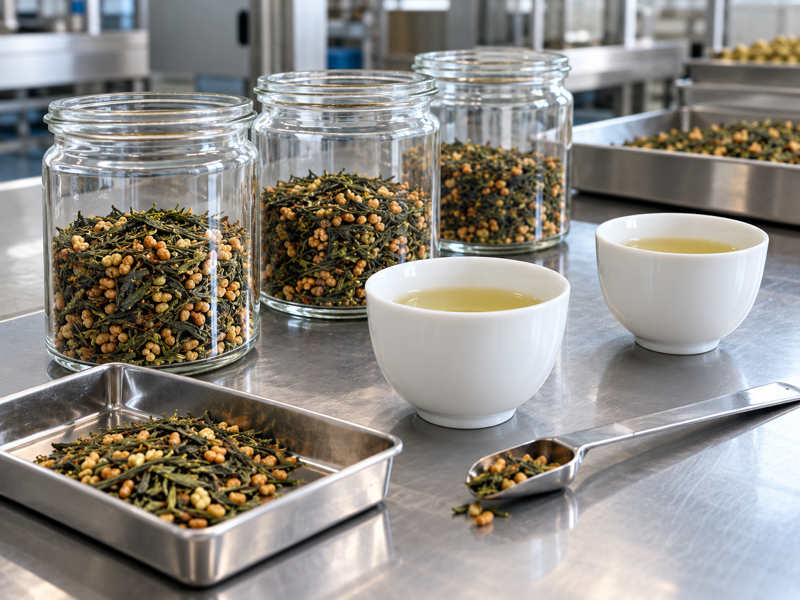
Genmaicha is green tea blended with roasted rice. For a beverage brand, its most useful benefits are a recognizable toasted aroma, an approachable taste, and several practical menu and retail applications. Buyers also ask about caffeine and health claims, but those require more care than a flavor description. This guide separates observable product advantages from claims that need finished-product evidence. It uses the Japanese Ministry of Agriculture, Forestry and Fisheries description of genmaicha as a reference for the traditional category; any particular supplier blend still needs its own specification.
Contents
- 1. What makes genmaicha different from plain green tea?
- 2. Which genmaicha benefits matter most in a commercial menu?
- 3. Can genmaicha support a lower-caffeine positioning?
- 4. Do genmaicha’s tea compounds justify health claims?
- 5. How can genmaicha broaden a tea product range?
- 6. What should a buyer check before describing a blend as genmaicha?
- 7. How should you compare flavor benefits across suppliers?
- 8. What are the limitations of genmaicha for a brand?
- 9. Which documents make a genmaicha claim credible?
- 10. How can a buyer turn genmaicha benefits into a sound launch decision?
1. What makes genmaicha different from plain green tea?
Green tea contributes vegetal notes and the structure of brewed tea. Roasted rice brings a grain aroma that many tasters describe as nutty or popcorn-like. The balance changes with the leaf material, rice preparation, blend ratio, and brewing method. A sample with a powerful roast may hide the leaf; a leaf-heavy sample can lose the quality that made a buyer choose genmaicha. Those are sensory judgments, not universal quality grades.
For procurement teams, this combination creates a distinct category story without requiring an elaborate recipe. A hot brewed cup can stand on its own. A concentrate can become a milk drink if it retains sufficient aroma after dilution. A loose blend can support a retail line where customers want visible ingredients. Ask suppliers to send a representative production sample rather than a hand-selected showroom sample, then repeat tasting in your own serving format. The useful question is whether the roasted note survives your real process, not whether the dry tea smells impressive when the bag opens.
| Component | What it contributes | What a buyer should check |
|---|---|---|
| Green tea | Body, vegetal character, natural caffeine | Leaf style and bitterness in a standard brew |
| Roasted rice | Toasted aroma and grain character | Roast evenness, stale notes, and visible distribution |
| Blend | Finished sensory balance | Consistency across three production lots |
2. Which genmaicha benefits matter most in a commercial menu?
A menu benefit must survive service. Buyers comparing roasted options can also review genmaicha versus hojicha before defining a drink brief. Genmaicha can give a tea latte more roasted character than a plain green tea base, and it can give an unsweetened iced tea a distinctive aroma. That does not mean every blend suits both. Milk, ice, and syrup dilute different parts of the profile; a sample that tastes balanced hot may disappear in a 16-ounce iced drink.
Build one reference recipe for each intended use. Record tea mass, water volume, temperature, time, dilution, sweetness, and final serving size. Have staff taste it after preparation and again at the end of the expected hold period. A café may care about fast extraction and clean strainability; a ready-to-drink developer will need stability and an appropriate food safety process. These are operational advantages only when your trial demonstrates them. Price per kilogram alone will not show how much tea each serving consumes or how much product you discard after holding.
3. Can genmaicha support a lower-caffeine positioning?
Roasted rice itself does not provide the tea-leaf caffeine. Replacing part of a green tea blend with rice can reduce caffeine per gram of dry blend compared with the same mass of the original leaf, but the brewed result also depends on leaf choice, ratio, dose, water, time, and serving volume. Matcha-added versions introduce another tea component. A blanket claim such as “caffeine free” is inaccurate for a conventional genmaicha blend unless a specific product has been tested and is legally eligible for that wording.
Japan's agriculture ministry publishes a value of 10 mg caffeine per 100 mL for genmaicha under a stated preparation method, in its caffeine reference table. Treat that as a reference example, not a specification for your SKU. The US FDA likewise notes that caffeine in drinks varies by product and preparation. If caffeine level affects a label, procurement decision, or customer promise, test the finished drink at the intended serving size.
| Claim under consideration | Evidence needed | Safer interim wording |
|---|---|---|
| “Contains caffeine” | Ingredient review | Suitable for ordinary tea descriptions |
| “Lower caffeine” | Defined comparator and lab result | Avoid until the comparison is measured |
| “Caffeine free” | Product test and local label review | Do not assume from rice content |
4. Do genmaicha’s tea compounds justify health claims?
Green tea contains compounds that researchers study, including catechins. Their presence in tea does not establish that a particular genmaicha drink prevents disease, improves metabolism, or produces another clinical outcome. The blend contains rice as well as tea, and extraction into a cup differs from swallowing the whole leaf. Sweetened milk tea also has a different nutritional profile from unsweetened brewed tea. The package, recipe, and actual serving matter.
For B2B copy, describe what you can verify: tea type, roast profile, ingredient list, preparation, and measured nutrients if you have a compliant analysis. Keep medical language out of menu copy unless a qualified regulatory review has accepted a claim for the exact market and formulation. A purchaser can still sell the sensory appeal of genmaicha. “Toasted rice aroma with green tea” tells a customer something real. “Detoxes the body” does not describe an established property of this blend and invites a substantiation problem. Build approval of marketing language into product development, before labels or cartons are printed.
5. How can genmaicha broaden a tea product range?
Genmaicha offers a bridge between plain green tea and more dessert-like flavored drinks. A tea brand can sell loose leaf for hot brewing, an unsweetened cold tea, or a blended powder designed for foodservice. A café can start with a simple hot or iced tea and then test a milk version. A food manufacturer might examine flavor in a syrup or dessert, but it should validate heat treatment and shelf stability separately. The product name does not guarantee performance across formats.
Assortment decisions should start with the customer and channel. Retail shoppers may value recognizable tea and rice in a clear window. Foodservice buyers care about grams per serving, training time, and repeatability. Beverage manufacturers usually care about extraction yield, sediment, filtration, and sensory retention through processing. A supplier that can provide the same target flavor in different formats may simplify sourcing, but a buyer should compare the actual samples rather than assume equivalence from a catalog name.
| Channel | Sensible initial format | Trial question |
|---|---|---|
| Tea retail | Loose tea | Does the blend stay evenly mixed in packs? |
| Café | Loose blend or tested base | Is the recipe repeatable at service speed? |
| RTD development | Process-compatible extract or infusion | Does aroma survive filtration and storage? |
| Dessert R&D | Infusion or validated powder | Is flavor detectable in the finished matrix? |
6. What should a buyer check before describing a blend as genmaicha?
Start with the ingredient statement. The ministry's traditional description combines roasted rice with green tea such as bancha, sencha, or gyokuro. It also notes that rice prepared from cooked white rice may be used. This matters because “brown rice tea” is a common English shorthand, yet a purchase specification should name the actual materials supplied. Do not infer leaf origin, rice variety, or processing method from the category name alone.
Ask for a product specification showing each ingredient, the intended use, allergen statement, shelf life, storage guidance, and the documents required in your import market. Where a buyer has a specific rice or tea-origin requirement, put it in the purchase specification and verify it through supplier records. Examine the blend for evenness, foreign material, off odors, and segregation after shipping. A jar from the top of a sack may contain a different leaf-to-rice mix from material taken near the bottom. Sampling procedure can therefore change the apparent quality result.
7. How should you compare flavor benefits across suppliers?
Set a brew method before opening the samples. If one supplier's tea is brewed hotter or at a heavier dose, the tasting does not compare the products. Use blind codes when possible, and score a small set of attributes that match the intended application: roasted aroma, green tea character, bitterness, aftertaste, color, and performance after milk or ice. Record an acceptable range rather than trying to crown a single “best” tea for every customer.
In a multi-store rollout, ask for at least two production lots and retain an approved control sample. Repeat the exact recipe when a later lot arrives. If a sample drifts, investigate whether the leaf, rice roast, blend ratio, packing, or storage changed. The best purchasing benefit is a flavor the operations team can reproduce, not a one-off cup from a sales meeting. Price evaluation should use cost per accepted serving after waste and extraction loss, alongside the quoted unit price.
| Trial measure | Record for every sample | Reject or investigate when |
|---|---|---|
| Dry aroma | Fresh roast and tea notes | Stale, burnt, or damp note appears |
| Brewed aroma | Strength at target recipe | Aroma vanishes after dilution |
| Taste | Bitterness and finish | Harshness exceeds menu target |
| Process | Straining and sediment | Service or line handling fails |
8. What are the limitations of genmaicha for a brand?
The roasted-rice character can be a strength and a constraint. Customers expecting the grassy punch of straight sencha may find a rice-forward blend mild. A dark roast can overwhelm delicate fruit flavors. Suspended particles may affect clear bottled drinks. Loose leaf and rice can separate during transport or dispensing. These are testable formulation and handling issues, not reasons to dismiss the category.
Genmaicha also remains a tea product with caffeine unless evidence establishes otherwise. It is not automatically suitable for people who must avoid caffeine. A product containing milk, sugar, or added matcha needs its own ingredient, allergen, and nutrition review. For an importer, the largest practical risk can be a vague product specification. Without clear ingredient proportions, sample retention, and change notification, the name on two cartons may be the same while their flavor differs. A brand should set acceptance criteria before the first commercial shipment, then confirm them against its incoming inspection plan.
9. Which documents make a genmaicha claim credible?
Ask for the current specification, ingredient declaration, lot identification, shelf-life basis, and a certificate of analysis where one is relevant to your market and risk assessment. If a claim uses a measured value, request the method, units, sample identity, and date. For a caffeine claim, the finished beverage may need testing as well as the dry blend. For a country-of-origin claim, confirm how blended ingredients are declared under local rules. Certificates mentioned in a supplier brochure should not be treated as proof that every SKU or lot falls under the same scope.
Matcha Village's wider tea and powder portfolio may suit buyers developing both plain genmaicha and matcha-added variants. That company context is a starting point for an inquiry, not evidence of a specific genmaicha ratio or certification. Ask the supplier to confirm the exact SKU, available packaging, batch documents, and lead time in writing before finalizing marketing copy. Keep the tested sample and paperwork together in the product record so future buyers can trace why the item was approved.
| Document | Decision it supports | Check before approval |
|---|---|---|
| Product specification | Ingredient and sensory target | Revision and SKU match |
| Lot record | Traceability | Code matches delivered bags |
| Test report | Measured claim or safety screen | Method, sample, date, and scope |
| Label proof | Market-facing wording | Legal review in destination market |
10. How can a buyer turn genmaicha benefits into a sound launch decision?
Write a brief that names the customer, channel, and serving format. Select two or three candidate blends against that brief, using the same brew method for each. Then make the finished drink or food, not merely a tasting cup. Record yield, sensory result, cost per serving, training burden, and required documents. If a claim about caffeine or nutrition is part of the proposition, commission the appropriate analysis and regulatory review before packaging approval.
The strongest genmaicha proposition is usually concrete: a roasted rice aroma that tastes good in a defined product at an acceptable cost. A supplier discussion can then focus on blend consistency, packaging, lot records, and sample-to-production matching. Request representative samples and specifications from Matcha Village or another qualified supplier, run a controlled trial, and approve only the version that performs in your finished application.
Frequently asked questions
Q1: Is genmaicha caffeine free? No. Conventional genmaicha includes green tea. Measure a specific drink before making a caffeine claim.
Q2: Is genmaicha always made with brown rice? No. Traditional descriptions also allow rice prepared from cooked white rice. Check the supplier's ingredient specification.
Q3: Does genmaicha have proven medical benefits? The category name alone establishes no clinical benefit. Health claims require evidence relevant to the finished product and market.
Q4: Can genmaicha be used in milk tea? Yes, if its roasted aroma remains clear after milk, ice, and sweetener are added. Test the final recipe.
Q5: What is the best way to compare samples? Brew equal doses under one method, taste blind, and repeat the trial in the intended commercial application.