
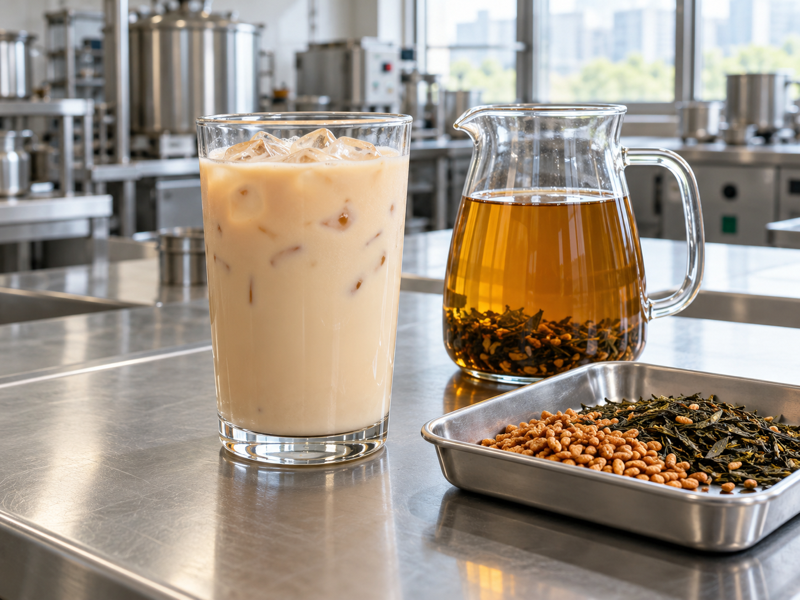
Genmaicha milk tea combines brewed green tea and roasted rice with milk or a plant-based alternative. For a tea shop, it is often built from a batch tea base, served iced, and sometimes finished with pearls or another inclusion. A good hot cup of tea does not automatically survive milk, sweetener, ice, and toppings. This guide focuses on the tea-shop workflow: a measured base recipe, assembly at the counter, ingredient costs, and consistency across shifts. The Japanese Ministry of Agriculture, Forestry and Fisheries defines the underlying genmaicha category as green tea blended with roasted rice.
Contents
- 1. What does genmaicha contribute to milk tea?
- 2. Which tea format should a beverage team choose?
- 3. What is a sensible tea-shop recipe for R&D?
- 4. How should hot and iced versions differ?
- 5. Which milk and sweetener choices deserve testing?
- 6. How can a chain keep the drink consistent?
- 7. What should a supplier specify for genmaicha milk tea ingredients?
- 8. How do you calculate cost per serving?
- 9. What claims are safe on a menu or pack?
- 10. What is the launch checklist for genmaicha milk tea?
1. What does genmaicha contribute to milk tea?
Genmaicha contributes roasted grain aroma alongside green tea flavor. That pairing can make a milk drink taste fuller without a flavored syrup. The degree of roast matters: light rice notes may disappear beneath dairy, whereas dark roast can read as burnt when combined with certain sweeteners. Leaf choice matters too. A strongly bitter tea base may become more tolerable with milk, but bitterness is still a poor substitute for a balanced extraction.
The business advantage is a clear product story tied to recognizable ingredients. A menu can say what the drink tastes like without claiming health effects. Buyers deciding whether added matcha suits the menu can compare genmaicha versus matcha before requesting a separate blend. Product developers should define the target in sensory terms before contacting suppliers: toasted rice at the front, mild green tea in the middle, clean finish, and a specified sweetness level, for example. Those are targets, not claims about any existing SKU. Taste against a control drink at the same temperature and sweetness. If customers must choose between this and a standard milk tea, the genmaicha character should remain distinct once served over ice.
| Sensory element | Desired observation | Common failure |
|---|---|---|
| Roasted rice aroma | Recognizable after milk addition | Vanishes after dilution |
| Green tea body | Supports the drink | Bitter or astringent finish |
| Color | Consistent with intended menu | Unappealing gray or separation |
| Aftertaste | Clean and repeatable | Stale grain or cooked-milk note |
2. Which tea format should a beverage team choose?
Loose genmaicha gives visible tea and rice and is suitable for brewing and straining. A powder or designed beverage base may be faster for high-volume operations, but its particle behavior, mouthfeel, and ingredient statement must be tested separately. An extract or concentrate can simplify portioning where production equipment supports it. Do not assume a powder behaves like a brewed infusion; powder may remain suspended, settle, or produce a stronger green color than the leaf version.
Match the format to the operation. A small café may handle a fresh daily brew. A chain needs a process that works with multiple shifts, water sources, and staff skill levels. A packaged beverage manufacturer must validate process compatibility, microbiological control, and shelf life in its actual packaging. Ask suppliers for format-specific specifications and representative samples. Prepare each candidate by its intended production method, then compare cost per finished liter rather than cost per kilogram alone. Include straining loss, labor, discarded hold volume, and any added filtration step.
3. What is a sensible tea-shop recipe for R&D?
Begin with a brewed genmaicha base and treat its proportions as a trial, not a universal formula. A useful bench run might brew 8 g of loose blend in 200 mL water at 90°C for one minute, strain, then combine a measured portion with milk and sweetener. Japan's agriculture ministry gives 90–100°C and about 30 seconds to one minute as a hot-brew starting range for genmaicha. A milk application may need a stronger base, but extending time can increase bitterness. Test dose before relying on a long steep.
Make at least three variants that change one factor at a time. Hold brew strength constant and compare dairy milk, oat beverage, and soy beverage. Then choose one milk and compare tea-base ratios. Record grams, milliliters, temperature, time, sweetener type, ice, and final yield. Use a scale for syrup rather than a pump count in development, since pumps differ. Taste the base drink before adding any pearls or topping, then taste the completed sale unit at handoff and after a normal carry time. A topping should not hide a weak tea base.
| Pilot variable | Initial range to test | Evaluation point |
|---|---|---|
| Tea dose | 6, 8, and 10 g per 200 mL water | Aroma versus bitterness |
| Base share | 40%, 50%, and 60% of drink | Roast clarity in milk |
| Sweetness | Three measured levels | Flavor balance, not just sweetness |
| Ice dilution | Actual service ice and hold | Taste at handoff and after 10 minutes |
4. How should hot and iced versions differ?
An iced drink is diluted by melting ice. If a hot recipe is poured over ice unchanged, it may taste thin even when the cup looks attractive. Brew a stronger base or reduce added liquid while preserving a clear extraction method. Test with the exact ice mass and cup size used in stores. Measure the drink at handoff and after a typical customer carry time. A recipe that survives ten minutes has a different commercial value from one that only tastes good at the bar.
For hot service, temperature changes aroma perception and milk texture. A hot drink may need less tea concentrate because the roasted note reaches the nose more readily. Do not overheat milk simply to intensify a weak tea base; that can create cooked flavors and create handling problems. Keep the preparation method simple enough for staff to reproduce. If hot and iced variants need different brew ratios, assign separate recipe cards. That is easier to audit than asking each barista to adjust by intuition when the cup size changes.
5. Which milk and sweetener choices deserve testing?
Dairy milk can provide body and soften astringency. Oat beverage often adds cereal notes that may amplify the roasted rice theme, although brands differ substantially in sweetness and stabilizers. Soy and other plant beverages can add their own dominant flavors. The right choice depends on your target customer, label, cost, and handling process. None is inherently best for every genmaicha blend.
Sweetener has similar effects. White sugar provides a relatively neutral baseline; brown sugar adds molasses notes that may compete with the roast; syrups can change viscosity and dilution. Compare a no-sugar reference before adding flavor. This shows whether sweetness is balancing the tea or hiding a quality issue. For packaged drinks, review ingredient interactions during processing and shelf life rather than relying on a fresh bench sample. The final choice should emerge from blind tasting and operational data, including allergen declaration and local labeling requirements.
| Ingredient option | Potential fit | What to test |
|---|---|---|
| Dairy milk | Creamy, familiar profile | Tea aroma and milk allergen |
| Oat beverage | Grain-forward profile | Added sweetness and settling |
| Soy beverage | Fuller plant-based body | Flavor competition and allergen |
| Neutral sugar | Clean baseline | Required level for balance |
| Dark syrup | Dessert-style drink | Whether roast becomes muddy |
| Optional pearls or jelly | Tea-shop customization | Portion weight, allergen review, and flavor after hold |
6. How can a chain keep the drink consistent?
Write a one-page standard operating procedure. It should name the exact tea SKU, mass, water volume, temperature, steep time, straining method, base hold time, milk amount, sweetener amount, cup size, and ice mass. Photograph the finished cup for visual reference, but do not rely on color alone; different light and milk types distort that signal. Store managers need a sensory control sample and an escalation path for a batch that tastes stale or bitter.
Run a small pilot in at least two real stores or shifts. Record preparation time, waste, stock rotation, and customer feedback. A recipe that only works when a product developer prepares it has not passed an operations test. Consider batch size carefully: a large tea concentrate reduces labor but may lose aroma during holding. Portion optional pearls or jelly separately; their preparation and discard rules must follow the operation's food-safety plan. Use appropriate guidance for cooling, refrigeration, and discard times rather than inventing a shelf life from tasting. A different milk, syrup, or topping is a recipe change that needs a check.
7. What should a supplier specify for genmaicha milk tea ingredients?
For loose tea, request the ingredient list, tea and rice descriptions, blend tolerance if available, particle distribution, storage conditions, shelf life, lot coding, and change-notification policy. For powders or preblends, ask whether sugar, dairy ingredients, emulsifiers, or other components are present. If a seller offers a “latte powder,” do not assume it is pure genmaicha. The purchasing document must match the product actually tested.
Request representative production samples from more than one lot when a chain launch is planned. A sample can taste good yet vary when the roasted-rice ratio changes. Keep an approved reference sample and record the milk drink recipe used for approval. If a supplier advertises certifications or testing capabilities, confirm the certificate scope and SKU-specific documents before making a package claim. Matcha Village lists genmaicha powder within its broader portfolio, but exact format, ingredients, and documents should be confirmed for the quoted item. A qualified supplier can discuss those questions directly and send a specification before pricing is finalized.
| Supplier record | Buyer decision | Check |
|---|---|---|
| Ingredient statement | Label and allergens | Exact offered SKU |
| Specification | Sensory and handling fit | Current revision |
| Lot code | Traceability | Match sample and shipment |
| Change notice | Recipe continuity | Notice period and trigger |
8. How do you calculate cost per serving?
Start with grams of tea used for one sale, including extraction losses. Add milk, sweetener, ice, cup, lid, and any topping. Allocate preparation labor and expected discard from brewed base. A lower-priced dry tea may require more grams to give the same flavor after milk, making the final drink more expensive. A faster base may cost more per kilogram yet reduce labor and waste. The economics are recipe-specific.
Model at least three sales volumes. A café selling a few cups a day may waste a large share of a daily concentrate; a busy chain can use that batch efficiently. Compare gross margin against the target price and the customer's willingness to pay. Include import costs and realistic lead time in a sourcing decision, particularly when roasted notes depend on freshness. Do not let the spreadsheet replace tasting. The cheapest recipe that fails your flavor target is an expensive menu launch if customers do not reorder.
9. What claims are safe on a menu or pack?
Describe ingredients and flavor accurately: “green tea with roasted rice,” “toasted aroma,” or “made with brewed genmaicha” when the process supports those words. Avoid “caffeine free” for a standard blend. A finished milk tea may contain caffeine from tea, sugar from syrup, and allergens from milk or soy. Health and nutrition claims require evidence for the final formulation and regulatory review in the destination market. The US FDA notes that caffeine amounts vary across drinks; a category estimate cannot serve as a tested menu value.
If a pack uses origin language, verify the origins of both tea and rice and review how the blend must be labeled locally. If a menu calls the drink “matcha genmaicha,” confirm matcha is actually included. A customer may reasonably expect a different color and caffeine profile from that variant. Keep a claims sheet with each statement, its supporting record, and an owner responsible for updates. Revise it whenever the formulation or supplier changes.
| Menu statement | Evidence needed | Practical note |
|---|---|---|
| Brewed genmaicha | Recipe and ingredient records | State the actual format used |
| Caffeine amount | Finished-serving lab result | Keep serving size fixed |
| Dairy-free | Ingredient and cross-contact review | Check toppings too |
| Origin claim | Ingredient traceability and local rules | Cover tea and rice separately |
10. What is the launch checklist for genmaicha milk tea?
Approve the target taste before locking the recipe. Then run a small set of controlled variations, select the best candidate, and repeat it with a second production lot. Validate hot and iced versions separately. Calculate cost per accepted serving, confirm allergen and nutrition information where required, and review every customer-facing claim. Pilot the drink in the conditions where staff will actually make it.
When those results are stable, ask the supplier for the exact specification, pack format, lead time, and lot documents that match the approved sample. Keep a retained sample and recipe card. A café or brand can then buy on repeatable performance rather than a pleasing one-time tasting. For a new project, request genmaicha and any relevant powder-format samples from Matcha Village or another qualified supplier, then test them in your milk, sweetness, and service conditions before committing to a rollout.
Frequently asked questions
Q1: Can genmaicha milk tea be served without sugar? Yes. Test whether the unsweetened tea and milk balance meets your customer target.
Q2: Can I use plant-based milk? Yes. Oat, soy, and other drinks should be tested for flavor, separation, and label requirements.
Q3: Is genmaicha milk tea caffeine free? No. Conventional genmaicha includes green tea and therefore caffeine.
Q4: Should I use loose tea or powder? Choose through trials based on flavor, handling, sediment, labor, and total cost per serving.
Q5: How should I test an iced version? Use actual cup, ice mass, and hold time, then taste at handoff and after expected dilution.