
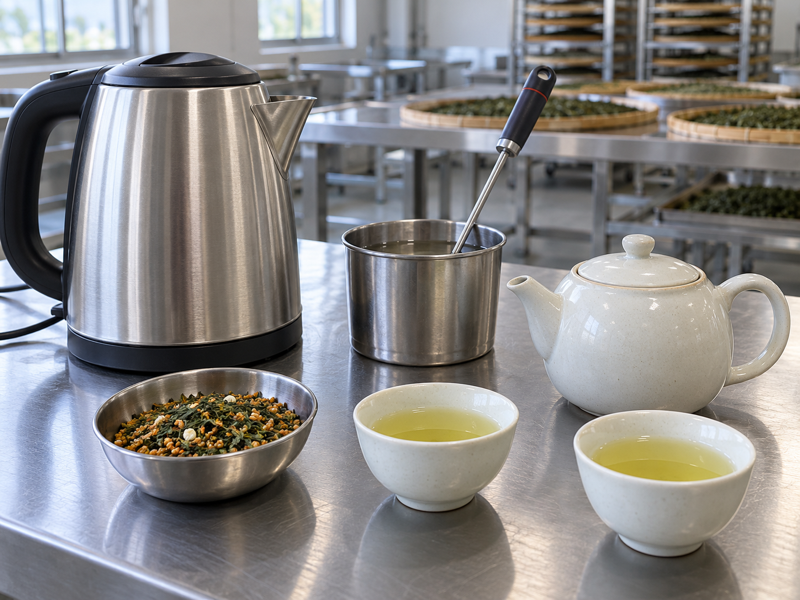
Genmaicha brewing temperature is the water temperature when it contacts a blend of green tea and roasted rice. A hot starting range of 90–100°C can bring out the rice aroma, according to Japan's agriculture ministry brewing guide. It is a starting point, not a guarantee that every leaf, rice roast, and serving format will taste best there. A commercial buyer needs a recipe that staff can repeat and that makes the finished drink taste right. This guide shows how to test temperature while controlling the other variables.
Contents
- 1. Why does water temperature matter for genmaicha?
- 2. What does the Japanese hot-brew guidance actually say?
- 3. How can a buyer compare three temperatures fairly?
- 4. Should leaf type change the temperature choice?
- 5. How do roasted rice and matcha additions affect the trial?
- 6. Can a lower temperature rescue a bitter brew?
- 7. What changes for iced tea and concentrated bases?
- 8. How should temperature be measured in a factory or café?
- 9. Which supplier and quality records support a brewing standard?
- 10. What genmaicha brewing temperature belongs on the recipe card?
1. Why does water temperature matter for genmaicha?
Water temperature changes how quickly flavors move from tea and roasted rice into the cup. Hot water can release the toasted-rice aroma promptly. It can also draw out stronger tea notes, including bitterness, if the dose or steep time is excessive for that blend. Cooler water may soften some harshness, yet the rice aroma can feel muted in a short brew. The result depends on more than the kettle setting, so “hotter is better” is too blunt for product development.
For a café or tea brand, temperature matters because it becomes part of a reproducible recipe. If one employee pours just-boiled water and another waits several minutes, they may serve noticeably different cups from the same stock. If one supplier sample looks better only because it received a hotter brew, the buying comparison is distorted. Record actual water temperature at the moment of contact, tea mass, water volume, vessel, and steep time. Make the decision from taste in the intended application, whether that is a hot cup, iced tea base, or milk drink.
| Temperature choice | Likely sensory direction | Buyer check |
|---|---|---|
| Lower hot range | Softer tea, potentially less roast aroma | Is the cup too weak? |
| 90–100°C start | Strong roasted aroma, fast extraction | Is bitterness acceptable? |
| Near-boiling plus long time | Heavy extraction | Does harshness rise? |
2. What does the Japanese hot-brew guidance actually say?
The agriculture ministry's public tea guide gives 90–100°C and approximately 30 seconds to one minute for genmaicha. An earlier ministry preparation guide describes boiling water and about 30 seconds for ordinary bancha, genmaicha, and hojicha. These are sound references for an initial sensory test, but they are not analytical specifications for a particular commercial blend. Each guide describes a preparation context, not every possible application.
Use those values to define your first trial, then change one variable at a time. A leaf-forward premium blend may benefit from a gentler method; a rice-forward blend may need more heat to make its roast character clear. Water source, vessel material, and cup size also change how the customer experiences the result. A printed preparation instruction should follow testing of your exact product, not a copied category recommendation. If a supplier provides its own recipe, run it alongside the ministry starting method and your target service method under controlled conditions.
3. How can a buyer compare three temperatures fairly?
Set up three cups using equal tea mass, water volume, vessel size, steep time, and filtration. Try a lower hot point, 90°C, and 100°C as exploratory conditions; choose the lower point based on equipment and the tea's intended use. Measure temperature in water entering the tea, not only on the kettle screen. Preheating vessels can reduce a hidden temperature difference between samples. Taste blind if possible, with the cups served at similar drinking temperatures after brewing.
Score roasted-rice aroma, green tea character, bitterness, color, and aftertaste. In an iced or milk drink, make each finished recipe with equal dilution. Do not judge the concentrate alone if customers will never drink it that way. Repeat the preferred temperature with another production lot. A one-degree precision on a recipe card is not useful if equipment cannot hold it; a practical acceptable range supported by tastings is better. Document both the target and the control points that operations can measure.
| Trial field | Keep fixed | Record as result |
|---|---|---|
| Blend dose | Same grams | Sample code and lot |
| Water | Same source and volume | Actual contact temperature |
| Time | Same seconds | Start and strain times |
| Vessel | Same model and preheat | Brewed yield |
| Sensory | Same scorecard | Aroma, bitterness, finish |
4. Should leaf type change the temperature choice?
Genmaicha can be made with different green tea materials. Buyers comparing another roasted tea can read genmaicha versus hojicha before adopting either product’s brew card. The Japanese ministry's Uji tea description names bancha, sencha, and gyokuro among the possible tea components. Those leaves can differ in flavor and cost, and a supplier's blend ratio adds another variable. A temperature that works for a coarse bancha blend may not give the desired balance in a more delicate leaf blend. The label “genmaicha” does not resolve that question.
Ask the supplier which tea material is used and whether the formulation can change. Where the exact mix is confidential, request a stable sensory specification and representative lots. Compare the samples in your service recipe and in a reference hot cup. If the hot cup is pleasant but the intended milk drink lacks aroma, temperature alone may not solve the mismatch. A different blend or dosage may be the better answer. Keep sourcing and recipe development connected: the approved temperature is tied to the approved SKU and must be reconsidered if the ingredients change.
5. How do roasted rice and matcha additions affect the trial?
Roasted rice gives genmaicha its distinctive aroma, and the roast level can change how much hot water helps. A light roast may need a stronger extraction to remain perceptible; a dark roast may become harsh when coupled with a long, hot brew. A matcha-added blend has another issue: fine powder can disperse into the cup. Its color and mouthfeel may change even when the steeped leaf component behaves similarly. Temperature trials should therefore be SKU-specific.
Photographs of dry tea can reveal rice distribution but cannot establish the right brew method. Make a fresh sensory comparison and note how much sediment enters the cup. If a beverage operation filters the tea, test through its actual filter; if a tea room pours the powder into the cup, reproduce that method. A brand comparing plain genmaicha with matcha-iri genmaicha should not carry over a recipe simply because both contain rice and green tea. Evaluate color, aroma, bitterness, and powder suspension after a realistic hold period.
| Blend characteristic | Possible effect | Trial response |
|---|---|---|
| Light rice roast | Aroma may be subtle | Compare hotter and stronger methods |
| Dark rice roast | Harsh notes may emerge | Check shorter time at same heat |
| Fine matcha addition | Powder may pass the filter | Test actual serving and hold |
| Leaf-heavy blend | Tea bitterness may dominate | Adjust dose or temperature |
6. Can a lower temperature rescue a bitter brew?
Sometimes, but identify the cause before changing the recipe. Excess tea mass, long steep time, slow straining, fine broken leaf, or a very bitter blend can all produce a harsh cup. Lowering temperature may soften extraction, but it can also sacrifice the roasted aroma that the product needs. Run a small diagnostic matrix: hold temperature fixed while shortening time, then hold time fixed while changing temperature. Taste each cup at the same drinking temperature.
If the target is an iced drink, remember that ice reduces perceived strength as well as temperature. A lower brewing temperature combined with heavy ice can make the drink thin. For milk tea, milk may mask bitterness in the first sip but leave an unpleasant finish. Record sensory notes after dilution, not merely in the brew vessel. A supplier should be willing to discuss suitable applications and provide a production sample. If every reasonable recipe tastes harsh, reject the blend or revise the target rather than writing an increasingly complicated brewing instruction for store staff.
7. What changes for iced tea and concentrated bases?
An iced tea base is usually stronger than a directly served hot cup because it will meet ice or additional water. You can change dose, water volume, or extraction, but changing all three at once makes results difficult to interpret. Start from the preferred hot-brew profile, then test a stronger dose at the same temperature and time. Compare it with a longer steep at the original dose. One may preserve roast aroma better with less bitterness. Measure final beverage yield and ice melt in the actual cup.
For a concentrate used across a chain, document cooling and holding under the operation's food safety plan. A sensory test does not establish safe storage time. Check how aroma develops during the intended hold and whether sediment affects pumps or dispensers. If the supplier proposes a powder or extract instead of loose tea, treat it as a new ingredient format requiring separate dilution and process trials. The brew temperature on a loose-leaf card may not apply to a powder that disperses directly into a drink.
| Application | What temperature trial must include | Decision metric |
|---|---|---|
| Hot tea | Cup after standard service | Aroma and finish |
| Iced tea | Brew plus actual ice melt | Flavor at handoff and later |
| Milk tea | Brew in chosen milk recipe | Roast clarity after dilution |
| RTD | Production-equivalent process | Stability and finished taste |
8. How should temperature be measured in a factory or café?
Use a calibrated thermometer suited to food or beverage work and identify the measurement point. A kettle may display the temperature of water inside its tank, while tea sees cooler water after pouring into a room-temperature pot. In a large batch, temperature can vary across the vessel. Record the contact temperature at the beginning of extraction and note whether the vessel was preheated. Precision should match the equipment and the sensory sensitivity of the product.
In a café, a simple operational instruction might specify a kettle setting and a preheated pot after a validation run. In a factory, a batch record may capture starting and ending temperatures, mass, mixing, and residence time. Train staff to start the timer when water contacts tea and to strain completely at the endpoint. A nominal one-minute steep becomes longer if tea remains submerged while staff fill several cups. Practical control points often improve consistency more than an elaborate temperature number that operators cannot reproduce.
9. Which supplier and quality records support a brewing standard?
Request the exact ingredient and product specification, representative samples, recommended brewing method, lot code, and change notice. If the roasted rice ratio or tea material changes, a previously approved temperature may no longer produce the same cup. Keep a retained reference sample and the documented recipe together. Incoming quality checks should brew both the new lot and the control under identical conditions before comparing aroma and bitterness.
Matcha Village's stated portfolio includes genmaicha powder, but the right brewing or dispersion method depends on the exact SKU. Confirm whether the offered material is loose tea, powder, or a formulated beverage base. Ask for its current specification and application guidance. Do not turn a generic portfolio description into a claim about a particular lot. If the finished drink carries a caffeine number, test it under the actual approved recipe; brewing temperature can be one of several variables affecting that measurement.
| Record | Why keep it | Update trigger |
|---|---|---|
| Approved brew card | Reproducible service | Recipe or equipment change |
| Retained sample | Sensory comparison | New lot or supplier |
| Product specification | Ingredient control | Supplier revision |
| Training check | Correct timing and pour | New staff or recurring defect |
10. What genmaicha brewing temperature belongs on the recipe card?
Use the temperature that repeatedly gives the intended flavor in the final served product. The ministry's 90–100°C range is a useful initial hot-brew test, especially for roasted-rice aroma. It should be narrowed or adjusted through trials with the purchased blend. A clear recipe card should say where temperature is measured, how much tea and water are used, when the timer starts, and when the brew is strained. Without those details, a temperature alone will not make service consistent.
Before rollout, repeat the preferred method with a second lot and with the equipment used in stores or production. Train operators with an approved sensory reference and record changes. Ask the supplier for samples and a current specification, then approve the blend and method as one package. That gives customers the flavor that was actually tested rather than a category recommendation copied onto a label.
Frequently asked questions
Q1: Is boiling water suitable for genmaicha? It can be. Japanese public brewing guidance includes 90–100°C, but verify taste for your exact blend.
Q2: Will cooler water remove caffeine? No. A cooler brew remains caffeinated; numerical claims require finished-drink testing.
Q3: Should I use the same temperature for milk tea? Start with the approved tea brew, then test aroma and bitterness after milk and ice are added.
Q4: Does matcha-iri genmaicha need a new recipe? Yes. Added powder can change color, mouthfeel, and serving behavior.
Q5: Where should I measure temperature? Measure water as it contacts the tea, or validate a practical kettle setting against that contact point.