
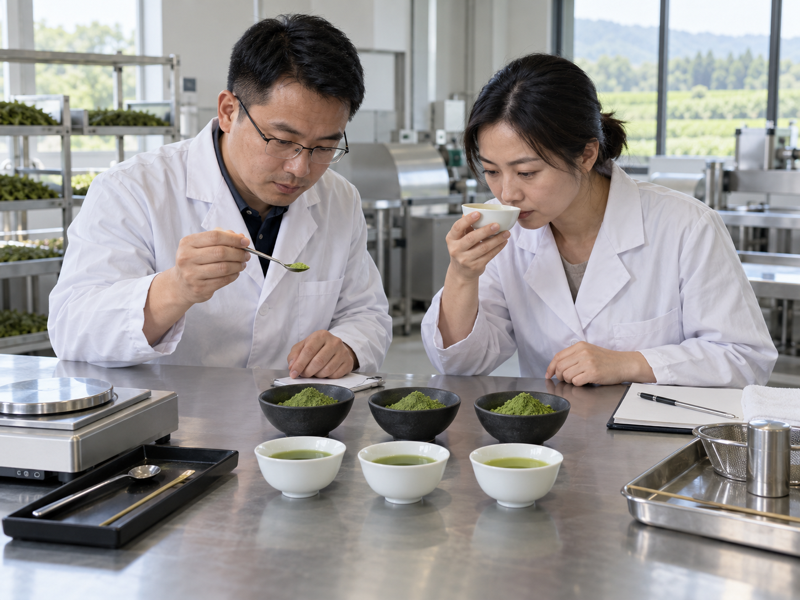
A buyer can approve a vivid green sample and still receive powder that fails in a latte, cake, or next shipment. Matcha is finely milled tea leaf, but its commercial value depends on how the leaf was grown, processed, tested, and packed. This guide gives beverage teams, food manufacturers, and importers a practical way to define the product, compare samples, and write a purchase specification. Matcha Village supplies matcha and related tea powders for B2B applications; buyers should validate any candidate lot in their own process and market.
Contents
- 1. What is matcha in a commercial ingredient specification?
- 2. How is matcha produced from leaf to powder?
- 3. Which matcha attributes matter in the finished product?
- 4. What do origin, shade, and grade claims tell a buyer?
- 5. How should buyers compare matcha suppliers?
- 6. How can a team test matcha before a bulk order?
- 7. Which safety and documentation checks belong in sourcing?
- 8. What packaging and storage protect matcha quality?
- 9. How should matcha cost be modeled for a brand or café?
- 10. What should an approved matcha purchasing brief contain?
1. What is matcha in a commercial ingredient specification?
Define what goes into the bag
Matcha is a finely ground green tea powder. A useful specification goes further: name the tea plant, leaf preparation, whether the source leaf was shaded, milling method, ingredient declaration, and intended use. ISO's published technical report on matcha describes cultivation, manufacture, and sensory characteristics; its scope excludes flavored, blended, decaffeinated, and soluble products. That distinction helps purchasing teams avoid treating a sweetened latte mix as straight tea powder. A supplier's marketing name alone cannot establish composition.
Separate identity from performance
Ask for a current product specification and a lot-linked certificate of analysis. Record the exact product code you sampled. A new code, origin, or processing route needs a new qualification, even if both bags say matcha. The practical test: specify attributes that change your finished product: color in milk, particle dispersion, bitterness after heating, packaging size, and shelf-life evidence. Let product development and quality teams sign off together. If a powder is offered for a retail tin, check whether its flavor works in water; a bakery may instead need flavor retention after baking. One ingredient name cannot answer both questions.
| Specification field | Question for supplier | Buyer decision |
|---|---|---|
| Ingredient statement | Is it 100% tea powder or a blend? | Label and formula fit |
| Product code | Will approved lots use this code? | Change control |
| Intended application | Water, milk, or heated food? | Sample plan |
| Lot identification | Can each shipment be traced? | Receiving and complaints |
2. How is matcha produced from leaf to powder?
Trace the processing path
The basic path runs from tea cultivation and harvest through heat treatment, drying, sorting, and fine grinding. Traditional Japanese matcha uses tencha, a shaded leaf that is steamed and dried without the rolling used for many other green teas. Japan's agriculture ministry describes matcha as ground tencha. Commercial buyers should ask a supplier to describe its actual process rather than assume every tea powder follows an identical route. The phrase “stone ground” also needs context: equipment type matters less to a drink manufacturer than a powder's heat exposure, particle distribution, and behavior in its recipe.
Identify controllable steps
Leaf selection shapes flavor before milling begins. Grinding creates a larger exposed surface and makes oxygen, light, heat, and moisture handling relevant after production. A factory should be able to explain how lots are segregated, how milling equipment is cleaned, and where finished powder is packed. Follow the lot: connect a submitted sample to its manufacturing batch and proposed commercial pack. If a sales sample came from one line but the order will ship from another, run a pilot with production material. Process descriptions are useful when they lead to a verifiable control or trial, not when they read like a decorative story.
3. Which matcha attributes matter in the finished product?
Judge within the application
Color, aroma, bitterness, astringency, umami, mouthfeel, and dispersibility can all matter, but their weight changes by product. An unsweetened drink exposes subtle off-notes. Vanilla syrup and dairy can hide those notes while muting the tea aroma you hoped to sell. In a cookie, oven exposure may dull green color even when a room-temperature sample looked attractive. Define a reference recipe and test every powder at the same dose. Use blind cups when possible and record comments before revealing suppliers or prices.
Turn impressions into limits
A useful sensory sheet uses anchored descriptions: “visible green after four hours in chilled milk” is easier to revisit than “excellent color.” Measure powder dose, liquid temperature, mixing time, and hold time. Photograph samples under fixed lighting for internal comparisons, while remembering that photographs are not color measurements. Check the next lot: retain an approved sample and repeat the trial on delivery. Slight color drift might be acceptable in a dark chocolate filling yet unacceptable in a plain iced latte.
| Application | Main sensory question | Trial condition |
|---|---|---|
| Straight tea | Is the finish balanced? | Fixed water temperature and dose |
| Milk latte | Can tea still be tasted? | Actual milk SKU and sweetness |
| Bakery | Does flavor survive heat? | Production bake profile |
| Ice cream | Does color hold in storage? | Frozen finished product |
4. What do origin, shade, and grade claims tell a buyer?
Ask for evidence behind the label
Origin identifies where a product came from; it does not guarantee a particular cup. Tea from two farms can differ by cultivar, harvest timing, and processing. Shade cultivation is associated with matcha production, yet the exact practice should be part of the supplier's documented story if a brand intends to print it. “Ceremonial” and “culinary” are common commercial labels, but they do not replace a shared, enforceable specification. Treat them as a starting conversation about taste and intended use.
Avoid paying for unused attributes
A café serving unsweetened bowls may justify a subtle, low-bitterness powder. A baked filling surrounded by sugar and fat may not show that difference to customers. Price the outcome: compare candidate powders in their final format, then calculate cost per saleable unit. Ask for evidence of origin when it will appear on packaging, and confirm the scope of any organic claim for the destination market. Matcha Village offers several grades and application options; the buyer should still choose a named code by trial rather than assume the most expensive tier suits every formula. The better grade is the one that meets an agreed result consistently.
5. How should buyers compare matcha suppliers?
Run the same qualification for each candidate
Send suppliers a short application brief: product type, target color and flavor, ingredient restrictions, pack size, destination, forecast range, and launch timing. Request samples under the same conditions. A supplier who asks about milk type, heat treatment, or packaging can often provide a more relevant sample than one who sends its prestige powder to every inquiry. Ask who manufactures and stocks the powder.
Check operational fit
Quality documents, traceability, lead time, minimum order quantity, and response process deserve a place beside price. If you need private label retail packs, review packaging capability separately from bulk ingredient supply. Before a contract: ask for a written change-notification process covering formulation, origin, manufacturing site, and primary packaging. Build an approval record that another employee can understand six months later.
| Supplier item | Evidence to request | Practical reason |
|---|---|---|
| Sample identity | Product code and lot | Link trial and order |
| Quality release | Current lot documents | Receiving check |
| Capacity plan | Lead time and order window | Avoid launch gaps |
| Change notice | Written procedure | Protect approved recipe |
6. How can a team test matcha before a bulk order?
Make trials repeatable
Use a written protocol, not an informal tasting table. For drinks, record powder mass, water volume and temperature, blending tool, milk SKU, syrup dose, ice, and waiting period. For a baked food, record batter pH if relevant, oven profile, inclusion rate, and finished-package conditions. Make at least two batches on different days with the staff and equipment planned for production. A laboratory pass does not establish line performance.
Test failure modes
Look for lumps, sediment, gritty mouthfeel, fading, bitterness, and variability across operators. Keep a control sample. If a powder fails, adjust one variable at a time before rejecting it: dose, dispersion method, or recipe may be responsible. Decision point: once a formula works, lock the product code and reference sample. Then ask for enough material from a commercial lot for a line trial. Record yield, waste, and rework. A tasting score alone misses labor and process cost. For a chain, try the same recipe in more than one store; water, tools, and training can expose differences that a central kitchen cannot.
7. Which safety and documentation checks belong in sourcing?
Match checks to destination and use
Food businesses should define which specifications, contaminant tests, microbiological limits, and labeling details their market and product require. Request a lot-linked certificate of analysis, ingredient and allergen statements, shelf-life support, storage instructions, and the supplier's traceability process. Ask which testing methods and limits are used, rather than accepting a generic “tested” claim. For certified organic sales, confirm that the product, facility, certificate scope, and chain of custody match the target market. A logo in a slide deck does not prove a particular lot qualifies.
Assign import responsibilities
U.S. importers, for example, face FDA food-import requirements, including applicable facility registration, prior notice, and foreign supplier verification obligations. Other destinations have their own rules. Route documents early: involve the importer and regulatory adviser before approving packaging or shipping. A supplier may provide records, but the importer remains responsible for its own obligations. Ask how complaints trigger batch investigation and how quickly records can be produced. A credible answer names people, records, and timing. It should not promise “zero risk,” because food safety depends on both supplier controls and what the buyer does after receipt.
| Document | Check against | Owner |
|---|---|---|
| Product specification | Approved formula and label | R&D and regulatory |
| Lot analysis | Agreed limits and methods | Quality team |
| Organic certificate, if used | Product and market scope | Regulatory team |
| Import records | Destination rules | Importer |
8. What packaging and storage protect matcha quality?
Design around exposure
Fine powder offers a large surface area to air. Moisture can cause clumping; light and heat can alter appearance and aroma. Ask the supplier for packaging barrier information and validated shelf-life conditions. Then check whether your warehouse, production line, and foodservice stores can follow those conditions. A nominally long shelf life offers little help if a large bag remains open through humid service shifts. Choose pack size from actual usage and opening frequency, not only from a lower price per kilogram.
Control handling after opening
Record receipt condition, lot, date opened, and storage location. Close packs promptly with clean, dry tools. Use a measured scoop or scale and avoid placing open powder beside steam. The hidden cost: a large bag can create more stale powder and variable dosing than several smaller packs. Test your proposed container under real service conditions and taste material near the end of its expected use period. Keep a retained sample from each received lot for later comparisons.
9. How should matcha cost be modeled for a brand or café?
Calculate cost in the product
Start with the delivered cost per usable kilogram, including freight, duties, testing, local handling, and expected waste. Multiply by the validated dose per unit. For a latte, include milk, sweetener, cup, lid, labor, and remakes. For a bakery product, include bake loss and unsold finished goods. The cheapest matcha per kilogram may need a higher dose to achieve the same tea flavor. That can reverse the apparent saving. Build a small sensitivity model before negotiating annual volume.
Price supply risk
Forecast demand using your own orders and estimate a late shipment’s cost. Test the assumption: trial an alternate approved lot or supplier if continuity is critical, but give that powder its own recipe validation. Fixing a substitution after a shipment is delayed invites inconsistent products. Contract terms should name product code, quality limits, packaging, lead time, order changes, and complaint handling. Do not promise volume beyond realistic demand merely to secure a nominal discount.
| Cost input | Unit to record | Common omission |
|---|---|---|
| Powder | Cost per usable gram | Spillage and over-dosing |
| Freight and import | Cost per landed kilogram | Duties and testing |
| Production | Cost per saleable unit | Rework and holds |
| Stock | Weeks of cover | Slow-moving opened packs |
10. What should an approved matcha purchasing brief contain?
Put the decision in one file
An approved brief should identify product code, supplier, manufacturing site if disclosed, sample lot, intended products, recipe dose, sensory reference, analytical limits, pack format, storage, shelf life, destination-market documents, and ordering terms. Include the people who approved flavor, food safety, regulatory fit, and price. If these decisions live only in email, teams may unknowingly reorder a similar-sounding but different powder. A short, controlled file makes repeat orders less dependent on one employee's memory.
Set review triggers
Review the approval after a process change, new origin, repeated color drift, new application, or destination-market expansion. Keep a simple issue log with batch and photo references. Next action: request samples and current documents against this brief, then run a matched trial in your real recipe. Matcha Village can discuss bulk powder, blends, and private-label formats, but a serious buying decision starts with a finished-product target. Contact suppliers with that target and ask them to identify the exact lot and code they propose to ship.
Further reading
The ISO matcha technical report explains its defined scope. Japan's agriculture ministry overview of Uji tea describes tencha and matcha. U.S. buyers can review FDA food-import guidance with their importer.
FAQ
Q1: Is matcha the same as ordinary green tea powder?
No. Matcha has a defined production identity; generic green tea powder may come from different leaf and processing routes. Request a precise specification.
Q2: Does ceremonial grade guarantee better matcha?
No single grade word guarantees performance. Compare named product codes in the finished application and agree on measurable limits.
Q3: Can matcha be used in milk drinks and baked foods?
Yes, but the same powder may perform differently in each. Test flavor, color, dispersion, and process losses separately.
Q4: What documents should an importer request?
Start with specification, lot analysis, traceability, allergen information, shelf-life support, and market-specific records agreed with your importer.
Q5: How should a buyer begin supplier qualification?
Send a short application brief, test matched samples, review documents, and approve a commercial lot before committing to volume.