
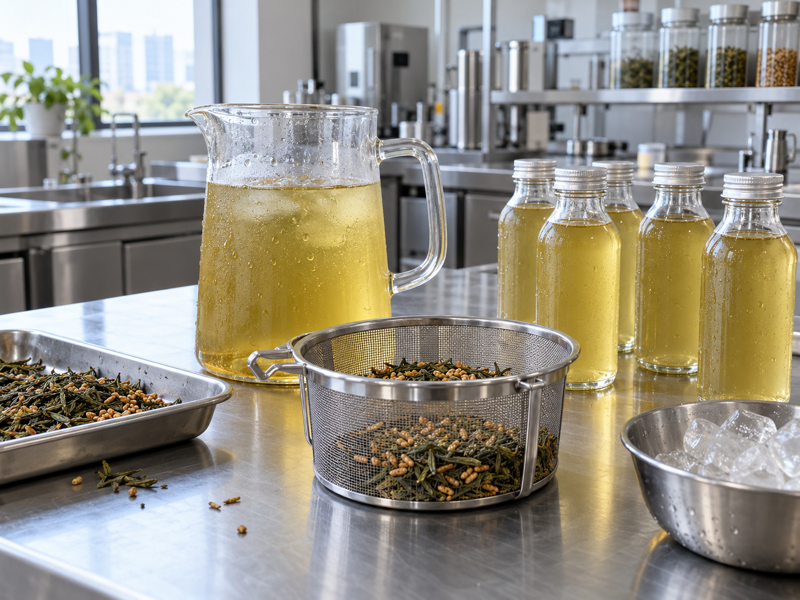
Cold brew genmaicha is green tea and roasted rice extracted in cold water over a longer period than a hot steep. For a café or beverage brand, the challenge is making a pleasant drink that stays consistent and safe through service or distribution. A bench pitcher can taste excellent yet create weak flavor, sediment, or unpredictable holding time at scale. This guide gives product teams a controlled trial method, a set of sensory checks, and a handoff list for operations. Treat the temperatures and times in early trials as variables to test, not universal claims about every tea or every food process.
Contents
- 1. What happens when genmaicha is brewed cold?
- 2. Which ingredients work well for cold brew genmaicha?
- 3. How should a small controlled trial be designed?
- 4. How do dose and steep time affect the drink?
- 5. What filtration and clarity checks are useful?
- 6. How can a café put the recipe into service?
- 7. What changes for a packaged beverage project?
- 8. How should caffeine be discussed?
- 9. How do buyers compare suppliers for a cold brew program?
- 10. What is a practical launch checklist?
1. What happens when genmaicha is brewed cold?
Cold water extracts compounds from tea leaves and roasted rice more slowly than hot water. The resulting drink often tastes gentler, but the exact difference depends on the tea base, roast level, dose, contact time, and water. A cold brew can emphasize a clean cereal aroma while suppressing some harsh notes. It can also end up thin if the blend was designed for a short hot infusion. Test your blend rather than assuming a cold preparation will improve any genmaicha.
The material itself varies. Japan's MAFF tea reference describes roasted rice blended with bancha, sencha, or gyokuro. These tea bases need not behave identically in a cold trial. Whole leaves, broken leaves, and fines can change extraction speed and filtration loss. Rice particles can settle in the tank. If the intended product is a clear bottled drink, evaluate the liquid after chilling and filtration, not just the first sip from a sample jar. A useful development note names the lot, recipe, and filtration method.
| Variable | Why it matters | Record in each trial |
|---|---|---|
| Tea dose | Controls flavor strength | Mass per water volume |
| Water | Affects sensory result | Source and treatment |
| Contact time | Changes extraction | Start and finish time |
| Temperature | Changes extraction and risk | Actual product temperature |
| Filter | Removes leaf and rice | Type and loss |
2. Which ingredients work well for cold brew genmaicha?
Begin with a clean, fresh genmaicha that has a recognizable roasted-rice note. Ask for a representative production sample and inspect leaf condition, rice distribution, fines, and any stale or smoky off-note. A delicate blend may work in an unsweetened drink; a stronger roast may be needed when the recipe includes milk or syrup. The best choice depends on the finished menu item. Do not select tea solely from its dry aroma because chilled liquid changes the way customers perceive flavor.
If a team is choosing between a brewed genmaicha base and powdered matcha, the genmaicha versus matcha comparison helps frame the different ingredient forms. Consider water as an ingredient. Use the same water source planned for production or service, and keep it consistent during comparisons. If the beverage will contain citrus, fruit, milk, or sweetener, test those additions after the tea has been filtered. A flavor that seems balanced alone can become dull in milk or sharp beside an acid. When testing a powder or extract instead of loose tea, develop a separate recipe. Powder is a dispersed ingredient and may create a different texture, appearance, and labeling path from a filtered infusion.
3. How should a small controlled trial be designed?
Run a simple matrix instead of changing every parameter at once. Choose one tea lot, one water source, one vessel, and one filtration method. Test two or three dose levels across a limited range of contact times. Keep samples covered and refrigerated under your food-safety procedure while they brew. Then taste each sample at the serving temperature, preferably blind. Record aroma, toasted-rice intensity, green-tea character, bitterness, aftertaste, and whether sediment appears after standing.
Use your own safe handling standard for brewing and holding. Cold extraction is not a preservation step, and long steeping does not make an unpasteurized beverage shelf stable. A food business needs a validated process and legal review for any packaged claim or distribution model. For a café, document who prepares the batch, when it is made, how equipment is cleaned, and when unused drink is discarded. For manufacturing, bring a process authority or qualified food-safety team into shelf-life and microbial decisions. A sensory recipe is only one part of a commercial specification.
| Trial code | Dose | Contact time | Sensory result | Action |
|---|---|---|---|---|
| A | Lower planned dose | Shorter test | Record after filtration | Keep or reject |
| B | Higher planned dose | Shorter test | Record after filtration | Keep or reject |
| C | Lower planned dose | Longer test | Record after filtration | Keep or reject |
| D | Higher planned dose | Longer test | Record after filtration | Keep or reject |
4. How do dose and steep time affect the drink?
More tea per liter normally raises flavor intensity, but it also raises ingredient cost and can add bitterness or more fine particles. A longer contact time can help a low-dose brew, yet it may yield a flatter or rougher cup than a shorter, higher-dose recipe. There is no single correct ratio for every blend, so compare samples under the same service conditions. Weigh tea and water rather than using scoops or container marks. A small weighing error can become a material difference in a concentrated test batch.
When a chilled drink tastes weak, identify what is missing. If the roasted-rice aroma is faint, a different blend may work better than simply doubling the dose. If the green-tea body is weak, changing the tea base or leaf cut might help. If the flavor is good but the liquor looks cloudy, focus on filtration and stability. Keep a control cup from the current recipe at every tasting. Without a control, the team may choose the sample that tastes strongest that day rather than the one that best fits the customer and the price target.
5. What filtration and clarity checks are useful?
Cold brew genmaicha contains leaves, rice grains, and sometimes fines. A coarse filter removes major solids, while a finer stage may improve visual clarity. Each stage can also remove liquid and alter aroma, so measure finished yield after filtration. If the drink will be served in an opaque cup with milk, perfect clarity may not matter. In a transparent bottle, sediment or a ring around the neck can become a serious quality complaint. Set the visual standard around the packaging and the consumer's expectation.
Run a small hold test in the intended package. Look for settling, color change, and flavor drift at the start and end of the proposed service period. This bench observation does not establish microbial shelf life, but it can reject an unstable recipe early. Measure how much prepared beverage remains after straining and how long the filter takes to work. A very fine filter may give beautiful liquor at a pace the café cannot manage. An industrial line may have other filtration options, yet pilot work is still needed because flow rate and fouling depend on the actual material.
| Appearance concern | Possible cause to test | Practical next trial |
|---|---|---|
| Visible leaf specks | Coarse filtration | Compare filter grades |
| Settling rice fines | Small particles in blend | Test pre-screening |
| Haze after chilling | Formula or process change | Hold packaged samples |
| Weak aroma | Low extraction or blend mismatch | Compare dose and tea lot |
6. How can a café put the recipe into service?
Write a batch card that a new employee can follow. Include tea code, lot handling, measured water volume, tea mass, container, start and stop time, filtration steps, storage location, and discard rule set by your safety team. Label the container according to your operating procedure. Train staff to use the finished drink in the same way every time, whether served plain, over ice, or as part of a latte. Ice dilution changes the cup; test the actual ice quantity and cup size.
Think through service pressure. A pitcher recipe that requires several slow filtration passes may work during a quiet tasting but fail on a busy morning. Use a container size that staff can lift and clean safely. Decide whether the store makes the drink daily or receives a controlled concentrate. If making a concentrate, define its dilution and verify that flavor survives the intended hold. Keep the operations card short enough to be used. Longer rationale belongs in the development record, while the card should specify the actions that protect taste and safe handling.
7. What changes for a packaged beverage project?
A packaged drink needs more than a successful café recipe. The product team must define the ingredient declaration, intended process, packaging, target shelf life, distribution temperature, and quality limits. Tea can change during processing and storage, so run trials after the actual treatment and fill step. Taste immediately and at planned checkpoints. Track color, aroma, sediment, package compatibility, and any flavor interactions with sweetener, acid, or milk. A cold-extracted base does not exempt the finished drink from food-safety validation.
Bring regulatory, QA, and process specialists into the plan early. They should decide the microbiological study, process validation, labeling, and any claim substantiation required for the market. A supplier's test report on dry tea does not validate a bottled beverage. The manufacturing plant also needs a repeatable way to handle tea solids, filter losses, and equipment cleaning. Ask whether the chosen tea form and pack size fit the production line. The most aromatic bench blend may be impractical if it blocks filters or separates during large-tank holding.
| Project stage | Main question | Evidence to keep |
|---|---|---|
| Bench | Does the drink taste right? | Recipe and tasting notes |
| Pilot | Does the process repeat? | Yield and process record |
| Safety review | Is the product safe for its route? | Qualified validation |
| Commercial | Does each lot meet the standard? | Release and retain records |
8. How should caffeine be discussed?
Genmaicha contains tea leaves and therefore can contain caffeine. A cold brew should not be described as caffeine-free. Extraction depends on tea composition and the exact preparation, so a hot-brew number should not be applied to a cold product. MAFF publishes a value for one specified genmaicha infusion method in its caffeine table; that result is not a universal level for commercial cold brew or powder.
If a caffeine statement is material to your label, menu, or buyer contract, test the finished drink with a suitable method and use the applicable market rules. Record sample preparation and serving size. A measured result can still vary across materials and batches, so agree on a control plan with QA. Consumers who are sensitive to caffeine, pregnant, or following medical advice should have clear information rather than a broad promise of “low caffeine.” A café can often avoid overclaiming by stating that the drink is made from green tea and making portion information available.
9. How do buyers compare suppliers for a cold brew program?
Send the same application brief to each supplier. State whether you need whole-leaf tea, a tea bag, a foodservice pack, or a powder; give the target flavor, annual volume estimate, destination, and document requirements. Ask for ingredient details, current specification, lot sample, packaging, lead time, and how changes in tea or rice components are communicated. A supplier may offer a strong sample but lack the pack format or batch traceability your operation needs.
Test more than one production lot when possible. Rice and leaf can segregate inside a bulk bag, so sample a representative mix and agree on handling instructions. Calculate cost per finished liter after filtration loss. Freight, packaging, preparation labor, and waste can change the economics. If you need both retail tea and a beverage base, do not assume one blend must serve both. Compare their end uses separately. For a powdered application, Matcha Village lists genmaicha powder among its ingredient range; request a current specification and pilot sample before making formula or marketing claims.
| Supplier item | Ask for | Decision use |
|---|---|---|
| Current lot sample | Production-representative quantity | Pilot brew |
| Specification | Ingredients, form, packing, storage | QA review |
| Change notice | Tea or rice changes | Reapproval plan |
| Commercial quote | Order size and delivery basis | Finished-cost model |
10. What is a practical launch checklist?
Select a candidate through coded tasting, then confirm it in the final recipe, cup or package, and service temperature. Write a batch card with measured ingredients and a controlled brew process. Run an operations pilot, quantify liquid yield, and test flavor after the expected hold. Have your qualified food-safety team approve handling and, where relevant, the commercial process and shelf life. Approve an ingredient specification, a representative lot sample, and any label wording before ordering launch stock.
Keep one controlled sample of the approved drink for training and future supplier checks. Set a trigger for retesting when the tea base, rice roast, supplier, water, filtration, or package changes. Cold brew genmaicha can be a useful café item or beverage base when its gentle tea and toasted-rice profile fits the product. Build the launch around repeatable preparation and verified safe handling. Invite suppliers to sample against your actual recipe so their recommendations address the conditions your customers will encounter.
FAQ
Q1: Is cold brew genmaicha caffeine-free? No. It contains tea leaves. Measure the finished drink if a caffeine figure is needed.
Q2: Can a hot-brew recipe be used unchanged for cold brew? No. Start a separate dose-and-time trial because extraction and serving conditions differ.
Q3: Does long steeping preserve cold brew tea? No. Steeping is not a preservation method; use a qualified food-safety plan for handling and shelf life.
Q4: Can genmaicha powder replace loose tea in a cold brew? It may support a different beverage format, but powder is a dispersed ingredient and needs separate texture, sediment, and labeling checks.
Q5: What should a café record for each batch? Record the tea lot, measured recipe, brew times, filtration, preparation date, storage, and the discard rule from its safety procedure.