
Chinese matcha is a sourcing question, not a single grade. China grows tea in many regions and processors use different leaf, shading, drying and milling systems. A powder made in Guizhou may behave differently from one produced elsewhere, and neither should be described as Japanese-origin tea. Buyers need a sample that works in their own product, a truthful origin statement and records that follow the commercial lot. The ten checks below help a café, distributor or private-label brand compare suppliers without relying on country stereotypes.
Contents: Identity · Farm · Shade · Process · Mill · Use · Safety · Origin · Consistency · Contract
1. What Does Chinese Matcha Identify?
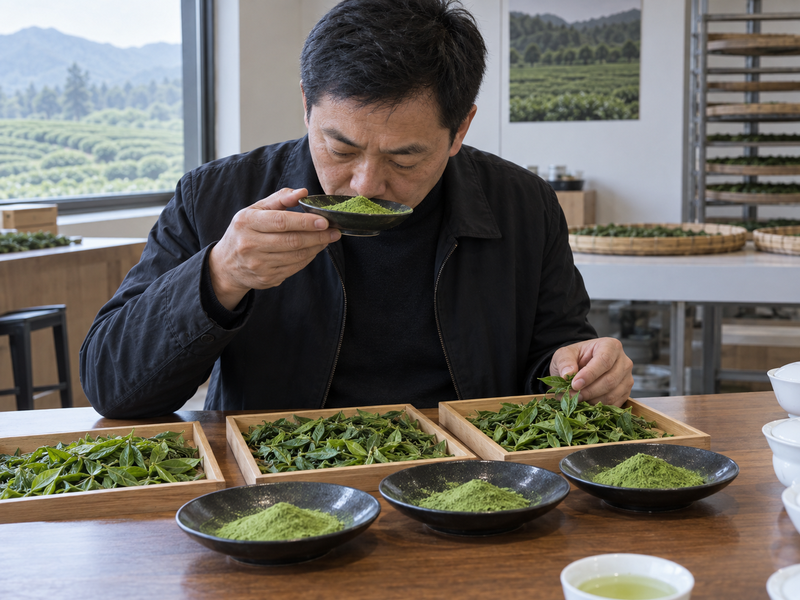
Define both origin and product form
“Chinese” indicates where the tea originates or is processed, depending on the claim being made. “Matcha” is a product term that buyers may understand as finely milled green tea prepared from shaded leaf material. Those ideas should be documented separately. A powder imported, blended and packed in another country does not become tea grown there. Ask for the leaf origin, processing location, milling location and packing location before approving an origin line.
Scientific work on shade-grown tea in Guizhou, China shows that Chinese producers and researchers are actively studying the crop and its quality. The study is evidence about specific plants and growing conditions, not a certificate for every Chinese matcha on the market. A useful buyer question is: what exactly is this lot, and what documents support its description? Define the intended use as well. A bakery powder needs to retain tea flavor after heat; a drinking powder needs a clean taste in water.
| Identity question | Document or sample | Why it matters |
|---|---|---|
| Leaf grown where? | Farm or region record | Truthful origin |
| Processed where? | Production record | Traceability |
| What raw leaf? | Specification | Product definition |
| Packed where? | Pack and shipment record | Label accuracy |
2. Where Was the Tea Grown?
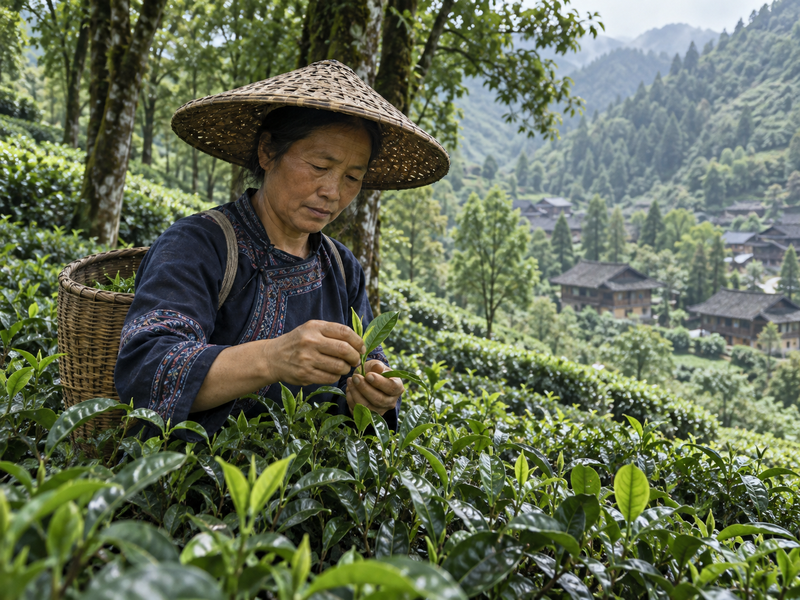
Ask for a traceable region, not a romantic story
China’s tea-growing areas differ in climate, cultivar, harvest timing and factory access. A region name can help identify a sourcing program, but it does not prove flavor or safety. Ask for farm or cooperative records, lot codes and the route from fresh leaf to finished powder. If a supplier blends material from several sites, that can be a legitimate way to maintain a target profile; the blend should still be traceable and accurately described.
Do not infer Japanese origin from the use of Japanese processing terms or equipment. Conversely, do not reject a Chinese sample because it lacks a famous Japanese place name. Compare physical samples in the application and review the supply records. For private label, confirm whether the proposed origin wording remains true if the supplier needs to substitute raw material next season. A label claim that cannot tolerate ordinary supply changes may require a more tightly controlled procurement program.
3. Was the Leaf Grown Under Shade?
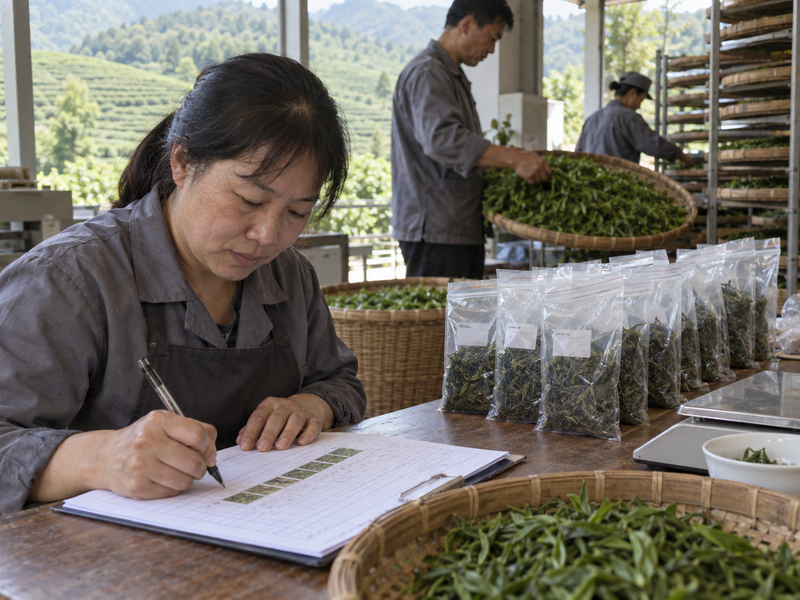
Record the practice and compare the result
Shading can influence tea leaf composition, color and flavor. In a controlled study of Chinese tea plants, the researchers compared open-air leaves with specific shade treatments and observed changes in chlorophyll and other measures. Those treatments are study conditions, not a universal recipe. A supplier should describe its own shade method, approximate timing and how it manages different lots.
The buyer’s goal is not to award points for the longest shade claim. A very dark powder can still fail a drink trial, and a production process must be viable for the required volume. Taste water preparations and the intended finished recipe. Keep photographs under standardized lighting and ask whether commercial shipments will use the same raw material program as the sample. When leaf supply changes, request notice and a new approval sample before the change reaches a retail pack.
| Shade-related claim | Useful follow-up | Avoid assuming |
|---|---|---|
| “Shade grown” | Where and for which lots? | Identical practice every season |
| “Deep green” | Standardized color sample? | Better taste automatically |
| “High theanine” | Product-specific test? | Fixed amount without data |
| “Traditional” | Which actual process steps? | Verifiable product standard |
4. How Was the Leaf Processed?
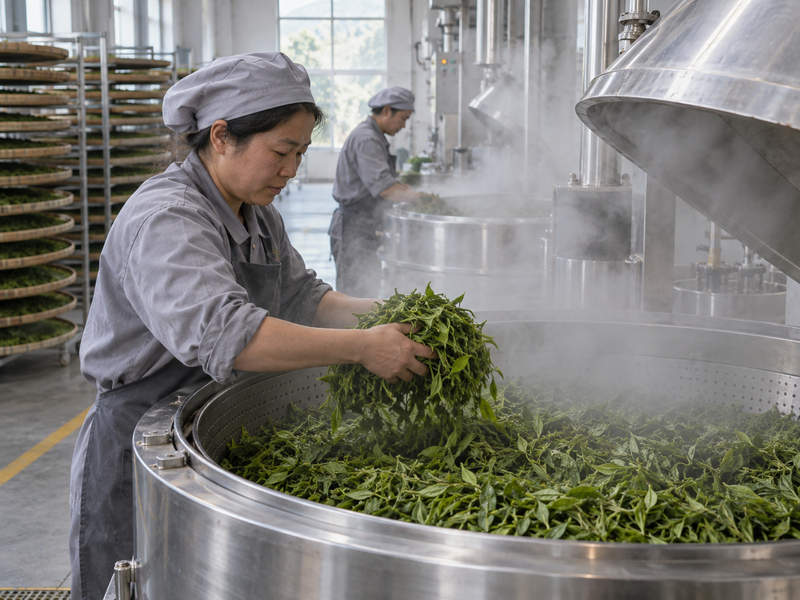
Follow fresh leaf to dry material
Leaf handling after harvest affects the powder ultimately sold. Buyers should ask for a simple process flow showing the steps used to stabilize, dry, sort and prepare the leaf for milling. Tea described as tencha-style material should have a process description that supports that term. A recent research review of Japanese green tea processing describes steaming, drying without rolling and milling as key features of conventional matcha manufacture. Chinese factories can be assessed against their actual process, rather than by assuming every factory uses the same equipment.
Ask what controls exist for time, moisture and foreign material. Are stems and veins removed before milling? How are batches segregated? How are process deviations recorded? A factory may protect its exact settings as proprietary, but it should be able to provide a credible flow and finished-product specification. Request a current commercial-lot sample, not only an exhibition sample. Process discipline matters to repeatability even when two powders have a similar green color.
5. What Milling and Particle Specification Applies?
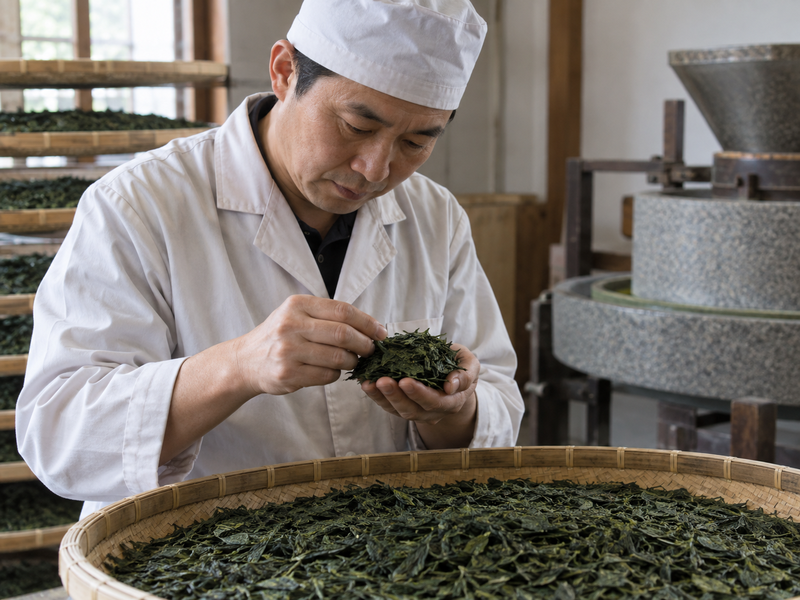
Test texture where the powder will be used
Fine grinding changes mouthfeel and how particles distribute in liquid or food. A powder intended for a whisked water bowl should be tested for smoothness and sediment after a standard mixing method. A powder destined for cake batter may need a different balance of cost, color and particle size. The equipment name alone—stone mill or mechanical grinder—does not predict success in every formula. Ask for a particle-size range or other agreed physical measure when performance matters.
During sampling, use a weighed dose and identical mixing conditions. Check for clumps and grit, then assess the cup after a reasonable hold. Record whether the problem disappears with better mixing or persists because of the powder. For a beverage manufacturer, a pilot run is more informative than a small hand-whisked demo. Our matcha measurements guide explains why a repeatable dose is essential to any comparison.
| Application | Physical check | Sensory check |
|---|---|---|
| Water bowl | Dispersion and sediment | Texture and aftertaste |
| Milk drink | Mixing and suspension | Balance after dilution |
| Bakery | Batter distribution | Flavor after heat |
| Dry mix | Flow and clumping | Finished drink consistency |
6. Does It Work in the Intended Recipe?
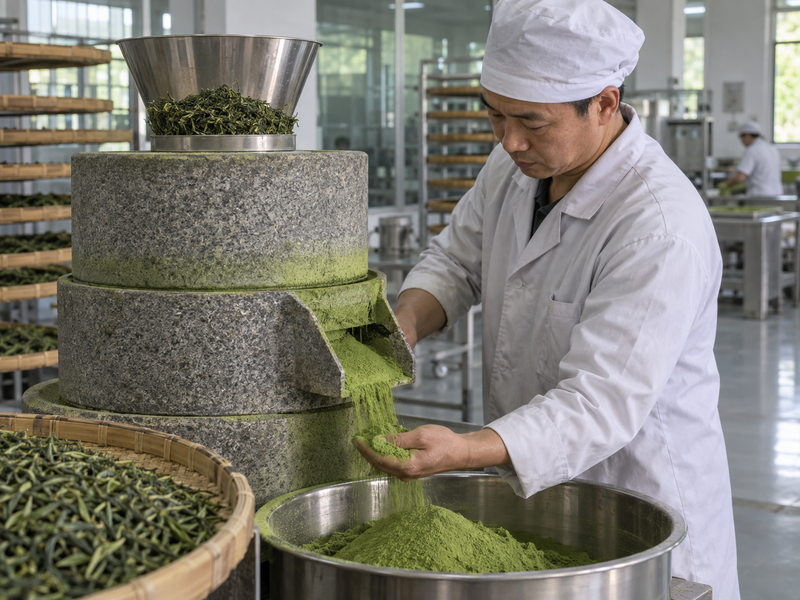
Approve the product, not just the powder
Country of origin does not tell a developer how matcha will perform in a particular recipe. Run the tea in the actual water, milk, bakery or dessert format. Use the proposed commercial dose, ingredients and processing conditions. Compare at least two lots if availability allows. Measure appearance and taste at serving and after the intended holding period. A café serving a fresh latte may accept characteristics that a shelf-stable bottled beverage cannot.
If the first trial is too bitter, adjust the tea dose and formulation method before concluding the source is unusable. If a deeper green is desired, check how much extra powder changes cost and caffeine. Keep a benchmark recipe so samples are compared fairly. Document the acceptance reasons in ordinary language: “smooth in oat milk at the approved dose” is more useful than “premium.” The latter adjective gives a supplier little guidance when the next lot differs.
7. Which Safety Records Should a Buyer Request?

Match documents to the market and lot
Ask for a current product specification, certificate of analysis where applicable, traceability records and evidence of the supplier’s food-safety system. Chemical contaminant and pesticide requirements depend on the destination market and the buyer’s standards. Do not assume one certificate or a generic “tested” badge covers every future shipment. Confirm the analytes, methods, limits, sample date and lot number. The importer or brand owner should determine the rules that apply where the tea will be sold.
Also review packaging and storage. A powder can leave the mill in good condition and arrive with moisture damage if the seal or freight handling fails. Set receiving checks for outer cartons, inner barriers and lot identity. Agree in advance what happens when a result is missing or out of specification. A buyer who asks for records only after the goods arrive has less room to solve problems without disrupting production.
| Record | Check for | Decision supported |
|---|---|---|
| Specification | Current revision and limits | Lot acceptance |
| Test report | Lot, method, units | Claim and safety review |
| Traceability | Farm-to-pack link | Recall readiness |
| Food-safety audit | Scope and dates | Supplier qualification |
8. How Should Origin Be Stated on Pack?
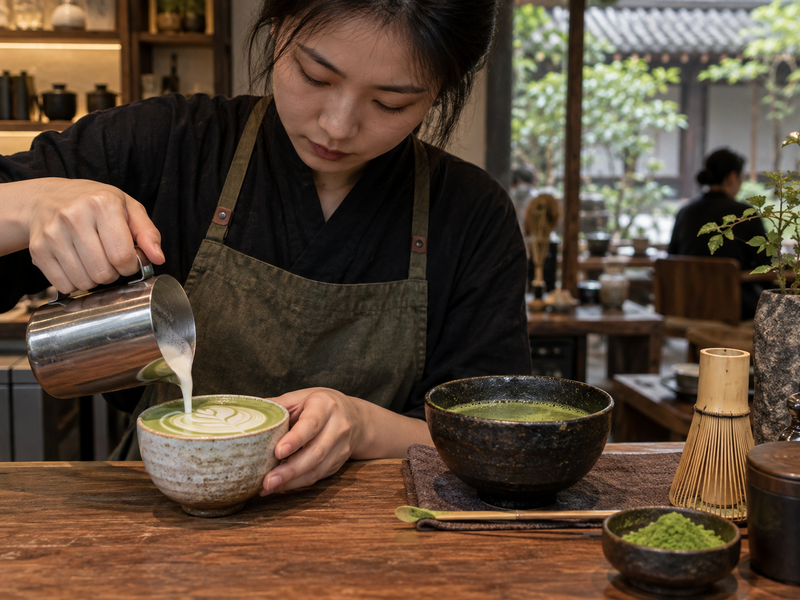
Use precise, defensible wording
A brand may want to tell customers that its matcha comes from China. It should do so plainly and in accordance with the destination market’s origin-labeling rules. “Japanese-style” describes a style only if the wording is not misleading in context; it does not transform Chinese-grown tea into Japanese-grown tea. Avoid Japanese place names, imagery or flags that imply an origin the product does not have. Review the whole front panel and online listing, not just a small legal line on the back.
For a multi-origin blend, disclose the origin as required and keep the underlying batch records. If a supplier changes from one Chinese growing area to another, check whether a regional claim must change. If it changes country, the artwork may need a more substantial review. Get the approved wording into the purchase specification so sales, sourcing and packaging teams are working from the same identity.
9. Can the Supplier Repeat the Approved Lot?
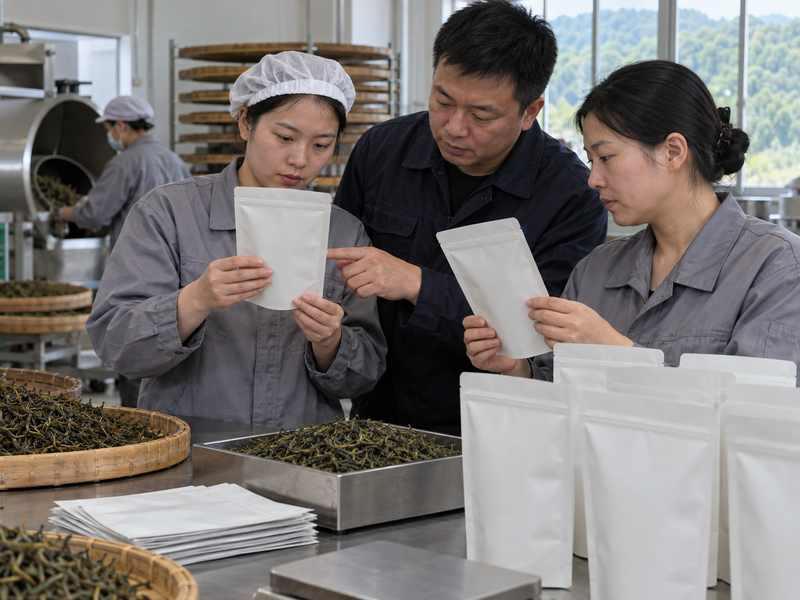
Look past the first sample
Ask for production capacity, lead time, batch size, reserve stock and a plan for seasonal changes. A supplier can make one beautiful sample yet struggle to reproduce it at scale. Compare a pre-shipment sample from the intended commercial lot with the approved reference. Define tolerances for color, flavor, moisture, particle size and relevant test results. If blending is used to smooth seasonal variation, agree how a changed blend is approved.
Check how long sealed stock can be held under the supplier’s documented conditions and how it will be shipped. Request notifications for a changed farm, process, pack material or formula. A private-label launch often has a narrow selling window, so a quality problem is also a scheduling problem. A clear release procedure and a retained sample from each lot help both sides resolve disputes without relying on memory or photographs.
10. What Belongs in the Purchase Specification?
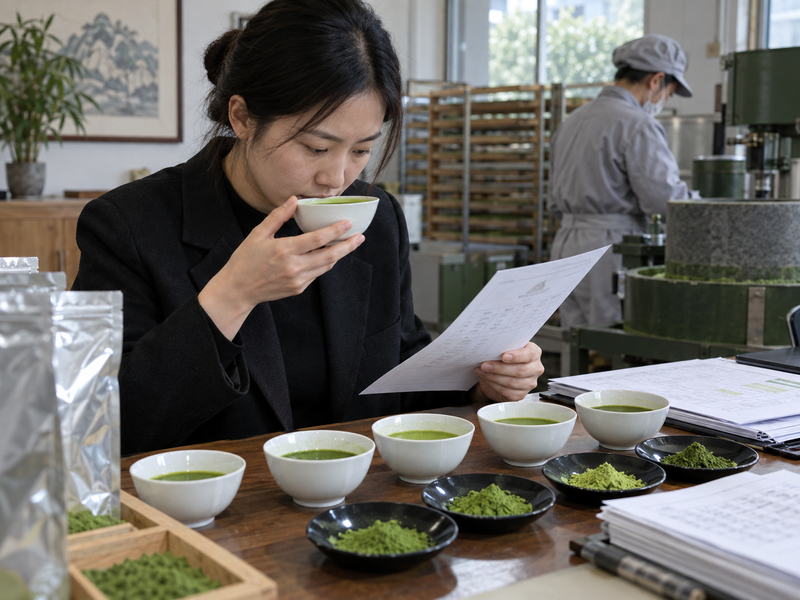
Write a document a receiving team can use
Specify product identity, origin, intended application, ingredient statement, sensory reference, physical limits, relevant chemical and microbiological criteria, pack structure, net weight, shelf-life basis and documents required with each shipment. Add the agreed sampling and rejection procedure. The limits should be measurable or observable by a defined method. “Top quality Chinese matcha” is a marketing phrase, not an acceptance criterion.
Matcha Village describes Chinese manufacturing and private-label supply capabilities in its materials. Buyers should still ask it, or any supplier, for product-specific samples and records before making a claim. A well-written specification protects both buyer and producer: it says what must arrive, how to check it and when a change needs new approval. That is more dependable than treating nationality as a shortcut for quality.
| Specification field | Practical detail |
|---|---|
| Product identity | Raw material and process description |
| Origin | Leaf, processing and packing locations |
| Sensory | Approved reference and test recipe |
| Physical | Particle, moisture and pack criteria |
| Documentation | Lot-linked reports and records |
Frequently Asked Questions
Q1. Is Chinese matcha the same as Japanese matcha?
Both can be finely milled green tea, but origin, cultivation, processing and sensory profile vary by supplier and lot. A Chinese-grown tea should be identified as such.
Q2. Is Chinese matcha always lower quality?
No country-wide conclusion follows from origin alone. Compare representative lots, product records and performance in the intended use.
Q3. Can Chinese matcha be used in a ceremonial-style bowl?
It can be prepared in a water bowl, but whether a given lot meets the buyer’s sensory target is a matter for sampling, not its country name.
Q4. What is the first document an importer should request?
Start with a current product specification that states origin, ingredients, process summary, lot identification and acceptance criteria, then request supporting test and traceability records.
Q5. Can a brand call Chinese-grown tea “Japanese matcha”?
That wording risks implying a false origin. Have the complete label reviewed for the destination market and describe the actual origin accurately.