
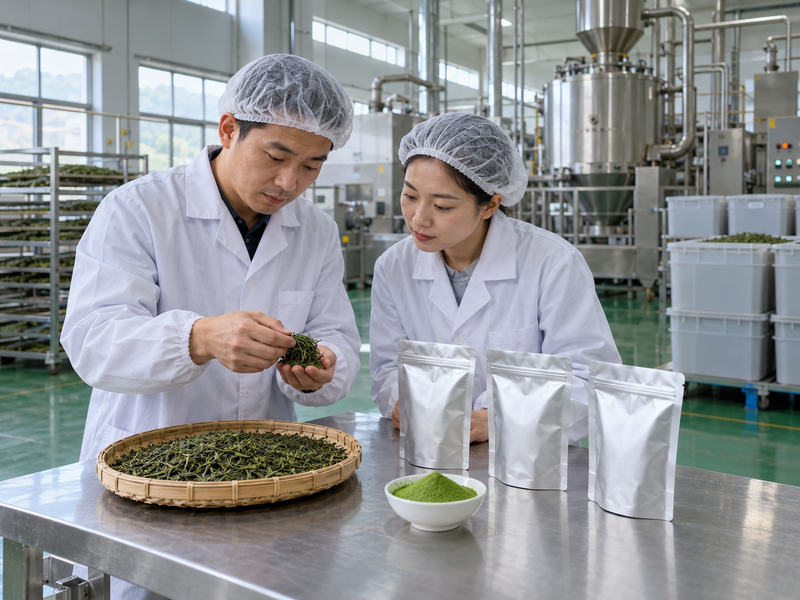
A buyer can receive a pouch described as “Japanese-style matcha” without knowing where its tea grew, where it was milled, or whether several harvests were blended. Those are different origin questions. For a food brand or importer, “where does matcha powder come from?” should lead to a traceable material flow, an accurate label, and a supplier who can identify the lots behind each shipment. This guide separates tea history from commercial provenance and gives buyers a practical way to verify what they plan to claim.
Contents
- 1. Where does the tea in matcha powder begin?
- 2. How is historical origin different from a commercial origin claim?
- 3. Which growing-region details are useful to a B2B buyer?
- 4. What happens between tea garden and finished powder?
- 5. How can a buyer verify a stated country of origin?
- 6. What do lot codes reveal about source traceability?
- 7. Can a blended-origin matcha still be a sound purchase?
- 8. How should source documents connect to food-safety evidence?
- 9. How can a buyer compare sources without relying on geography alone?
- 10. What should go into an origin-aware supply agreement?
1. Where does the tea in matcha powder begin?
Matcha begins with leaves of the tea plant, Camellia sinensis. The leaves are cultivated, harvested, processed into a suitable dried tea material, and finely ground. The agricultural origin is the place where the tea was grown. That location may differ from the milling, blending, packing, or exporting locations shown on commercial documents. A buying team should ask for these stages separately, because a single country name on a sales page can blur them.
Map the physical route. Ask the supplier where the leaves were grown, where they were processed before grinding, which site milled the powder, and who filled the final pack. Request lot codes that connect those stages. A retailer may care about a consumer-facing country claim; a beverage manufacturer may care about continuity of the raw material stream; an importer may need both. Do not infer agricultural origin from a seller's address or the language on a bag. For historical context, ITO EN's overview of green tea and matcha origins describes the movement of tea culture from China into Japan. That history does not identify the origin of any current shipment.
| Origin question | Stage it describes | Evidence to request |
|---|---|---|
| Where was tea grown? | Agriculture | Source and intake records |
| Where was leaf processed? | Primary processing | Site and lot link |
| Where was powder milled? | Grinding | Production record |
| Where was it packed? | Finished goods | Packing lot and operator |
2. How is historical origin different from a commercial origin claim?
Tea has a long history across East Asia, while modern matcha is strongly associated with Japanese cultivation and tea culture. Buyers should respect that history without treating it as proof that a specific commercial powder was made in Japan. Matcha is also manufactured in China and other producing regions. A style of processing, a traditional preparation method, and a country-of-origin statement describe different facts. Label rules for those statements depend on the destination market and the actual supply chain.
Keep the language precise. “Japanese-style” may refer to an intended flavor or process; “grown in Japan” asserts an agricultural fact. “Packed in Japan” says where final packaging happened and does not necessarily say where leaves grew. Before approving packaging, ask a local regulatory reviewer what origin language is permitted and what records support it. A supplier's marketing brochure may use broad cultural language; an importer needs shipment-level evidence. An honest origin story can describe the tea garden and processing route without borrowing cultural authority from a place the goods never passed through.
3. Which growing-region details are useful to a B2B buyer?
A regional name can help set expectations, but it should be connected to actual lots and application results. Climate, cultivar, farming practices, harvest timing, and processing all influence powder character. Two powders from one broad region can taste different; two powders from different regions can fit the same latte specification. Ask for the level of geographic detail the supplier can substantiate, such as country, province or prefecture, and certified or contracted garden group where appropriate. Do not demand a single-farm story if the commercial grade is intentionally blended for consistency.
Ask what the region means operationally. Does the named place identify the tea gardens, a processing facility, or the export office? Can the supplier retain that source through your forecast volume? If the powder uses leaves from several gardens, ask how the mix is controlled and whether the label language remains accurate. A premium retail brand might need a narrower provenance than a foodservice chain. Both still need reliable lot identification. Test the powder in the intended product, because a compelling regional story does not guarantee suitable color, flavor, or dispersion in a milk drink or cake.
| Buyer goal | Useful source detail | Caution |
|---|---|---|
| Retail origin story | Substantiated growing region | Avoid broader claim than records |
| Chain consistency | Approved source group | Track substitutions |
| Factory formulation | Repeatable sensory profile | Region alone cannot specify performance |
| Import compliance | Country and operator chain | Check destination-market rules |
4. What happens between tea garden and finished powder?
The material passes through several controlled steps. Leaves are harvested and processed into dry tea suitable for matcha production; milling reduces that material to a fine powder. Some products are blended across inputs or lots before or after milling to reach a consistent color and flavor target. Finished powder is packed in a barrier format that protects it from moisture, light, air, and handling. Exact process choices vary by producer, so buyers should request the process flow for the offered grade rather than assuming every factory uses an identical method.
Follow one lot through the chain. Ask for an example from intake to finished pack: incoming tea lot, processing batch, milling batch, blend batch if any, packing date, and export case code. The supplier may redact commercially sensitive garden names while still proving a coherent link. Check whether rework or carryover can enter the final lot and how it is recorded. A technically strong powder can lose value if packaging or storage damages it before delivery. Understanding the route helps the buyer distinguish an agricultural-origin question from a later manufacturing or handling problem.
5. How can a buyer verify a stated country of origin?
Start with the exact statement proposed for the label or sales contract. Then map each physical operation and ask which records establish agricultural source and any legally relevant transformation. Invoices, certificates, shipping papers, production records, and supplier declarations may all contribute, but no single document should be read in isolation. Rules on country-of-origin marking differ by jurisdiction and product form, especially when material is grown in one place and processed or packed in another. Qualified local advice should settle the legal wording.
Check consistency across channels. Compare the product specification, carton, retail pouch, invoice, marketplace listing, and customs description. A discrepancy may be a simple template error or a deeper supply-chain gap. Ask the supplier to explain before printing or shipping. If a distributor sells the same powder to several markets, it may need different compliant label versions even when the tea lot is identical. Keep the approved claim tied to the product code and source route. A country flag on a website is not evidence that the current shipment meets the same statement.
| Claim surface | Check against | Typical mismatch |
|---|---|---|
| Retail pouch | Approved origin wording | Country named too broadly |
| Invoice | Product and lot records | Trader address mistaken for origin |
| Carton | Packed goods identity | Mixed codes |
| Online listing | Current physical pack | Old source claim remains live |
6. What do lot codes reveal about source traceability?
A lot code should connect finished units to the inputs and processing events behind them. The supplier should be able to trace backward and forward within a defined time, whatever code format it uses. Ask for a mock recall or trace exercise: choose one finished case and identify its tea input lots, packing date, stock locations, and customers. Then choose one input lot and show which finished goods it entered. The exercise tests records rather than the attractiveness of a traceability diagram.
Measure response, not decoration. A QR code can display a story but may not expose the internal records needed in a real investigation. Ask who can retrieve documents, how long retrieval takes, and how mixed or blended lots are handled. A brand using several pack sizes needs to know whether they share the same powder batch and how each format maps back. If a supplier changes gardens within an approved source group, decide whether notification is required by contract. The code should also appear on shipment documents so the importer can link physical cases to the approved file.
7. Can a blended-origin matcha still be a sound purchase?
Yes, if the blend is honestly described and controlled. Blending can smooth seasonal variation and support stable color and flavor for a chain or manufacturer. It also raises provenance questions: which inputs are eligible, how are substitutions approved, and what origin claim remains accurate? A single-origin product may suit a narrow retail proposition; a controlled multi-source blend may suit a consistent beverage formula. Neither format is automatically superior. The buyer should choose according to application, disclosure needs, and supply risk.
Write the boundary. List approved countries or source groups if origin matters to the brand. Specify whether a change of garden, country, processor, or milling site requires advance notice and a new trial. Ask how the supplier verifies the ratios or identity of blended inputs. A new blend can pass a dry powder check but shift taste in milk or color after baking, so revalidate the finished application. For a private label, review whether any origin wording on the pouch survives the change. Traceability must preserve each contributing input lot rather than collapsing the blend into an unexplained final code.
| Sourcing model | Benefit | Buyer control |
|---|---|---|
| Single region | Specific story | Source continuity review |
| Approved source group | Supply flexibility | Listed eligible inputs |
| Multi-origin blend | Consistency potential | Blend trace and claim review |
| Spot purchase | Fast availability | Full requalification each time |
8. How should source documents connect to food-safety evidence?
Origin records show where material moved; they do not by themselves prove safety or compliance. Buyers may require pesticide-residue, contaminant, microbiological, allergen, organic, or other documents according to product risk and destination-market requirements. Test reports should identify the sample and lot they cover. Certifications should identify the operator and product scope. A certificate for a farm does not automatically cover a separate packer or a finished blend. Keep provenance and release evidence in one linked file, but evaluate each for the question it actually answers.
Build a document map. For each ordered code, list the growing-source declaration, relevant operator certificates, product specification, COA or test reports, and shipment papers. Record dates and versions. If an organic or other regulated claim is planned, confirm the entire applicable chain with qualified advisers before artwork approval. If a test result is absent, ask whether the buyer's risk plan requires it for this lot; do not treat a country name as a shortcut. Reliable source verification combines records, audits where appropriate, and the ability to investigate discrepancies.
9. How can a buyer compare sources without relying on geography alone?
Run a controlled application trial using representative commercial lots. Compare powder identity, aroma, color, dispersion, flavor, stability, documentation, lead time, and landed cost. A source that wins a plain-water tasting may fail in a sweet latte; another may perform well in bakery products but be too assertive for straight tea. Use the same dose and process for each candidate. Evaluate a later lot to see whether the supplier can repeat the result rather than presenting one ideal sample.
Price the delivered outcome. Freight, packing format, rejects, and extra dose can outweigh a low kilogram quotation. Ask whether the proposed source can support the forecast volume through a full purchasing cycle. Document an approved alternate source before a shortage occurs and state when a substitution requires customer or regulatory review. Country of origin can be central to a brand promise, but it should sit beside product performance and documentary reliability in the decision. Keep a retained reference lot and a written acceptance method so the comparison remains usable after the original buyer moves on.
| Comparison area | Evidence | Decision question |
|---|---|---|
| Application fit | Recipe trial | Does finished product meet target? |
| Provenance | Source and lot map | Can claim be substantiated? |
| Continuity | Capacity and repeat lots | Can supply stay consistent? |
| Economics | Landed cost per unit | Is margin viable? |
10. What should go into an origin-aware supply agreement?
Name the exact product code, permitted source claims, approved agricultural regions or source groups where relevant, processing and packing sites, traceability standard, pack format, and change-notice triggers. Attach a specification and document list. Define what happens if a source changes or a claim cannot be supported: hold, retest, relabel where lawful, replace, or reject. Commercial and legal teams should review the language for the destination market. A verbal promise of “same origin” is hard to enforce when several operators handle the product.
Keep the agreement usable. Purchasing needs a short approved-source list, quality needs lot records, and marketing needs approved wording. Review all three when a new harvest or blend is introduced. Ask the supplier to run a trace exercise periodically and provide a current commercial-lot sample before material changes. If a retailer wants a narrower region claim, verify that the supplier can reserve and segregate the relevant input at the planned volume. The result should be a truthful package and a repeatable supply route, not merely an appealing answer to a consumer's origin question.
Where matcha powder comes from has several answers: the tea garden, the processing site, the mill, and the packer. Identify each for the ordered lot, approve only origin wording the records support, and test the resulting powder in the finished product. Ask suppliers for a source map and a traceable commercial sample before signing a claim or volume contract.
FAQ
Q1: Is matcha always grown in Japan?
No. Modern matcha supply can come from more than one producing country; verify the agricultural source of the ordered lot.
Q2: Does “packed in Japan” mean Japanese-grown tea?
Not necessarily. Packing location and leaf-growing location are different facts.
Q3: Can one matcha powder include leaves from several gardens?
Yes. Ask how the inputs are controlled, recorded, and described on labels.
Q4: Does a QR code prove origin?
No. The supplier must be able to retrieve the lot records behind the displayed story.
Q5: What should an importer request before approving an origin claim?
Request the source declaration, operator chain, lot trace, shipment records, and market-specific label review.