
Butterfly pea matcha looks striking in a photograph, but a layered sample can turn muddy during a lunch rush. Café teams need a recipe that tastes like tea, stays visually clear long enough to serve, and can be costed. We work with matcha applications for commercial buyers; this guide treats the blue botanical ingredient and green matcha as separate inputs, then builds a practical testing plan around the finished drink.
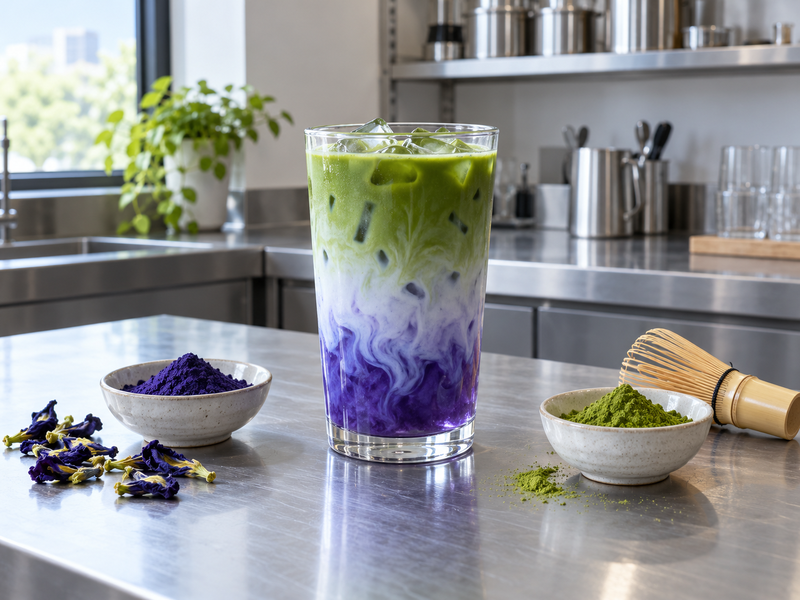
1. What is butterfly pea matcha in an ingredient brief?
It is usually a beverage concept combining matcha, made from milled green tea, with a blue or violet preparation from butterfly pea flowers. The two powders are not interchangeable. Matcha brings a recognizable green tea taste and fine suspended particles; butterfly pea is generally used for color and a milder botanical note. A finished drink may also contain milk, a plant-based base, sweetener, citrus, or foam. Each extra component changes both the appearance and the labeling work.
Write the brief as a formula, not a picture. State whether the blue ingredient is dried flower, extract, or powder; whether matcha is plain or pre-sweetened; and whether the service format is layered, shaken, or blended. A purple gradient in a photo could result from pH, milk diffusion, or a separate colored syrup. Without that detail, two stores can follow the same vague recipe and sell different drinks. The ingredient brief should specify the actual serving size, target sweetness, target cost, and how long the drink should remain presentable after assembly.
2. Which matcha and butterfly pea inputs should buyers compare?
Buy matcha for its performance in your chosen base. A vibrant powder can look dull after milk dilution; a very assertive tea can overpower a delicate floral layer. Ask for a sample lot, particle-size guidance if available, storage advice, and sensory notes in both water and milk. For butterfly pea, compare whole-flower infusion with a powdered or liquid format. Infusion can be easy to explain but needs steeping, cooling, filtration, and consistent extraction. Powder or extract can save preparation time, yet it may introduce sediment or a carrier ingredient.
Run each input alone before assembling the drink. Taste and photograph the blue preparation at a fixed concentration. Do the same for matcha. Then combine them in the standard cup. This isolates a bitter matcha, a weak botanical extraction, or an overly sweet syrup before the team blames the layering technique.
| Input | Ask the supplier | Watch in service |
|---|---|---|
| Plain matcha powder | Lot, grade, application sample | Color and dispersion in milk |
| Matcha latte blend | Matcha percentage and full formula | Less control over sweetness |
| Butterfly pea infusion | Flower specification and brewing guidance | Prep time and color consistency |
| Butterfly pea powder or extract | Composition and carrier details | Sediment or speckling |
3. Why does its blue or purple color shift?
Butterfly pea pigments can change appearance when acidity changes. Citrus may push a blue preparation toward purple or pink, while milk can lighten both layers and blur the boundary. Matcha itself is green, so mixing all ingredients together may yield a muted grey-green rather than a clean two-color drink. The result depends on the formula, not solely on photography or powder quality. Test under the exact lighting and cup material used at the point of sale; a dark paper cup hides most of the visual effect.
Record the pH of each prepared component if your team has that capability, especially when developing an acidified drink. Do not add lemon solely for a color trick without checking taste and the stability of the full formula. A citrus dose that makes the blue layer dramatic may also curdle some dairy systems or clash with matcha. Photograph the drink at assembly and after five, ten, and twenty minutes. Those images tell the team whether a delivery order, a busy queue, or customer stirring will erase the intended presentation.
4. How can a café build reliable layers?
Layering depends on the density and pouring behavior of each liquid, along with ice, temperature, and cup shape. A syrup-heavy layer often sinks below a lighter milk or tea layer. Pouring slowly over ice or along a spoon can reduce turbulence, but it will not rescue a formula whose densities are too similar. Start with small clear cups during development, then repeat the trial in the actual serving cup. A tall narrow glass often shows a boundary better than a wide tumbler, yet the customer’s cup choice may be fixed by packaging cost.
Prepare three identical drinks with different pour orders. Keep the ingredients, volumes, and ice mass constant. Have a different barista repeat the best method without a long explanation. If the second person cannot reproduce it, the recipe needs a clearer step or a simpler design. The drink should still taste balanced after stirring; customers will mix the layers eventually, even if the first photograph captures them separately.
| Variable | Keep fixed during test | Failure to note |
|---|---|---|
| Pour order | Ingredient volumes | Layers merge at once |
| Ice mass | Cup and temperature | Too much melt or turbulence |
| Sweetener concentration | Tea dose | Heavy layer sinks unexpectedly |
| Cup shape | Same recipe | Weak visual separation |
5. How should the finished drink taste?
Set a flavor goal before optimizing color. A buyer might want a matcha-forward latte with a blue accent, or a lightly sweet floral drink with a green tea finish. Those are different briefs. Taste the drink before stirring, after stirring, and after a normal hold. If the first sip contains only sugar and flower while the bottom holds all the matcha, adjust layer volumes or ask staff to serve with a clear mixing cue. A drink that looks beautiful but tastes unbalanced creates a one-time photo sale.
Make sweetness a measured variable. Butterfly pea preparations often need some help in a café-style beverage, but the added sugar can mask tea character. Compare a plain matcha against a premix at the same sweetness in the final cup. Check the base too: dairy, oat, and other plant-based milks can change the perceived bitterness and color. Sensory notes should name what happened—grassy, creamy, floral, watery, or chalky—rather than assign a broad score. A precise comment lets purchasing ask for the right next sample.
6. What workflow keeps the drink practical at the bar?
A good menu recipe specifies preparation ahead of time and final assembly at service. Decide whether the blue component is brewed daily, portioned as a concentrate, or prepared per order. Define who labels the container and when it is discarded under the café’s food safety plan. For matcha, test whether a measured water slurry can be made quickly without clumps. Avoid an attractive method that requires three clean pitchers and a long whisking step for every order unless the price supports that labor.
Run a timed test during a mock rush. Put ingredients where staff would actually keep them. Have two baristas make five drinks each and record preparation time, appearance, and waste. The test should include a request for less sweet and a plant-based milk substitution if those are realistic menu options. Some variants may need their own recipe rather than an improvised adjustment. A written build card with weights or measured volumes beats “a splash of blue” when several stores must serve the same product.
| Field | Example of a usable instruction | Reason |
|---|---|---|
| Matcha dose | Grams per cup | Controls tea strength and cost |
| Blue component | Milliliters of specified concentrate | Controls color and sweetness |
| Pour sequence | Numbered steps with cup type | Controls layering |
| Holding rule | Site-approved time and storage | Controls quality and safety |
7. Can the concept scale into a packaged beverage?
A packaged butterfly pea matcha drink is a new development project, even if the café recipe sells well. The visible layers may separate during shipping, and a stable blended beverage may have a different color than the in-store version. Heat processing, acidification, milk proteins, packaging light, and storage temperature can all affect the result. A manufacturer should decide whether the goal is a shaken drink, a uniform colored drink, or a layered pack, then validate the process for that goal.
Ask a co-manufacturer or technical team to test microbial safety, physical stability, and sensory change over the intended life. Do not infer retail shelf life from a café drink held for twenty minutes. Matcha particles may settle, while a botanical color may fade under light. A suitable ingredient specification can narrow variation, but no powder can replace product-level validation. If a private-label powder mix is the intended product, test how consumers reconstitute it with water or milk and how sensitive the color is to ordinary water differences.
8. How should the buyer calculate real menu cost?
Cost the whole drink per sellable cup. Matcha price matters, but so do flower extract, syrup, milk, ice, cup, garnish, and preparation labor. Include waste from infusion that expires before use. If the botanical component is a concentrate, compare cost by usable dose rather than bottle price. A cheaper powder can require filtration or leave visible particles, moving cost from purchasing into bar labor. Calculate gross margin using the actual selling price and recipe yield.
Ask whether the color effect supports a premium price in your channel. A store with clear cups and strong social sharing may get more value from layered presentation than a delivery-focused chain using opaque lids. In a trial, track both sales and remakes. An order returned because a layer collapsed affects margin and staff confidence. Revisit the recipe when ingredient prices or cup formats change; small variations in a premium beverage can shift the economics quickly.
| Line | Unit to calculate | Hidden risk |
|---|---|---|
| Matcha | Grams at tested dose | Overportioning |
| Blue component | Usable concentrate per cup | Discarded leftovers |
| Base and sweetener | Milliliters and grams | Substitution cost |
| Service | Labor time and packaging | Slow assembly or remakes |
9. What should the menu and pack disclose?
Describe the actual ingredients in plain language: matcha green tea, butterfly pea flower preparation, milk or plant-based base, and sweetener as applicable. A customer should not have to guess whether the blue layer contains a flavor or color ingredient. Review allergen information for dairy and other recipe components. For packaged goods, have qualified staff check the destination market’s ingredient naming and labeling rules. Avoid unsupported wellness claims tied to either botanical ingredient.
Menu photography should match a reproducible service drink. If the shoot uses a dense blue concentrate unavailable at stores, the image can set an expectation the recipe cannot meet. Put the approved build card and the approved photo under one version number. Train staff to answer the simplest customer question: “What makes it blue?” A direct explanation is more credible than a vague promise about natural energy or health.
10. What should a launch pilot prove?
A two-week pilot can answer questions a bench test cannot: can staff make the drink consistently, do customers like its taste after mixing, and does it earn its place on the menu? Select stores with the intended cup and equipment. Provide measured ingredients, a build card, and a way to log failures. Photograph a small sample of drinks at sale, then record prep times and remakes. Make sure the test includes both a quiet shift and a busy one.
Set pass criteria before the pilot begins. A chain might require acceptable preparation time, low remake rate, target cost, and clear taste feedback. If the drink misses one gate, change one variable and retest. If all gates pass, finalize the supply plan for both matcha and butterfly pea preparation, including lot documents and replenishment timing. Butterfly pea matcha succeeds when the colorful first impression survives ordinary café service.
| Measure | Collect | Decision |
|---|---|---|
| Appearance | Same-light photos at sale | Matches approved image? |
| Speed | Timed drinks across shifts | Fits service target? |
| Waste | Expired prep and remakes | Fits cost model? |
| Flavor | Specific customer and staff comments | Balanced after mixing? |
Frequently asked questions
Q1: Is butterfly pea powder the same as matcha?
No. Butterfly pea comes from flowers; matcha is powdered green tea.
Q2: Does citrus change the color?
Acidity can shift butterfly pea pigment toward purple or pink. Test the full drink for flavor and stability.
Q3: Can the layers remain separate all day?
Do not assume so. Measure appearance over your actual service interval; mixing and transport blur layers.
Q4: Which matcha grade works best?
Choose by sensory performance and cost in the final milk or water base, using a documented sample.
Q5: Can a café recipe become a bottled drink?
It can be a starting formula, but the packaged product needs its own process and shelf-life validation.
For matcha samples suited to your beverage base, share the recipe target with Matcha Village. A supplier can then help you test butterfly pea matcha with a specified tea ingredient rather than an unrepeatable photo recipe.