
Bulk matcha storage becomes difficult when one purchase serves both a warehouse and a busy drink counter. A sealed case can spend weeks in transit, then staff may repeatedly open one bag beside a steamy blender. Those conditions require different controls. This guide gives importers, distributors, and café operators a receiving-to-service plan: record the lot, protect unopened stock, issue small working quantities, and review deviations before the next order. Research on matcha storage temperature and light and water activity supports controlling exposure; it does not supply a universal shelf life for every supplier pack.
Contents
- 1. What should the supplier specify before shipment?
- 2. How should staff receive a bulk matcha delivery?
- 3. Where should unopened cases be stored?
- 4. How do temperature changes affect handling?
- 5. Which package sizes limit repeated exposure?
- 6. What should happen when a pack is opened?
- 7. How should lots rotate across sites?
- 8. What signs call for a hold or quality review?
- 9. How can buyers plan stock without guessing shelf life?
- 10. What belongs in a written storage procedure?
1. What should the supplier specify before shipment?
Ask for the instructions tied to this pack
Start with the actual SKU, not a general internet rule about matcha. Ask the supplier for its declared storage condition, date marking, unopened shelf life, packaging description, lot coding, and any validated guidance after opening. Confirm whether a temperature statement refers to an unopened barrier bag or to a frequently opened service container. A distributor may receive a master carton containing smaller inner bags; that arrangement should be visible on the purchase order and confirmed in a pre-shipment photograph.
Request a sample label and product specification before committing to bulk volume. If a quote says “cool and dry,” ask what the supplier means for transport, warehouse, and retail display. Record the answer in the agreed specification. The buyer’s handling practice must match the supplier’s evidence, and product date marking must not be replaced with a guess based on another brand. Research shows that storage temperature affects several matcha quality measures under experimental conditions. Actual commercial stability depends on formulation, package barrier, filling process, and conditions through the supply chain.
| Supplier document | Detail to request | Why the buyer needs it |
|---|---|---|
| Product specification | SKU, pack size, powder description | Prevents a grade or format swap |
| Label artwork | Lot and date field locations | Supports receiving and rotation |
| Storage instruction | Conditions for sealed and opened stock | Guides both warehouse and service teams |
| Shipment record | Case count and lot allocation | Links the delivery to the order |
2. How should staff receive a bulk matcha delivery?
Keep suspect cartons out of saleable stock
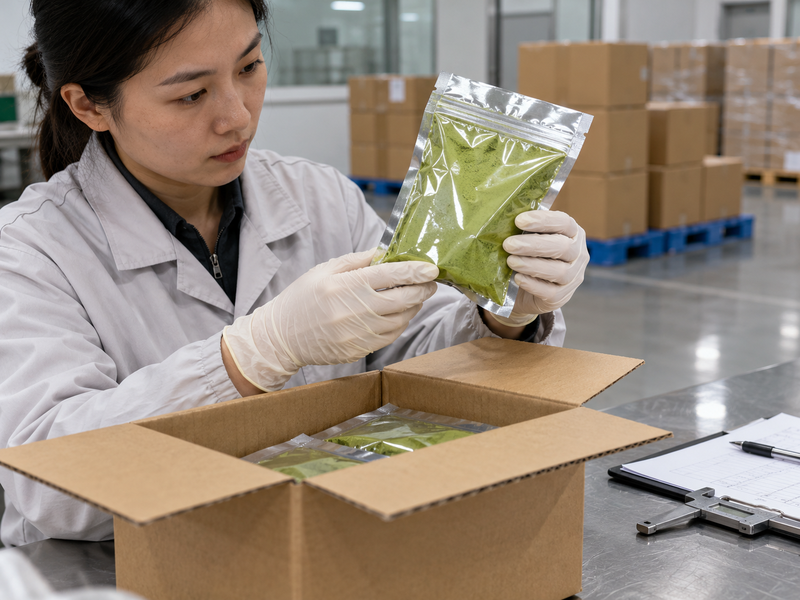
At receiving, count cases and compare labels against the purchase order. Record arrival time, lot, date marks, pack format, visible carton damage, and any transport condition that conflicts with the agreed instruction. Photograph crushed corners, wet patches, punctures, broken seals, or signs of contamination before moving the shipment. A clean outer carton does not prove every inner bag is sound, so inspect a sample according to the written receiving plan. Open a case only where the bags will remain clean and dry.
Set aside uncertain stock with its lot identity intact. The buyer and supplier can then review photographs, packing documents, and the agreed acceptance terms. Avoid turning a visual check into a safety certification: a bag may look normal yet still require a specified test, while cosmetic scuffing may not affect the powder. The USDA warehouse handbook advises dry, stable storage and protection from floor moisture for processed commodities. A receiving checklist turns that broad principle into an action staff can repeat during a rushed delivery.
| Receiving check | Record | Action if outside plan |
|---|---|---|
| Case and inner-pack count | Ordered versus delivered | Reconcile before booking stock |
| Seals and dry cartons | Photos and case IDs | Hold affected cases |
| Lot and date marks | Every lot present | Resolve missing or mismatched codes |
| Transport condition | Any logged exception | Compare with supplier instruction |
3. Where should unopened cases be stored?
Give sealed stock a controlled location
Keep unopened cartons in a clean, dry, dark area that follows the supplier’s temperature instruction. Place them on suitable shelving or pallets and leave room to inspect walls and packaging. Do not park matcha beside a loading door where sunlight and weather repeatedly reach the cases. Separate it from strong-smelling products and from cleaning chemicals. A stockroom plan should identify an approved shelf or pallet position, who checks it, and where readings or observations are recorded.
Matcha is a finely milled tea and its exposed surface gives air, moisture, and light many chances to affect quality. A 2026 matcha study found lower retention of measured compounds under higher water activity and light exposure in its tested conditions. That finding supports careful protection; it does not prescribe one storage temperature for every commercial pack. Use the supplier’s product-specific instruction as the operating limit. If several grades arrive together, mark shelf locations so staff do not substitute one lot or grade for another during picking.

4. How do temperature changes affect handling?
Plan the move before the seal breaks
A refrigerated or cooled sealed bag may meet warm, humid air at the counter. Opening it immediately can bring moisture into contact with cold powder or the inner surface of the pack. Keep the bag closed while it reaches the opening condition specified by the supplier; then open it in a dry preparation area. Record the practice for staff instead of leaving each operator to make a different judgment. If a shipment experienced a temperature excursion, isolate the affected lot and ask the supplier how to assess it.
The matcha temperature study followed color and chemical changes under several controlled storage temperatures over two months. It supports treating heat exposure as a quality issue, but its test design cannot validate the unopened shelf life printed on a different supplier’s pack. Consider the entire route: origin warehouse, vehicle, destination storage, and service station. A high-quality cold chain loses value if workers repeatedly carry a large open bag between a refrigerator and a humid bar.
| Transition | Practical control | Record when abnormal |
|---|---|---|
| Vehicle to warehouse | Move promptly to approved area | Arrival delay or heat exposure |
| Cool store to preparation | Keep bag sealed during transition | Visible condensation or damaged barrier |
| Preparation to service | Issue only working quantity | Time and lot of transfer |
5. Which package sizes limit repeated exposure?
Size the inner bag for actual consumption
A low unit price on a large bag can conceal a high handling cost. If a café uses only a small quantity per day, one open bag may spend too long beside heat, steam, and frequent scooping. Ask for pack options that fit a site’s recorded weekly use. Compare a master carton of smaller sealed bags with fewer large bags, including the cost of packaging and extra handling. The choice depends on menu demand, staffing, and storage space rather than a universal “best” size.
Run a short usage calculation: planned drinks multiplied by powder per drink, plus test batches and reasonable variation. Compare that quantity with how quickly a site can consume a working bag under its documented open-pack practice. Keep the unopened balance sealed in its approved location. A food manufacturer using a controlled dispensing system may sensibly choose larger packs than a café with hand scoops. Before contracting for a pack size, trial the actual bag opening, resealing, and portioning steps with the people who will do them.

| Operating setting | Pack-size question | Trial observation |
|---|---|---|
| Single café | How long is one bag open? | Opening frequency and closure quality |
| Multi-site chain | Can sites use the same bag size? | Waste and transfer records by site |
| Food plant | Does dispensing preserve the barrier? | Line changeover and residual powder |
| Distributor | Can cartons carry mixed inner bags? | Picking accuracy and case integrity |
6. What should happen when a pack is opened?
Keep the working container small and identifiable
Write the opening date, original lot, and responsible site on the working container or its traceable record. Use a clean, dry utensil dedicated to the powder. Transfer a measured working quantity rather than tipping a whole bulk bag into a display jar. Close both the original pack and the working container promptly after each use. An opaque, suitable food-contact container can reduce light exposure; its lid still needs a reliable seal. Confirm the container and cleaning method with the site’s food-safety procedure.
Do not mix fresh powder into an old container that still holds unknown residue. Empty and clean it under the site’s procedure, dry it fully, then refill and relabel. The FDA Food Code is a model for retail and foodservice controls, including food-contact equipment practices; local rules and the site’s plan govern its use. For a café, a small working quantity also makes stock investigation easier: staff can trace a complaint to the pack and lot used for that shift.
7. How should lots rotate across sites?
Make picking follow date and condition
First-expiring, first-out rotation works only when date marks and lot identifiers remain visible after a case is opened. Put the date on the shelf card and in the inventory system. When newer stock arrives, check the older stock’s condition before automatically placing it in service. A damaged older pack should be held, not issued because its date is earlier. Keep transferred inner bags with their original labels; a loose unmarked bag defeats traceability.
At chain scale, reconcile physical stock with each site’s issue log. One location may sell substantially more matcha than another, so equal deliveries can leave slow sites with aging powder. Review use by site, menu, and season before the next allocation. Do not promise that rotation alone preserves flavor. It keeps stock order visible while temperature, light, package integrity, and open-pack handling still need their own checks. When a customer reports a color or aroma change, lot-level records show which other sites should examine their stock.

| Rotation record | Minimum detail | Who uses it |
|---|---|---|
| Receipt | Lot, date, quantity, location | Warehouse team |
| Issue | Lot, quantity, destination | Picker and receiving site |
| Open pack | Lot, opening date, station | Service team |
| Hold | Lot, reason, photographs | Quality and purchasing |
8. What signs call for a hold or quality review?
Decide by comparison and evidence
Hold a pack when the seal is broken before intended opening, moisture appears inside, powder has unexpected clumps, or a strong foreign odor is present. Mark its lot and location; do not return it to general stock while someone seeks an explanation. A visible color difference can also deserve review, but compare under consistent light against an approved retained sample. Different grades and harvest lots may begin at different shades. Appearance alone cannot establish safety or authenticity.
Keep the original bag and relevant transport and storage records for supplier review. Ask what testing, if any, is appropriate under the agreed specification. If a café sees a change only after several days at the bar, examine scoops, closures, and steam exposure as well as the incoming powder. The research on temperature and humidity and light gives reasons to investigate these conditions; it does not diagnose an individual batch from a photograph. Record the disposition, including any replacement or process change.
9. How can buyers plan stock without guessing shelf life?
Use supplier dates and real depletion rates
Ask for the remaining life required at delivery and put that requirement in the purchase agreement. Forecast consumption from recent orders, planned promotions, and store openings, then calculate how much can sell before the supplier’s marked date under the agreed conditions. Set a reorder point that reflects transport lead time and a realistic buffer. If sales are uncertain, stage orders or ask about smaller call-offs rather than accepting more powder simply to reach a price tier.
For a new smoothie menu, track actual portions during a trial month before converting projected traffic into a large order. For a distributor, separate customer commitments from speculative demand. The calculation should account for inner-pack size: a site may hold plenty of unopened powder yet have too much in one exposed working bag. Review stock age by lot each month. A supplier can explain its date marking for its product; neither a generic article nor a single scientific study can replace that evidence.

| Planning input | Ask or calculate | Review trigger |
|---|---|---|
| Remaining dated life | Supplier agreement at receipt | Short-dated delivery |
| Use rate | Powder issued per site and week | Menu or traffic change |
| Replenishment lead time | Order through usable receipt | Route or production change |
| Pack exposure | Days and openings per working bag | Waste or quality complaint |
10. What belongs in a written storage procedure?
Give each handoff an owner
A short procedure should cover receiving, approved unopened location, monitoring, case picking, transition before opening, working-container transfer, cleaning, lot tracking, hold decisions, and supplier contact. Put the relevant supplier specification beside it. Assign one person or role to each step, including the weekend shift. A procedure that says only “store properly” cannot tell a new employee whether to reject a wet case or where to record a broken seal.
Trial the procedure on one actual delivery. Follow a single inner bag from carton to drink counter and ask staff where its lot remains visible. If a step needs equipment the site does not own, revise the process before expanding volume. Matcha Village can discuss pack formats and intended use when a buyer requests a quotation; confirm storage instructions and dated-life commitments for the specific SKU in the final documents. Share a one-page receiving and service checklist with every location, then review deviations after the first replenishment order.
For daily handling after a pack is opened, adapt the checks in our matcha storage guide to the staff handling sheet.
FAQ
Q1. Should every bulk matcha shipment be refrigerated? Follow the product-specific supplier instruction. A general recommendation cannot account for packaging, distribution conditions, and the way a site opens stock.
Q2. Can an opened bulk bag stay on a café bar? Use the supplier’s opened-pack guidance and the site’s food-safety procedure. A small sealed working container usually makes repeated handling easier to control than a large open bag.
Q3. Does a darker shade always mean spoiled matcha? No. Compare the same grade and approved lot sample under consistent light, then review storage records and supplier guidance before deciding.
Q4. Does first-expiring, first-out rotation guarantee quality? No. It orders stock by date; packaging condition and storage history still matter.
Q5. What should an importer request before a first bulk order? Obtain SKU-specific storage and date-marking instructions, pack details, lot coding, a sample label, and written receiving terms.
Put the first shipment through a dry run
Choose one SKU and trace one inner bag from delivery to its first use. If staff cannot identify its lot, storage location, opening date, and responsible station, fix those handoffs before increasing volume. Buyers planning a new order can send Matcha Village the intended application, site count, expected use, and desired inner-pack size so the quotation can be assessed against a real handling plan.