
A café can buy a beautiful bamboo chasen and still serve a gritty matcha latte. The whisk may be too wide for the prep bowl, its tips may scrape the base, or staff may have no place to dry it between orders. The best matcha whisk is the one that makes your actual drink reliably, survives your cleaning routine and fits the counter. Here is a practical way to choose it without treating tine count or a product photo as proof.
For a café that serves mainly iced lattes, my starting choice is a flexible bamboo chasen that clears a smooth, wide prep bowl, with a spare whisk and a protected drying place. For a straight-tea bar, put greater weight on the foam and feel of the served bowl. These are purchase starting points, not claims that one untested brand is best.
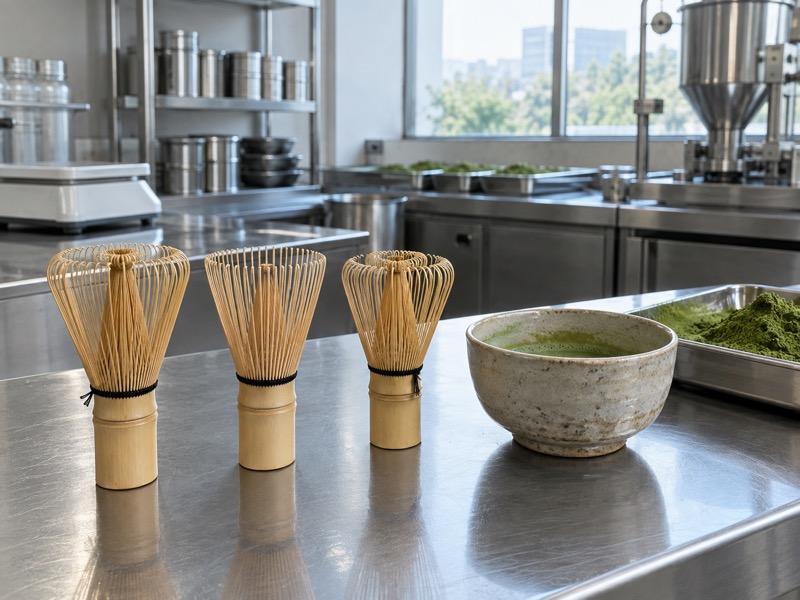
1. What drink should the best matcha whisk make?
Begin with the finished cup
First decide whether the whisk will prepare a small bowl of straight matcha, a concentrate for iced lattes, or both. A light bowl of tea rewards a fine, even foam. A latte concentrate needs the powder dispersed before milk hides clumps. Those are related jobs, but they are not identical. Write the recipe that staff actually follow: powder weight, water volume, water temperature, bowl, whisking endpoint and what happens before the drink reaches the customer. Keep the recipe fixed during the equipment trial. Changing the tea or dilution at the same time makes the result impossible to interpret.
For a café, the most telling sample is often the last sip, when undispersed powder can collect at the bottom. Prepare the drink as sold, let it stand for the usual handoff interval, and taste from top to bottom. A dramatic foam crown in a demonstration bowl is useful only if the finished drink also passes. If the menu includes both straight tea and sweetened lattes, test each; one whisk may be excellent for a shallow bowl yet awkward when making a thicker concentrate.
| Drink | Main whisk task | Check at service |
|---|---|---|
| Straight matcha | Disperse tea and create fine foam | Texture and evenness |
| Iced latte base | Disperse powder before cold milk | Sediment after standing |
| Thick tea | Work a denser mixture gently | Smoothness without tine damage |
2. How does the bowl change the answer?
Match the moving space
A chasen needs room to move without striking the side of the bowl. Put each candidate in the vessel used behind the counter, then check the clearance before adding water. A narrow mug may be convenient for pouring into a takeaway cup but can crush the outer tines. A very wide bowl can leave a thin pool that splashes when staff move quickly. The bowl’s inside surface matters too: a rough base can wear delicate tips. Tezumi’s discussion of bowl shape makes the same practical point that bowl size and interior texture affect whisking.
Watch an operator use the tool at a normal pace, not with a cautious showroom motion. Are the tips suspended just above the base, or does the handle force them downward? Can the operator reach the tea around the edge? Does the rim keep liquid in the bowl? These observations can save a purchase: the right change may be a different bowl, not a more expensive whisk. Record the exact bowl model with the approved whisk so a later vessel substitution does not quietly alter the process.
3. Does tine count tell you which whisk to buy?
Treat the number as a design clue
Tine count is one visible difference among chasen, but it is not a quality score. Shape, bamboo flexibility, handle size and the drink being made matter alongside the count. Traditional whisks come in different forms for different tea styles; Tezumi’s chasen guide describes both the range of tine patterns and the way each whisk is cut from bamboo. That craft is a reason to inspect an actual unit, not a reason to assume the largest number of tines must win a café trial.
Choose two or three credible candidates and put them through the same recipe. Ask staff whether the handle gives enough control when they are moving fast. Look at the tips after use; flexibility should not mean they collapse or shed. If a finer whisk makes prettier foam but needs twice the handling time or fails in the prep bowl, it may suit a demonstration service better than the main latte station. Make the selection from cups and wear records rather than packaging shorthand.
| Supplier claim | What it may indicate | What to verify |
|---|---|---|
| More tines | Different foam and feel | Your recipe and bowl |
| Handcrafted bamboo | Skilled shaping | Finish and consistency across units |
| Café grade | Intended commercial use | Cleaning and replacement terms |
4. How should a side-by-side whisk test run?
Change one variable at a time
Make a short test card that any trained barista can repeat. Use one matcha lot, a weighed dose, measured water and the same vessel. Prepare several cups with the current tool, then several with each candidate. Alternate the order so the first attempt is not always the one made while staff are still settling into the method. Record operator, mixing time, visible clumps, foam, splashing and the appearance of the drink after it stands. Photograph the bottom of the glass under the same light if residue is hard to describe.
Do not let a single expert operator make the buying decision. Once the method is written, give it to a second person and watch for different results. This reveals whether the whisk is forgiving or whether the successful cup depended on a practiced wrist movement. Repeat the trial after a few normal cleaning cycles. New bamboo and damp, used bamboo may behave differently. When tasting, label samples with codes rather than product names; that keeps a costly or ornate handle from influencing the flavor verdict.
5. What defects matter more than foam?
Inspect the whole serving
Foam is easy to photograph, but it is only one part of drink quality. A passing cup should have no hard lumps, no bamboo fragments, an acceptable mouthfeel and the expected flavor for the recipe. Inspect the tips and the bowl after each trial. A few bubbles are less useful than a consistent suspension that stays pleasant through the customer’s drinking time. For iced drinks, examine the first sample before milk goes in and the final cup afterward. Milk can disguise a weak dispersion step until powder settles later.
Set a clear stop rule before the trial starts. Remove a whisk that has loose or broken tines; do not keep using it because its foam looks good. If one candidate repeatedly leaves dry powder, confirm that staff used the written dose and water volume, then compare it with the baseline. Record the failure instead of quietly changing the recipe to rescue the new purchase. A product that needs a different bowl or longer whisk time may still be viable, but those costs must be included in the buying decision.
| Observation | Likely question | Trial response |
|---|---|---|
| Powder at cup base | Did tea disperse before milk? | Repeat with fixed recipe |
| Broken tine | Is the tool or bowl damaging it? | Remove tool and inspect bowl |
| Uneven foam | Is technique too sensitive? | Ask a second operator to repeat |
6. How much handling can a busy station support?
Time the entire cycle
Start the clock when staff reach for a clean whisk and stop when that whisk is ready for the next order. Include measuring, mixing, transfer, rinse and the handoff to drying space. An apparently fast preparation can lose its advantage if the bowl needs a long rinse or the whisk must be carried to a sink across the room. Test at the station where it will live. A spare whisk can prevent a bottleneck, but only if clean and used tools have clearly separated locations.
Watch the drink sequence during a real rush. Does the whisk interfere with espresso service, occupy a shared sink, or require the only large prep bowl? If a delicate candidate forces staff to slow down to avoid damage, the labor cost is real even if the purchase price is low. Conversely, a whisk that makes a stable base in a predictable motion can reduce remakes. Time accepted drinks rather than attempts, since a quick cup that must be remade is slower for the customer.
7. What care routine keeps the whisk serviceable?
Rinse, inspect and dry
Bamboo needs a care routine staff can perform consistently. After use, rinse away tea and inspect between the tines; trapped powder dries hard and can encourage rough handling next time. Do not press the tips into the bowl or scrub them aggressively. Follow the maker’s care instructions and the site’s sanitation procedure, then let the whisk dry in a position that does not bend its tines. Ippodo’s chasen care guidance is a useful reference for handling and storage.
The storage spot is part of the equipment choice. A wet whisk shut in a box or left on a crowded counter will have a different life from one that can dry without being knocked. Label a place for tools awaiting inspection. Teach staff what damage looks like and who may retire a whisk; a retirement rule prevents a broken tip from reaching a drink. If the candidate requires a special stand, count it in the station footprint and purchase cost. Care instructions are useful only when the counter makes them possible.
| Stage | Staff action | Check |
|---|---|---|
| Before use | Inspect tines and handle | No loose fragments |
| After use | Rinse away tea | No trapped powder |
| Storage | Allow to dry safely | Shape intact for next use |
8. What should a supplier sample prove?
Examine more than one unit
Request a sample of the exact item and pack you plan to buy. Check tine alignment, finish, handle comfort and protective packaging. A single pristine sample says little about consistency in a carton, so inspect several units if the order will supply multiple stores. Ask whether the vendor can provide the same specification on repeat orders and whether changes in bamboo source, finish or packaging will be communicated. Record product code and approved sample so the next buyer knows what was tested.
Ask for use and care instructions that staff can understand, plus replacement lead time. For a chain, a nominally cheap whisk with uncertain supply can create an expensive menu interruption. Check that the pack protects the tips during shipping and that units are dry and intact on arrival. If a supplier makes an origin or craftsmanship claim, request documentation for that particular product before putting the claim in customer-facing copy. The trial can verify performance; it cannot verify a production story.
9. What is the cost per accepted cup?
Count use, not just units
The sticker price of a whisk is only the first number. Divide landed tool cost by the accepted cups it produces before retirement, then add cleaning time, damaged arrivals, remakes and any stands or spare bowls needed. Track these during a pilot rather than borrowing a supplier’s optimistic service-life estimate. If two whisks give equally good drinks, a candidate that lasts through more normal shifts may be cheaper even at a higher unit price. If a durable whisk demands slower handling, that difference belongs in the calculation too.
Use a simple log: date opened, station, number of cups, damage notes and retirement date. Review a few tools together, since one dropped whisk should not define the product’s expected life. Put drink quality beside cost; an inexpensive tool that leaves gritty cups is not a saving. For multi-site purchasing, include storage and reorder timing. A small spare stock can be cheaper than emergency shipping when a station depends on a particular model.
| Cost item | Evidence to collect | Buying consequence |
|---|---|---|
| Tool and freight | Invoice per usable unit | Landed price |
| Life in service | Cup log and retirement date | Replacement rate |
| Labor and rejects | Timed cycles and remakes | Cost per accepted cup |
10. When is a whisk ready for rollout?
Approve the method with the tool
Run the preferred whisk through more than one shift with ordinary staff. Keep the recipe, bowl and cleaning card attached to the approval. Review final-cup texture, sediment, service time, wear and cost per accepted cup. Ask a second shift to repeat the method without coaching. If the results diverge, revise the instructions or reconsider the candidate before ordering for every site. A limited pilot is also where hidden problems appear: no drying space, missing spares, or a bowl that the closing team stores elsewhere.
Finish with a decision record: approved whisk and bowl codes, acceptable drink result, cleaning procedure, retirement rule and a named buyer for reorders. Keep one reference unit or dated photographs for receiving checks. If procurement later changes the whisk, treat that as a new trial rather than assuming the word “chasen” describes interchangeable performance. A clear record makes the next order easier and protects the drink the team actually approved. For tea choices that change the cup independently of the tool, see our matcha flavors guide.
At receiving, open a few units from each carton and compare them with the reference. Check the tine shape before the tools reach a store. Small discrepancies are easier to resolve while the delivery is still traceable than after several cafés have started using mixed batches.
Further reading: A guide to the chasen.
FAQ
Q1: Is a higher tine count always better? No. Tine count describes one aspect of the design; test the whisk with your tea, recipe and bowl.
Q2: Can the same whisk make straight matcha and latte bases? It can, but test both drinks. Thick concentrates and light tea expose different handling problems.
Q3: When should a café retire a whisk? Remove it when tines are loose, broken or otherwise likely to enter a drink, following the site’s tool policy.
Q4: Does a whisk stand matter? It can help protect shape and provide a drying location, provided the complete care routine fits the station.
Q5: What should buyers compare besides price? Accepted cups, staff time, replacement rate, supplier continuity and the quality of the served drink.