
What is hojicha? It is Japanese green tea roasted after its initial processing. In a café, that later heat step turns the drink brown and gives it a toasted aroma that can work with milk, cocoa, or pastry. Yet “hojicha” alone does not tell a buyer whether the bag contains leaves, stems, or powder, or how deep the roast will taste. This guide explains what hojicha is, how to assess a sample, and what to put in a supplier brief before a drink or food launch.
1. What is hojicha?
It describes a roast, not one fixed leaf grade
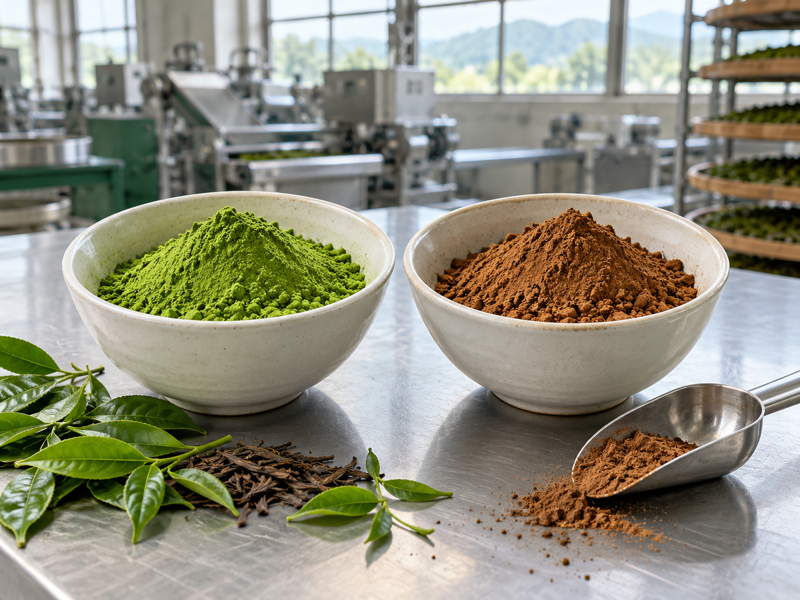
Hojicha is green tea roasted after the underlying tea was already made. That definition leaves room for leaf, stem, or a blend; it also leaves room for light and deep roasts. A supplier may sell the finished tea as loose material for infusion or mill it into a brown powder. The name therefore tells a buyer something real about processing, yet much less about the particular lot. A request for “hojicha” without a form, roast profile, and application is still an open specification.
Japan’s Ministry of Agriculture, Forestry and Fisheries describes hojicha as sencha or bancha roasted over a high flame in its tea guide. The Japan Hojicha Association points out that the name describes a method rather than restricting the material to bancha. Translate that into product questions: Will the tea be brewed and filtered, dispersed into a latte, baked into a cookie, or used in a shelf-stable drink? A loose leaf and a powder cannot be substituted at the same weight. Their preparation method and the amount of tea actually consumed differ.
| Hojicha specification | Choice to make | Why it matters |
|---|---|---|
| Base tea | Leaf, stem, or blend | Changes flavor and extraction |
| Roast | Light to deep, against a sample | Changes aroma and bitterness |
| Form | Loose tea or powder | Changes preparation and texture |
| Use | Infusion, latte, or food | Sets test conditions |
2. How is hojicha made?
The finishing roast changes a processed green tea
Green tea is heated early in manufacture. Hojicha receives another strong heating step later, after the base tea has been processed. This later roast changes the leaf’s color and aromatic profile. It does not turn the product into black tea, whose processing follows a different oxidation route. The Japan Hojicha Association’s processing explanation is helpful here: brown liquid alone cannot identify a tea category. In a shop, the original material and the stage of roasting are more useful than the color name.
Ask a supplier which tea was roasted, whether stems are included, how the roast is described, and whether a powder was milled after roasting. A heavy roast may be useful in a milk drink but too dominant in a lightly sweetened dessert. A delicate roast may taste clear in water and disappear under chocolate. Build a sample set that spans the roast range instead of choosing from a photograph of brown powder. Request a retained production sample to compare with later lots. The goal is repeatability: the next delivery should make the same cup as the approved pilot.
3. What does hojicha taste like?
Use a finished-cup test, not a dry-powder sniff
Hojicha tends toward toasted, nutty, woody, or caramel-like notes, but roast level and base tea change the balance. A light roast can retain more of the underlying green-tea character; a deeper roast may emphasize toast. Those words are sensory shorthand, not a specification. Milk fat can soften astringency, sugar can flatten delicate aroma, and ice dilutes a drink. A powder that smells strong in an open bag may taste thin once it reaches a 400 ml latte. Use the finished recipe when judging a sample.
Set up a blind test with coded samples. Hold cup size, milk, syrup, tea dose, temperature, and mixing method constant. Let staff taste at service and after a realistic wait. Record a small number of useful attributes: tea identity, roast intensity, sweetness balance, bitterness, mouthfeel, and finish. Ask whether the drink still tastes of tea after the first sip. The published work on key hojicha odorants supports the point that roasting changes aroma chemistry; it does not tell you which roast your customers will prefer. That choice needs a controlled trial.
| Product goal | Candidate to test | Failure to watch |
|---|---|---|
| Clear unsweetened tea | Loose hojicha leaf | Harsh or flat roast |
| Roasted milk drink | Hojicha powder | Tea note lost behind sugar |
| Light pastry cream | Lighter roast powder | Roast note vanishes |
| Chocolate dessert | Deeper roast powder | Roast and cocoa competing |
4. Should a brand buy hojicha powder or leaves?
Form changes the manufacturing job
Hojicha gives you a choice: brew leaves and remove them, or disperse milled roasted tea in the product. Brewing can deliver a cleaner liquid but introduces extraction yield, filtration, and spent-leaf handling. Powder can provide a fuller tea impression and brown color, but particle feel and sediment may become visible. Neither route is automatically cheaper. Calculate cost per accepted serving after yield, labor, waste, and rejects, rather than dividing bag price by nominal dose. Use a leaf trial and a powder trial before committing to equipment or menu language.
Try both forms when developing a beverage. For a clear bottled tea, infusion may be the practical starting route. For a thick latte, a powder can be easier to portion and may hold flavor through milk. For a baked filling, powder avoids adding water, although its particle size can affect texture. Specify whether the powder is intended for dispersion or is merely finely cut tea for brewing. Request a sieve or particle-size specification, then inspect the actual production lot in your base. A “fine” label from two suppliers is not a comparable measurement.
5. Does hojicha contain caffeine?
Roast color cannot answer a dose question
Yes. Hojicha is tea from the Camellia sinensis plant, so it is not inherently caffeine-free. Many menus call it a low-caffeine option. That may be true for a particular leaf or stem blend, serving size, and preparation, but roasting itself should not be presented as a reliable decaffeination step. The Japan Hojicha Association’s review describes one tea-station trial in which a dark roast reduced measured caffeine by 6–13%, while a light roast changed little. A brewed cup also depends on extraction, not just the dry-leaf measurement.
If caffeine affects your label or menu claim, request a result for the exact supplied lot and calculate the finished serving using the actual formula. Measure packaged products when needed. Do not infer a number from another brand’s cup or from a table about “green tea” in general. The U.S. FDA notes that caffeine in specific products and serving sizes varies, and that consumer sensitivity differs. A cautious menu description can say “roasted green tea” without promising a therapeutic effect or a universal caffeine ranking.
| Caffeine question | Evidence needed | What not to assume |
|---|---|---|
| Powder per cup | Supplier lot test and grams used | All powders match a category average |
| Brewed tea per cup | Leaf mass, water, time, extraction | All caffeine in dry leaf enters the drink |
| Low-caffeine claim | Finished-product result and market review | Roasting removed most caffeine |
6. How should hojicha be brewed or mixed?
Use a measured method for each form
For loose hojicha, set leaf mass, water mass, water temperature, steep time, and straining method before tasting. The Japan Hojicha Association collects maker guidance showing that roast and material can call for different brewing choices. Treat supplier directions as a starting point, then adjust one variable at a time for the intended service. Taste hot and after cooling. In a café, record brew yield and the time a pot can sit under the site’s food-safety plan. A fragrant cup at the brewer may become flat by the time it reaches a takeaway lid.
For hojicha powder, use a scale rather than a scoop. Mix powder into a measured liquid portion with the specified tool, then add milk or the rest of the formula. Check clumps, sediment, color, and flavor at handoff and after a realistic wait. An iced drink needs its own recipe because melting ice changes concentration. A hot latte needs a separate temperature and foam check. Keep a reference cup from an approved lot so staff can tell whether a weak drink comes from a new tea lot, a dose error, or a mixing problem.
7. Which food applications suit each tea?
Color, water, and heat change the answer
Hojicha suits applications that can use a brown color and toasted aroma: milk tea, chocolate, caramel-based desserts, ice cream, and pastry cream. That is a direction for trial, not a recipe guarantee. The roast note may become sharp at a high dose or fade when a stronger flavor is added. A light infusion and a deep-roast powder will behave differently even though both are sold as hojicha. Write the desired final flavor before asking for samples, then compare the actual outputs rather than the bag labels.
In bakery work, compare powder in batter and in a post-bake filling. Baking exposes the tea to heat and can mute aromas; a filling may keep more of the intended profile. In a ready-to-drink product, assess separation, sediment, package appearance, and flavor after processing and storage. A clear beverage using leaf extraction needs different work from a cloudy latte with suspended powder. Ask the ingredient supplier for application samples and records, then run your own shelf-life and food-safety validation in the final product. An attractive pilot cup does not establish a retail expiry date.
| Application | Starting form | Trial checkpoint |
|---|---|---|
| Clear bottled tea | Hojicha infusion | Extraction and clarity |
| Café latte | Hojicha powder | Flavor in milk; sediment |
| Cookie or cake | Hojicha powder | Flavor after baking |
| Ice cream | Powder or infusion | Flavor after freezing |
8. What belongs in a buyer’s specification?
Write acceptance criteria before scaling
A sample is useful only if the production lot can be assessed against it. Request the exact product name and form, botanical identity, source and processing description, ingredient list, allergen statement, lot code, shelf life, packaging, storage guidance, and a certificate of analysis suited to the product and sales market. For powder, add particle or sieve criteria, moisture, color or sensory reference, and dispersion behavior in your use case. For hojicha, describe roast level through a retained reference sample because “medium roast” may mean different things across suppliers.
Separate legal and marketing questions. Import rules, pesticide limits, microbiological criteria, and permissible claims depend on the destination and product category. Ask your regulatory team to define them before comparing quotes. A certificate logo alone does not establish compliance for every market; check the scope and validity of each document. Matcha Village’s product materials describe B2B hojicha supply, but any order still needs product-specific documents and sample approval. A buyer can ask for the same structured pack from each supplier and score the replies against fixed criteria.
9. How can you compare the real cost?
Price per kilogram is only one line
Calculate ingredient cost from the actual grams or extraction yield in a saleable unit. Add processing time, filtration loss, equipment cleaning, rejected cups, packaging, and storage conditions. A low-priced hojicha leaf can become expensive if extraction is weak or filtration is slow. A pricier powder may be economical at a smaller dose if it holds flavor in the chosen base. The direction cannot be known from a catalog. Test representative lots at your intended scale and use the accepted yield in the calculation.
For a café, track cost and speed over several normal shifts, not a single calm training session. For a packaged product, include pilot line yield and stability failures. Keep the flavor target fixed while comparing alternatives: reducing tea dose until a cup becomes cheap can remove the reason to buy it. Consider supply continuity too. If a seasonal lot changes color or roast character, the next shipment may require reformulation. Agree on a sensory reference, change-notice process, and replacement plan before the menu is printed or the package goes to press.
| Cost input | What to record | Why it matters |
|---|---|---|
| Tea input | Grams per accepted unit | Connects quote to recipe |
| Yield | Extraction or dispersion loss | Shows usable material |
| Labor | Preparation and cleaning time | Changes café throughput |
| Rejects | Clumps, sediment, weak flavor | Raises effective cost |
| Supply | Lead time and lot variation | Affects repeatability |
10. What should you send a supplier before asking for samples?
A short brief makes the test more useful
Tell the supplier what you are making, who will drink it, and where it will be sold. Include powder or leaf preference, hot or cold service, dairy or plant base, target serving mass, sweetness level, processing conditions, expected monthly volume, pack size, and required documents. If you have a benchmark cup, describe its aroma, flavor, color, and texture in plain language. A supplier can then send two or three relevant samples instead of a box of unrelated grades. Keep the request neutral enough to allow a better technical option.
Ask for sample lot identification and a route to production-scale confirmation. Record each trial in a shared sheet with formula, preparation method, panel notes, defects, and cost. A useful decision is a selected hojicha material and form for a specific product, with a passing sample, acceptable documents, a repeatable recipe, and a workable commercial term. For B2B tea options, send that brief to Matcha Village and compare the supplied lot in your own finished product.
FAQ
Q1: Is hojicha still green tea?
Yes. It is green tea roasted after the base tea was made; the brown appearance does not make it black tea.
Q2: Is hojicha the same as matcha?
No. Matcha is ground tencha. Hojicha describes roasted green tea and may be sold as leaves or powder.
Q3: Does roasting remove most hojicha caffeine?
Available roasting data do not support that broad claim. Ask for lot-specific data when caffeine affects a product claim.
Q4: Can hojicha be used in a bottled drink?
Yes, with an appropriate process. Validate extraction, filtration, flavor, safety, and shelf life in the final product.
Q5: What should a buyer request from a supplier?
Ask for material and roast details, a coded sample, product specifications, market-relevant documents, and a path to repeatable supply.