
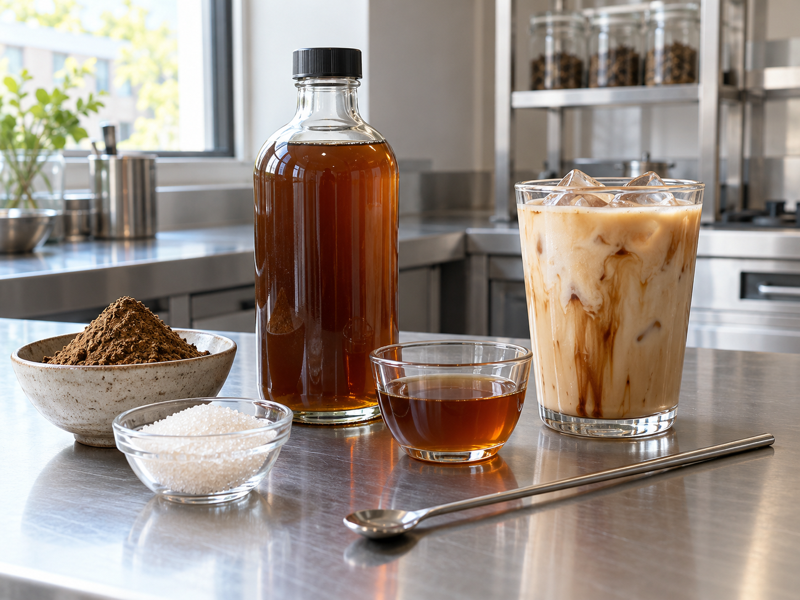
A hojicha syrup gives a café a repeatable way to add roasted tea flavor and sweetness with one measured pour. That convenience is useful only if the tea remains clear in the finished drink, the bottle can be handled safely, and the recipe costs what the menu team expects. Hojicha powder can make a cloudy syrup with a fuller tea presence; a brewed concentrate can look cleaner but may taste lighter. This guide treats syrup as a product-development project for cafés and beverage brands, not a claim that a home recipe has a commercial shelf life.
1. What job should hojicha syrup do on the menu?
Define the serving before choosing a recipe
Some cafés want a sweetener that happens to taste of roasted tea. Others want the syrup to supply nearly all of the hojicha identity in a latte or cold drink. Those goals require different tea concentrations. Write down the target cup, syrup dose, sweetness level, and final aroma before requesting powder or brewing leaves. In a 350 g iced milk drink, a 15 g pour and a 40 g pour will affect sugar, dilution, cost, and visibility in different ways. The same bottle may work in one drink and overpower a dessert drizzle.
Choose a service route too. A pump bottle at the bar needs consistent flow and a known mass per pump. A squeeze bottle for pastry plating can tolerate another viscosity. A packaged syrup sold to other businesses needs its own processing, label, and shelf-life program. Record whether the tea material remains suspended or is filtered out, because “hojicha syrup” can describe either route. The Hojicha Co. recipe shows a powder-based household version and several uses; its quantities are a useful reference point for a small trial, not a commercial specification.
| Menu job | What the syrup must deliver | Key test |
|---|---|---|
| Latte sweetener | Tea aroma plus controlled sugar | Flavor after milk dilution |
| Clear iced tea accent | Roast note without visible solids | Clarity after chilling |
| Dessert drizzle | Flavor with a thicker pour | Flow and coating |
| Wholesale bottle | Repeatable product specification | Validated process and packaging |
2. Should the tea come from powder or infusion?
Choose the route that fits the finished product
Powder places milled roasted tea in every serving. It can give a pronounced brown color and a broad tea taste, although undissolved particles may settle. A brewed infusion extracts flavor from loose leaves or stems before they are removed. It may suit a clear drink, but its strength depends on leaf mass, water temperature, time, and filtration. A syrup made from filtered tea and one made from powder should not be compared at equal dry-tea grams without accounting for what actually enters the bottle.
For an initial screen, make a small powder batch and a small infusion batch at the same sweetness target. Label both with tea lot, roast description, water mass, sugar mass, and final yield. Stir each into the intended beverage and evaluate at service and after waiting. A fine powder may still leave visible residue in a transparent cup; an infusion may need a larger dose that weakens the drink with water. Ask the supplier whether its “hojicha powder” is milled for dispersion or intended for brewing.
3. What pilot formula gives a useful starting comparison?
Measure by mass, then change one variable
Start with a pilot formula that is easy to reproduce, not one you intend to sell unchanged. For example, a powder route might combine 200 g sugar, 240 g water, and 30 g hojicha powder, reflecting the broad proportions in Hojicha Co.’s public recipe. A parallel infusion route could begin with a concentrated brewed tea plus sugar, then be adjusted to the same soluble-sugar target. These are formulation trials only. Final syrup yield will differ from the sum of inputs when heat and transfer losses occur, so weigh the cooled batch instead of assuming a theoretical volume.
Record the tea dose in the finished drink, not only in the syrup pot. If a batch contains 30 g tea and yields 450 g syrup, a 20 g pour carries about 1.3 g of original powder before any losses. That arithmetic helps a menu team compare a syrup-based latte with one made from direct powder. It does not establish flavor equivalence, because powder, brewing, and roast depth change extraction and perception. Run at least two tea strengths and two syrup doses, but keep milk, ice, cup, and sweetness consistent within each comparison. Use coded samples so panelists judge the drink rather than the roast label.
| Pilot variable | Powder route | Infusion route |
|---|---|---|
| Tea source | Milled hojicha lot | Roasted leaf or stem lot |
| Water | Measured mixing water | Measured brew water |
| Sugar | Weighed to target sweetness | Weighed to same target |
| Loss to measure | Pot and bottle residue | Leaf and filter hold-up |
| Finished-dose record | Grams of syrup per cup | Grams of syrup per cup |
4. How should a test batch be mixed?
Control clumps, heat, and actual yield
For a powder route, dry-mix the tea powder and sugar before adding them gradually to warm water. That order can help prevent dry islands of powder, as shown in the Hojicha Co. reference recipe. It does not guarantee full dispersion with every commercial powder. Use a measured mixing tool and record the endpoint: no dry clumps, a repeatable appearance, and a pour that does not block the dispenser. Gentle heat may aid sugar dissolution, but record the actual product temperature and heating time. Excessive heat can change flavor or color, so do not treat a long simmer as a harmless shortcut.
For an infusion route, brew the tea under a fixed mass, temperature, and time, then strain it using the filter intended for service or production. Add sugar to the measured infusion and weigh the cooled syrup. Check the filter for fine particles and the discarded leaf for retained liquid. Both routes need clean, suitable equipment and an approved handling plan. Transfer the batch to an identified container with the date, tea lot, formula code, and operator. A café should avoid topping off an old bottle with new syrup, because it makes lot tracing and hold-time control unreliable.
5. How can you tell whether the tea flavor survives?
Evaluate the cup, not just the bottle
A syrup can smell strongly of toasted tea in the bottle and still disappear in milk. Taste it at the intended dose in the final beverage, with the planned ice, sweetener, and dairy or plant base. Record roast aroma, tea identity, sweetness balance, bitterness, mouthfeel, and finish. A darker syrup is not necessarily stronger in the cup; color can reflect roast and powder loading without predicting the aroma customers notice. Test at handoff and after the time a customer might take to reach a seat.
Make a short reference set from at least two roast profiles. The Japan Hojicha Association’s review of roast labels explains that “light” and “dark” do not form a shared numerical standard across producers. Compare supplier samples under your own fixed formula rather than assuming their naming systems align. Ask tasters to describe a difference they can actually perceive: toasted grain, nut, wood, caramel-like sweetness, or a bitter edge. Avoid claiming that a particular flavor note proves origin or quality. The useful outcome is a target profile that can be checked against later production lots.
| Sensory checkpoint | Acceptable evidence | Common failure |
|---|---|---|
| Roast aroma | Present in finished cup | Masked by milk or cocoa |
| Tea identity | Distinct from plain caramel syrup | Sugar dominates |
| Bitterness | Within target range | Harsh aftertaste |
| Texture | Matches drink style | Grit or sediment |
6. Which drinks and foods can use one syrup?
Test each application at its own dose
A café can trial hojicha syrup in an iced latte, hot milk drink, cold brew coffee, sparkling tea, milkshake, or shaved ice. Pastry teams may test it as a cake soak or drizzle. These uses are related by a shared roasted-tea note, but they do not all need the same sweetness or viscosity. A syrup designed for an iced latte may make a cake soggy. A thick dessert sauce may be hard to pump into a drink. Set one primary application and treat other uses as separate validation tasks rather than assuming one formula is universal.
For each product, record grams of syrup per saleable unit and the final tea impression. Milk and cocoa can bury a light roast, while sparkling water can expose bitterness. A hot beverage changes aroma release and may need a lower syrup dose than a heavily iced one. A bakery application may require a more concentrated flavor because the tea is diluted into batter or cream. The original Hojicha Co. recipe suggests several household uses; a chain should translate those into repeatable station recipes, allergen information for the complete product, cost sheets, and service training before putting them on a menu.
7. What physical defects should the team check?
Watch the bottle over time
Powder-based syrup may show settling, a ring on the bottle, or uneven tea dose between early and late pours. A high-solids syrup may become too thick for a standard pump, especially when chilled. An infusion route can haze, or its flavor may seem weaker after storage. Watch the syrup in the actual bottle and dispenser, not only in a laboratory jar. Weigh several pump strokes at the start and end of a service period. If the mass drifts, the drink recipe and unit cost drift with it.
Record color, sediment, separation, crystallization, viscosity by a consistent practical measure, and whether a shake restores uniformity. Do not make “shake before use” a remedy until staff can execute it reliably and the food-safety team accepts the method. A clear label on an internal bottle can tell staff the batch code and mixing instruction without promising the public a shelf life. Compare defect photos under the same light and container. A batch that looks acceptable in opaque packaging may still leave a visible brown line in a clear drink.
| Defect | Likely check | Decision |
|---|---|---|
| Bottom sediment | Powder size and mixing | Rework formula or serving method |
| Variable pump dose | Viscosity and nozzle | Change pump or syrup solids |
| Crystal growth | Sugar concentration and cooling | Review formula and process |
| Weak tea after storage | Roast lot and hold conditions | Shorten hold or change source |
8. How should safety and shelf life be handled?
A recipe does not validate a commercial bottle
Do not copy a household recipe’s “keeps for two weeks” line into a café standard or wholesale label. Sugar, water, tea solids, pH, water activity, heat treatment, fill method, packaging, and storage conditions all affect microbial risk and quality. The FDA’s review of potentially hazardous foods notes that traditional high-sugar syrups and modified, lower-sugar syrups can behave differently. That general point is enough to reject a one-size-fits-all expiry date. It is not a substitute for the product’s own validation.
For a café batch, use the site’s approved food-safety plan for preparation, clean containers, chilled or other specified storage, labeling, opening, and discard. For a packaged syrup, involve a qualified food technologist and the relevant market’s regulatory team. They should define process controls, microbiological testing, shelf-life study, ingredient and allergen label, and packaging compatibility. If the team changes sugar concentration to meet a nutrition target, repeat the safety review. A bottle that pours well and tastes good today has passed a sensory trial, not a commercial release test.
9. What will a saleable serving really cost?
Count labor and loss as well as ingredients
Start with the ingredient cost of sugar, hojicha, water, and any other declared component. Divide by accepted finished yield, then multiply by the syrup dose in each drink. Add preparation time, sanitation, bottle and pump, filter or mixing consumables, spills, old-batch discard, and remakes caused by inconsistent pour. A powder route may use fewer tools but waste tea in a container heel. An infusion route may have a cheaper raw tea quote yet lose liquid in spent leaf and filtration. Only a measured pilot can show the effective cost.
Run the calculation at two syrup strengths. A stronger syrup may cost more per kilogram while requiring fewer grams per cup; a thin syrup may need a large pour that changes drink dilution. Keep the sensory target fixed during cost comparison. Ask staff to make several cups at normal service pace and record actual weights. A chain should check whether a pump stroke is repeatable across stores and bottle temperatures. Make the costing sheet version-controlled so a new tea lot, sugar price, or package size triggers a review rather than an undocumented substitution.
| Cost line | Measurement | Why it changes decisions |
|---|---|---|
| Tea and sugar | Grams per accepted batch | Shows formula cost |
| Yield loss | Batch in versus bottle out | Shows usable syrup |
| Serving dose | Grams per cup | Connects batch to menu margin |
| Labor | Minutes per batch | Shows production burden |
| Discard and remakes | Units and cause | Shows hidden cost |
10. What should a buyer send a hojicha supplier?
Brief the application, then compare coded samples
Tell the supplier whether the syrup will use powder or brewed leaf, the finished drink base, target sweetness and dose, required roast note, expected monthly volume, and destination market. Request material identity, form, roast description, particle or sieve data for powder, lot code, storage guidance, and the documents your regulatory team requires. Ask for representative commercial samples rather than only a tasting tin. A sample made from a special lot can make a fine pilot and still fail if the same profile cannot be supplied at production scale.
Test samples in the actual syrup and in its primary finished application. Keep the formula and tasting panel fixed for the initial screen; change one variable after a candidate passes. Retain an approved syrup and tea reference where your quality plan permits, and agree on lot-change notice with the supplier. Matcha Village describes B2B hojicha supply; a buyer can send a technical brief through its contact page. The buying decision should end with a repeatable tea specification, a validated syrup process, a measured cost per serving, and a drink that still tastes of roasted tea at the last sip.
FAQ
Q1: Can hojicha syrup replace tea powder in a latte?
It can supply tea flavor and sweetness, but dose and dilution must be retested in the finished cup.
Q2: Is powder or brewed leaf better for syrup?
Powder can give a fuller, cloudier syrup; infusion can be clearer. Choose by the product’s sensory and physical requirements.
Q3: Can a café set a two-week hold from an online recipe?
No. Use a hold supported by its own food-safety plan and the exact formula and handling method.
Q4: Why does syrup settle in a bottle?
Undissolved tea particles can sink. Test powder size, mixing, viscosity, and the serving method.
Q5: What should a supplier sample include?
Identify the tea lot and form, provide product specifications and relevant documents, and supply enough material for repeatable application trials.