
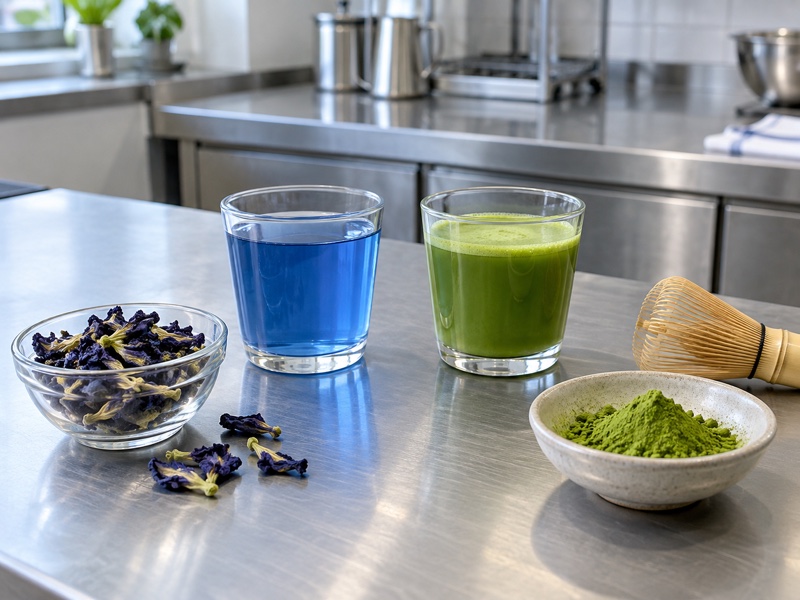
Buyers asking what is blue matcha often expect a blue version of powdered green tea. In most commercial usage, the name refers to butterfly pea flower powder, an ingredient from a different plant. That naming gap can create a wrong purchase order, a misleading menu, or an unsupported claim. Start with botanical identity and the intended food application, then test color and flavor in the actual formula. Cleveland Clinic’s ingredient explainer confirms the basic distinction; commercial specifications and market rules still require separate review.
For: beverage developers, food brands, and ingredient importers. Decision: whether a butterfly pea ingredient fits the product and label brief.
Contents: 1 · 2 · 3 · 4 · 5 · 6 · 7 · 8 · 9 · 10
1. What does blue matcha actually contain?
Ask for the botanical name
Blue matcha commonly describes a powder made from butterfly pea flowers, usually identified as Clitoria ternatea. It does not describe ordinary green matcha dyed blue. A product sold under the name might be pure flower powder, an extract, or a blend with other ingredients, so a buyer needs the actual ingredient list and botanical identification. Read the specification before the menu: a catchy trade name does not answer what a customer will consume. Ask which plant part is used and whether carriers, colorants, or flavorings are present.
The distinction matters to flavor expectations. Green matcha is powdered tea leaf from Camellia sinensis and carries a recognizable tea profile. Butterfly pea powder is generally selected for its blue color and behaves differently in recipes. If a brand wants the taste of matcha and a blue appearance, it may need a formulated product with both ingredients; the resulting label and color stability must be tested. Procurement should write the purchase order using an agreed ingredient identity, not only “blue matcha.” Retain a reference sample and the lot’s documents so future deliveries can be compared with the approved material.
| Purchase description | Ingredient identity to verify | Product risk |
|---|---|---|
| Green matcha | Tea leaf, Camellia sinensis | Wrong flavor if replaced |
| Butterfly pea powder | Flower, Clitoria ternatea | Wrong label if called tea |
| Blue beverage blend | Full composition and carriers | Unexpected allergen or claim |
2. How does it differ from green matcha?
Compare the two in one product brief
Color is the obvious difference, but it is not enough for formulation. Green matcha has tea solids, tea flavor, and naturally occurring caffeine. Pure butterfly pea flower powder has a different sensory profile and is not a tea-leaf ingredient. Do not assume a blue-colored retail blend is caffeine-free; another component might supply caffeine. Keep the terms precise: use “butterfly pea flower powder” in technical files and verify whether “blue matcha” is suitable consumer wording in the destination market.
Run a side-by-side test using matched serving masses and the same base, while remembering that equal gram doses may not create equal flavor intensity. Evaluate aroma, color, dispersion, sediment, and customer expectation. A café guest ordering matcha may anticipate a tea taste that butterfly pea alone does not deliver. Conversely, a brand choosing blue for a visual effect might not want tea bitterness. The two ingredients are not interchangeable in a finished formula, even if both arrive as fine powders. A buyer comparing supplier quotes should compare intended function, dose, and acceptance criteria rather than price per kilogram alone.
3. Which claims need special care?
Separate composition from benefit language
A company can describe an ingredient’s verified identity and observed color without promising a health outcome. Blue matcha is sometimes marketed with broad wellness claims, but a product developer should not turn those claims into packaging copy without the evidence and legal review required in the sales market. Cleveland Clinic notes that research on specific disease-related benefits remains limited. Keep claims grounded: a color-changing drink is a visual product feature; it is not evidence of treatment, prevention, or improved health.
“Caffeine-free” also needs care. Pure butterfly pea flower is distinct from caffeinated tea leaf, yet a blend can include tea, coffee, or other caffeine sources. Confirm the full formula and whatever testing or substantiation the market requires before making a finished-product claim. Colorant status and permitted uses may vary by country and product category. Regulatory teams should check the exact ingredient form, including extract versus ground flower, against current rules before import or launch. Organic, natural, and additive-free claims need their own documentation. A supplier’s promotional language cannot replace a review of the actual product, formulation, and destination market.
| Proposed statement | Evidence needed | Owner |
|---|---|---|
| “Butterfly pea flower” | Botanical and composition records | Purchasing and quality |
| “Caffeine-free” | Full formula and market-appropriate support | Regulatory and quality |
| Health benefit | Substantiation and legal permission | Regulatory review |
4. What specifications should buyers request?
Build a lot-level file
Request botanical name, plant part, processing form, country of origin, ingredient composition, particle size or extract concentration where relevant, and batch traceability. Ask for current product specification and applicable results for microbiological safety, contaminants, and other requirements in the importing market. Ask for the tested form: a certificate for dried flowers may not describe a concentrated extract or a blend sold under the same trade name. Confirm that documents match the lot offered for purchase.
Define color and flavor acceptance in an application test, because a powder sample can look similar while producing different beverage shades. Supplier photographs are poor comparators: lighting and editing alter blue. Use a standard liquid, dose, pH, vessel, and observation time for incoming quality checks. Note moisture and caking, which can affect dosing and dispersion. Also request pack material, shelf-life support, storage instructions, minimum order, lead time, and change-notification procedure. If the buyer is importing into several markets, build a separate compliance checklist for each. Avoid assuming one country’s approval or label name transfers automatically to another.
5. How does blue color behave in beverages?
Treat pH as a formulation variable
Butterfly pea pigments can shift hue when acidity changes; a blue preparation may move toward purple or pink in an acidic drink. That can be attractive in a demonstration but troublesome in a packaged beverage expected to stay one shade. Test the real acid level: a lemon-flavored concept and a neutral milk drink will not necessarily show the same color. Record pH with a calibrated method, use a consistent dose, and photograph samples under one light source at fixed time points.
Other ingredients may affect visible color through opacity, competing pigments, or interactions. A cloudy oat base can make a blue hue look muted, while fruit may dominate it. Heat, light, and storage can also change the result, so a freshly mixed cup is only the start of the trial. Do not write a universal dose from a social-media video. A hypothetical matrix can compare three powder levels within one base, but all percentages must state whether the denominator is the finished drink mass or a dry premix. The production target should specify an acceptable color range at both filling and the end of the supported shelf period.
| Trial factor | Keep fixed | Observe |
|---|---|---|
| Acid level | Ingredient lot and powder dose | Hue shift |
| Base opacity | pH and dose | Visual intensity |
| Hold condition | Formula and pack | Color drift over time |
6. Where can the ingredient fit in food?
Match the application to its strengths
Cold beverages, syrups, frozen desserts, confectionery, and bakery concepts may all use butterfly pea for color, subject to local rules and technical fit. Each category exposes the ingredient to different heat, pH, light, and water activity. Start with the product, not the photograph: a vivid blue sample in water says little about a baked muffin or opaque dairy drink. Make a small application sample in the actual base and process before promising a launch color.
Flavor also matters. A neutral-looking visual ingredient can still contribute an earthy or floral note at the dose needed for a strong blue. In a citrus drink, the acid may intentionally shift the hue; in a blue vanilla dessert, the same shift could be a defect. For layered products, inspect migration where blue meets an acidic fruit layer. If green matcha is included for taste, evaluate whether its green pigments turn the visual result muddy. Record the intended ingredient declaration and any required additive classification with the regulatory team. A useful product brief says why the ingredient is present, what shade it must deliver, and how long that shade must hold.
7. How should R&D run a comparison?
Use matched formulas and coded samples
Choose a control without the ingredient and two or three candidate lots or forms. Prepare each at a clearly defined dose by mass of finished formula. Keep water source, base, mixing time, temperature, pH, vessel, and light constant. Taste coded samples, then reveal the color scores separately so visual appeal does not overrule a flavor fault. Measure the hold: inspect at preparation, after normal service delay, and after the proposed packaged shelf period if applicable. Record sediment, ring formation, odor, and change in shade.
A hypothetical pilot could compare 0.1%, 0.2%, and 0.3% butterfly pea powder by mass of the complete beverage. Those numbers are screening points, not a supplier recommendation or validated production specification. Extracts require their own matrix because concentration differs. Retain photos with a color reference card if the team uses visual acceptance, and note camera and lighting conditions. A spectrophotometric color measure can support comparisons where equipment is available, but sensory acceptance still matters. Bring purchasing and regulatory colleagues into the review early; a technically successful sample is not launch-ready if the source documents or market permission are unresolved.
| Comparison | Fixed conditions | Pass question |
|---|---|---|
| Supplier lots | One base and dose | Is color repeatable? |
| Dose levels | One lot and process | Is flavor acceptable? |
| Acid variants | One lot and dose | Does hue fit the brief? |
8. What processing issues arise at scale?
Transfer dispersion and color together
Powder can form clumps, float, or settle depending on grind and liquid viscosity. A small blender may disperse it quickly, while a production tank may need a defined wetting step. Record addition order, mixing speed, temperature, and time. Watch the final fill: if color or sediment changes between the first and last container, tank uniformity needs work. Sampling only from the top of a batch can miss settling near an outlet.
Filtration can remove visible specks but might also change color strength or yield, so test it rather than assuming it improves quality. For an extract, verify its carrier and how it enters the formula. CIP and sanitation plans should address colored residue on seals and clear tubing. Heat processing and final package exposure require specific validation, including any safety controls set by the plant. A product developer should transfer an approved bench formula through a pilot scale before a commercial run, then compare color and sensory results across the run. Record any process change so later supplier or customer complaints can be traced to a lot, a formula version, and a manufacturing date.
9. How should the ingredient be packed and stored?
Protect the approved material
Powder can absorb moisture and cake, while light and oxygen may affect visible color over time. Select packaging that suits the ingredient form, expected use rate, and supplier’s supported shelf life. Size the pack to usage: a large opened bag may spend weeks exposed on a humid production floor even when unopened shelf-life data look good. Test an opening and resealing procedure under actual working conditions.
Keep lots identified, protected from contamination, and stored under documented temperature and humidity conditions. If refrigeration is proposed, prevent condensation when a cold pack is opened in a warm room. Do not extend the supplier’s shelf life by inference from appearance alone. Check incoming package integrity and compare a retained sample with new deliveries using a standard color application. For a finished drink or dessert, storage validation must cover the whole formula and package, not only the ingredient. Supplier changes in bag liner, extraction method, or flower source should trigger review because they can affect handling and shade even if the trade name stays the same.
| Storage question | Record | Decision |
|---|---|---|
| Pack barrier | Supplier specification | Fit for expected hold |
| Open-pack use | Actual use rate | Choose pack size |
| Lot change | Color in standard drink | Accept or requalify |
10. What is a responsible sourcing decision?
Close the identity, performance, and compliance gaps
A buyer can approve the material only when botanical identity, composition, market permission, supplier documents, application performance, and commercial supply align. Create one decision sheet with the agreed use, dosage basis, color target, sensory target, tests, documents, pack, lead time, and change triggers. Write the purchase name carefully: if the finished product uses butterfly pea flower, internal records should say so even when marketing considers “blue matcha” for consumers. Have regulatory staff approve any consumer-facing name and claims.
Run a final pilot with the qualified lot and actual production process. Review color at fill and after the planned hold, then taste for off-notes and inspect sediment. If the color changes with acid, decide whether that behavior is part of the product experience or a defect. Do not replace green matcha in a tea-flavored product without a sensory redesign. Next, request two traceable candidate samples and test them side by side in the intended base at fixed pH and dose. For background on the common term and plant distinction, read the reference below; rely on current market rules and supplier documents for launch approval.
Reference: “The Benefits of Blue Matcha” — Cleveland Clinic. It identifies butterfly pea flower as the common source and describes acid-driven color change; this article does not adopt health-benefit claims.
FAQ
Q1: Is blue matcha made from tea leaves?
Usually no. Check the ingredient list; the common blue ingredient is butterfly pea flower.
Q2: Does blue matcha contain caffeine?
Pure butterfly pea flower differs from tea leaf, but verify any commercial blend before making a caffeine claim.
Q3: Why does the blue color change with acid?
Butterfly pea pigments respond to pH, so acidic ingredients can shift blue toward purple or pink.
Q4: Can green matcha replace blue matcha?
No direct substitution preserves both tea flavor and blue color; reformulate and test.
Q5: What should an importer ask for?
Botanical identity, full composition, lot documents, relevant tests, pack details, and market-specific compliance review.