
A matcha pudding recipe for scale combines a defined tea flavor and green appearance with a repeatable set texture, process, and serving format. A small pan of smooth pudding can turn lumpy in a kettle or release liquid after filling. R&D can avoid blind adjustment by choosing the target texture, testing one setting system at a time, and recording heat and cooling conditions. These controls give buyers evidence for a supplier and process decision without treating a consumer dessert as a production specification.
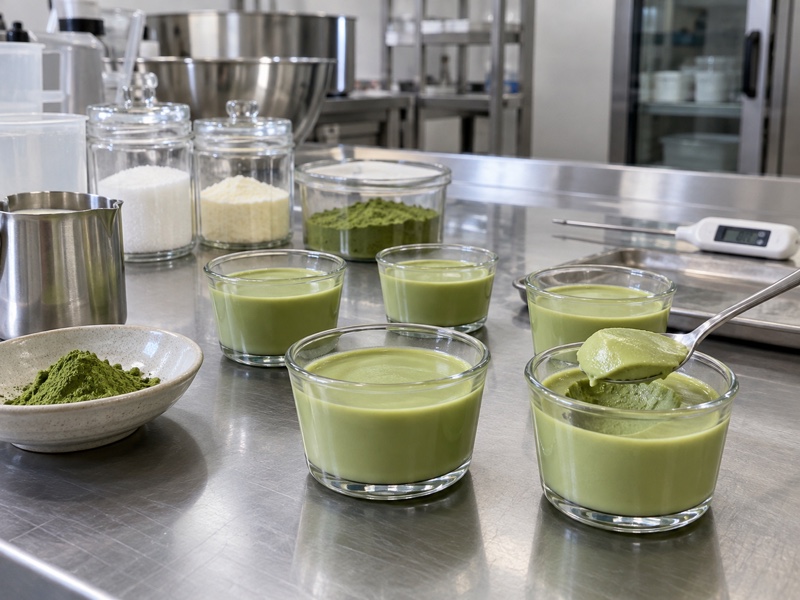
For: dessert manufacturers, café groups, and ingredient buyers. Decision: which formula and process give the required cup through its intended hold.
Contents: 1 · 2 · 3 · 4 · 5 · 6 · 7 · 8 · 9 · 10
1. What texture should matcha pudding deliver?
Describe a finished spoonful
“Smooth” alone does not specify a dessert. A café may want a soft spoonable pudding served the same day, while a chilled retail cup may need to hold shape during transport and release cleanly from packaging. Define portion mass, cup depth, serving temperature, sweetness, tea intensity, firmness, and acceptable surface appearance. Test the first spoon and the last: a top layer can feel set while the bottom is weak or grainy. Record whether the dessert should wobble, cut cleanly, or flow when poured.
Choose the format before selecting a gelling system. A layered dessert needs enough strength to support another component; a pourable sauce does not. The required hold period also shapes the formula. A customer eating the dessert hours after preparation sees a different product from a consumer opening it after distribution. For a pilot, write a simple sensory rubric with words tied to observations: spoon drag, visible liquid at the edge, powder residue, and tea aftertaste. Use the same cups and fill mass for comparisons. A matcha pudding recipe becomes usable for production only after its desired texture can be recognized by people beyond its original developer.
2. Which setting system fits the product?
Compare mechanisms in the real base
Starch-thickened pudding, gelatin-set custard, and hydrocolloid systems can all produce a green dessert, but their process and label implications differ. Starch needs enough heating and agitation to develop viscosity. Gelatin needs a suitable hydration and cooling sequence. Other gelling ingredients require their own temperature and mixing controls. Choose the mechanism deliberately: swapping one thickener gram for another without redesigning the process rarely preserves texture. Any system should be tested in the intended dairy or plant base.
Build a small matrix that keeps matcha dose, sweetness, portion mass, and storage condition fixed while the setting system changes. Score texture immediately after setting and after the planned hold. A plant-based or vegetarian claim may exclude some ingredients. Allergen statements can change with the base and any stabilizer carriers. Keep a no-matcha control because powder solids may alter mouthfeel, but a weak set may come from the base formula rather than the tea. Document whether the product is cooked, chilled, or both; a consumer recipe title does not establish a safe manufacturing process.
| System | Process point to control | Buyer question |
|---|---|---|
| Starch | Cook and agitation | Does viscosity hold after chilling? |
| Gelatin | Hydration and cooling | Does the ingredient fit label needs? |
| Other hydrocolloid | Supplier-specific use method | Is texture stable in this base? |
3. How should matcha enter the formula?
Disperse before the batch thickens
Matcha does not dissolve like sugar. It disperses as fine particles, which can form dry pockets if tipped into a thick or hot base without enough mixing. Try pre-wetting the powder in a measured portion of liquid, then add that slurry at a defined stage. Compare it with direct addition if the line has adequate shear. Check the sidewall: green specks on a kettle or cup rim often signal a dispersion problem that a surface taste test misses. Sift only when a controlled trial shows that it solves a real defect.
Specify matcha dose using a clear denominator. A hypothetical screening series could compare 0.4%, 0.7%, and 1.0% matcha by mass of the complete uncooked formulation. Those are trial starting points, not validated production levels. Evaluate bitterness, color, and suspended-powder feel after the dessert sets. A strong tea may need less powder and cause less sediment; a milder one may better fit a sweet dairy profile. Run coded samples in opaque and clear cups if packaging differs, since visual expectations can influence tasting. Retain each matcha lot number in the batch record so later color shifts can be investigated.
| Matcha trial | Fixed elements | Observe after setting |
|---|---|---|
| Low screening dose | Base, sugar, setting system | Tea visibility and flavor |
| Mid screening dose | Same process | Balance and color |
| High screening dose | Same process | Bitterness and residue |
4. What processing steps need control?
Track heat, shear, and cooling
A cook step may be needed for texture or food safety, depending on ingredients and route to market. Write a process card that records ingredient addition order, batch size, heating profile, mixing speed, endpoint, fill temperature, and cooling method. Do not borrow a consumer stovetop time for a larger kettle. Measure the endpoint: the same clock time can give a different cook when vessel size or starting temperature changes. Product safety limits should come from a qualified process and the applicable market requirements.
During trials, sample the beginning, middle, and end of filling. A mixture can thicken as it cools, causing uneven portion weights or a surface skin. Gentle agitation may maintain uniformity, but excessive shear after a gel begins forming can damage the final set. Document whether matcha is added before or after the highest heat exposure and compare both only if the chosen system permits it. Cool filled cups under a controlled plan and record the time to the specified storage condition. A smooth bench sample does not prove that a packed cup will set uniformly in a full crate.
5. How can dairy and plant bases be evaluated?
Make the base a controlled variable
Milk, cream, oat drink, soy drink, and coconut bases differ in fat, protein, sweetness, and stabilizers. Those traits affect tea flavor and how a thickener behaves. Compare bases at one matcha dose and one process before optimizing each candidate. Read the ingredient list: a branded plant drink may contain gums or oil that change the pudding even when its front label sounds similar to another. Use the exact commercial base in qualification trials.
Taste at the intended serving temperature and after the planned hold. A cold dessert can suppress some aromas while making bitterness or powderiness more noticeable. Plant-based positioning calls for review of all ingredients, processing aids, and cross-contact controls, not only a milk substitution. A dairy-free cup may still contain other allergens. If a base gives attractive color but weak set, test the setting system separately rather than increasing matcha to hide a texture issue. Package and serving format also matter: a firmer coconut cup might work as a layered dessert while a lighter oat cup may suit direct spoon service. Keep both ideas as different product briefs.
| Base | Possible formulation effect | Validation note |
|---|---|---|
| Dairy milk | Protein and fat alter tea perception | Check allergen and hold texture |
| Oat drink | Viscosity varies by supplier | Recheck each qualified base |
| Coconut base | Distinct flavor and fat profile | Test tea balance cold |
6. Which defects reveal process problems?
Diagnose before changing ingredients
Lumps, liquid release, sediment, surface skin, color loss, and uneven set point to different causes. Record when each appears: during cooking, just after filling, after chilling, or after transport. Keep a defect map: mark whether faults cluster in one kettle zone, one filling period, or all cups. That pattern can distinguish process variation from a formula-wide problem. Retain a matched no-matcha control to see whether tea addition is implicated.
Lumps may reflect incomplete thickener hydration or matcha dispersion. Liquid release, often called syneresis, can reflect a weak network, processing stress, or storage conditions. Sediment suggests particle suspension and viscosity need review. Do not solve every problem by adding more thickener; a firmer gel can have a less pleasant mouthfeel and may still release liquid. Design one-variable follow-up trials, then evaluate the whole cup after the intended hold. Safety defects require the site’s quality procedure and cannot be dismissed as cosmetic. Log failed cups and the corrective action so the next batch begins with evidence.
| Defect | Check first | Controlled follow-up |
|---|---|---|
| Green specks | Slurry and addition order | Compare wetting methods |
| Free liquid | Hold time and set process | Change one process variable |
| Bottom sediment | Particle distribution | Compare shear and viscosity |
7. What changes in a larger batch?
Rebuild the heat and mixing window
A kettle heats and cools differently from a small pan. Thick product near the wall can see a different heat history from product in the center. Matcha may collect on equipment surfaces, while a setting system may develop viscosity before filling ends. Transfer the formula in stages and sample across time and location. Follow the final cup: if its fill temperature, mass, or texture differs from the first, the batch is not uniform enough for approval.
Record equipment geometry, agitator speed, batch depth, heating and cooling curves, and line hold time. Check that the dispersion step is feasible without creating airborne powder or cleaning difficulty. If the process uses a premixed slurry, specify how long it may wait and how it will be stirred before dosing. Large batches also create more rework questions. Establish a documented policy for off-spec product rather than returning it casually to the kettle. A food safety specialist should validate the final process and any refrigerated shelf life. A successful scale trial matches the target cup and the site’s control plan, not merely the ingredient percentages.
8. How should the dessert be packed and held?
Test the package with the pudding
Cup shape changes cooling rate and how a spoon reaches the bottom. A transparent wall displays color and sediment; an opaque cup hides them but does not remove the fault. Choose a closure that fits the planned distribution and food safety controls. Open the real pack: evaluate condensation, surface skin, headspace, leakage, color, and texture after the full planned hold. A pilot in an open ramekin cannot answer those questions.
Light, oxygen, and temperature can affect matcha appearance and flavor, while temperature abuse can create safety concerns for chilled desserts. Storage conditions and shelf life must come from product-specific validation. Run trials with the actual fill mass and case configuration because a full case cools differently from a single cup. Record handling instructions for operators and distributors. If a layered product includes fruit or syrup, test migration at the interface and review the finished ingredient and allergen statement. The approved pack should protect the qualified dessert and fit the buyer’s merchandising route, whether café case or retail chilled cabinet.
9. What should buyers require from suppliers?
Tie acceptance to the tested lot
For matcha, ask for identity, lot traceability, a product specification, relevant test results, packaging details, shelf-life evidence, and storage guidance. Apply the same discipline to bases and setting ingredients. A lower quote may require a higher tea dose or yield a less stable color, so compare cost per accepted cup rather than powder price alone. Retain a reference: keep an approved powder sample and finished dessert sample under defined conditions to support future lot comparisons.
Ask suppliers how they notify customers of changes in grade, pack, origin, or formulation. A new carrier in a stabilizer blend can change allergens; a new matcha source can change flavor. Review certificates for the exact market and product scope. Do not claim that a supplier meets a standard merely because a logo appears on a brochure. Purchasing should also check minimum order, lead time, and exposure after opening a bulk pack. A material that works in the pilot but expires before it can be used at expected sales volume is a poor fit. Write the acceptance tests into the buying file before the first production order.
| Supplier item | Ask for | Why it matters |
|---|---|---|
| Matcha | Lot specification and sample | Color and taste continuity |
| Setting ingredient | Use instructions and composition | Process and label control |
| Packaging | Barrier and closure data | Hold and distribution performance |
10. Which launch checks close the trial?
Approve formula, process, and package together
Run the final pilot with approved ingredient lots, intended equipment, actual cups, and the planned cooling and holding route. Evaluate spoon texture, flavor, color, liquid release, fill variation, and defects at several time points. Include the site’s food safety and shelf-life validation requirements. Use a decision sheet: mark pass, fail, and unresolved items against the original brief. A cup that tastes good on day one but leaks or separates before its stated shelf period cannot move forward.
Regulatory review should check ingredient naming, allergens, claims, and any market-specific requirements before artwork approval. Freeze the formulation and process version that passes, then define which substitutions trigger another trial. If the product fails, test the likely cause with one controlled change. The next useful action is a small matrix comparing two setting systems at one matcha dose in the final base, followed by a packed-cup hold. The linked consumer reference offers a dessert concept; a manufacturer’s recipe must earn its own production approval through trials and documented controls.
Reference: “Easy Matcha Pudding – RecipeTin Japan”. It is consumer recipe context, not a production process or shelf-life source.
FAQ
Q1: What is a matcha pudding recipe for manufacturers?
A formula plus controlled dispersion, setting, filling, cooling, packing, and quality checks.
Q2: Can matcha pudding use a plant base?
Yes, but test the exact base with the chosen setting system and review all label claims.
Q3: Why does pudding release liquid?
A weak or stressed gel, process variation, or storage conditions may cause it; run controlled checks.
Q4: When should matcha be added?
At a validated stage that disperses powder without damaging the chosen texture or tea profile.
Q5: What defines a successful pilot?
Consistent accepted cups through the planned hold, with documented process and safety evidence.