
A café can approve a hojicha sample for its inviting roasted smell and still end up with a latte that tastes mostly of milk. When a buyer asks “what does hojicha taste like?”, the answer must be more useful than “nutty and smooth.” Hojicha is roasted green tea, and its flavor changes with the base tea, roast, form, dose, and recipe. This guide turns those variables into a repeatable tasting and purchasing process for drinks and food.
1. What does hojicha taste like in plain water?
Start with the unflavored infusion
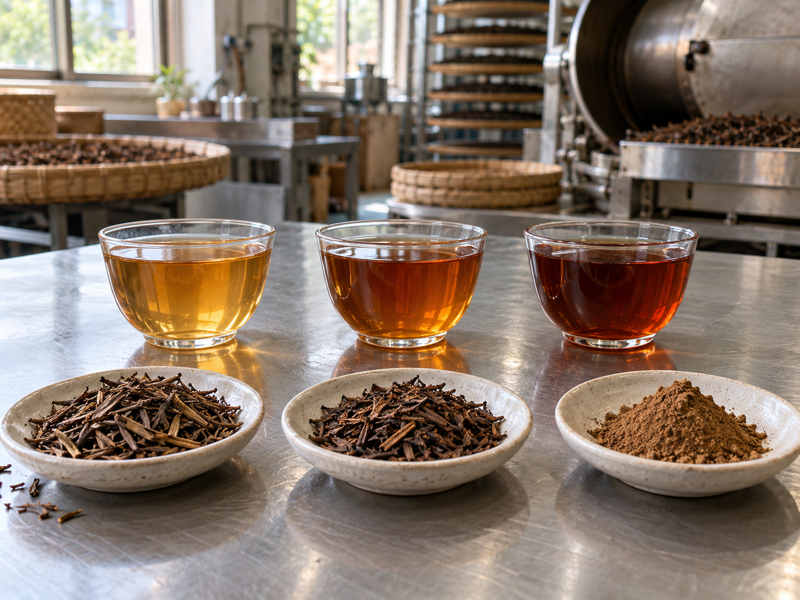
In water, hojicha commonly presents a toasted aroma, a rounded brown-tea character, and less grassy intensity than many unroasted Japanese green teas. Tasters may describe nuts, wood, caramel, cocoa, or warm cereal. Those words describe impressions rather than ingredients: a hojicha labeled “caramel” does not necessarily contain caramel. The finish can be clean and short or more persistent and dry, depending on material and preparation. Japan’s Ministry of Agriculture, Forestry and Fisheries (MAFF) describes its roasted fragrance and clear drinking character. That is a useful starting description, but a buyer still has to assess the actual lot.
Taste it twice. Brew each coded sample under one fixed method, then taste immediately and once the infusion has cooled. Heat can make an aromatic sample seem fuller than it does at service temperature. Record aroma, roast intensity, sweetness impression, astringency, and finish separately. If a cup smells attractive but leaves a thin taste, do not score its dry-leaf aroma as if it were finished-drink flavor. For a menu or packaged beverage, include the planned cup size and serving temperature in the tasting brief. That keeps a supplier’s marketing language from replacing evidence in the glass.
| Sensory attribute | Question for the panel | Useful note |
|---|---|---|
| Roast aroma | Is it light, moderate, or dominant? | Describe in the cup, not only the bag |
| Tea body | Does flavor persist after swallowing? | Check at service temperature |
| Astringency | Does the mouth feel dry? | Use one brew method for comparison |
| Aftertaste | Is the finish pleasant or burnt? | Retaste after cooling |
2. How does roasting change hojicha flavor?
Roast depth is a purchase decision
Hojicha begins as processed green tea and receives a later roasting step. This heat builds browned, toasted aromas while changing the way the original tea presents in the cup. It does not establish a single flavor profile. A lighter roast may keep more of its base tea’s character; a darker roast can push caramelized and smoky notes forward. MAFF’s Kaga bocha description explains this direction particularly well for roasted stem tea: lighter roasting preserves more original flavor and deeper roasting increases roasted aroma and perceived sweetness.
Compare against a target. A coffee chain seeking a clear roasted tea may choose a different roast from an ice-cream manufacturer seeking flavor after freezing. Ask for two or three roast styles prepared from documented material. Hold dose, water, steep time, and tasting temperature steady. Never choose a roast only because its powder is darker; color is one observation, not a measure of flavor quality. A very deep roast may stand up to sweet milk yet appear burnt in plain water. A delicate roast may taste graceful as tea and vanish behind cocoa. The best roast is the one that survives the intended formulation without introducing an off-note.
3. Do leaves and stems taste the same?
Find out what was roasted
The word hojicha does not specify one botanical part or one base grade. Finished tea may contain leaves, stems, or a blend. That difference changes how much surface area meets water, how a batch extracts, and which flavors remain after roasting. Japan’s Uji tea guide identifies hojicha as tea made by roasting sencha or kawayanagi. Other regional styles may roast stems. Buyers should therefore request the actual material description instead of treating a country-of-origin or roast name as a complete specification.
Ask for the blend. A café can compare a leaf-led sample with a stem-led sample in the same service recipe. Assess the initial aroma, tea body, and finish without assuming that stems always mean weak flavor or that leaves always mean better value. Size distribution matters too. A bag with many fines may extract fast and produce a cloudy cup; large pieces may require a different time or dose. Ask whether the supplier can keep the blend and cut size stable across production lots. If those variables move, a recipe that passed on a sample can drift after launch even when the product name remains unchanged.
| Material question | What to request | Why it affects taste |
|---|---|---|
| Leaf or stem share | Written composition description | Sets a repeatable base |
| Cut size | Representative production sample | Changes extraction speed |
| Roast range | Reference sample and description | Sets aroma expectations |
| Lot consistency | Change-notice arrangement | Protects approved recipe |
4. How does hojicha compare with matcha or sencha?
Compare finished drinks under comparable conditions
Sencha is an unroasted Japanese green tea, so a grassy or fresh-green note is more likely to sit at the front of its profile. Hojicha’s later roast makes toast more prominent. Matcha is finely ground tencha and is consumed as a suspension rather than strained like a typical leaf infusion. These processing differences explain why swapping any one for another changes flavor and texture. MAFF’s overview of Japanese green teas lists the production distinctions. A brand should still avoid claiming that all sencha is bitter or all hojicha is sweet; grade, concentration, and water conditions alter the result.
Test the use case. In a plain hot-tea flight, prepare each product according to a sensible method and declare the method on the score sheet. In a latte comparison, use each tea’s intended form and a dose that produces a saleable drink. Equal grams do not create an equal sensory challenge when one sample is a leaf infusion and another is a powder. Tell panelists the target: a roasted alternative to a matcha latte, a lower-green-note tea, or a dessert base. Without that target, tasters often vote for the strongest cup rather than the product that fits the menu.
5. What happens to hojicha taste in milk?
Milk can soften and obscure the roast
Milk changes the evaluation. Fat and protein alter texture; sweetness shifts which roast notes tasters notice; ice dilutes the finished cup. A hojicha that seems assertive in water may produce a gentle latte. That may be desirable for a broad café audience, but the tea should still be identifiable if the menu promises hojicha. Prepare the same sample with dairy and any planned plant milk. Use the intended syrup, because vanilla or brown sugar can either complement the roast or make every candidate taste similar.
Watch the finish. Taste a fresh hot latte, then taste it near the expected handoff temperature. For an iced drink, record the first sip and the cup after a standard holding interval. Weigh powder, liquid, sweetener, and ice; a “scoop” introduces enough variation to hide small differences between suppliers. If a powder settles, inspect mouthfeel at the bottom of the cup. If a leaf concentrate is used, note filtration yield and whether its aroma holds after dilution. Give each candidate a score for both flavor and ease of service. A memorable pilot that baristas cannot reproduce has limited commercial value.
| Latte variable | Hold constant during comparison | Failure to look for |
|---|---|---|
| Tea dose | Measured grams or brew yield | Weak identity |
| Milk base | Brand and volume | Muted roast |
| Sweetener | Type and grams | Cloying finish |
| Ice and wait | Mass and minutes | Dilution or sediment |
6. Which food applications suit hojicha’s flavor?
Choose where the roast has room to speak
Roasted tea often fits milk-based desserts, chocolate, caramel, pastry cream, cookies, and ice cream. Those are candidate applications rather than proof that one ingredient will work in every formula. In a cookie, baking can change aroma; in a cream, dairy can round it; in chocolate, cocoa can compete with it. Powder usually makes more sense when the formula cannot accept extra water, while a filtered infusion may suit a clearer beverage. Trial the ingredient in the real matrix and under the actual process. A spoonful of tea powder in water will not predict a baked filling.
Separate stages. For a bakery product, compare tea in batter with tea added to a post-bake filling. In ice cream, taste the base before freezing and the finished product after it reaches service temperature. For a ready-to-drink tea, evaluate immediately after processing and through a validated shelf-life program. Keep controls without tea so tasters can identify what the hojicha truly adds. Note whether the roast gives the product a distinct identity or merely darkens it. That observation helps a brand decide whether it needs a higher tea dose, a different roast, or an entirely different application.
7. What off-flavors should a buyer reject?
Describe defects without romantic language
Toasted does not mean charred. A sharp burnt note, stale cardboard impression, persistent ash-like finish, or sourness outside the intended formula deserves investigation. The exact cause cannot be diagnosed by tasting alone; roast level, storage, packaging, and preparation all deserve review. Compare a suspect sample with a retained approved sample under the same brew conditions. A closed bag can trap intense aroma, so judge the cup too. If only a finished latte tastes harsh, check dose and preparation before blaming the ingredient.
Record the defect. “Bad” is too vague for a supplier to act on. Record which sample, lot, form, water, dose, temperature, and time produced the note. State where it appeared: dry aroma, hot infusion, cooled infusion, milk drink, or finished dessert. Photograph packaging and retain a sealed lot sample when practical. If the problem repeats, request a traceable comparison from the supplier and pause approval until your quality team reviews it. This process also prevents an attractive sample from masking defects through heavy syrup. A product sold as roasted tea needs a pleasant roasted finish at the expected serving conditions.
| Observed issue | Immediate check | Next action |
|---|---|---|
| Burnt finish | Compare roast samples at equal strength | Ask for lighter profile |
| Thin tea taste | Review dose and dilution | Test strength before switching |
| Stale aroma | Check pack seal and lot age | Request retained lot comparison |
| Grit in latte | Check powder dispersion | Review particle specification |
8. How can a team run a fair sensory trial?
Blind samples reveal more than packaging
Use coded samples and one written preparation sheet. Set the same water, vessel, dose, brew time, and tasting temperature for comparable loose-leaf products. For powders, set mixing method, base, and serving mass. Bring in people who will make, sell, and buy the product: a development lead, a quality reviewer, and a service operator may notice different failures. Ask each person to score aroma, tea identity, body, off-notes, and fit for the intended use. Allow short free-text notes, because a number cannot tell a supplier what to change.
Then repeat it. A single tasting can be skewed by order or palate fatigue. Change serving order in a later session, and compare the favorite with a retained benchmark. If teams disagree, investigate the use condition. A powder may win in a hot latte yet lose in an iced drink because sediment appears after ten minutes. Keep the formula and coded result together, including supplier lot codes. That record gives procurement a reason for selection and gives operations a reference when a later shipment tastes different.
9. How should flavor become a supplier specification?
A shared reference beats “medium roast”
Once a candidate passes, write down what made it pass. Include botanical and material description, leaf or powder form, roast reference, cut or particle range when relevant, sensory sample, package, shelf life, storage instructions, and lot traceability. Ask for the same documents from each contender. A certificate of analysis can describe measurable quality and safety attributes, but it cannot replace a sensory reference for a roasted flavor. Set a practical change-notice process for shifts in base tea, roast, or milling. Those shifts can change a menu product even when nominal ingredient specifications still pass.
Use the final recipe. Accepting a sample only in plain water misses changes that emerge in milk, baking, or bottling. Keep a small approved lot sample and the original formulation, then use both for a future lot check. The supplier should know whether you need a clean leaf infusion, a powder that disperses in milk, or a roast strong enough for chocolate. Discuss the intended market and label before print. Product descriptions such as “naturally sweet” should reflect the finished product; they should not suggest that unsweetened hojicha contains added sugar or guarantee the same perception for every lot.
| Specification item | Buyer record | Approval test |
|---|---|---|
| Form | Leaf, blend, or powder | Actual production sample |
| Flavor | Retained roast benchmark | Blind finished-product tasting |
| Performance | Extraction or dispersion method | Pilot preparation |
| Supply | Lot code and change notice | Subsequent-lot check |
10. What should a buyer send with a hojicha sample request?
Make the brief specific enough for useful samples
Describe the intended product, target drinker, sales market, and expected service conditions. Give the supplier the form you currently prefer and explain why, but allow a technically suitable alternative. Specify hot or iced use, dairy or plant base, sweetness range, serving size, processing heat, storage, projected volume, packaging format, and quality documents required for your market. Attach a benchmark flavor description using ordinary terms such as toasted cereal, mild wood, or deep roast. If an existing drink must be matched, share a properly handled reference sample rather than an invented tasting score.
Ask for traceability. Request relevant candidates with lot identities and preparation directions. Run the blind trial before discussing a long-term quote. Matcha Village supplies hojicha powder for food and beverage applications; its contact page is a route for a product brief and sample inquiry. The decision should follow your pilot, document review, and production-lot check. Aim for repeatable roasted-tea flavor at a dose and cost that customers and operations can accept.
FAQ
Q1: Does hojicha taste like coffee?
It can share roasted notes, but hojicha remains tea. Compare its finish and body in the intended drink instead of treating it as a coffee substitute.
Q2: Is hojicha naturally sweet?
Some roasts give a sweet impression without sugar. That sensory impression varies with material, roast, and preparation.
Q3: Why does my hojicha latte taste weak?
Check tea dose, milk volume, sweetener, ice dilution, and powder dispersion or infusion yield before rejecting the lot.
Q4: Is a darker powder always stronger?
No. Color alone cannot establish flavor quality or strength. Test the finished recipe with measured doses.
Q5: How many samples should a buyer request?
Two or three documented candidates spanning useful roast or material choices usually make a more informative initial trial than many unlabeled grades.
Buyer takeaway: Select hojicha with a coded tasting in your real formulation and keep an approved reference. See MAFF’s Japanese tea categories and Kaga bocha profile.