
A menu team wants to call a hojicha latte “caffeine free,” while the supplier sheet only describes roasted green tea. That gap creates a labeling and trust problem. Hojicha contains caffeine unless testing establishes otherwise for a specific product. Japanese food composition data and roasting studies offer useful reference points, but neither substitutes for a finished-product result. This guide shows café chains and food brands how to assess a real serving.
1. Does hojicha contain caffeine?
It is roasted tea, not a caffeine-free herb
Yes. Hojicha is made from processed green tea that receives a later roast. Tea from Camellia sinensis naturally contains caffeine, so a cup of hojicha should not be presented as caffeine-free without appropriate product evidence and a compliant claim. The roast changes aroma and appearance, yet brown color tells a buyer little about a finished serving’s caffeine. Japan’s MAFF tea guide places hojicha among Japanese green teas and describes roasting as its defining step. That category fact is more reliable than a menu myth based on color.
Ask what is in the cup. A café serving leaf infusion extracts only part of the leaf’s constituents into water and discards spent leaves. A latte made with powder puts the measured powder into the drink. A bottled blend may add other tea or coffee ingredients. All three can carry the same hojicha name while producing different caffeine exposure. Start every claim review with the actual ingredient list, grams per serving, and preparation. If a consumer asks whether the drink contains caffeine, the safe factual answer is yes unless a finished-product test and applicable labeling rules support a more specific statement.
| Product format | What enters the serving | Evidence a buyer needs |
|---|---|---|
| Loose-leaf tea | Extracted infusion | Brew recipe and drink test |
| Powder latte | Powder in the beverage | Lot result and exact powder dose |
| Packaged blend | All included tea and caffeine sources | Finished-product result |
2. How much caffeine does a reference hojicha infusion contain?
Read the test method with the number
Japan’s Standard Tables of Food Composition list 0.02 g caffeine per 100 g of hojicha infusion, commonly expressed as about 20 mg per 100 mL for a water-like drink. The listed preparation used 15 g tea in 650 mL water at 90°C for 30 seconds. That is a defined analytical reference, not a guarantee for every teapot or brand. A 250 mL serving prepared identically would scale to roughly 50 mg, but actual cafés may use another tea, ratio, time, or volume. State those assumptions whenever a number appears in copy.
Compare methods before values. The same Japanese MAFF caffeine table lists sencha infusion at 20 mg per 100 mL under a different method and genmaicha infusion at 10 mg per 100 mL under a defined method. Those figures do not prove that every hojicha has less caffeine than every sencha. They show why a universal ranking is unsafe. A buyer who needs a number for a label or product page should commission analysis on the relevant material or drink rather than transplant a public table value into a commercial claim.
3. Does roasting remove hojicha caffeine?
A reduction can occur without decaffeination
Roasting can reduce measured caffeine in dry tea, but the size of that reduction varies. A Japanese Tea Association report measured samples before and after roasting. Its average dropped from about 2,139 mg to 1,770 mg in the report’s stated basis, around 17%, while individual reductions ranged widely. That study supports a limited statement about its samples. It does not support a claim that roasting removes nearly all caffeine or that every market product falls below a particular threshold. Different base leaves, roast conditions, and serving recipes complicate the comparison.
Follow the material. If two suppliers offer different hojicha powders, ask whether they use leaves, stems, or a blend and request lot-specific analytical results. A dark color does not demonstrate a low value. Nor does a powerful roasted aroma, since aroma and caffeine are different measurements. For a leaf tea, even a dry-leaf result must be connected to an extraction method. For powder, the total powder dose is especially relevant because the material remains in the drink. Treat the roasting study as a reason to test rather than a shortcut around testing.
| Statement | Evidence status | Buyer action |
|---|---|---|
| “Hojicha contains caffeine” | Supported by tea composition | Use as baseline answer |
| “Roasting can reduce caffeine” | Supported for studied samples | Avoid a fixed universal percentage |
| “Our latte has X mg” | Needs the actual recipe and data | Test or calculate with verified inputs |
| “Caffeine free” | Needs stringent product and legal review | Do not infer from roast color |
4. Do leaf and stem choices change caffeine?
Request a material description, not a stereotype
Hojicha can be made from different tea materials, including leaves and stems. Their composition, harvest, and blend proportions may affect caffeine in a supplied lot. Yet a buyer cannot assign a dependable number from “stem tea” or “mature leaf” alone. The supplier’s actual dry-material analysis provides a better starting point. Roasting and processing history also matter. If your menu hinges on a lower-caffeine positioning, compare actual candidate lots under the same lab method and then evaluate the beverage produced by the intended process.
Put blend stability in the specification. A sample made from one composition can pass a claim review, while a later production lot may contain a different proportion of material. Ask for a written base-tea description, a lot identifier, change notification, and the agreed testing frequency. If the supplier changes the source or composition, review the caffeine evidence again. This applies even when flavor seems stable: consumers cannot taste a milligram difference reliably. Procurement and regulatory teams should agree on the acceptance rule before approving artwork or national menu boards.
5. Why can hojicha powder differ from brewed tea?
Powder remains in the serving
A filtered infusion and a powder drink are different exposure models. Brewing transfers some soluble caffeine from leaves into water; the spent material is removed. With hojicha powder, a measured mass of roasted tea remains suspended in the latte or dessert, so its caffeine contribution is tied to the powder’s content and dose. Mixing technique changes texture and distribution, but it does not remove caffeine from the material. A powdered product sold as “instant hojicha” may be a soluble extract or a ground tea, so identify which one you bought before estimating the serving.
Use units correctly. If a laboratory reports caffeine in mg per gram of powder, multiply by grams of that powder in a serving. Then add any other caffeine-bearing ingredients and assess whether processing changes the final value. Do not transfer an infusion number in mg per 100 mL directly to a powder in mg per gram. Also avoid presenting a calculation as measured finished-product content when the powder specification is only a broad range. A chain can start with a calculated estimate for formulation work, then test representative finished drinks when it needs a public number.
| Input | Correct unit | Why it matters |
|---|---|---|
| Powder test | mg caffeine/g powder | Connects lot to dose |
| Powder dose | g powder/serving | Sets tea contribution |
| Infusion result | mg caffeine/100 mL drink | Describes brewed liquid |
| Finished serving | mg caffeine/declared serving | Supports customer information |
6. How does a recipe change hojicha caffeine per serving?
Serving design can outweigh a broad tea category
Tea dose, steep time, water temperature, extraction yield, final volume, and powder mass all affect the amount consumers receive. For a leaf concentrate diluted into a latte, track caffeine in the concentrate and the volume used in each saleable cup. For a powder latte, track both powder concentration and drink size. If a café offers one, two, or three powder scoops, each version needs its own estimate. Sweetener or milk may lower concentration per 100 mL by dilution but does not erase the caffeine contributed by the tea.
Count the whole recipe. Coffee shots, chocolate, matcha, other teas, and added caffeine can alter a drink’s total. The U.S. Food and Drug Administration (FDA) reminds consumers to consider all caffeine sources. For a ready-to-drink product, test after the real production process and within the actual pack. For a café, use a controlled standard operating procedure so the posted information stays aligned with service. Reweigh “standard” scoops periodically; a rounded scoop can depart from the training recipe. A responsible number refers to the sold serving, not a theoretical teacup.
7. When should a buyer test hojicha caffeine?
Match testing to the claim and risk
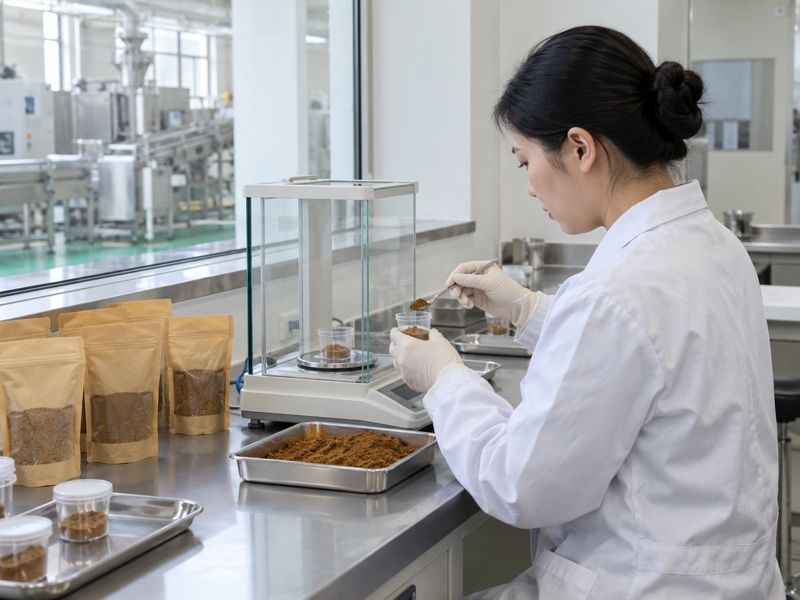
Test when caffeine is part of a public claim, a menu comparison, a customer specification, or a sensitive product decision. Begin with supplier data for the named lot, method, result, and units. If a product is brewed, include a beverage sample made by the intended method. If the product is powder, use the actual powder and dose. A finished packaged drink usually warrants a finished-product result. Discuss method and sampling with a qualified laboratory, including how many lots or production runs represent normal supply. A single sample is a point observation, not a lifetime guarantee.
Keep the chain of evidence. Record sample ID, production lot, package status, formula version, preparation, laboratory report, and interpretation. If a café changes cup size, tea dose, or supplier, review the number. If a brand changes a blend, rerun the finished-product assessment before relying on old artwork. Define an internal action limit and review process with regulatory staff for each destination market. This record costs less than investigating a claim after launch and helps the supplier understand whether a variance came from raw material or from preparation.
| Decision | Minimum useful evidence | Review trigger |
|---|---|---|
| Internal prototype | Lot result plus recipe estimate | Recipe changes |
| Café menu number | Representative prepared drink data | Serving or supplier changes |
| Packaged product claim | Finished-product testing and legal review | Formula or process changes |
| Supplier approval | Defined lot specification and frequency | Material change notice |
8. What caffeine language should a menu avoid?
Keep statements within the evidence
“Caffeine free,” “safe for everyone,” and “contains no stimulant” go beyond what a roasted-tea name can prove. “Lower caffeine than coffee” also needs care: a small hojicha serving may differ from a large coffee, but the comparison depends on both products and portions. The FDA’s consumer guidance shows wide caffeine ranges across drink types and notes individual sensitivity. A claim should identify the serving and comparison if it makes a numerical or relative promise. Destination-market rules can differ, so have local regulatory reviewers approve wording before use.
Plain language travels better. “Roasted green tea latte” accurately identifies the ingredient and lets customers ask about caffeine. If a measured amount is disclosed, state the serving size, use a defensible value or range, and maintain evidence that reflects ongoing production. Do not imply a health benefit from an absence of data. Nor should staff confidently repeat a number from a supplier website for a different formulation. Give store teams a short answer based on the approved product file and a route for customers who need more detail.
9. How can a chain keep caffeine information consistent?
Make the operating recipe measurable
Write a recipe with grams of tea, liquid mass, water temperature, steep time when relevant, final drink size, and allowed substitutions. Train staff with a scale and a visual cup reference. For leaf concentrate, specify brew yield and maximum hold time under the chain’s food-safety plan. For powder, specify the mixing tool and how to handle settling. Store the supplier lot code with inventory records. This practice supports both flavor consistency and a defensible caffeine estimate. If portioning changes during a busy shift, the label file alone cannot keep a cup consistent.
Audit the actual pour. Pick a representative service shift and weigh several drinks discreetly. Compare ingredients with the approved recipe. If a syrup contains chocolate or an espresso add-on is common, make the menu distinction clear. Central manufacturing should verify mixing uniformity and packaging fill, especially where the beverage contains suspended powder. Feed deviations back into training or formula design. A stable product is easier to explain to customers and easier to compare across new suppliers.
| Control point | Record | Reason |
|---|---|---|
| Tea portion | Grams per cup | Controls input |
| Brew or mixing | Time, temperature, tool | Controls extraction or distribution |
| Finished size | mL or g served | Defines the claim unit |
| Ingredient change | Lot and formula version | Signals reassessment |
10. What should a buyer request from a hojicha supplier?
Buy the material and its evidence together
Send a brief stating whether you need loose leaf, ground powder, or an extract; describe the application, dose range, serving size, and countries of sale. Request material composition, roast description, lot code, product specification, shelf life, storage conditions, and a caffeine result with its method and units where the claim requires one. Ask whether the supplied sample represents routine production and how changes will be communicated. For a blended or private-label product, request the full ingredient details needed for an independent regulatory review.
Then test the serving. Matcha Village offers hojicha powder for B2B food and beverage development. Buyers can send a sample brief through its contact page and compare candidate lots in their real formulation. Approve a product only after sensory, quality, commercial, and claim checks agree. The practical rule is straightforward: use published tea data to frame questions, then use your own lot and finished drink to answer them. A customer-facing caffeine statement should survive the next production run as well as the pilot.
FAQ
Q1: Is hojicha caffeine free?
No. Hojicha is roasted tea and naturally contains caffeine unless a specific processed product has evidence supporting a compliant claim.
Q2: Does hojicha always have less caffeine than sencha?
No. Published reference infusions can be similar, and preparation changes the result. Compare actual servings.
Q3: Can a powder latte use an infusion caffeine number?
No. Powder remains in the drink, so use powder content, dose, and preferably a finished-serving result.
Q4: Does a darker roast prove lower caffeine?
No. Roast color is not a caffeine test. Request an analytical result for the material or beverage.
Q5: What should a brand publish?
Publish only claim language supported by the actual serving, documented testing, and review under the destination market’s rules.
Buyer takeaway: Set a serving, document the recipe, request lot-specific data, and test the final drink when a caffeine claim will reach consumers. Review the Japanese composition entry, Japanese Tea Association roasting report, and FDA guidance while preparing the product file.