
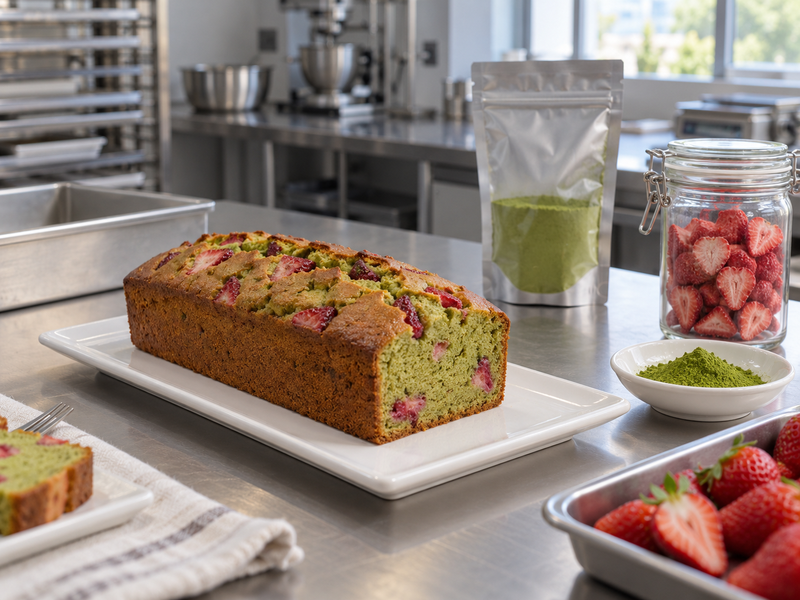
A strawberry matcha loaf combines berry flavor and green tea in a sliceable cake, often with two batters or a glaze. For a bakery, the appealing cross-section is only one part of the brief. The loaf must bake evenly, cut cleanly, hold its flavor, and survive the planned display period. This guide turns a recipe idea into a measured product trial for café, retail, or foodservice buyers.
Contents
- What is a strawberry matcha loaf?
- Which product format suits the sales channel?
- How can a bakery build a repeatable formula?
- Which strawberry ingredient should a team test?
- What matcha works in a baked loaf?
- How should a team test the swirl and crumb?
- What changes when a glaze is added?
- How should the loaf be packed and labeled?
- What should the cost and yield sheet include?
- How can a buyer prepare a supplier brief?
1. What is a strawberry matcha loaf?
Define the cake before choosing ingredients
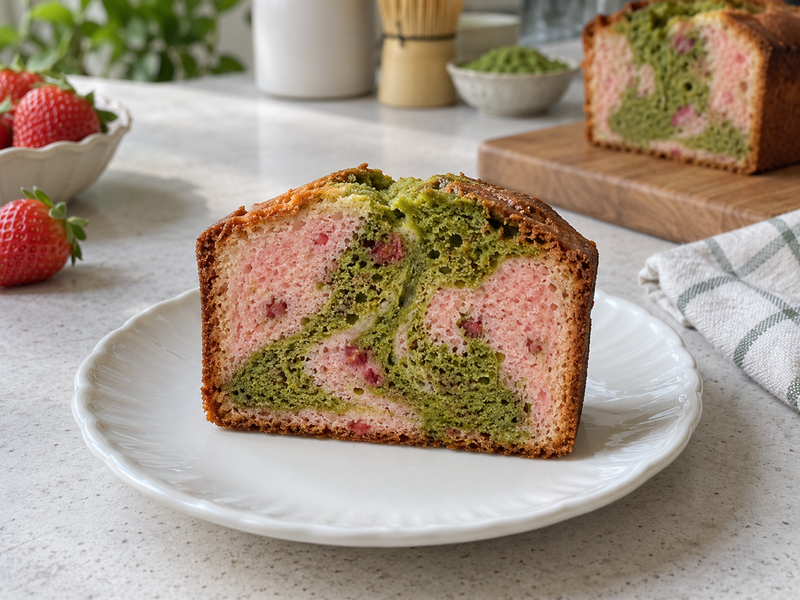
A strawberry matcha loaf is a loaf-pan cake with strawberry and matcha components. The flavors can occupy separate layers, form a loose marble, or appear as matcha cake under strawberry icing. A published Baking A Moment recipe divides one batter, flavors the portions separately, and alternates them in the pan. That approach provides a useful prototype, but it does not set the formula for commercial production.
The phrase on a menu creates expectations. If the product name promises both flavors, the customer should find both in an ordinary slice, not only in an end piece or decorative drizzle. Define the finished slice size, color target, sweetness level, and whether the loaf will be sold whole or portioned. Cut a representative center slice. It reveals more about the product than a top-down photo of the uncut loaf.
For B2B buyers, the initial brief should also name the intended sales setting. A café slice served today, a wrapped supermarket loaf, and a frozen foodservice cake face different packaging and shelf-life questions. Treat them as separate product specifications even when they begin with the same kitchen recipe.
2. Which product format suits the sales channel?
Set a serving and holding plan
The loaf format has several practical advantages: a standard pan, simple portioning, and an exposed cross-section that makes the flavor pairing visible. It also presents risks. Uneven swirls create inconsistent slices, a wet fruit layer can weaken the crumb, and a fragile glaze can stick to a wrapper. Select the sales format before optimizing color or adding a decorative topping.
| Format | Buyer | Trial question | Acceptance evidence |
|---|---|---|---|
| Whole fresh loaf | Bakery counter | Does it slice and display cleanly? | Photos and weights across the day |
| Wrapped individual slice | Convenience or café | Does pack contact damage glaze? | Pack test after planned hold |
| Frozen pre-sliced loaf | Foodservice | Does thawing change texture? | Thaw-and-serve tasting |
| Shelf-stable retail pack | Grocery brand | Is validated shelf life achievable? | Formal product-specific study |
The package changes the cake. A loaf that tastes moist on a cooling rack may collect condensation when packed warm. A slice with fresh strawberry pieces may look attractive immediately and bleed into the surrounding crumb later. Record the time and temperature from oven to packing. For longer distribution, work with a qualified food technologist and testing plan instead of assigning a shelf life from a blog recipe.
3. How can a bakery build a repeatable formula?
Work in weights and percentages
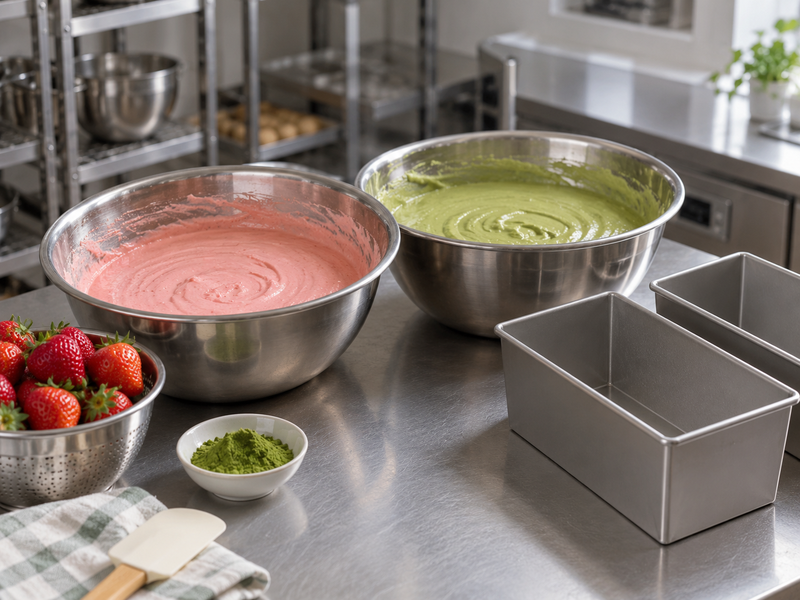
Choose a tested base cake formula, then weigh its total batter and divide it for the two flavor portions. Record grams of flour, sugar, fat, liquid, egg, strawberry ingredient, matcha, and leavening. The percentage of each ingredient relative to flour or total batter lets a team scale from a home pan to several pans without guessing. Keep pan size, fill weight, mixing order, and oven settings fixed through early trials.
Strawberry and matcha additions are not interchangeable. Powdered freeze-dried fruit contributes flavor with little added liquid, while puree adds water and may change batter viscosity. Matcha is a fine dry powder and can form clumps if added without adequate mixing. If the two batters differ greatly in thickness, a neat swirl may collapse into broad layers or leave one flavor concentrated near the bottom. Compare viscosity by observing how each batter falls from the same spatula; a laboratory viscosity measure can follow when the product advances.
Change one component at a time. If the crumb is dry, do not alter the matcha dose, strawberry form, and oven profile in the same batch. Keep a control loaf and a numbered batch record. This protects the team from approving a visually appealing slice whose texture cannot be reproduced on a full production day.
4. Which strawberry ingredient should a team test?
Balance flavor, moisture, and supply
Fresh berries, puree, freeze-dried powder, jam, and flavoring bring different results. A bakery may prefer fresh fruit for a local daily special, yet a packaged cake may need the more predictable water contribution of a dry ingredient. Baking A Moment’s recipe uses freeze-dried strawberries in its cake and icing. Its choice is a recipe example, not proof that every buyer should use the same ingredient.
| Strawberry form | Likely formulation effect | Supply question | Trial checkpoint |
|---|---|---|---|
| Fresh pieces | Localized moisture and fruit pockets | Seasonal size and quality | Bleeding after holding |
| Puree | Stronger wet ingredient contribution | Solids consistency | Batter thickness |
| Freeze-dried powder | Concentrated flavor with low added liquid | Particle size and pack protection | Smooth distribution |
| Jam or filling | Defined ribbon and sweetness | Sugar and fruit specification | Settling during bake |
Ask the strawberry supplier for an ingredient specification, allergen information, and lot identification. Record whether the form contains added sugar or color, since that changes both formulation and a future retail label. Test the cake after cooling. Strawberry aroma can seem strong in the mixing bowl but less distinct in a baked, chilled slice. Compare the product at the temperature in which customers will actually eat it.
5. What matcha works in a baked loaf?
Select by the slice, not the dry powder
A dry sample can look vivid green, but the cake’s fat, sugar, strawberry component, and bake conditions change the visible color and tea flavor. Ask for a food-grade matcha appropriate for baking, then test at least two identified samples under the same formula. A higher priced powder may not produce a better cake; a cheaper powder may need a higher dose or leave more bitterness. The proper comparison uses the finished slice at a specified dose.
Matcha Village can supply candidate grades for a baking trial. Request a current specification for the exact grade and note the sample lot on every test sheet. Ask about package size, storage instructions, expected lead time, and whether a future bulk order will use the same grade code. Supplier marketing terms such as “ceremonial” and “culinary” help identify intended uses, but a buyer still needs a sensory test and product documentation.
| Matcha criterion | How to assess it in a loaf | What to record |
|---|---|---|
| Flavor | Blind taste against a control slice | Tea note, bitterness, finish |
| Appearance | Compare center slices under fixed light | Green hue and brown edge |
| Dispersion | Inspect batter and crumb | Specks or clumps |
| Procurement | Review supplier documents | Grade code, lot, pack, lead time |
Check the day after baking. A café may sell slices later than the initial tasting. Keep the proposed storage and wrapping method consistent across samples so the powder comparison remains fair.
6. How should a team test the swirl and crumb?
Inspect several positions in the loaf
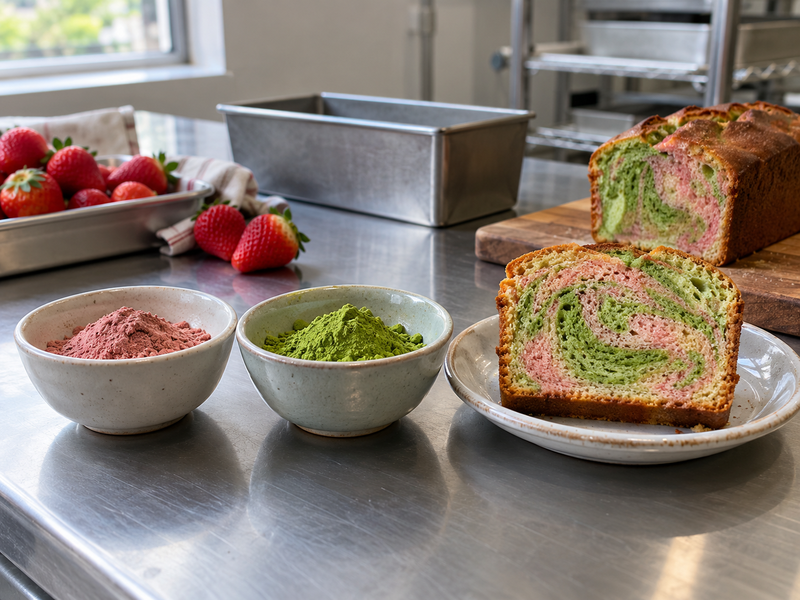
A single hero slice can hide problems. Cut samples from the front, center, and back of each test loaf. Compare the distribution of pink and green, crumb density, tunnels, wet streaks, and crust thickness. Weigh the batter added in each layer. Record the sequence and number of spatula passes used for marbling; freehand swirling without an instruction can make every production loaf different.
For scale-up, test multiple pans in a realistic oven load. Heat flow can differ between a lone center pan and a crowded rack. Note pan material, fill level, rack position, baking time, and cooling method. If a dense strawberry layer sinks, compare batter thickness and depositing order before adding more leavening. If the top is browned while the center remains underbaked, the pan size or oven profile may need revision.
Set a tolerance a packer can use. Perfectly identical marbling is neither realistic nor necessary, but each slice should clearly contain both components. Define reject conditions such as a collapsed center, uncooked streak, or missing matcha portion. The team can then calculate saleable yield and give the production crew a fair standard.
7. What changes when a glaze is added?
Treat glaze as part of the specification
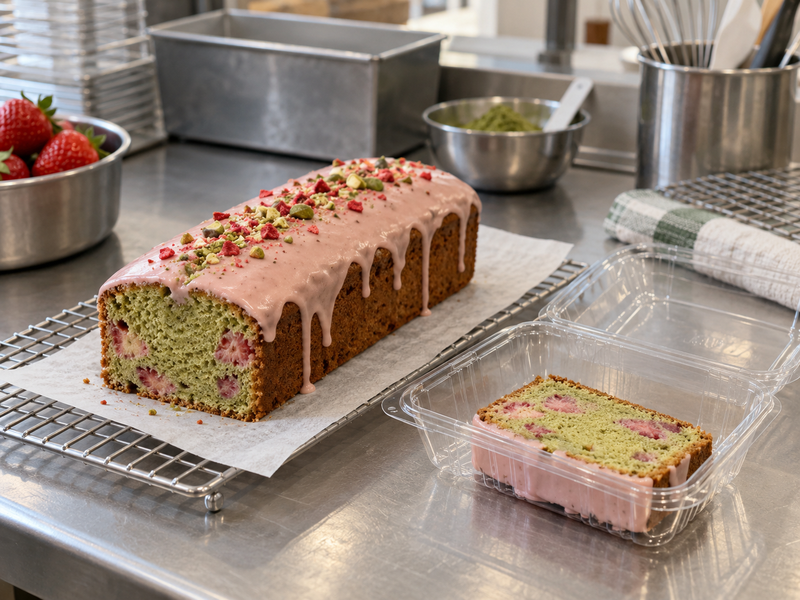
Strawberry icing increases the berry signal and can make a dark baked top look more attractive. It also adds sweetness, handling time, and a new failure point. Apply it only after the cake has cooled enough for the selected icing to set as intended. Test whether glaze sticks to film or tray lids and whether it flakes when the loaf is sliced. A display cake and a wrapped slice may need different finishes.
There are several workable choices: a thin strawberry icing, a plain sugar glaze with berry powder, a piped cream for immediate service, or no glaze at all. The last option may provide the clearest taste of tea. Record icing weight per loaf, application method, setting time, and visible coverage. Do not decide only from photographs; taste the full slice to see whether sugar overpowers matcha.
| Finish | Advantage | Operational check |
|---|---|---|
| Thin set icing | Clear berry cue | Does it stay attached when cut? |
| Soft cream topping | Fresh café presentation | Is chilled holding needed? |
| Powdered fruit dusting | Light finish | Does it rub off in packaging? |
| No topping | Simpler line and label | Are both flavors still clear? |
Packaging settles the decision. Run the same handling test a distributor or café employee will perform, including moving, stacking, opening, and serving the loaf.
8. How should the loaf be packed and labeled?
Review the finished recipe and sales market
The final cake may contain wheat, milk, egg, soy, tree nuts, sesame, or other ingredients depending on the formula and production site. For U.S. packaged foods, the FDA’s current allergen guidance explains how major food allergens must be declared. Local requirements vary, so buyers should have the exact pack and ingredient statement reviewed for the destination market.
Build the label from approved supplier specifications and the weighed recipe, not a draft photo or kitchen shorthand. Check whether a strawberry ingredient contains added sugar, flavors, or colors. Keep batch records that link matcha and strawberry lots with production date and finished packs. For a café counter, provide staff with an ingredient and allergen sheet they can consult during service.
Shelf life needs product-specific evidence. Moisture, glaze, packaging, storage temperature, and handling all affect the result. Do not infer stability from the loaf shape. Test the planned package and distribution conditions, including how the slice looks when a customer opens it. For a chilled or frozen version, include the intended thawing or service instructions in the trial.
9. What should the cost and yield sheet include?
Calculate saleable slices, not only batter cost
Ingredient cost begins with a weighed recipe. Add matcha, strawberry ingredient, base cake materials, glaze, packaging, direct labor, and expected waste. Divide by the number of saleable slices from a real bake. An uneven marble might produce attractive center slices and unsaleable end pieces, so the cut plan belongs in the cost sheet. For a whole-loaf product, account for any units lost to handling or failed pack seals.
| Cost input | Measurement | Common oversight |
|---|---|---|
| Matcha | Grams per loaf × unit price | Comparing powders at different flavor strength |
| Strawberry ingredient | Grams per loaf × unit price | Ignoring added sugar or moisture changes |
| Base and glaze | Actual batch weights | Leaving icing out of cost |
| Labor | Minutes per batch and slice | Underestimating two-batter assembly |
| Yield | Saleable units per bake | Counting damaged slices as sales |
Compare two formulations at the same target slice weight and visual standard. A lower ingredient bill may hide a lower yield. If one recipe collapses more often or takes much longer to marble, its cost per saleable slice may rise. Review price only after the pilot gives a stable yield.
10. How can a buyer prepare a supplier brief?
Send enough detail for a useful sample recommendation
Tell a matcha supplier whether the powder will be baked into one batter, used in icing, or both. Include the destination market, target flavor, estimated dose range under test, annual volume as an estimate rather than a commitment, preferred pack size, and expected launch schedule. Ask for grade-specific samples, current specifications, lot details, storage instructions, relevant test documents, and lead-time information.
Then share results in terms the supplier can act on. “The green layer turned too brown at our approved oven profile” is more useful than “the matcha failed.” “The tea taste vanished under our strawberry glaze” may point to a recipe adjustment rather than a powder change. Matcha Village can propose powder options and discuss bulk or private-label supply after the application and documentation requirements are clear.
Approve the complete system. Retain the accepted sample, final weighed formula, pan and bake specification, pack method, label review, and sensory reference. Repeat the approved trial with a second lot before broad distribution. That gives procurement and production the same basis for deciding whether the next shipment is fit for the loaf.
FAQ
Q1: What is a strawberry matcha loaf? A sliceable cake that combines strawberry and matcha components, often in layers or a marble.
Q2: Must the strawberry layer use fresh berries? No. Fresh fruit, puree, freeze-dried powder, and fillings behave differently. Select by flavor, moisture, and sales format.
Q3: Does a vivid dry matcha guarantee a green cake? No. Judge an identified powder in the finished, cooled slice under consistent lighting.
Q4: Can a bakery assign shelf life from a recipe blog? No. Validate the finished formula, packaging, and distribution conditions.
Q5: What should a buyer ask a matcha supplier? Request samples tied to grade and lot, specifications, relevant documents, pack options, and lead times.