
A matcha spoon can mean a traditional bamboo chashaku, a household teaspoon, or a calibrated scoop used behind a counter. Those tools do different jobs. Tea brands and café operators need to decide whether the spoon is part of a customer ritual, a staff measuring method, or a retail kit. This guide covers the differences, practical dose testing, care, sourcing, and supplier questions.
Contents
- What is a matcha spoon?
- How does a chashaku differ from a measuring spoon?
- Can a spoon measure matcha accurately?
- Which spoon fits a café workflow?
- What materials and finishes should buyers inspect?
- How should a matcha spoon be cleaned and stored?
- What belongs in a retail matcha kit?
- How can importers assess food-contact requirements?
- What should a product inspection plan cover?
- What should buyers ask a supplier?
1. What is a matcha spoon?
Name the intended tool
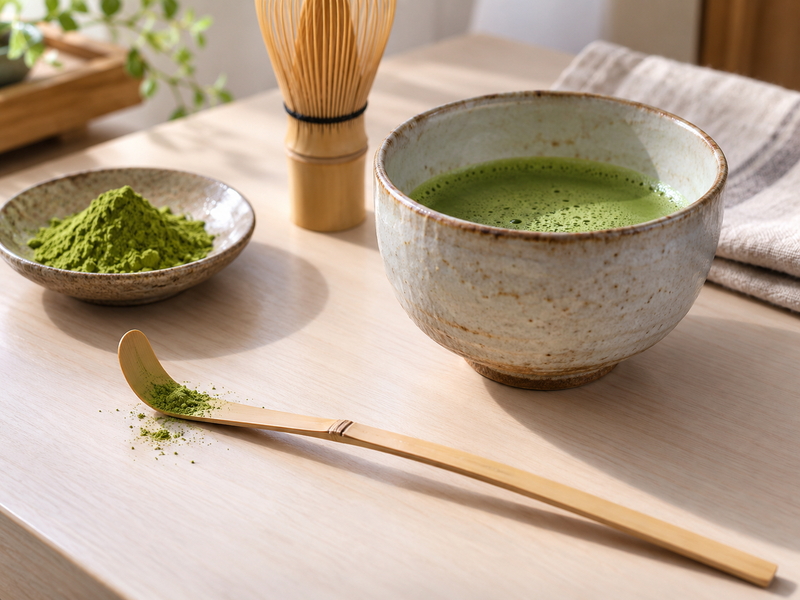
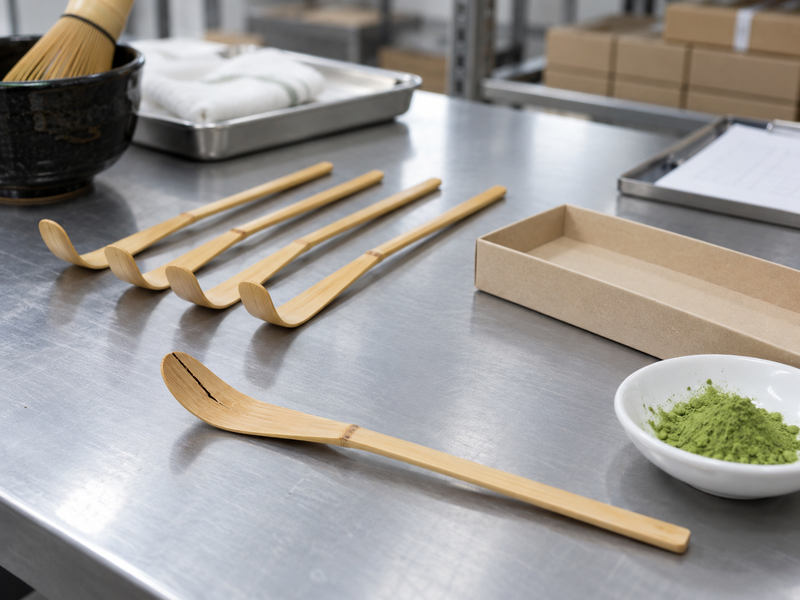
In traditional tea preparation, a chashaku is a narrow scoop used to take matcha from its container. A modern “matcha spoon” might instead be a short metal spoon, a plastic scoop packed with a tin, or a measuring tool marked for a recipe. The phrase describes an accessory category, not a single capacity or material. Ippodo’s chashaku product page shows the curved bamboo form and describes its role in scooping tea.
Buyers should decide what the spoon must do. A gift-set customer may value the quiet ritual and natural appearance of bamboo. A beverage chain may need an easily cleaned dosing utensil that fits a narrow prep station. A manufacturer filling single-serve sachets may have no operational use for a spoon at all, though one could still support a retail kit.
Write the use case on the purchase order. Include whether the spoon touches food, whether it is disposable or reusable, and whether it needs to fit inside a specific tin. Those details lead to a useful specification. “Matcha spoon, green” is too vague for a buyer to inspect consistently.
2. How does a chashaku differ from a measuring spoon?
Ritual serving and operational dosing
A chashaku has a curved tip and long handle. It reaches into a tea container and moves a small amount of powder into a bowl or sifter. Its natural shape varies between pieces. Ippodo calls its own chashaku a deliberately imprecise tool and says that about one and a half heaped ladles correspond to roughly 2 grams in its usucha method. That statement describes Ippodo’s tool and serving style; it is not a calibration for every scoop sold under the same name.
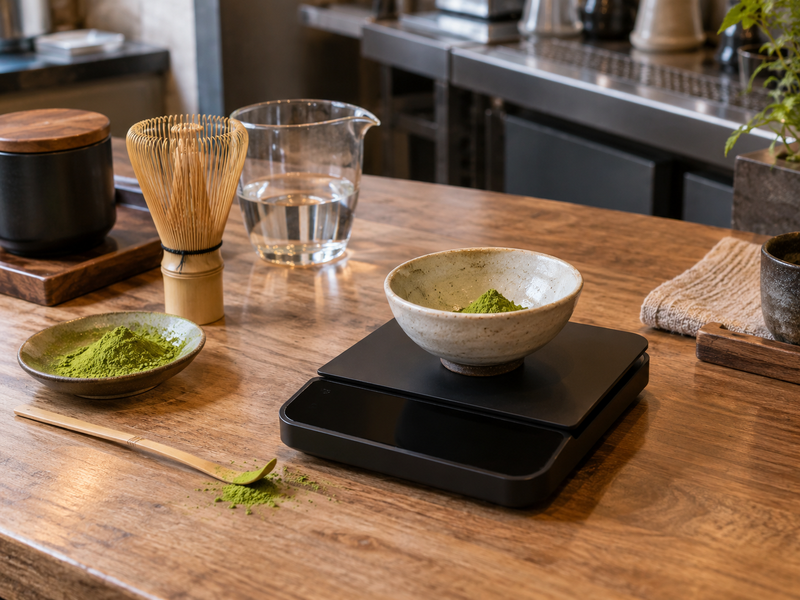
A measuring spoon has a defined volume, but volume still does not guarantee a fixed matcha mass. Heaping, tapping, humidity, and powder density change the quantity. A digital scale measures mass directly and gives a café an easier way to validate a new recipe. Once a team understands the dose, it can test whether a chosen scoop produces acceptable variation during service.
| Tool | Strength | Limitation | Suitable use |
|---|---|---|---|
| Bamboo chashaku | Traditional presentation | Portion varies by scoop | Tea ceremony and premium kit |
| Household teaspoon | Easy to replace | User technique varies | Home instructions with an approximate dose |
| Standard scoop | Repeatable shape | Still measures volume | Fast beverage station after validation |
| Digital scale | Direct mass measure | Slower for every cup | Recipe development and spot checks |
Do not print a universal grams-per-spoon claim. Measure the actual spoon, tea grade, and filling method used in the product.
3. Can a spoon measure matcha accurately?
Calibrate the tool in the intended workflow
The answer depends on the tolerance required. For an individual home bowl, an approximate serving can be acceptable. For a chain beverage with specified flavor and cost, the variance may need tighter control. Ippodo’s basic usucha recipe lists 2 grams of matcha and equates that in its kitchen to one and a half heaped tea ladles or one level teaspoon. This gives context, not a guarantee that any teaspoon delivers exactly 2 grams.
To test a spoon, have several staff members fill it the way they would during a shift. Weigh each portion on an appropriate scale, record the spread, and repeat with a second powder lot. Decide whether the resulting cup variation is acceptable through tasting and cost review. If it is not, change the dosing method rather than telling staff to “scoop more carefully.”
| Calibration step | Record | Decision it supports |
|---|---|---|
| Define fill style | Level or heaped, with photo | Training consistency |
| Weigh repeated scoops | Individual gram values | Portion variation |
| Prepare drinks | Flavor and appearance | Sensory tolerance |
| Calculate cost | Powder used per cup | Margin estimate |
| Recheck new lots | Difference from approved lot | Ongoing control |
Use grams in the master recipe. A spoon can remain a convenient service tool, but the recipe should retain a measurable target.
4. Which spoon fits a café workflow?
Match the tool to cup volume and station layout
An operator preparing one traditional bowl has time to scoop, sift, and whisk. A busy café preparing milk drinks may favor a dedicated scoop or a pre-portioned serving. Consider how staff open the powder container, whether the handle reaches the bottom, and where the used utensil rests. A spoon that falls into a wide bag or catches on a narrow tin slows work and can create handling problems.
Set the beverage recipe by weight before selecting the utensil. Then test the spoon in a realistic rush simulation: several staff members, full and nearly empty packs, and the actual drink vessels. Check whether powder clings to the spoon, drops outside the bowl, or forms clumps when added. A tool that looks elegant in a product photograph may be awkward behind a counter.
A chain should also define ownership and cleaning. Is each station assigned a scoop? Is a clean spare available? Can the chosen material follow the site’s cleaning procedure? Watch one complete shift. The best matcha spoon for retail branding may differ from the best dosing tool for beverage production, and using two tools can be a sensible decision.
5. What materials and finishes should buyers inspect?
Specify surfaces that will touch powder
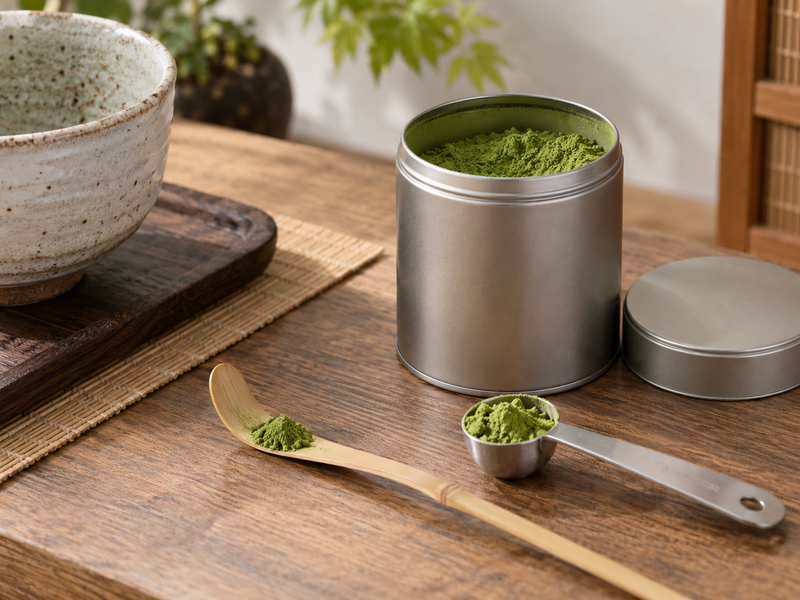
Bamboo offers the classic chashaku shape and a light feel. Stainless steel and other manufactured materials may be easier to standardize in size, while wood and ceramic offer different presentation options. No material is automatically suitable for every food-contact market or cleaning routine. Ask the supplier to identify the material, coating, adhesive, finish, and intended use. Inspect the food-contact surface for splinters, burrs, chips, and rough edges.
| Material or feature | Buyer check | Why it matters |
|---|---|---|
| Bamboo | Smooth tip and sound handle | Natural pieces can vary |
| Metal | Edge finish and joint design | Rough seams trap powder |
| Coating or paint | Food-contact documentation | Decoration may touch tea |
| Scoop capacity | Tested mass with actual powder | Volume alone does not set dose |
| Handle length | Fit in the pack and vessel | Affects daily use |
For a kit, inspect color and finish under ordinary light, but write functional reject criteria as well. A beautiful utensil still needs a sound edge. Document the accepted sample and compare incoming cartons against it. If the product is advertised as dishwasher safe or heat resistant, require evidence for that exact construction before printing the claim.
6. How should a matcha spoon be cleaned and stored?
Follow material-specific care instructions
The cleaning method depends on the item. Ippodo tells owners of its bamboo chashaku to wipe it with a dry cloth or tissue and avoid water or soap. That advice belongs to that product’s design. A commercial kitchen may operate under a different cleaning policy, which can make a traditional chashaku a poor choice for repeated shared use. Do not copy one brand’s bamboo care instructions onto a metal or coated spoon without checking the supplier’s guidance.
Keep clean utensils protected from dust and accidental contact. Store dry bamboo away from heat as advised by its maker. For a reusable café scoop, establish when it is changed, cleaned, and stored, and document the process under the site’s food safety system. Avoid leaving any scoop buried in powder if that conflicts with the container’s closure or hygiene procedure.
Care instructions belong in the specification. If a retail kit includes a bamboo spoon, print a short, accurate care note. If the product is intended for a high-volume station, ask whether the material and design fit the operator’s approved cleaning process before placing a bulk order.
7. What belongs in a retail matcha kit?
Make the kit usable rather than crowded
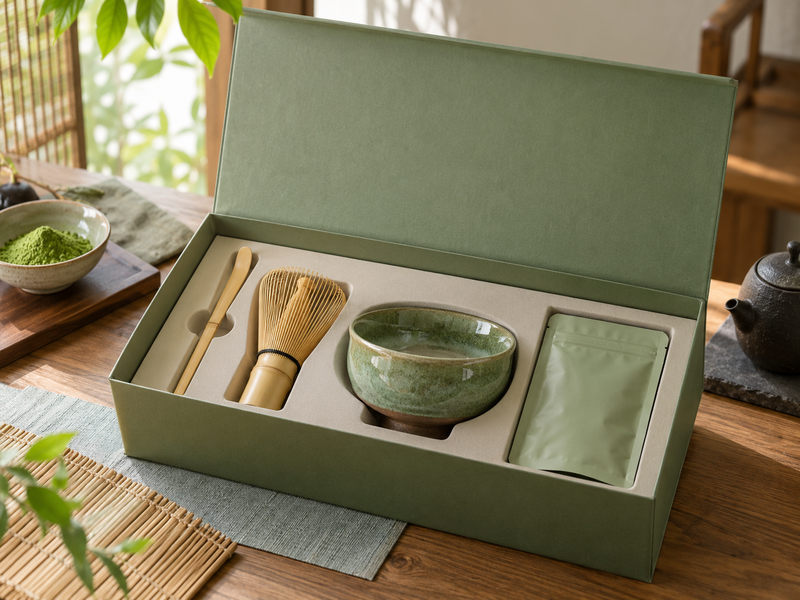
A basic retail kit can pair matcha with a spoon, a sifter, and a whisk or preparation instructions. The spoon should fit the chosen container, and the instructions should state whether portions are approximate or weighed. Ippodo’s 2-gram usucha recipe is a useful example of clear preparation guidance. A branded kit should provide its own tested instructions for the matcha it actually contains.
Consider shipping and unboxing. A long bamboo chashaku can bend if loose inside a large carton, while a heavy metal scoop can dent a thin tea tin. Test the inner tray or sleeve with the real components and perform the ordinary handling expected in distribution. Keep the spoon separate from loose powder if its packaging material could shed fibers or coating into the tea.
| Kit decision | Question | Verification |
|---|---|---|
| Spoon and tin fit | Can the user scoop near the bottom? | Physical fit test |
| Protection | Does the tip survive transit? | Pack and handling test |
| Instructions | Is the serving method clear? | User preparation test |
| Replacement | Can buyers reorder the utensil? | Supplier continuity check |
A kit should teach one good cup. Extra accessories add cost and packing work; include them only when they improve preparation or the intended gift experience.
8. How can importers assess food-contact requirements?
Review the destination market and actual materials
If the spoon is intended to touch matcha, food-contact requirements may apply. The European Commission describes Regulation (EC) No 1935/2004 as the general EU framework for food-contact materials. Additional rules can depend on the specific material. In the United States, the FDA Food Code serves as a model for retail food rules; local adoption and requirements vary.
Ask the supplier for the exact construction and available compliance documentation. A declaration for a plain stainless-steel utensil may not cover a painted handle or glued ornament. Check whether testing covers the conditions of intended use, such as dry powder contact, washing, or heat exposure. Have the importer or local compliance adviser confirm what the destination market requires before labeling or distributing the accessory.
Keep utensil compliance separate from tea compliance. Matcha specifications and food-contact declarations answer different questions. A tea supplier may offer both in a bundled kit, but buyers still need documents for each component and a way to trace the finished pack to its parts.
9. What should a product inspection plan cover?
Inspect function, appearance, and packing
Agree an approved sample and a written drawing or dimension sheet before production. Define acceptable variation in length, tip curvature, scoop volume if relevant, and surface finish. For bamboo, natural grain and slight shape differences can be acceptable while splinters and cracks are not. For manufactured scoops, check whether edges are smooth and whether the measuring cavity matches the approved tool.
Open cartons from different positions in the shipment. Inspect the utensils, inner sleeves, labels, and quantity. Test fit with the actual matcha container. If a kit includes a printed serving claim, perform a dosing check with the supplied powder. A sample from a different factory run may not handle the same way as the original approval piece.
| Inspection point | Acceptable evidence | Reject example |
|---|---|---|
| Surface | Smooth food-contact area | Splinter, burr, or chip |
| Dimensions | Within agreed drawing tolerance | Will not fit intended tin |
| Portion behavior | Tested against recipe target | Excess variation for café use |
| Pack | Protective and clean | Crushed tip or loose debris |
| Marking | Correct agreed wording | Unsupported “2 g per scoop” claim |
Record defects by lot. A count of damaged tips or poor fits gives the supplier something concrete to correct and helps the buyer decide whether to release the shipment.
10. What should buyers ask a supplier?
Keep tea and accessory questions distinct
For the utensil, request material details, dimensions, finish, care instructions, packing method, customization options, production lead time, and food-contact documents appropriate to the target market. Ask for an unbranded production sample, not only a rendering. If a private-label kit is planned, request samples with the final tin or pouch so the fit can be checked.
For the matcha, ask for the grade-specific specification, lot identification, storage advice, and a sample large enough to test the intended dose. Matcha Village supplies tea products and can discuss kit or private-label needs in a sourcing brief, but claims about any spoon should be confirmed against the selected accessory and its documents. The tea’s taste and the utensil’s performance are separate approval steps.
Write the purchase decision as two approvals. One approves the matcha for its flavor and quality specification. The other approves the matcha spoon for function, care, packing, and market requirements. Only after both pass should the team approve a combined retail kit or service instruction.
FAQ
Q1: What is a matcha spoon called? The traditional bamboo scoop is a chashaku. “Matcha spoon” can also describe modern measuring or serving tools.
Q2: How many grams does one chashaku hold? There is no universal fixed amount. Ippodo describes roughly 2 grams as one and a half heaped scoops with its method.
Q3: Should cafés dose matcha by spoon or scale? Set the master recipe by weight, then validate any service scoop against that target.
Q4: Can a bamboo spoon go in a dishwasher? Follow its maker’s instructions. Ippodo advises dry wiping for its bamboo chashaku.
Q5: What documents should an importer request? Ask for material and food-contact information for the spoon, plus separate specifications and lot details for the tea.