
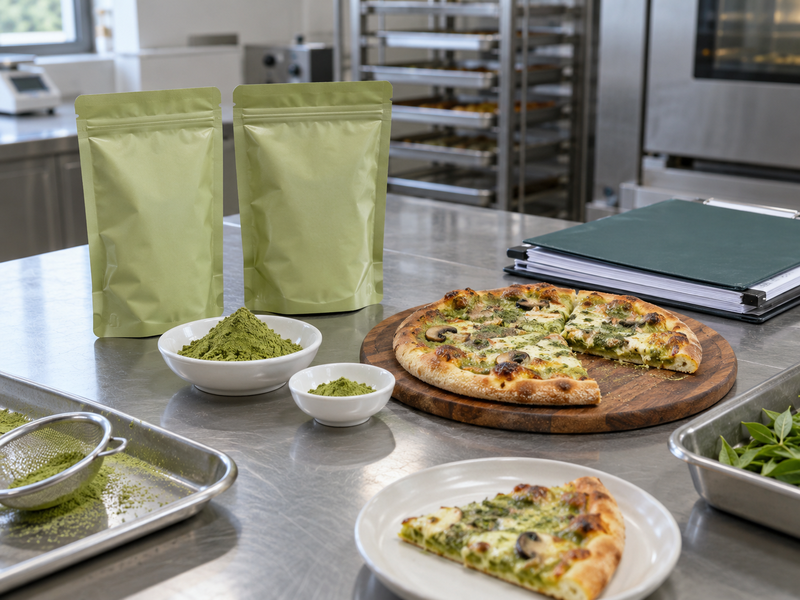
Matcha pizza puts powdered green tea into a familiar format, usually a savory dough or a dessert-style base. For a café or food manufacturer, the real challenge is keeping the tea recognizable after baking while preserving the texture customers expect from pizza. This guide covers formulation choices, kitchen trials, supplier questions, and menu economics without promising that one recipe suits every oven.
Contents
- What counts as matcha pizza?
- Which format fits a commercial menu?
- Where should matcha go in the recipe?
- How should a kitchen choose matcha powder?
- What should a first dough trial measure?
- Which toppings make sense with the tea flavor?
- How can a team control color and flavor in service?
- What food safety and labeling issues matter?
- How can buyers calculate a workable cost?
- What should a supplier sample request include?
1. What counts as matcha pizza?
A format rather than a fixed recipe
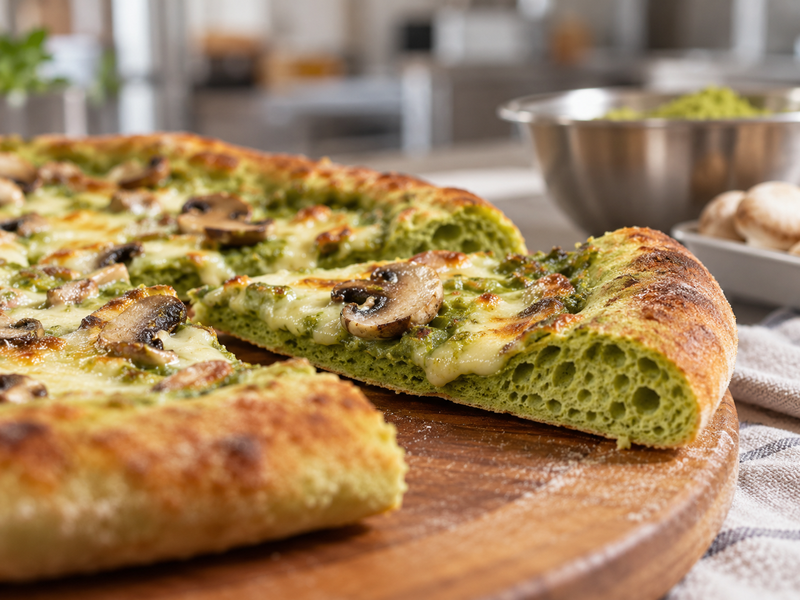
Matcha pizza can mean pizza with matcha mixed into its dough, a baked base finished with a matcha sauce, or a sweet flatbread with tea-flavored cream. Those products share a name but behave differently on a production line. Specify the format before discussing powder price. A green dough needs reliable mixing and baking performance. A cold topping needs dispersion and a flavor profile that works with dairy or plant-based cream.
The concept is not hypothetical. Aiya’s published recipe puts culinary matcha directly into yeasted dough, then adds tomato sauce and mozzarella. Other published examples use mushrooms or strawberries. They show the range of possible formats; they do not prove commercial demand in a particular market. Start with the eating occasion. A savory lunch slice, a limited dessert, and a packaged crust each call for different portion sizes, equipment, and shelf-life testing.
For procurement, write a one-sentence product definition: “individual savory pizza with matcha in the crust, baked to order,” for example. That sentence keeps kitchen trials focused and stops the team from comparing a dough sample with a matcha frosting sample.
2. Which format fits a commercial menu?
Choose around throughput and customer expectations
A made-to-order café can test a matcha dough without changing its entire menu. A chain may prefer a par-baked crust, while a bakery can sell a sweet pizza by the slice. Each route changes preparation time, waste, and quality checks. A vivid green photo may win a first order; repeat sales depend on a crust customers want to eat.
| Format | Likely sales setting | Main production question | Sensory risk to test |
|---|---|---|---|
| Matcha in yeasted crust | Café or restaurant | Can dough proof and bake consistently? | Tea bitterness after baking |
| Matcha in thin flatbread | Quick-service menu | Can staff portion evenly? | Dry or brittle edge |
| Matcha in cold sauce | Dessert bar | Does powder disperse smoothly? | Grit and color separation |
| Matcha in cream topping | Bakery counter | Can the topping hold through service? | Sweetness hiding tea flavor |
The service model decides the trial. For a restaurant, record order-to-serve time and whether staff can assemble the pizza during a rush. For packaged food, conduct shelf-life and packaging tests under the conditions in which it will be sold. Do not borrow a café holding time for a frozen retail product. A foodservice distributor should also ask whether each account has a pizza oven, a convection oven, or only a reheat station.
3. Where should matcha go in the recipe?
Dough, topping, or both
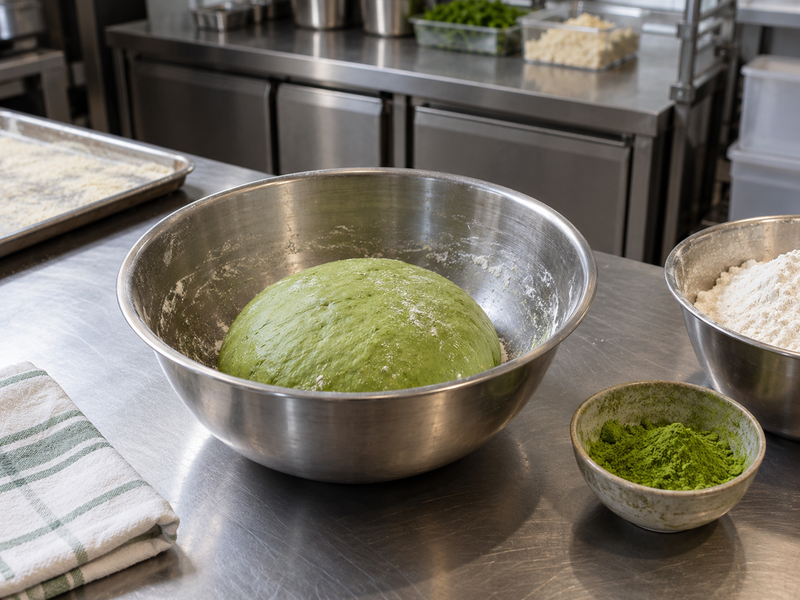
Matcha in dough gives every bite a tea note but also exposes the powder to mixing, proofing, and baking. A post-bake finish can preserve a fresher tea impression, although it adds an assembly step and may not suit delivery. Putting matcha in both components can work, but the combined dose should be judged in a complete serving rather than by tasting ingredients separately.
Begin with two controlled prototypes: one dough formulation and one finish. Keep flour, hydration, proofing time, sauce, and bake settings constant while changing only the matcha treatment. Use grams per batch, not spoonfuls. Powder packs differently by scoop and can make a comparison meaningless. Note finished crust color, aroma, bitterness, crumb, and whether the topping masks or supports the tea.
A dough trial may need adjustment. Aiya’s recipe uses matcha in a yeasted dough and describes extra yeast in its own formulation. That is a recipe-specific choice, not a universal yeast rule. Check your own dough before changing the formula. If fermentation lags, compare a control batch and examine mixing temperature, yeast condition, salt, sugar, proofing environment, and powder addition. Then alter one variable at a time.
4. How should a kitchen choose matcha powder?
Buy for the finished application
The most expensive drinking matcha is not automatically the strongest choice for a baked crust. Heat, flour, sauce, and cheese change what the customer can taste. Ask for food-grade powder intended for cooking, plus a second candidate for comparison. Test both at the same inclusion level in the same finished pizza. Record color in the crust interior and on the surface, since browning can make the two look different.
| Supplier question | Why the answer helps | Trial evidence to keep |
|---|---|---|
| What is the ingredient specification? | Confirms identity and declared parameters | Current specification sheet |
| What are the lot identifiers? | Links samples with later deliveries | Lot code and sample date |
| How is the powder packed? | Affects storage and line handling | Pack size and seal type |
| Which documents are available? | Supports buyer review | Relevant test reports and declarations |
| Can the same grade be supplied later? | Avoids silent reformulation | Grade code and change process |
Matcha Village offers culinary and other matcha options for application trials, but a buyer should request the specification for the exact grade proposed. Avoid interpreting a grade name as a guaranteed color, origin, or sensory standard. Taste the baked result. A powder that looks bright in a dry bowl may taste flat in tomato sauce. The winning sample is the one that meets the product brief at a workable use rate.
5. What should a first dough trial measure?
Keep a simple batch record
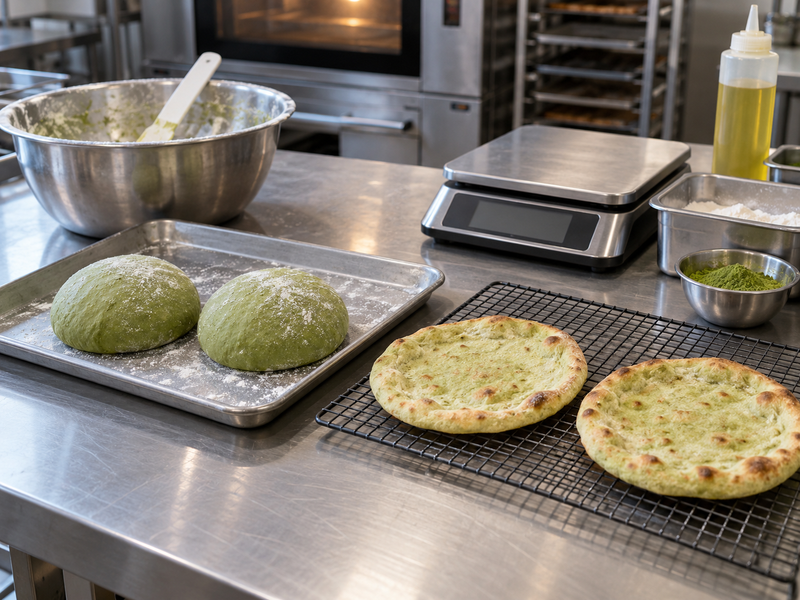
Write down the control recipe before adding matcha. Include flour weight, water weight, dough temperature, mixing time, proofing conditions, ball weight, oven setting, bake duration, and finished weight. Trial one or two matcha inclusion levels chosen by the development team. Because recipes and ovens vary, those levels are starting experiments, not published performance claims. Repeat the promising batch on another day with a fresh sample portion.
Measure attributes the customer can notice and staff can repeat. A photograph under stable lighting helps compare color, while a tasting sheet helps separate tea flavor from topping flavor. Note the time between opening the powder pack and mixing it into dough. Store an unopened reference sample if later lots need comparison.
| Checkpoint | Record | Reason |
|---|---|---|
| Dough after mixing | Temperature, feel, visible specks | Catches dispersion or handling changes |
| After proofing | Volume and handling | Shows whether process still works |
| Baked crust | Top, edge, and crumb appearance | Separates browning from interior color |
| Tasting | Aroma, bitterness, balance | Judges the actual serving |
| Next-day review | Texture under planned storage | Tests a realistic sales window |
One batch cannot establish consistency. If a result looks promising, test it with the intended oven, staff, portioning tool, and toppings before writing a menu description or ordering bulk inventory.
6. Which toppings make sense with the tea flavor?
Build a short, testable menu
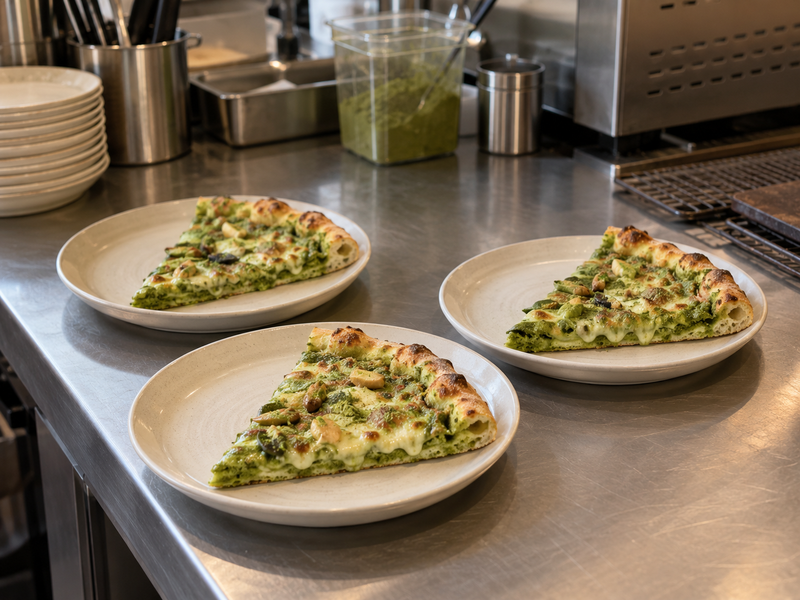
For savory pizza, start with mild components that leave room for the tea note: mozzarella, mushrooms, a restrained white sauce, or vegetables. Tomato sauce brings acidity and a strong flavor, so test it separately rather than assuming the tea will remain obvious. Aiya’s public recipe shows that a tomato-and-mozzarella version is possible, but your final product should reflect your own tasting and customer base.
A sweet format can pair matcha cream with strawberries, white chocolate, or a plain dairy base. The fruit supplies contrast; the matcha supplies a slightly bitter edge. Keep sauces and toppings in measured portions. A generous cream layer can make the pizza attractive while hiding the feature named on the menu. Another operational issue is moisture: fresh fruit may soften a thin crust during display or delivery.
Run a small blind tasting with the intended buyers or menu team. Give them the same crust with two topping sets and ask which version reads as “matcha pizza” without showing labels. The answer may change with serving temperature. Taste immediately after baking and after the planned holding period. The best topping is one that works under the actual service conditions, not only in a product-development room.
7. How can a team control color and flavor in service?
Standardize what staff can control
Matcha color varies across powders and appears different under warm display lights, daylight, and camera settings. Baking adds browning. Specify an acceptable finished range using reference photos taken under fixed light, and retain a physical or digital standard from an approved production batch. Do not set a single green hex code as a purchasing specification for baked pizza; a screen color cannot capture crumb texture or oven browning.
Keep powder sealed, dry, and protected according to the supplier’s storage instructions. Portion by weight. Train staff to add matcha at the same mixing stage, since uneven blending creates dark streaks and pale sections. For a cold finishing sauce, check whether powder settles during service and define a mixing routine if needed.
| Variable | Control method | What to check at service |
|---|---|---|
| Powder dose | Weighed batch sheet | Correct green intensity and flavor |
| Mixing | Set addition point and time | No clumps or streaks |
| Oven load | Consistent placement and bake check | Edge and base cooked as intended |
| Topping amount | Portion cup or scale | Tea remains perceptible |
| Holding | Approved time and temperature plan | Texture after expected delay |
Keep the release standard practical. A shift lead should know when to serve, remake, or hold a batch for review. If two powder lots look different, compare them in the same complete recipe before declaring either unacceptable.
8. What food safety and labeling issues matter?
Treat the whole pizza as the product
Ingredient control covers much more than matcha. A savory pizza may contain wheat, milk, sesame, fish, or other allergens depending on its crust, sauce, and toppings. For packaged food in the United States, the FDA identifies nine major food allergens and explains the relevant labeling framework. Rules differ by market and format, so a local regulatory review is needed before selling a retail pack.
Ask each supplier for a current specification and allergen information. Map shared equipment and utensils, especially when a sweet pizza uses nuts or a savory version uses fish. Record the full ingredient list and the finished product’s storage plan. A powdered tea ingredient does not make a baked pizza shelf stable; shelf life depends on the entire formulation, process, pack, and distribution conditions.
For foodservice, staff need a clear answer when a customer asks what is in the crust or topping. Keep the answer tied to the approved recipe. Do not describe the dish as “detox,” “antioxidant rich,” or suitable for every diet without a review of the final product and market rules. The useful claim is straightforward: the recipe contains matcha, and the menu states where it appears.
9. How can buyers calculate a workable cost?
Model cost per saleable serving
The powder’s price per kilogram says little on its own. Multiply its unit price by grams used in one pizza, then add dough, toppings, labor, packaging, expected waste, and delivery costs. If a cheaper powder requires a higher dose to give the same finished flavor, compare the cost at the sensory target rather than at equal grams. If a better powder reduces rejects or permits a simpler topping, account for that as well.
| Cost item | Calculation to use | Question for the trial |
|---|---|---|
| Matcha | Price per gram × grams per pizza | What dose meets the flavor target? |
| Base ingredients | Recipe quantity × purchase cost | Does the crust need reformulation? |
| Toppings | Standard portion × purchase cost | Which topping stays within target cost? |
| Waste | Unserved units × full unit cost | How many remain at close? |
| Packaging | Pack plus label plus handling | Does delivery affect presentation? |
Use an actual quotation and a measured recipe before setting a selling price. A pilot is also a cost test. Record preparation time and the percentage of saleable crusts. For a distributor, test whether customers can reproduce the recipe with ordinary equipment; otherwise a low ingredient price may turn into a high support burden.
10. What should a supplier sample request include?
Request evidence that supports a decision
Send the supplier the intended use, the target market, estimated batch size, preferred pack size, and a brief sensory description. Ask for two clearly identified grades when possible and state that both will be tested in the same pizza formulation. Request available specifications, lot identifiers, storage guidance, relevant safety documents, and commercial details such as lead time and minimum order quantity. A supplier can only propose a relevant option when it knows whether the powder will be baked in dough or added after baking.
Share the trial outcome in concrete terms: the dough handled well, the green disappeared after baking, or the flavor became too bitter with tomato sauce. This lets the supplier adjust its recommendation without inventing a universal “pizza grade.” Matcha Village can discuss culinary matcha and bulk supply against that brief, subject to sample approval and current documentation.
End with a repeatable decision. Approve one grade, one recipe, one process sheet, and an acceptable finished range. Then compare a second lot before rollout. A menu launch should wait until kitchen staff can make the same pizza on a busy day and buyers know how the next powder shipment will be checked.
FAQ
Q1: What is matcha pizza? A pizza or flatbread that includes matcha in the dough, a topping, or both. The exact format should be stated on the menu.
Q2: Can matcha be baked into pizza dough? Yes. Published recipes such as Aiya’s do this, but the formulation and oven need their own trials.
Q3: Is culinary matcha always the right choice? It is a sensible candidate for testing. Choose by finished flavor, appearance, documentation, and cost rather than the grade label alone.
Q4: How should a business price matcha pizza? Cost the approved matcha dose and the complete saleable pizza, including toppings, labor, packaging, and waste.
Q5: What should a buyer ask a matcha supplier? Share the application brief and request grade-specific samples, specifications, lot information, storage guidance, and commercial terms.