
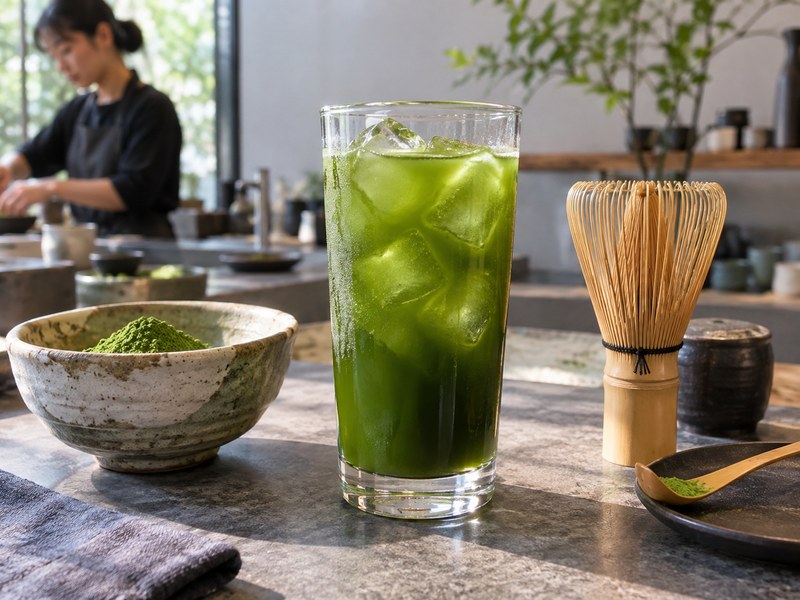
Iced matcha tea is matcha powder dispersed in cold water and served over ice, usually without milk. For a café, the challenge is a drink that tastes clean at the last sip as well as the first: cold powder can clump, ice dilutes unevenly, and a batch left standing settles. A weighed concentrate mixed for each order solves much of that problem. The consumer recipe at Oh, How Civilized shows a cold-water shaking method; the following guide turns that idea into a measurable service spec for buyers, beverage developers, and baristas.
1. What counts as iced matcha tea?
Iced matcha tea contains whole ground tea leaf, water, and ice. A sweetener may be optional, but milk changes the drink into an iced matcha latte. This simple distinction helps a buyer choose powder: water exposes bitterness, coarse particles, and stale aroma that a sweet dairy base may conceal. It also makes menu claims easier to manage. If your recipe uses a premix with sugar, name it accordingly and confirm the ingredient list before calling it pure matcha.
How does it differ from cold-brewed leaf tea?
Cold-brewed leaf tea is an infusion. Leaves remain in water and are later removed. Matcha particles remain in the cup, so cold mixing is dispersion rather than extraction followed by filtration. That is why a clear-looking drink is not the goal, and a little settling is normal. A short stir before drinking is an honest service instruction. A café may still use “cold brew matcha” as familiar menu language, but staff should be able to explain what they actually do. The reference recipe makes this point clearly while using a shaker and a small portion of water.
| Drink | Base | What the customer receives |
|---|---|---|
| Iced matcha tea | Matcha, water, ice | Full leaf powder in suspension |
| Iced matcha latte | Matcha, milk or plant drink, ice | Creamier, more opaque drink |
| Cold-brewed green tea | Tea leaves, water | Filtered infusion |
2. Which matcha works best in cold water?
Select powder by tasting it in the intended recipe, not by the seller’s grade name alone. In water, look for a clean tea aroma, a balanced finish, and a texture that feels fine rather than sandy. Bright color can help the drink look fresh, but photographs and color labels cannot tell you how a lot will taste. Ask for lot-linked specifications, a sealed sample, an ingredient declaration, and documents required for your destination market. Then run the same blind tasting at the same concentration for each candidate.
What should a purchasing panel record?
Record dry aroma, color after mixing, initial flavor, bitterness after dilution, visible clumps, and residue at the bottom after a defined wait. A cheap powder that demands extra syrup or a higher dose may cost more per acceptable cup. Conversely, the most expensive sample may be unnecessary for a sweetened drink. Test one plain recipe and one intended menu variant, and keep the approved sample as a reference. Matcha Village’s pure matcha range can be assessed with the same protocol; supplier category labels should not replace your own cup results.
| Sample check | Simple method | Record |
|---|---|---|
| Flavor | Blind tasting at fixed dose | Notes and panel preference |
| Texture | Inspect final sip | Grit or smoothness |
| Dilution | Taste at service and after 10 minutes | Flavor drift |
| Documents | Compare sample and specification lot | Traceable match |
3. How much powder and water should a café start with?
An initial test can use 2 g matcha, 40 mL cold water for a concentrate, another 150 mL water, and a measured 120 g ice in a suitable cup. These are development starting points, not a universal formula. Powder strength, ice shape, cup size, and local preference will move the target. Weigh powder because a teaspoon changes with density and how the barista fills it. Measure water and ice separately; “fill the cup” is too vague for costing or training.
How can you refine the ratio?
Make three coded samples at 1.5 g, 2 g, and 2.5 g with all other quantities fixed. Taste them immediately and after the typical customer carry time. If the drink starts good but becomes thin, change ice and water balance before increasing powder. If it is harsh from the start, compare powder lots or reduce concentration before masking the problem with syrup. Write the chosen recipe in grams and milliliters, including cup size and ice type. Run the trial again with the actual service water; minerals and off-odors in water can change how a delicate tea is perceived.
4. How do you prevent clumps without hot water?
Cold water wets matcha slowly. Dumping powder onto a full cup of ice often leaves dry islands floating near the surface. Mix a small concentrate in a shaker, sealed jar, or suitable blender vessel before adding the remaining water. A fine sifter can help with powder that has compacted in storage. For a quick counter order, shaking powder with a little water gives room for the particles to separate. Use equipment that seals reliably and is easy to wash between drinks.
Which mixing method belongs on the bar?
Compare a hand whisk, shaker, and powered mixer using the same dose and stopwatch. Check the cup immediately, then inspect the bottom after five minutes. A whisk may suit a visible craft service but needs adequate bowl space. A shaker may be faster for a small concentrate; it also creates a predictable staff motion. A powered tool may suit volume, provided cleaning and cross-contact control fit the line. The best method is the one your team can repeat on a rush shift, not the one that looks smooth in a single demonstration.
| Tool | Useful setting | Test before approval |
|---|---|---|
| Bamboo whisk | Counter demonstration | Breakage, cleaning, speed |
| Shaker | Made-to-order concentrate | Seal, clumps, wash cycle |
| Powered mixer | High-volume station | Splash, cleaning, texture |
5. What do ice and water change in the cup?
Ice is an ingredient with a mass, source, and melt rate. A cup packed with small crushed ice chills quickly but dilutes faster than a cup with larger cubes under the same conditions. For iced matcha tea, that change can make a well-balanced opening sip feel weak before the customer finishes it. Set a target ice weight rather than an approximate scoop, and check how it fits the cup after the full liquid volume is added. Clean water matters for both the concentrate and the ice.
How should a shop test carry time?
Serve the approved recipe in the intended cup with its lid. Taste at handoff, after five minutes, and after fifteen minutes under the conditions customers actually face. Note sweetness, bitterness, temperature, and visible separation. If most sales are takeaway, the later sample may be the one that decides whether a customer reorders. Try the same test with the alternative ice your shop uses when the machine is busy. A written substitution rule keeps staff from changing two variables at once when supply fluctuates.
6. Can you batch iced matcha tea ahead of service?
You can prepare measured components ahead, but a mixed pitcher is not automatically a stable ready-to-pour product. Matcha settles because its particles remain in the liquid. A re-shake may restore appearance, yet time, temperature, sanitation, and flavor still need a local holding rule. The home recipe’s comment thread also notes that premixed matcha sinks and needs shaking. Commercial service adds another question: whether the container and handling method meet the food rules that apply in your market.
Which prep model keeps service predictable?
For low volume, weigh powder into covered single-use portions and mix each order. For a short rush, a properly controlled concentrate may help, if your food safety plan defines preparation time, refrigerated holding, agitation, and discard. Do not invent a shelf life from color alone. Record when each batch was made and evaluate microbiological and sensory risks with your food safety lead before extending hold time. If you plan a packaged beverage rather than same-day café service, commission a separate formulation and shelf-life validation. A countertop pitcher is not a substitute for commercial product development.
| Prep model | Speed advantage | Control needed |
|---|---|---|
| Powder per order | Fresh mix | Staff dose and mixing |
| Portioned dry powder | Faster weighing | Portion labeling and storage |
| Short-hold concentrate | Rapid assembly | Time, temperature, agitation |
| Packaged RTD | Distribution | Process and shelf-life validation |
7. How should sweetness and flavor additions be handled?
Plain iced matcha tea lets customers judge the leaf. A sweetened option may sell better in a particular market, but a syrup changes flavor, cost, and the menu description. Start with an unsweetened reference cup. Then test measured syrup increments against it, keeping matcha and liquid volume constant. Lemon, fruit, and sparkling water can work as separate recipes; each changes acidity, foam, color, and dilution. Do not fold them into one vague “iced matcha” procedure.
What should appear on a menu and recipe card?
State whether the default drink is sweetened. Give staff an exact syrup measure and define what “less sweet” means operationally. If you use a matcha latte powder or blend, check its sugar and dairy ingredients before offering a dairy-free or unsweetened claim. Keep a separate allergen review for each flavor addition. Your menu can be brief while the production card stays precise. For instance, the customer sees “iced matcha with optional vanilla,” while the barista sees powder mass, concentrate water, final water, ice, and a syrup increment.
8. What makes an iced matcha service profitable?
Calculate cost per served cup, including powder, syrup, cup, lid, straw where used, and realistic waste. Powder price per kilogram is useful only after you set dose and assess how much product is discarded from opened packs. A stronger but better-performing powder could yield a lower cost per accepted cup than a bargain lot that requires a high dose. Labor also matters: a recipe that takes an extra minute can crowd the bar during a rush even if ingredient cost is low.
Which numbers belong in a pilot?
Track order time, remakes, powder grams per cup, ingredient waste, and complaints about clumps or weak taste. Use the same three-day window for each candidate recipe, ideally covering a busy period. Record modifications customers request. If many ask for milk, you may need a separate latte offer rather than quietly changing the tea spec. For private-label packs, test whether consumers can reproduce the intended cold drink at home with the instructions and tools supplied. The economics of a retail pouch depend on successful repeat preparation, not just its shelf price.
| Metric | How to measure | Decision use |
|---|---|---|
| Powder cost | Dose × price per gram | Recipe margin |
| Assembly time | Start to handoff | Bar capacity |
| Remakes | Count and reason | Training or powder issue |
| Carry-time taste | Blind panel at set intervals | Takeaway quality |
9. What should a buyer request from a powder supplier?
Ask for a specification tied to the offered product, ingredient statement, origin information, lot identification, applicable test records, packaging details, and available formats. For a foodservice buyer, sample stability across reorder lots matters more than an attractive single pouch. Request a sample large enough for several shifts and recipes. If your business needs organic or other certified claims, verify the exact certificate scope and current validity for the product and market. Do not infer that one supplier certificate covers every item it sells.
How do you compare two offers fairly?
Specify your expected monthly volume, serving dose, preferred pack size, and destination before asking for a quote. Compare landed cost and lead time alongside sensory results. Reclose and use a sample pack under ordinary bar conditions to see whether powder stays workable. Ask what happens when an approved lot runs out and how a replacement is reviewed. Matcha Village describes bulk wholesale supply and application options; ask for documents and current commercial terms against your written brief rather than relying on a generic catalog claim.
10. How can a café launch a consistent iced matcha tea?
Approve one powder lot, one recipe, one cup, and one mixing method before training the whole team. Run a small pilot across quiet and busy shifts. Place the scale, water measure, shaker or whisk, and cleaning supplies where staff can use them without crossing the bar repeatedly. Photograph the target cup, but pair the image with tasting notes and a measured recipe. A drink can look vividly green yet taste thin. Assign someone to check opening stock and the condition of each opened package.
What should the final sign-off contain?
Keep a recipe card, sample evaluation, cost sheet, cleaning instructions, and a short script for customer questions. State whether it is sweetened, what “cold brew” means on your menu, and how staff should respond when a drink settles. Record the approved powder and the process for replacing it. Review the formula after a change in ice, water, package size, or supplier lot. If you need a new source, ask for trial material against this spec. A calm, repeatable service is the strongest sales pitch for a drink built from only three core ingredients.
| Launch item | Evidence to retain |
|---|---|
| Powder | Approved lot and sample notes |
| Recipe | Weights, volumes, method, cup |
| Food handling | Cleaning and holding rules |
| Economics | Cost and remake record |
FAQs
Q1. Is iced matcha tea the same as an iced matcha latte? No. Iced matcha tea normally uses matcha, water, and ice; a latte adds milk or a plant drink.
Q2. Can matcha be mixed with cold water? Yes. Make a small concentrate with a shaker or whisk before adding the rest of the water and ice.
Q3. Why does matcha settle? Matcha contains fine leaf particles suspended in water. Stir or shake before drinking if the cup stands.
Q4. Should a café sweeten iced matcha tea by default? Decide from customer testing and state the choice on the menu. Keep an unsweetened reference recipe.
Q5. Can a café sell a premixed pitcher all day? Use a holding period supported by its own food safety plan and sensory checks; do not assume a fresh-looking pitcher is safe or stable.