
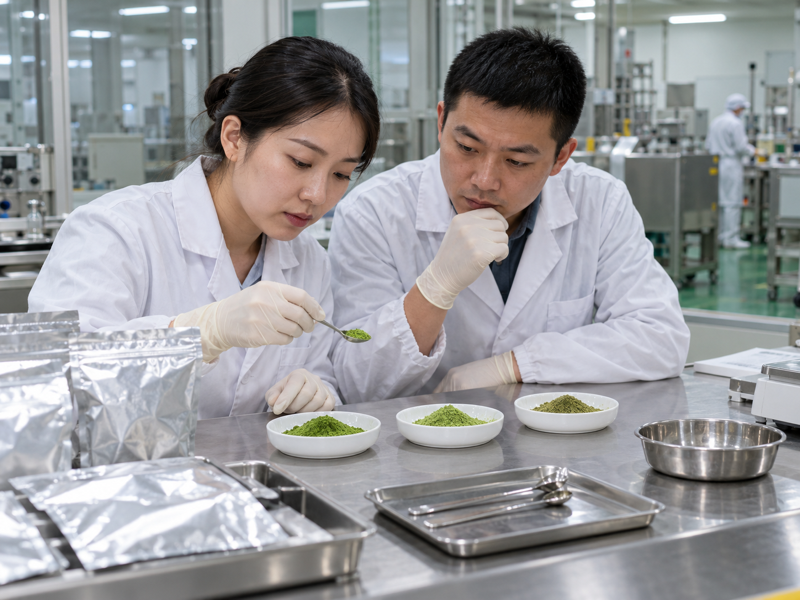
A buyer can find “pure matcha powder” on a retail tin, a foodservice bag, and a latte premix, yet those products may have different ingredient lists. The practical starting point is the specification: identify exactly what is in the bag, then test whether that material works in the intended recipe. This guide helps importers, brands, cafés, and manufacturers check purity, quality, documentation, and total cost without treating a marketing adjective as proof.
Contents
- 1. What does pure matcha powder mean on an ingredient list?
- 2. How can a buyer verify a purity claim?
- 3. Which grade of pure matcha fits each application?
- 4. What should color, aroma, and texture tell the buyer?
- 5. What food-safety and compliance files should accompany it?
- 6. How should pure matcha be tested in drinks and food?
- 7. How do packaging and storage affect a pure powder?
- 8. What does pure matcha really cost per serving?
- 9. Which claims should brands avoid making from “pure” alone?
- 10. What belongs on the final buying checklist?
1. What does pure matcha powder mean on an ingredient list?
Start with a single ingredient
Pure matcha powder should contain ground tea only. The supplier's ingredient declaration should say so plainly and match the saleable product and label. A sweetened matcha latte mix, even one made with excellent tea, is a formulated product. It can be useful, but it is not a single-ingredient powder. A flavoring, sugar, creamer, color, or carrier changes how the buyer must describe and handle the material. The product name alone cannot settle that question.
Read the back, then the specification. Ask for the full ingredient statement, product specification, and a sample from the proposed commercial lot. Check whether the offer refers to tea powder or a blend, especially when quotation sheets shorten names. If a supplier sells several grades and premixes, confirm the item code on every document. A mismatch between a sample label and commercial invoice can put a brand into the wrong product without anyone intending it.
| Product type | Typical ingredient question | Buying implication |
|---|---|---|
| Pure matcha | Is tea the only ingredient? | Buyer controls sweetness and milk |
| Sweetened blend | What share is tea and sugar? | Dose and label need review |
| Latte powder | Which dairy or plant ingredients? | Allergen and recipe review |
| Flavored mix | Which flavors or carriers? | Claims and taste consistency |
2. How can a buyer verify a purity claim?
Cross-check documents
Request an ingredient declaration signed or issued through the supplier's normal quality system. Compare it with product specifications, quotation, pack label, certificate of analysis, and sample code. The files should point to the same item and batch where relevant. A certificate of analysis may list test results without providing a full ingredient declaration, so one document cannot replace the other. If wording differs, resolve it before artwork approval or a bulk order.
Ask one direct question: does the offered product contain anything other than ground tea leaves? If yes, request the complete list and reason for each addition. If no, ask how the producer prevents mix-ups with premixes on shared equipment and how lots are identified. Buyers with strict claims may need further supplier audit evidence or agreed testing. The level of diligence should fit the market, contract, and risk; “pure” should never be based only on a product photograph.
3. Which grade of pure matcha fits each application?
Let the finished product decide
“Ceremonial,” “premium,” and “culinary” are commercial grade descriptions, not a universal global ranking with identical rules across suppliers. Ask the seller what each grade means in its own range and request samples. Straight tea often benefits from a softer finish and clear aroma. Milk drinks need tea flavor that remains present after dilution. Baking needs color and flavor after heat. A product can be excellent in one use and economically poor in another.
Build a side-by-side trial. Prepare each candidate at the same dose and conditions, then test each in the target application. If one requires more powder for equivalent flavor, compare cost at the approved dose. If a more expensive grade creates no noticeable improvement in a strongly flavored cookie, keep that finding. If a lower-cost grade leaves grit in a plain drink, record the specific defect. A buyer's written evaluation is more useful than a debate about grade names.
Account for customer expectations
A retail tin sold for whisked tea makes a different promise from an ingredient bag sold to a bakery. The retail buyer may examine aroma, smoothness, origin story, and presentation. A manufacturer may prioritize batch consistency, stable supply, and process behavior. The café buyer needs speed and repeatability at the bar. Segment the product brief before requesting quotes. Matcha Village offers several matcha grades and application selection support; a buyer should ask which proposed lot fits the intended format and test it there.
| End use | Primary check | Secondary check |
|---|---|---|
| Whisked tea | Flavor and finish in water | Foam and mouthfeel |
| Café latte | Tea through milk | Clumps and service time |
| Bakery | Post-bake flavor and color | Cost per batch |
| Retail powder | Label and sensory consistency | Pack and shelf guidance |
4. What should color, aroma, and texture tell the buyer?
Use controlled sensory checks
Inspect powder under repeatable lighting on a clean white surface. Record color without assuming that greener always means better. Smell the dry powder soon after opening and again during the storage trial. Prepare a measured drink to assess aroma, astringency, bitterness, and mouthfeel. Note visible particles or residue at the bottom of a cup. Use at least two trained tasters where possible and hide supplier names in the early comparison.
Keep the method steady. Changing water temperature, dose, cup, or mixing tool between samples can create a false winner. A powder stored open for a week should not be compared with one freshly opened that morning. If the target product is ice cream, a water test alone is insufficient. Run the powder through the real process and inspect the finished item after the intended storage period. That is when color drift, flavor loss, or sediment may become visible.
5. What food-safety and compliance files should accompany it?
Match documents to the destination
The buyer should identify which specifications and tests apply in its market and product category. Common review areas can include microbiological results, pesticide residues, heavy metals, allergens, and other customer-specific checks. Ask for product and lot identification on the relevant files, test methods where needed, and current certificates within their valid scope. An importer may also need origin and export documents. Regulatory details change by destination, so qualified local review belongs in the approval process.
Separate certification from the ingredient claim. Organic, halal, kosher, food-safety certification, and facility registration answer different questions. They do not, by themselves, establish that a powder contains only tea or that it will taste right in a latte. Matcha Village lists support for several international certification and testing requests. Buyers should request current copies and confirm product, facility, and market scope before putting a claim on pack.
Build a supplier file
Keep the approved specification, ingredient statement, sample and lot record, relevant certificates, test files, packaging details, traceability explanation, and change-notification agreement together. Assign an owner for updates. A document that was current during the first order may expire before the next run of retail tins. Clear document control prevents an old file from being attached to a new lot merely because it is easy to find.
| File | Buyer uses it for | Check before approval |
|---|---|---|
| Ingredient statement | Label and formulation | Correct item code |
| Specification | Quality acceptance | Agreed limits and method |
| Lot test report | Shipment review | Matching lot and date |
| Certificate | Market claim or audit | Scope and validity |
| Traceability record | Recall readiness | Link from pack to source |
6. How should pure matcha be tested in drinks and food?
Design a small application matrix
Use the actual formulation and processing equipment. For a café, prepare plain tea, hot milk drink, and iced milk drink if all will appear on the menu. For a food manufacturer, test the intended bake, churn, or blending step, then review the product after its normal storage interval. Vary one powder at a time and hold other ingredients fixed. Note dose, mixing time, clumps, color, flavor, and serving cost.
A controlled trial saves false conclusions. If a smoothie looks dull, fruit color may be responsible. If a latte tastes flat, a sweetened oat drink may be muting tea. If a cookie loses green color, baking conditions may matter more than the raw powder's appearance. Change one factor, repeat, and keep the recipe version with the result. Supplier samples should be evaluated under a method that another employee can reproduce.
7. How do packaging and storage affect a pure powder?
Match pack size with usage
Matcha powder can lose sensory appeal when exposed repeatedly to air, heat, moisture, or light. Follow the supplier's storage guidance and validate it against the buyer's operation. A high-volume factory may use large sealed packs efficiently. A small café with low daily demand may benefit from smaller packs even at a higher unit cost. Keep opened-pack handling in the recipe or stock procedure so staff do not guess.
Count exposure events. If a bag is opened many times each day, inspect how it is resealed and where it sits during service. A clear bin near a warm machine may be convenient but unsuitable for long use. Do not add a strict “use within” period without evidence from the product supplier or internal validation. Date opened packs and define the site's review or discard rule under its food-safety system.
Test the delivered pack
Samples often arrive in small foil pouches, while commercial goods may come in much larger formats. Ask to inspect the real bulk or retail pack, closure, inner liner, lot code, and shipping carton. Verify that outlet staff can identify the product and batch without relying on outer paperwork. Check whether a private-label package protects powder as well as the supplier's original pack. Artwork and visual design cannot make up for a poor moisture barrier or awkward daily handling.
| Setting | Packaging question | Practical test |
|---|---|---|
| Small café | Will an open pack last too long? | Use-rate and handling trial |
| Chain warehouse | Can cartons be traced? | Receive and pick simulation |
| Food factory | Does pack feed production safely? | Pilot line run |
| Retail tin | Does barrier protect sensory quality? | Shelf-life validation |
8. What does pure matcha really cost per serving?
Calculate at an approved dose
Divide purchase cost by usable servings at the dose that passes sensory testing. Include any powder lost during portioning, sifting, equipment cleanup, or expired stock when those losses appear in the pilot. A cheaper kilogram may need a higher dose to carry through milk or baking. A premium powder may cost more without improving the finished product enough for customers to notice. Only the approved application trial reveals the relevant difference.
Do not compare unlike formulas. A sweetened premix may be quoted at a similar bag price while containing less tea per gram. It can still save labor or add consistency in the right setting, but its economics should be calculated as a complete recipe. For pure powder, sugar and milk remain under the buyer's control and cost separately. Include import costs, freight, duties, financing, and stock holding when comparing overseas offers. Keep supplier terms visible beside quality scores.
9. Which claims should brands avoid making from “pure” alone?
Keep claims specific
“Pure” tells customers little unless the ingredient list and product identity support it. It does not automatically mean organic, pesticide-free, caffeine-free, healthier, Japanese, or suitable for every diet. Those statements require separate evidence and often local regulatory review. A brand should avoid suggesting medical outcomes from matcha or claiming that an ingredient is free from a substance without an appropriate basis. Put the accurate ingredient statement near the marketing copy so the product remains clear.
Origin needs its own proof. Matcha is associated with Japanese tea culture, but a powder may be produced in China or another country. State the actual origin accurately on labels and product pages. Matcha Village is a China-based producer with tea resources in the Hangzhou region. Buyers of its products should not imply a different origin through imagery or wording. If blending or repacking takes place elsewhere, explain the roles of source and pack location under the rules of the destination market.
Explain “no additives” carefully
If the product contains only tea, a concise “100% matcha green tea powder” statement may be clearer than a long list of things absent. Review exact wording with the label team. For a formulated latte mix, do not carry over a pure-powder claim onto the finished blend. A product line can contain both types, but each SKU needs its own ingredient declaration and supporting documentation. A sales sheet that blurs them invites avoidable disputes with retail buyers.
| Claim | Separate evidence needed? | Buyer action |
|---|---|---|
| 100% tea | Ingredient and production records | Verify SKU and lot |
| Organic | Current product certification | Check market scope |
| Specific origin | Traceability and trade records | Review label wording |
| Allergen-free | Appropriate controls and evidence | Seek qualified review |
10. What belongs on the final buying checklist?
Approve the product in stages
Start with identity: full ingredient statement, item code, origin, and processing description. Move to food-safety files and market requirements. Then run controlled sensory and application trials. Finally, review pack format, storage, lead time, price, and change-control terms. This order keeps the team from negotiating a low price for the wrong ingredient or approving excellent flavor without legal documentation.
Make the decision traceable. Record who approved the product, which sample and lot were used, the recipe tested, the documents reviewed, and any open conditions. Retain an approved sample under suitable storage. Require a review if the supplier changes ingredient composition, source, production site, or package in a way that can affect the product. For ongoing supply, compare incoming lots against the same standard rather than starting from memory each time.
Send suppliers a useful brief
Describe the intended product, customer, destination market, target sensory profile, expected volume, pack format, and required documentation. Ask for both a sample and a specification that match the saleable offer. Matcha Village can discuss pure matcha grades, bulk formats, private-label needs, and application testing. The most productive request names the finished use and its acceptance criteria. That lets the supplier recommend a grade the buyer can actually test, cost, and approve.
FAQ
Q1: Is pure matcha powder the same as a matcha latte mix?
No. Pure powder contains tea only; latte mixes can include sugar, milk components, or other ingredients.
Q2: Does pure mean organic?
No. Organic status requires separate certification covering the relevant product and market.
Q3: Can color prove a powder is pure?
No. Color is a quality observation, not proof of ingredient composition.
Q4: Which pure matcha grade is best for a café?
Choose through a controlled trial in the café's actual drinks at the approved dose and cost.
Q5: What document should a buyer request at the start?
Ask for the full ingredient statement and product specification tied to the exact offered item code.
Use the formal product definition in the ISO matcha report. For commercial sourcing context, see our wholesale buying guide.