
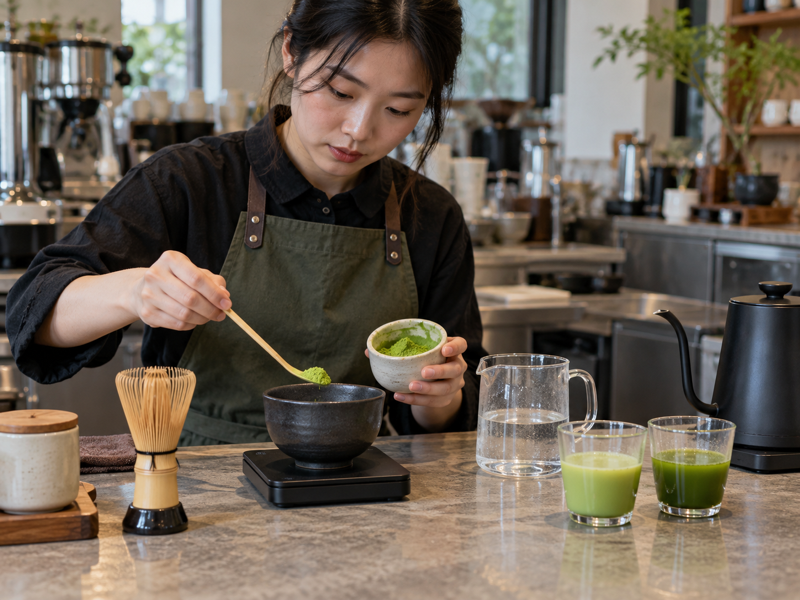
The right matcha powder to water ratio depends on what the mixed tea must do next. A straight bowl, an iced latte base, and a smoothie concentrate need different strength and handling. This guide gives operators a way to choose a starting ratio, test it, and write a recipe staff can repeat. Example numbers are trial settings, not universal standards.
Contents
- 1. What does a matcha powder to water ratio describe?
- 2. Which starting ratios suit straight matcha, thick tea, and lattes?
- 3. How should operators measure powder and water consistently?
- 4. How does water temperature change the result?
- 5. Which mixing method works for a given ratio?
- 6. How should a latte ratio account for milk and ice?
- 7. Can a matcha base be batched for multiple drinks?
- 8. How should different powders be compared at the same ratio?
- 9. What mistakes cause weak, bitter, or clumpy matcha?
- 10. How should a chain document and maintain its ratio?
1. What does a matcha powder to water ratio describe?
Define the numbers
A matcha powder to water ratio records how many grams of dry powder are mixed with a measured amount of water. Write both units. “One scoop with a splash” tells a new barista very little, and scoops can vary with powder density or humidity. A ratio expressed as 2 g powder to 60 mL water describes the initial tea mixture; it does not describe a finished 350 mL latte unless milk, ice, and sweetener are also specified. Treat the water measurement as one part of a complete recipe.
If the mixture will be served straight, taste it at serving temperature. If it will enter milk, assess the finished milk drink. If it will be poured over ice, check dilution after the ice begins melting. Ratios only make sense beside cup size, ingredient dose, and application. A procurement team comparing powders should use an identical test ratio initially, then allow each candidate's approved dose to determine real serving cost.
| Recipe element | Record it as | Why it matters |
|---|---|---|
| Matcha | Grams | Controls flavor and cost |
| Mixing water | Grams or milliliters | Controls dispersion and strength |
| Water temperature | Measured range | Affects mixing and taste |
| Milk or other liquid | Exact amount and SKU | Changes finished dilution |
| Ice | Grams | Changes drink over time |
2. Which starting ratios suit straight matcha, thick tea, and lattes?
Use trial ranges, then decide by tasting
For a light straight tea, an operator might begin a pilot around 2 g matcha with 60–80 mL water. A thicker preparation uses more powder relative to water and needs a powder that remains pleasant at that concentration. A latte base might start with 2–3 g powder dispersed in 30–50 mL water before milk is added. These are development examples, not rules for every powder, cup, or market. Supplier guidance and sensory results should determine the approved setting.
Do not stop at the base. Two cafés can both mix 2 g with 40 mL water yet serve drinks that taste very different because one adds 180 mL unsweetened milk and the other adds 300 mL sweetened oat drink plus ice. Record the final cup as carefully as the base. A product developer can use a small dose ladder at fixed water and milk amounts, then adjust water only after deciding which tea strength works.
3. How should operators measure powder and water consistently?
Set up a simple station
Use a scale with resolution appropriate for small powder doses, a clean vessel, and a repeatable water measure. Tare the vessel before adding powder. Avoid a heaped scoop as the only control: humidity and how staff fill it can shift the dose. If a scoop is operationally necessary, calibrate it against the approved weight and check it periodically. Train staff to read the recipe in the correct unit and to discard a mismeasured base rather than hiding it under more milk.
Test the workflow under pressure. A precise bench method can fail at a crowded service counter if the scale is blocked by cups or splashed with milk. Watch several employees prepare the base and record their actual weights. Place the scale and water source where the motion is straightforward. A pre-portioned pack may reduce variation, but it raises packaging and labor questions. Compare those costs with the waste from inconsistent drinks.
Record tolerances
A recipe card should specify a target and a practical tolerance set by the operator's quality team. The tolerance must be narrow enough to protect flavor but realistic for the equipment. Calibrate scales according to site practice and replace damaged measuring tools. When a new powder lot arrives, do a reference mix at the same settings. If it needs a different dose to pass the finished-drink test, product development should approve that change before staff alter the card.
| Method | Strength | Risk to manage |
|---|---|---|
| Digital scale | Direct dose control | Calibration and speed |
| Calibrated scoop | Fast service | Density and fill variation |
| Pre-portioned sachet | Repeatable dose | Pack cost and waste |
| Bulk premix base | Fast assembly | Hold time and traceability |
4. How does water temperature change the result?
Set a repeatable range
Water temperature affects how matcha wets, disperses, and tastes. Very hot water can make a drink seem harsher and create handling problems at the counter. Cool water may be attractive for iced service but can be slower to wet some powders without suitable mixing. Choose a temperature range based on the actual powder and drink. Measure it during trials and write it down. A phrase such as “warm water” leaves too much interpretation to individual staff.
Taste at the point of service. A hot base will cool when milk enters, and an iced base will meet ice and cold milk. The temperature that makes a plain bowl pleasant may not produce the fastest café workflow. Compare a few realistic settings with the same dose and water amount. Note clumps, foam, flavor, and preparation time. If a barista must wait for a kettle to cool, that delay belongs in the service trial.
5. Which mixing method works for a given ratio?
Match the tool to the volume
A bamboo whisk can work well for a small bowl. An electric frother may be fast for one serving. A shaker or controlled mixer may suit a batch or a latte station. Each tool has different cleaning, foam, and sediment behavior. A thick mixture may require careful wetting before vigorous mixing; a dilute mixture may be easy to disperse but slower to build flavor in a final drink. Test the proposed ratio with the actual vessel and tool.
Look at the bottom of the cup. A smooth top does not prove the powder dispersed. Pour the base into a clear vessel and inspect for dry pockets or settled material. Taste for grit. If clumps persist, test powder storage, mixing order, water amount, and tool speed before changing every variable. Sifting may help in some operations, but it adds handling and potential loss. Use it only if a measured trial shows enough improvement.
Compare repeatability
Have several staff members make the same base without coaching. Weigh the result, inspect texture, and time the step. The best method is one they can repeat while serving other orders. A batch method can reduce ticket time but introduces settling, temperature, and hold-time controls. A single-cup method may be slower yet easier to trace. Record the decision and the cleaning procedure, especially when tools are shared across drinks containing allergens.
| Mixing tool | Good trial use | Approval check |
|---|---|---|
| Whisk | Straight tea or single cup | Texture and cleaning time |
| Frother | Fast latte base | Splashing and foam |
| Shaker | Cold preparation | Sediment and seal cleaning |
| Batch mixer | Multiple servings | Hold time and first/last cup |
6. How should a latte ratio account for milk and ice?
Calculate finished dilution
The matcha base is only part of a latte. Write powder, mixing water, milk, sweetener, and ice on the card. A 250 mL hot latte and a 450 mL iced latte rarely give the same tea impression at an identical powder dose. Ice melts, and plant milks can add sweetness or grain notes that alter perceived strength. Test the hot and iced versions separately at their real cup sizes. Do not let a layered appearance substitute for a fully mixed taste test.
Taste after a wait. Make an iced drink and sample it at handoff, after a short queue, and after a normal takeaway interval. If tea fades quickly, consider the entire formula: milk volume, ice weight, sweetness, and powder dose. Increasing powder might help, but reducing an oversized pour of milk may solve the problem with less cost. For a hot latte, check taste after steaming and after it cools slightly. Both stages can reveal bitterness or weak tea.
7. Can a matcha base be batched for multiple drinks?
Check both ends of the batch
Batching can reduce individual order time, but suspended powder may settle and flavor can change while the base waits. Make a small trial batch using a measured powder-to-water ratio and a controlled mixing procedure. Sample the first and last portions at the proposed use interval. Compare their powder content by weight or an appropriate quality method where possible and taste them in the finished drink. If the last cup is stronger, staff need a validated remixing step or a different batch design.
A batch needs a clock. Record preparation time, storage container, temperature, mixing or stirring rule, and discard point under the operator's safe handling system. The time is not something to copy from another café. It must fit the exact recipe and local food requirements. Label the container clearly in the workplace. Keep batch records when lots matter for traceability. A barista should never top up an old batch with new liquid and reset the clock without an approved procedure.
Compare labor honestly
Batching saves some service motions but adds prep, cleaning, storage, labeling, and waste if demand falls short. Measure total labor and discarded base across several shifts. At a low-volume café, single-cup preparation may be cheaper and safer to control. At a busy chain store, a validated concentrate could make sense. The purchase plan also changes: powder consumption becomes tied to batch size and discard, not only drinks sold.
| Batch question | Evidence to collect | Decision |
|---|---|---|
| Does it settle? | First and last cup comparison | Remix or reject method |
| Does it change flavor? | Timed sensory checks | Shorter use window |
| Is it safe to hold? | Validated local procedure | Approved limit |
| Does it save labor? | Prep, service, cleanup time | Keep or abandon batch |
8. How should different powders be compared at the same ratio?
Screen fairly, then optimize
Begin with a common powder dose, water amount, temperature, and tool so candidates receive the same initial test. Record color, flavor, mouthfeel, and dispersion. Then optimize each promising powder within the recipe's acceptable range. A supplier may recommend a different dose because its product has a different sensory profile. Compare candidates at the dose that makes an approved finished drink, and calculate serving cost at that dose. Equal grams make a fair screening test, not necessarily a fair commercial comparison.
Blind the early tasting. When tasters know which sample is called ceremonial or expensive, expectations can affect judgments. Use coded cups and a simple score sheet. Ask specific questions: Can you taste tea through milk? Is bitterness acceptable? Are clumps visible? Does color fit the menu photograph? Include a control sample from the current approved lot when replacing a supplier. If a new candidate looks good but fails service speed, it may not suit the counter.
Ask for saleable-lot evidence
Request the product specification, ingredient statement, pack format, lot identification, and market-relevant files. Samples should correspond to material the supplier can actually deliver. A ratio approved on a tiny marketing sample needs confirmation on a production lot. Keep a retained sample and documented recipe. Matcha Village offers several grades and application support; buyers should provide the intended drink and ratio trial so a recommendation can be checked in the same conditions.
9. What mistakes cause weak, bitter, or clumpy matcha?
Diagnose one symptom at a time
Weakness can come from low powder dose, too much milk, large cup size, high ice melt, sweeteners that mask tea, or a powder poorly matched to the drink. Bitterness may reflect powder choice, excessive concentration, water temperature, or the way other ingredients frame the tea. Clumps can come from moisture exposure, rushed mixing, or insufficient wetting. A single symptom does not identify a single cause. Record the actual recipe before adjusting it.
Run a short diagnostic ladder. Weigh a real staff-made drink. If the ingredients match the card, remake it with a controlled powder and water mix. Then test one change: water amount, temperature, tool, or powder lot. Compare side by side. If the defect appears only during rush service, observe the station rather than assuming the specification is wrong. A new grinder or milk SKU can change perception even when the matcha ratio is unchanged.
| Symptom | Check first | Avoid assuming |
|---|---|---|
| Weak tea | Actual dose and final volume | Powder is always poor |
| Bitter finish | Powder, dose, temperature | More sugar fixes it |
| Clumps | Storage and mixing sequence | Longer blending always helps |
| Variable cups | Scale and staff method | Customers are inconsistent |
10. How should a chain document and maintain its ratio?
Write the complete card
List powder grams, water amount and temperature, tool, mixing time, cup size, milk and sweetener amounts, ice weight, assembly order, target appearance, and remake triggers. Add approved ingredient SKUs and recipe version. A matcha powder to water ratio without the rest of the cup invites drift. Train staff to make several drinks independently, then compare weight, taste, and ticket time with the approved reference. Update the card only through the operator's change process.
Review every material change. New powder lots, milk substitutions, cup sizes, and blender tools can shift the result. Record the comparison against a retained reference cup or sample. For an international rollout, water characteristics and locally sourced milk may vary; test in each market rather than assuming an identical written card yields an identical drink. Keep documentation short enough for a busy barista to use and detailed enough for a quality manager to investigate a complaint.
Give suppliers a defined brief
State the end use, current ratio trial, finished cup, target flavor, volume forecast, and required packaging. Ask suppliers for a sample and a saleable-grade recommendation. The next step is a side-by-side test, followed by a serving-cost calculation. If a powder only works after changing several other ingredients, record those costs too. A controlled ratio gives buyers and suppliers a common language, while the finished drink remains the final judge.
FAQ
Q1: Is there one correct matcha powder to water ratio?
No. A useful ratio depends on powder, cup size, later dilution, and the desired drink.
Q2: Should powder be measured by scoop or weight?
Weight gives better control. A scoop can be used after calibration against the approved dose.
Q3: Does an iced latte need a stronger base?
It may, because milk and melting ice dilute flavor. Test the completed cup after a realistic wait.
Q4: Can a café batch matcha base?
Yes, if it validates settling, quality, safe handling, labeling, and discard time for its process.
Q5: How should two matcha powders be compared?
Screen them under identical conditions, then compare their approved finished drinks and real cost per serving.
Compare a consumer cup in this ratio guide. For commercial sourcing context, see our latte ratio test.