
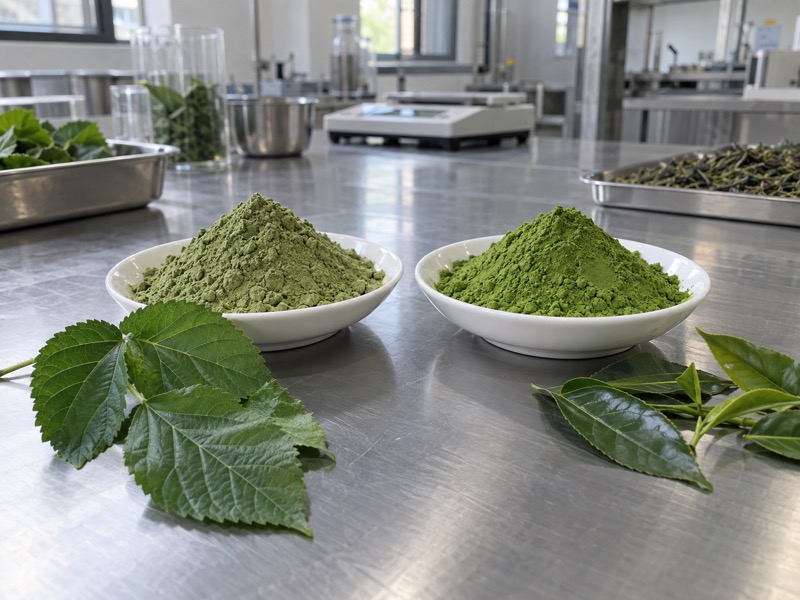
Mulberry matcha is often a matcha-style powder made from mulberry leaves, not powdered green tea. A green drink made with it may contain no Camellia sinensis at all. That changes the ingredient statement, expected flavor, caffeine wording and supplier file. For a café or beverage brand, the first job is to identify what is actually in the bag. Only then can the team decide whether the powder makes a useful drink and how to describe it to customers.
For: tea importers, beverage brands and café menu teams. Decision: whether a mulberry-leaf powder can meet a defined menu promise with accurate naming and documented ingredients.
1. What plant is behind the name mulberry matcha?
Read the ingredient declaration
“Matcha” describes a specific powdered tea tradition, while “mulberry matcha” is often a trade name for powder made from mulberry leaves. The source recipe we reviewed uses leaves of Morus alba, the white mulberry tree, as a matcha substitute. It does not turn those leaves into Camellia sinensis tea. Some commercial products may blend mulberry leaf and true matcha, so the product name alone cannot identify the contents. Ask the supplier for the botanical name, plant part, blend percentages and manufacturing description for the exact SKU.
Confirm identity before tasting or drafting a menu. A green color and fine grind do not prove tea content. If the product contains only mulberry leaf, describe it as mulberry-leaf powder or a matcha-style drink, according to the destination market’s naming rules. If it includes real matcha, state both ingredients and their amounts in the approved formula. Keep a sample of the purchased lot and its specification together. A buyer should be able to trace the powder in the cup back to a named plant and a dated supplier record, not to a photograph on the bag.
2. What customer promise can the drink make?
Choose a use before writing claims
A mulberry-leaf drink may appeal to customers who want a green, whisked beverage with a different flavor from tea. That is a defensible product idea when the menu says what it is. Do not promise that it tastes like high-grade matcha or delivers the same nutrients. The leaf, processing and dose differ. Set a target for aroma, mouthfeel, color and acceptable sediment in the actual cup. Make the sample in water and in the intended milk or plant base; a powder that tastes harsh in water may read differently in a sweet latte.
Decide whether the drink is a café special, retail powder or packaged beverage. An immediate whisked cup has a short drinking window; a bottle has a longer distribution and safety problem. A no-added-caffeine or caffeine-free statement needs support for the complete recipe and possible cross-ingredients, not an inference from the green color. If the product includes matcha, coffee, cacao or another caffeine source, the wording must reflect that. Review the customer promise with quality and label staff before it appears in a menu photo or sales sheet.
| Product idea | What to test | Wording risk |
|---|---|---|
| Whisked leaf drink | Flavor and sediment in water | Calling it tea without tea leaves |
| Mulberry latte | Powder in chosen milk base | Implied matcha equivalence |
| Powdered blend | Each botanical proportion | Unclear caffeine statement |
3. Which supplier records deserve a first review?
Check identity and suitability
Start with the item code, botanical identity, plant part, source, processing steps, lot code, pack and storage directions. Ask for the supplier’s food-safety and contaminant documentation suited to the sales market. A botanical powder also needs an ingredient and allergen review for the finished product. If the supplier uses a caffeine statement, request its basis and scope. A certificate for a different leaf product or an old marketing sheet is not enough for the pack that will be purchased.
The Japanese Food Lab’s home experiment is useful for understanding why a coarse mulberry powder can feel gritty, but it is not a commercial safety specification. Its author also raises a caution about individual tolerance. A business should route questions about safety, permitted use and any vulnerable consumer group to its qualified food-safety and regulatory team before launch. Do not copy online health claims into the product file. A supplier who cannot identify the leaf, processing and lot has left the buyer without the information needed to investigate a complaint or approve a public description.
| Document | Reason | Match to the lot? |
|---|---|---|
| Botanical specification | Confirms plant and part | Yes |
| Processing and safety file | Supports food use review | Yes |
| Caffeine or claim support | Checks public wording | Finished product scope |
4. How should mulberry matcha be sampled fairly?
Compare finished servings
Use an identified mulberry powder lot, an identified matcha lot if comparison matters, and one fixed drink base. Do not judge equality by using a casual teaspoon of each: different densities make spoon volume a poor dose measure. Weigh powder and finished drink, record water temperature and mixing method, and taste after a fixed wait. Compare aroma, bitterness, leafy notes, graininess and sediment. The question is whether the mulberry product meets its own menu target, not whether it can pass as matcha in a blind trick.
Test at least two plausible doses without changing syrup or milk at the same time. If more powder makes the drink darker but gritty, record that tradeoff. A supplier’s finest sample may differ from the production lot; ask for a specification that controls particle size or screen performance where it affects the cup. Make samples from the beginning and end of a pack if fine and coarse particles can separate during shipping or handling. Keep the accepted reference serving and preparation card together so another operator can reproduce the result.
5. Which process details control the texture?
Wet the powder before service
Fine leaf powder can clump when dropped straight into a cold, fatty base. Trial a measured pre-wetting step and compare it with direct addition. Use the actual whisk, frother or production mixer, and check what remains on the bowl or vessel wall. Record active mixing time, water mass, temperature and the point at which the powder looks evenly dispersed. Some visible suspension may still settle; decide how much is acceptable after a normal customer wait rather than promising a perfectly clear drink.
If the product is scaled beyond one cup, inspect the first and last fills. A powder that appears smooth in a small beaker may separate in a holding tank or clog a dispenser. Do not solve texture by adding an unapproved stabilizer or changing the botanical dose without updating the formula and ingredient statement. A café should also check the drink under its normal lid and straw. Staff need a short method they can follow during service, including how to recognize a clumpy portion and when to remake it.
| Process variable | Record | Customer effect |
|---|---|---|
| Powder dose | Grams per cup | Flavor and sediment |
| Pre-wetting | Water and mixing time | Clump control |
| Service wait | Minutes in final cup | Settling and last sip |
6. What defects should reject a sample?
Decide before the pilot
Likely defects include a coarse mouthfeel, grassy or harsh aroma, clumps, a gray color in milk and heavy sediment at the bottom. List which of these the intended customer would notice and write a pass rule. A mild leaf note may be part of the product; a gritty last sip usually needs a formula or particle-size change. Compare a failed serving with a retained powder lot and the same method before blaming the supplier. Staff may have skipped the pre-wetting step or changed the cup size.
Check the ingredients behind each failure. If a sweetener removes bitterness but hides the leaf flavor altogether, the drink promise may need revision. If citrus changes the green color, test that actual recipe and state the expected appearance. If a pack arrives with a foreign odor, moisture damage or inconsistent color, hold the lot for quality review. A tasting cup is not a safety test. Keep complaints, pack codes and preparation records so the team can distinguish a bad material from a service error.
7. How should the powder and drink be stored?
Test the real pack and route
Follow the supplier’s storage conditions for the identified mulberry-leaf powder. Dry leaf powder can pick up moisture and odors after opening, so use a clean, dry scoop and close the pack promptly. Record opening dates and do not mix a new lot into an old container without a trace. Trial the actual café container or retail pouch, including repeated openings. A pleasant fresh sample does not establish the sensory life of a partly used bag.
The finished drink follows its complete formula. Milk, plant beverages, fruit, syrups and toppings may impose chilled handling or a short service window. A dry-powder date cannot validate a bottled latte or a topping held at the counter. Food-safety staff should decide the process, holding limits and any testing required for the proposed route. Keep quality checks separate from safety decisions. A drink may remain green while its flavor turns stale, or taste fine while its handling history is unacceptable.
8. How should the product be priced?
Cost the accepted serving
Compare the powder cost at the dose that makes an acceptable drink, not just the quoted price per kilogram. Add milk or water, syrup, cup, labor, packaging and remakes. A coarse powder may leave residue in tools or produce more rejected servings; a fine powder may cost more but waste less. Record both effects in a pilot. If a blend contains true matcha, calculate the actual tea dose separately so purchasing and public wording remain aligned.
Consider pack size and stock pace. A café that sells a few specialty cups a day may use a small sealed pouch more completely than a large discounted bag. For retail powder, include sieve losses, fill variation and damaged packs. If the brand needs new label artwork or claim testing, include those costs in the launch decision. Do not treat a lower-caffeine position as free marketing language. The support for that wording has a cost and must remain valid when suppliers or formulas change.
| Cost item | Measure | Why it matters |
|---|---|---|
| Botanical dose | Grams per accepted cup | Real ingredient cost |
| Residue and remakes | Rejected portions | Hidden process loss |
| Pack use | Days open and write-off | True stock cost |
9. What should the menu and label say?
Name the leaf plainly
The front of a menu can use an appealing name, but the ingredient description should tell customers whether the drink contains mulberry leaf, true matcha or both. A phrase such as “mulberry-leaf latte” is clearer than implying the powder is Japanese green tea when it is not. If the brand retains “mulberry matcha” as a product name, explain the botanical ingredient close to the name and let the qualified reviewer check destination-market rules. The same review should cover caffeine, allergen, nutrition and health wording.
Test the wording with staff. Ask a new operator what they would tell a customer who asks “Is this matcha?” If the answer changes by person, the product file is too vague. Put the exact ingredient identity and recipe on the staff card. Avoid claims borrowed from a home recipe or a supplier’s general marketing page. If the business wants to say the drink is caffeine-free or has a specific nutritional effect, it needs evidence for the final formula and the appropriate review. A botanical name is a fact; a physiological promise is another kind of claim.
10. What pilot is enough for a launch decision?
Test the drink and the wording together
Run a small pilot with the actual powder lot, staff tools, milk or water base, cup, pack and menu description. Measure dose and accepted yield. Taste the first and last cups made during a busy period, not one carefully prepared demonstration. Check settling after a normal customer wait and inspect powder left in the working pack. Keep written stop rules for gritty texture, off-odor, pack damage and inconsistent ingredient identity.
Have quality and label staff review the supplier file and finished-product wording before ordering launch stock. If the drink passes but the supplier cannot document what plant it contains, the menu is not ready. If identity is clear but the texture fails, fix the process or choose another powder and repeat the cup test. A good pilot produces a named ingredient, a repeatable preparation card, an honest product description and a cost per accepted serving. Those four records are the release decision.
Keep one unopened unit from the approved lot beside the pilot records. When the next delivery arrives, make the same drink before replacing the reference. If the color, grind or aroma has shifted, the buyer can compare a known material with the new shipment while both are still traceable. This is faster than reconstructing a failed cup from staff memory.
| Pilot checkpoint | Evidence | Release question |
|---|---|---|
| Ingredient identity | Lot and botanical file | Do we know what is in the bag? |
| Service cup | Dose, texture and wait | Can staff repeat it? |
| Public copy | Reviewed menu and label | Is the name accurate? |
The Japanese Food Lab’s mulberry-leaf experiment illustrates the texture challenge of grinding a leaf powder; it is a home preparation, not a commercial process or safety approval. For true tea selection, see the matcha flavors guide.
FAQ
Q1: Is mulberry matcha real matcha? Often it is powdered mulberry leaf used in a matcha-style drink. Check the exact ingredient list; some products may also contain true matcha.
Q2: Does mulberry matcha contain caffeine? Do not infer a finished drink’s caffeine status from its green color. Check every ingredient and support any public statement with suitable evidence.
Q3: Why can a mulberry-leaf drink feel gritty? Powder fineness, dose and mixing determine how much leaf material remains noticeable in a suspension. Test the final cup after a normal wait.
Q4: Can a home recipe set a commercial shelf life? No. The purchased powder and finished drink need supplier records and a product-specific handling plan.
Q5: What should a buyer approve first? Botanical identity, food-use documentation and an accurate product name should be clear before scaling sensory and cost trials.