
Matcha wholesale purchasing starts with a written description of the product you need, the quantity you can use and the evidence required before payment. A bag that tastes good in a sample session can still create problems if the production lot, packaging or delivery terms change. For an overseas buyer placing a new commercial order, the useful output is a purchase specification that follows the powder from quotation through receiving.
The following process separates decisions that sales, product development, quality and purchasing must approve. It uses proposed buyer controls, not a promise about any supplier’s current stock, prices or delivery schedule.
Contents: 1. What should a matcha wholesale brief contain? | 2. Which supply arrangement fits the order? | 3. How do samples become a usable specification? | 4. Which documents belong in the approval file? | 5. How should packaging and order quantity work together? | 6. What makes two quotations comparable? | 7. How do delivery responsibilities affect the purchase? | 8. What should the initial commercial order prove? | 9. How should receiving staff handle discrepancies? | 10. What information should trigger a reorder?
1. What should a matcha wholesale brief contain?
Describe the finished use
Write down where the matcha will end up before requesting a catalogue. A cafe group may need one ingredient for an iced milk drink. A manufacturer may need powder that performs in a chocolate coating. Those applications need different trials, even if both suppliers describe their powder with the same grade name. State whether the request concerns pure matcha or a blend, and list ingredients that your product brief allows.
| Brief field | Buyer supplies | Supplier confirms |
|---|---|---|
| Application | Finished drink or food | Proposed product code |
| Formula | Relevant base ingredients | Suitability to test |
| Quantity | Trial and repeat requirement | Available order basis |
| Destination | Delivery address and market | Documents offered |
Identify the person who can approve each part of the brief. Purchasing should not decide that a sweeter blend is equivalent to pure matcha merely because it has a lower kilogram price. Product development should not promise an order before the commercial conditions are checked. Give the brief a version number so a revised milk base or retail format does not disappear inside an email chain.
2. Which supply arrangement fits the order?
Match the service to your capabilities
Buying through a distributor, an export supplier or a producer can involve different work for your team. Compare who holds stock, who provides product information, who arranges delivery and who handles a rejected shipment. A shorter commercial chain may still require the buyer to coordinate tasks that a local distributor previously handled.
UnD’s wholesale article describes its own samples, bulk formats and private-label services. Treat those as that supplier’s stated offering and request the current terms for your own inquiry. Compare the services included in each offer with the work your purchasing and operations teams can perform.
Request a contact list with responsibility for quotations, quality documents, shipping and claims. Ask whether the seller owns the quoted inventory or obtains it after receiving an order. If another company packs the powder, identify that company and its role. A supplier can have a useful arrangement with external partners; your approval file should show which party controls each step. Choose the arrangement your staff can manage during an ordinary reorder and during a problem.
3. How do samples become a usable specification?

Keep the sample identity intact
Assign each sample a buyer code and retain its supplier product code, lot number, receipt date and storage instructions. Keep the original pouch until the decision is complete. Loose powder transferred into an unmarked jar can become impossible to connect with the quotation that follows.
| Trial question | Hold constant | Record |
|---|---|---|
| Does tea remain noticeable? | Finished recipe | Flavor description |
| Is preparation repeatable? | Equipment and method | Clumps and handling |
| Does appearance fit? | Lighting and cup | Comparison photograph |
| Is the sample identified? | Original packaging | Product and lot codes |
Run the comparison in the intended application. A water tasting can describe the powder, but it does not replace a milk drink, baked product or confectionery trial. Ask another operator to repeat the preparation from written instructions. If the result changes, investigate preparation variables before rejecting the powder.
Keep one approved reference under the agreed storage conditions. Define how long it can serve as a sensory comparison and when a fresh reference is needed. A reference that has deteriorated can make a new, acceptable lot appear different for the wrong reason.
4. Which documents belong in the approval file?
Request evidence for the specific product
Build the document request around your actual application and destination. It may include a product specification, ingredient statement, lot identification, analysis report, storage instructions and packaging information. Ask quality staff to specify which fields they need and why. A large collection of unrelated certificates takes time to review without answering whether the offered powder meets the approved brief.
The FSSC public register provides a route for checking organizations claiming FSSC certification. That check is separate from reviewing a particular product and lot. Do not treat a website logo or an unrelated facility certificate as a substitute for the document your quality team requested.
Use the matcha certificate of analysis checklist to prepare questions about lot identity, methods and reported results. Have the responsible importer or qualified adviser confirm current destination requirements. A generic list of tests does not establish permission to import. Log unanswered questions with an owner and a due date; leave the order approval pending where the missing information affects acceptance.
5. How should packaging and order quantity work together?

Plan around opened packs
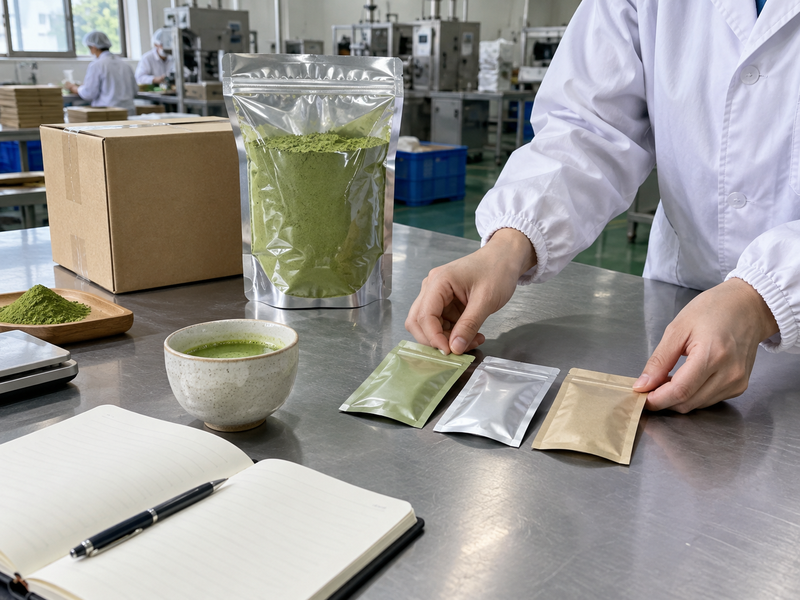
Calculate how much powder the receiving operation expects to use from each opened pack. A large order can contain smaller sealed units, which gives purchasing and operations separate choices about shipment size and working pack size. Ask for the pack configuration rather than assuming that a larger shipment arrives in one large bag.
| Decision | Information needed | Operational check |
|---|---|---|
| Inner pack | Net weight and closure | Fits daily handling |
| Outer carton | Pack count and protection | Fits receiving storage |
| Order quantity | Forecast by application | Can be used as planned |
| Opening routine | Supplier instructions | Staff can follow it |
Keep pack size discussions connected to storage capacity and handling. A branch with limited space may need a different replenishment plan from a central kitchen. Identify how staff mark an opened pouch and keep its lot code available after powder moves to a working container.
Ask the supplier to state the product’s storage and shelf-life basis in writing. Your team then needs to assess the actual route, packaging and opened-pack practice. Avoid assigning a universal use period from another supplier’s website. Pack changes should trigger review when they alter exposure, dispensing or traceability.
6. What makes two quotations comparable?
Create one comparison basis
Send suppliers the same quantity, pack format, destination and required specification. Record each deviation next to the price instead of placing unlike offers into a single ranking. A quote for a blend, an unapproved grade or a different delivery point remains a separate option until the technical and commercial differences are resolved.
Convert product prices to one currency and net kilogram basis using a dated exchange assumption. Keep the original amount alongside the converted value. List freight, testing charges, packing setup and other quoted fees separately, then mark any amount still missing. A blank should mean that a cost has not been confirmed, not that the service is free.
Check quote validity and the event that makes a price binding. Ask whether the quote names a specific lot, a continuing product code or a provisional allocation. If a repeat order uses a different production lot, determine what remains fixed and what needs renewed approval. Save the accepted quotation with the specification version so finance can later explain the amount paid without reconstructing conversations.
7. How do delivery responsibilities affect the purchase?

Name the handover and destination
Write the agreed delivery rule, its version and the named place in the order. Then ask the supplier and logistics provider to identify the charges included in their quotations. Terms such as shipping included leave too much room for different assumptions about import clearance, destination handling and delivery beyond a terminal.
| Task | Responsible party | Evidence before dispatch |
|---|---|---|
| Export packing | Named supplier or packer | Approved configuration |
| Main transport | Contracted booking party | Route and booking details |
| Import coordination | Named importer or broker | Document requirements |
| Receiving | Buyer location | Contact and delivery window |
The U.S. International Trade Administration’s Incoterms overview explains that the rules allocate transport tasks, costs and risks. Confirm the precise arrangement for your transaction rather than relying on the abbreviation alone.
Work backward from when approved stock must be available for use. Include document review, receiving checks and any planned testing in that internal schedule. The supplier’s dispatch estimate does not by itself tell a cafe or factory when the ingredient can enter production.
8. What should the initial commercial order prove?
Test the complete purchasing process
Choose an initial quantity that fits the agreed minimum and your planned validation work. The purpose is to evaluate the complete supply process: order confirmation, product identity, documents, packing, delivery and use. A successful sample is one part of this decision. The commercial order shows whether the supplier can repeat the information and handling expected in a regular transaction.
Before payment, confirm the seller’s legal identity and the approved payment instructions through an established contact. Match the invoice to the accepted quote and purchase order. Have finance record what the payment covers and which approvals must occur before any later payment. Avoid treating payment as product approval if quality review remains open.
Tell the receiving team what is arriving and what must remain on hold. Provide the expected carton count, lot documents and a contact for discrepancies. Arrange the application trial before the shipment arrives, so the powder is evaluated while the decision team is available. Save both positive observations and unresolved issues; an initial order should produce a practical reorder decision.
9. How should receiving staff handle discrepancies?

Compare the shipment with the order
Check outer damage, pack integrity, identity, quantities and the supplied documents before releasing stock. Photograph discrepancies while the original packaging is available. Keep affected material identified and separate according to your quality procedure. A supplier can investigate a specific pouch and lot more effectively than a complaint describing the delivery as disappointing.
| Observation | Immediate record | Decision owner |
|---|---|---|
| Damaged carton | Photos and delivery reference | Logistics and quality |
| Different product code | Pack and order comparison | Purchasing and quality |
| Missing analysis report | Expected lot and document | Quality |
| Sensory difference | Controlled comparison notes | Product development |
Agree how the supplier will receive evidence, respond and propose a disposition. Do not blend questionable material into acceptable stock while waiting for an answer. Keep the commercial claim and the technical investigation connected, but allow the quality decision to determine whether the material may be used.
When an issue closes, record the replacement, credit, rework or acceptance decision and its authorization. Preserve the original observation even if the outcome is satisfactory. It may help explain a repeated problem in a later lot.
10. What information should trigger a reorder?
Replace memory with an order record
Use actual consumption from the approved application to update your forecast. Record stock that is usable, stock committed to production and stock on hold. A carton in the warehouse should not support a reorder calculation if quality has not released it. Keep expected inbound supply separate until the relevant order and delivery details are confirmed.
Record the last accepted product code, specification version, packaging, price basis and required delivery window. Ask the supplier to identify proposed changes before confirming a repeat order. Your change list might include a new packer, a revised blend, a different inner bag or an altered document format. Decide which changes require another trial and which can be handled by document review.
Matcha Village’s company materials describe participation in cultivation, processing and packing. Buyers should request the current scope relevant to their proposed order and review the same evidence they would request elsewhere. Prepare a one-page purchasing brief with your application, trial results, destination and repeat requirement, then request a quotation tied to that exact brief.
FAQ
Q1: Can several departments share one sample set?
Yes, if the coordinator allocates enough material for each planned evaluation and keeps the sample identity intact. Reserve material for a repeat comparison before distributing the rest.
Q2: Should an annual forecast be a binding order?
State its status explicitly. A planning forecast, reserved allocation and firm purchase order create different expectations. Record what either party may change and when written acceptance is required.
Q3: Can a supplier substitute another product during a shortage?
Only under the approval process agreed for the order. Ask for the substitute’s identity and evidence, then review application performance before authorizing use.
Q4: Who should own the approved product file?
Assign one coordinator and give quality, purchasing and operations access. Keep the current version identifiable while retaining superseded documents that explain earlier orders.
Q5: Does a discounted sample create a purchase commitment?
Check the stated sample terms. Record any credit conditions separately from the decision to approve the product, so a small sample incentive does not determine a larger order.