
A matcha manufacturer should be evaluated against the production work your order requires. Some businesses process tea, some mill purchased material, some blend ingredients and some pack finished powder. A buyer needs to know which operations happen at which site, who approves the material and what changes when volume increases.
For a food brand or ingredient buyer, the decision is whether a proposed production arrangement can make the approved product repeatedly. A useful factory discussion follows one material through the process and connects equipment, records and responsible people. General claims about factory size cannot answer that question.
Contents: 1. Which operations must the matcha manufacturer perform? | 2. How can a buyer verify the proposed production route? | 3. What incoming-material controls support your specification? | 4. How should milling capability be assessed? | 5. What changes when the manufacturer blends ingredients? | 6. How do you distinguish capacity from an available production slot? | 7. What should packaging capability demonstrate? | 8. Which quality evidence should come from the factory? | 9. How should a production trial be approved? | 10. What should the manufacturing agreement record?
1. Which operations must the matcha manufacturer perform?
Define the production boundary
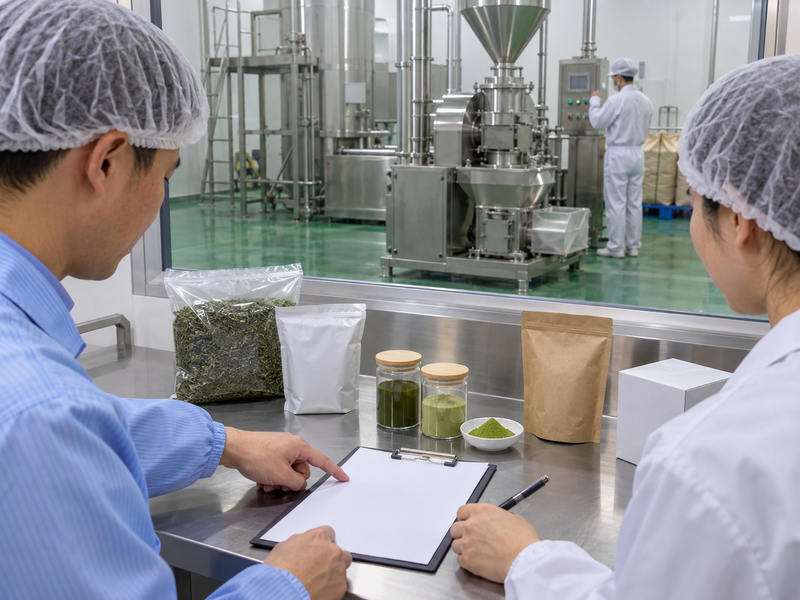
List the work needed between incoming tea material and the pack your business receives. Ask the supplier to mark each operation as performed internally, performed by a named partner or outside the proposed service. Include blending and repacking if those activities apply. An attractive photograph of a mill does not establish who controls the other stages.
| Operation | Question to resolve | Record to request |
|---|---|---|
| Material sourcing | Who approves incoming tea? | Supplier approval method |
| Milling | Which site makes the powder? | Process and product scope |
| Blending | Who controls the recipe? | Version and approval record |
| Packing | Where are packs filled? | Pack specification and site |
Separate the manufacturer from the selling entity on your order. Ask who signs the specification and who handles a quality complaint. A trading company may coordinate a suitable manufacturing arrangement, but its quotation should not obscure the actual production roles. Make the list specific to the proposed product code; capabilities offered elsewhere in the group may not be available for your order.
2. How can a buyer verify the proposed production route?
Follow one identifiable lot
Request a process description that starts with the actual incoming material and ends with the commercial pack. During a discussion or authorized visit, ask staff to connect each stage to a record. The goal is to understand how the proposed product moves through the site, including storage, any transfer between buildings and release before shipping.
AKI Matcha’s manufacturer and supplier article describes its own wholesale products and sample access. Such a page can identify an offering, but a buyer still needs transaction-specific production evidence. Aiya’s bulk product information also describes its own packaging and fulfillment arrangement; those details should not be assumed to apply to another business.
Ask where the lot code is assigned and whether it changes after blending or packing. Request an explanation of how the old and new codes connect. If a partner performs a stage, ask how the manufacturer approves that partner and receives the related records. Record gaps as questions to resolve, rather than filling them with assumptions about a vertically integrated factory.
3. What incoming-material controls support your specification?
Examine acceptance decisions
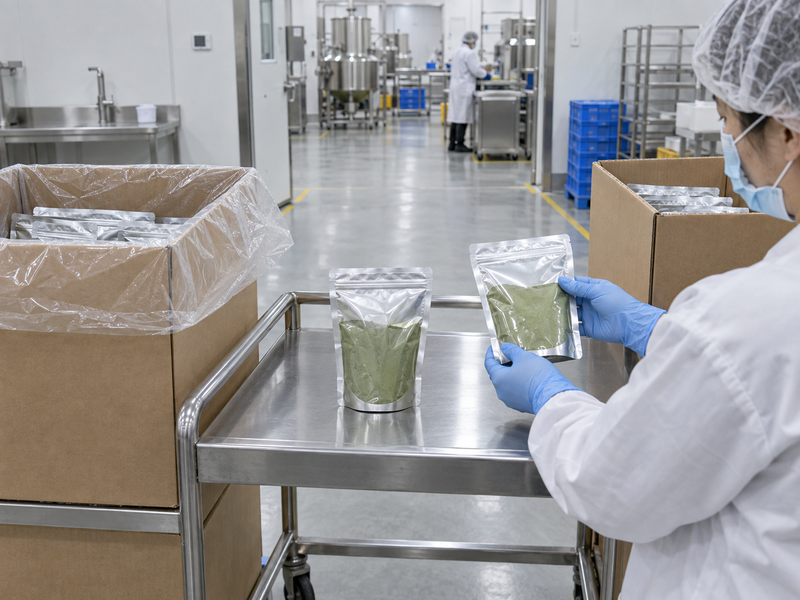
Ask how receiving staff distinguish accepted material, material awaiting a decision and rejected material. Request a redacted example showing the identity received, checks performed and person authorizing release. The useful question is how the site prevents an unapproved material from entering the product, including when production needs stock urgently.
| Incoming field | Why the buyer asks | Follow-up question |
|---|---|---|
| Material identity | Connects receipt to product | How are substitutions controlled? |
| Supplier lot | Supports investigation | Can the previous supplier be traced? |
| Receipt condition | Records transport concerns | Who decides on damaged packs? |
| Release status | Controls access to production | Can operators see a hold? |
If your brand specifies an origin, composition or certification claim, ask how the manufacturer verifies that attribute at receipt and preserves the supporting records. Do not accept an attractive powder color as evidence for those statements.
Discuss what happens when an incoming material is unavailable. Ask whether the supplier proposes a new source, changes a blend or delays production. Your agreement should identify which changes need buyer approval before the replacement material enters an order.
4. How should milling capability be assessed?
Connect equipment claims to product measurements
Describe the application problem the powder must solve. A buyer concerned about gritty mouthfeel needs a repeatable way to evaluate particle characteristics in the finished product. A buyer concerned about mixing needs an application trial. A machine name, an advertised mesh figure and a smooth-looking powder photograph answer different questions.
Ask the manufacturer which particle measurement method it uses and how results are reported. Confirm the sample preparation, units and interpretation before comparing figures from different suppliers. If the site provides only a broad product description, keep the method unresolved and use your development team to decide what additional evidence is needed.
Request a record showing the relationship between a production setting, a lot and a measured result, with confidential details redacted where appropriate. Ask how operators respond when a result falls outside the agreed range. This discussion should also cover cleaning, changeover and control of material remaining in equipment. Your approved specification should express the needed product outcome without prescribing equipment merely because it appears impressive in a brochure.
5. What changes when the manufacturer blends ingredients?
Control recipe identity and ownership
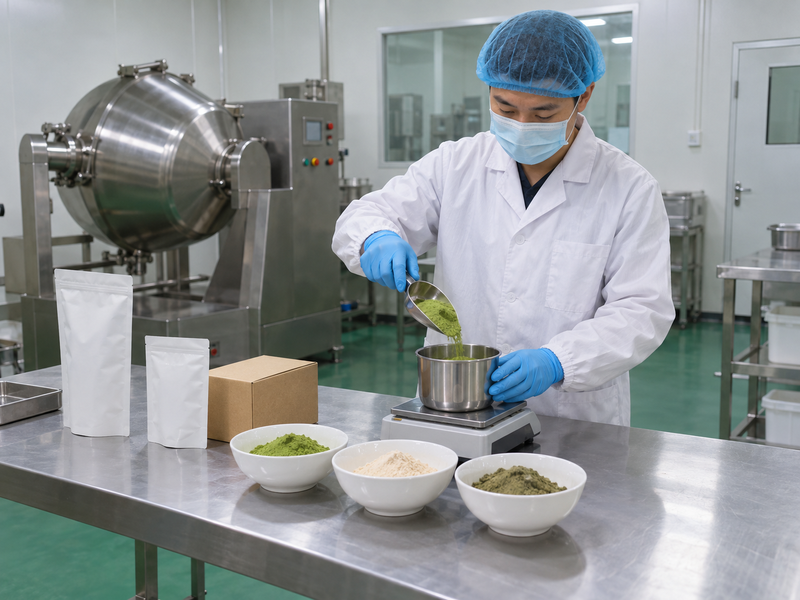
Pure matcha, a matcha latte powder and a customized blend should have separate product identities. Ask who owns the formula, who can authorize a revision and how the packing line receives the current ingredient information. A buyer’s approved sample can be reproduced only if the recipe and ingredient versions remain connected.
| Blend decision | Buyer confirms | Manufacturer confirms |
|---|---|---|
| Ingredient scope | Permitted ingredients | Proposed composition |
| Recipe ownership | Rights required | Contracted access and limits |
| Revision approval | Authorized reviewer | Change notification process |
| Pack information | Destination and artwork | Current production version |
Agree how the manufacturer checks blending consistency at a scale relevant to the order. Request its proposed sampling plan and the reason for the selected locations or timing. Do not assume that a small hand-mixed sample proves uniformity in a commercial batch.
Discuss the transition from development material to a routine product code. Preserve unsuccessful trial versions so nobody accidentally orders an earlier formula. If the manufacturer cannot disclose a proprietary recipe in full, determine whether the available information is sufficient for your technical review, labeling responsibilities and contractual needs before approving production.
6. How do you distinguish capacity from an available production slot?
Ask about the order’s bottleneck
Have the manufacturer explain the proposed route for your quantity and pack format. Milling, blending, testing, packing and dispatch can each affect the schedule. A site may have available milling time while the required filling line or packaging material remains unavailable. Ask for the activities that must finish before your order can ship.
Request a provisional schedule with dependencies. Identify what starts after a deposit, after artwork approval, after packaging receipt or after a lot passes review. Ask which dates are estimates and when the manufacturer will confirm them. Record the consequences of a late buyer approval so the team can distinguish its own delay from a production delay.
For repeat supply, discuss how forecast changes are handled. Ask whether a demand increase requires a larger batch, another production slot or a different site. Request advance notice when the proposed route changes. Do not translate machinery counts or annual capacity statements into a promised delivery date. The evidence needed for a purchase is an accepted schedule for that product, quantity and route.
7. What should packaging capability demonstrate?

Approve the filled pack
Ask for samples of the intended inner pack and carton configuration, then examine how they work with your receiving and dispensing process. A pouch shown in a catalogue may differ from the material or closure available for your production order. Keep the agreed packaging specification connected to the product code.
| Packing check | Practical evidence | Buyer decision |
|---|---|---|
| Fill identity | Product and pack version | Correct combination |
| Seal control | Inspection method and record | Suitable acceptance method |
| Lot marking | Position and legibility sample | Traceable during use |
| Transport protection | Carton and internal arrangement | Suitable shipment trial |
Ask how the line removes obsolete packaging after a changeover. Where more than one product or customer uses the same line, inspect the method for reconciling printed material and confirming the next run. Review who authorizes line startup and what happens if a coding or seal problem is detected.
A packing trial should include the material that your warehouse or production staff will handle. Have staff open, close, move and identify the pack. Their observations can reveal a practical problem before the artwork and packaging order become difficult to change.
8. Which quality evidence should come from the factory?
Separate routine records from certificates
Ask for the controls relevant to the proposed operations, including product release, equipment checks, cleaning and traceability. A quality manager should be able to explain what each record decides and who can stop a shipment. Avoid requesting every document the site holds; start with evidence that answers a question about your product.
Where the manufacturer claims FSSC certification, use the FSSC register to check the organization and stated scope. Certification evidence should be reviewed alongside the proposed product and site. The record of a specific lot remains a separate part of approval.
Use matcha traceability questions to plan a lot exercise. Select a finished pack and ask the site to connect it with the production record, incoming materials and dispatch information. Record what the exercise demonstrated and what remained unavailable. A demonstration using a convenient example is useful preparation, but your agreement should also define the records supplied with actual orders and the contact available during an investigation.
9. How should a production trial be approved?
Evaluate the route you intend to buy
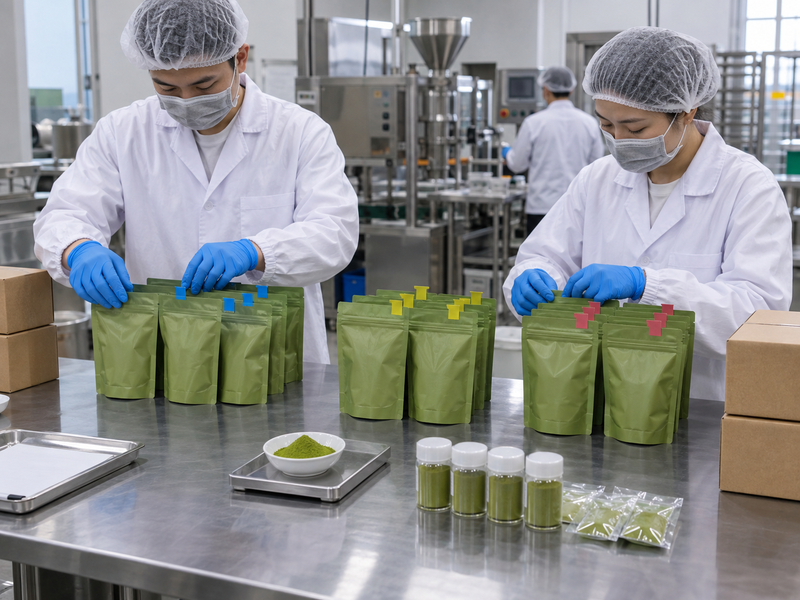
Specify the trial’s product code, quantity, site, packaging and review responsibilities. Ask the manufacturer to identify any difference between the trial route and routine commercial production. A trial can be useful even when it uses different equipment, provided the difference is recorded and addressed before broader approval.
| Trial outcome | Evidence to save | Approval consequence |
|---|---|---|
| Application fits | Controlled product comparison | Technical acceptance |
| Pack works | Handling and inspection notes | Packaging acceptance |
| Records connect | Lot document set | Traceability acceptance |
| Process differs | Listed scale-up differences | Further validation needed |
Review retained samples and records together. If the finished product fails, examine ingredient identity, process settings, packing and your own application method before assigning a cause. Keep an unaltered reference of what was received where your quality procedure permits it.
Close each trial issue with an action, owner and evidence. A promise to improve the next shipment is too vague to guide purchasing. State whether approval covers a single trial lot, a named production route or routine supply under the agreed specification.
10. What should the manufacturing agreement record?
Make future changes visible
Record the approved manufacturing and packing sites, product specification, permitted partners, packaging version and release documents. Define how the manufacturer notifies the buyer of proposed changes and which changes require approval before production. Include changes that can be easy to overlook, such as an alternative inner bag or a revised ingredient supplier.
Matcha Village’s company presentation describes involvement in tea cultivation, processing, powder production and packing. Those are company statements. A prospective buyer should ask which current site and operations would serve the proposed order, then obtain product-specific evidence. Avoid treating presentation numbers, certification language or factory images as acceptance of a manufacturing route.
Give purchasing one approved route summary and a list of unresolved items. Assign the technical reviewer who can close each item. Send the manufacturer a marked process map showing the proposed product, sites, partner operations and document handovers, and request written confirmation before scheduling the commercial trial.
FAQ
Q1: Must the seller own every production site?
Ownership alone does not decide suitability. Review control, disclosure, approval responsibilities and access to relevant records for every operation that affects the proposed product.
Q2: Can a remote review replace a site visit?
It can answer some document and process questions. Your quality team should identify what remains unverified and decide whether the residual gaps require an onsite assessment.
Q3: Should a factory disclose every production setting?
Agree the information needed to evaluate performance and investigate problems. Confidential settings may remain protected while product specifications, change controls and relevant evidence remain reviewable.
Q4: Can one approved factory supply every pack format?
Confirm each proposed packing route. A new tin, pouch or stick format may use another line or partner and may require separate packaging and handling checks.
Q5: What happens when the manufacturer changes its legal name?
Update the supplier file after checking the relationship between the old and new entities. Review contracts, payment instructions, certificates and site identities before changing purchasing records.