
Matcha whisk prong count is easy to print on a package and harder to connect to a better drink. A 120-tine whisk can feel very different from another with the same label, because bamboo thickness, head diameter, curl, and bowl fit also matter. A café should choose a chasen with a recipe test, not a ranking of numbers. This guide compares common count bands as buying questions and shows how to run a fair trial for thin tea, thick tea, and latte concentrate.
Contents
- 1. What does a prong count describe?
- 2. Which counts should a buyer sample?
- 3. How does thin tea change the choice?
- 4. What about thick tea preparation?
- 5. Does a latte base need the same whisk?
- 6. How do tine thickness and shape matter?
- 7. Will the whisk fit the bowl and holder?
- 8. What should a controlled trial measure?
- 9. How does use affect replacement cost?
- 10. How should the result be specified?
1. What does a prong count describe?
Count the strips, then examine the head
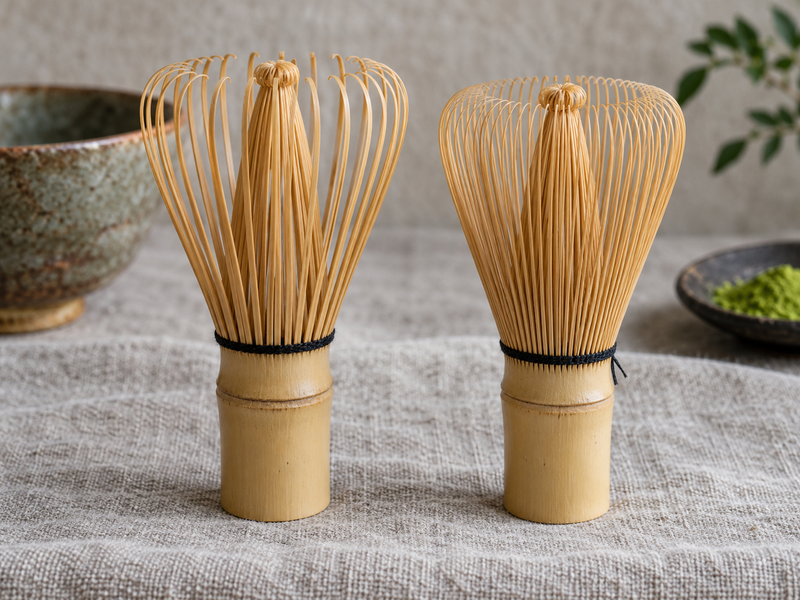
A bamboo chasen is split into multiple fine tines. The advertised prong or tine count is a useful way to identify a design family, but a count alone does not specify tine width, outer diameter, curvature, or how the head flexes. Some product listings also round counts or use different counting conventions. Ask the vendor how it names the model and examine a production sample rather than arguing about one visibly irregular tine.
The MatchaWhat comparison of whisk counts discusses 80, 100, and 120-prong options. For purchasing, treat those as candidates to test, not a ladder of inherent quality. The same advertised count can produce different handling when the bowl or operator changes. Record the physical whisk model beside its nominal count so a later buyer can reorder the actual tool that passed, not merely any whisk carrying the number.
2. Which counts should a buyer sample?
Limit the trial to plausible options
There is no need to buy every count on a catalog page. Start with the recipe and tool already used, then choose nearby alternatives that offer a different head density or shape. A program might compare a roughly 60-tine model, an 80-tine model, and a finer 100- or 120-tine model. Availability and construction matter more than filling a numerical grid. Buy several units of each if variation between handmade whisks is likely.
Write the hypothesis for each sample. Perhaps a denser head could create a different surface in a small usucha serving; perhaps a sturdier head could feel easier in a thicker concentrate. These are questions to test, not promises. Before tasting, check that every whisk is sound and fits the bowl. A broken tine should not be mistaken for a count effect. Limit other variables so the trial can answer the question you actually have.
| Candidate band | Reason to test | Do not assume |
|---|---|---|
| Around 60 | Different head openness or stiffness | Automatically best for thick tea |
| Around 80 | Common general-use comparator | Universal café standard |
| Around 100 | Finer head alternative | Always smoother texture |
| Around 120 | Dense-head comparison | Highest count means highest quality |
3. How does thin tea change the choice?
Judge the drink at the point of service
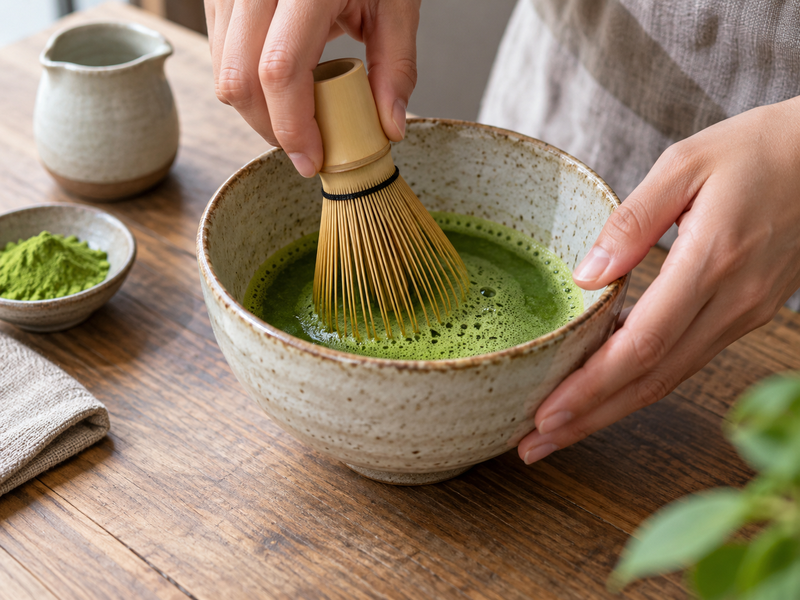
For a thin tea served directly in a bowl, surface texture and mouthfeel are visible to the guest. Prepare the same weighed matcha and measured water in the same bowl with each candidate whisk. Use a trained operator and a second operator to see whether a result can be reproduced. Record preparation time, visible clumps, foam distribution, and how the tea feels when tasted promptly. A count that performs well for one person but requires a difficult stroke from everyone else may not suit a café.
Take photographs from above under the same light, then taste without the tester knowing which whisk made each bowl where feasible. Do not give more points to the tallest foam automatically; define what your tea service aims to present. Temperature and matcha lot can change the result, so run candidates within the same session. Keep the winning model’s construction details, not just its count, in the purchase record.
4. What about thick tea preparation?
Test the movement required by the recipe
Thick matcha is generally worked differently from a frothy thin tea. If your venue offers it, ask the tea preparer to test candidate whisks with the actual powder and water ratio used there. Watch whether the tines move through the mixture without excessive force or leaving dry pockets. Do not generalize from a supplier’s “koicha whisk” label alone; confirm the design and the operator’s method. The best candidate should handle the intended texture and still be practical to rinse under the maker’s instructions.
If the menu does not serve thick tea, do not optimize purchasing around a use case that exists only in marketing copy. Retailers can present a whisk as suitable for a preparation style only with clear guidance and a realistic recipe. Count is not a substitute for teaching customers the correct amount of water or the motion required. A simple comparison table should say what was actually tested and what remains a choice of personal preference.
| Thick-tea check | Observation | Decision use |
|---|---|---|
| Movement | Does head move without strain? | Operator fit |
| Powder pockets | Any dry material left? | Recipe performance |
| Tine condition | Any damage after trial? | Construction fit |
| Cleaning | Residue between tines? | Service practicality |
5. Does a latte base need the same whisk?
Focus on dispersion in the finished drink
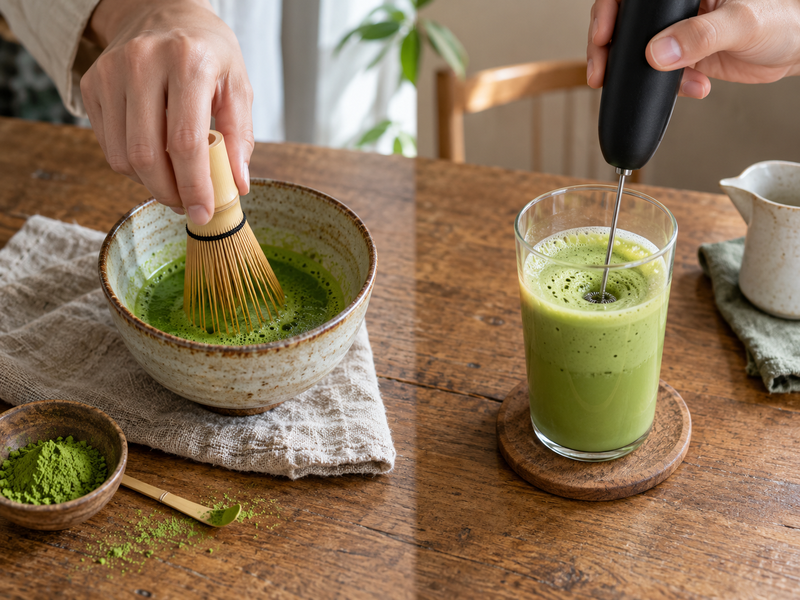
A café often whisks a small amount of matcha with water, then adds it to milk and ice. In that workflow, smooth dispersion and speed may matter more than a foam layer that disappears under milk. Test whisk counts with the same concentrate recipe, then pour each into the finished latte. Compare visible clumps at the bottom, uniformity of color, and flavor at the normal handoff time. A whisk that looks impressive in a clear bowl may not change the finished latte.
Keep bowl shape and water volume constant during the comparison. A very shallow concentrate in a broad bowl can make any whisk seem ineffective. If the café uses a spouted bowl, also evaluate the pour and cleaning after each candidate. The result might support one general-purpose whisk or separate tools for tea and latte lines. Add a second SKU only when the difference is clear enough to justify training and inventory.
6. How do tine thickness and shape matter?
Read the physical tool behind the label
Two whisks with the same count can feel different because one has finer tines or a different curl. Inspect the inner and outer tine rows, head width, and the transition into the handle. Flex is best assessed during a normal preparation, not by bending a dry tine with a finger. A more flexible head may feel responsive in a light mixture; a stiffer one may offer a different sense of control. Neither is automatically durable or superior.
Ask for several production units to distinguish the design from individual variation. Photograph each head beside a ruler and note any rough or split bamboo. If the supplier changes construction while keeping the same prong count, the new lot should be tested again. The number is useful for cataloging, but the purchase specification must include the model, maker where known, and approved sample. That is how a count becomes a reliable reorder rather than a guess.
| Physical attribute | Compare directly | Reason |
|---|---|---|
| Tine thickness | Side view under light | Alters flex and feel |
| Head diameter | Ruler at widest point | Determines bowl clearance |
| Curl profile | New samples side by side | Changes contact with liquid |
| Binding and handle | Normal grip | Affects control and quality |
7. Will the whisk fit the bowl and holder?
Test the whole accessory set
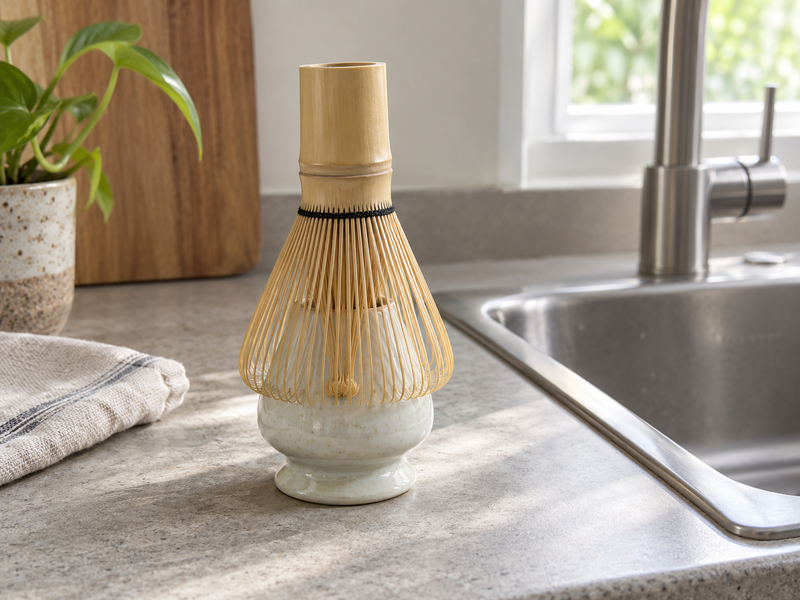
Put each candidate in the actual bowl and make the normal wrist stroke. A wider head may strike the side where a narrower one moves freely, regardless of its tine count. Measure the working floor rather than relying on the bowl’s outside diameter. If the program uses a whisk holder, place the rinsed chasen on it and ensure the support does not force the tines outward or snag them when lifted. A holder advertised for “80 prongs” may not fit every 80-prong head.
Retail sets should be assembled and photographed with their real components. A customer should not receive a dense whisk that cannot move in the included small bowl. For café operations, test a new and a used whisk; bamboo shape can change over time. Recheck compatibility whenever the bowl or holder supplier changes. The whole set determines service fit, not a tine number in isolation.
8. What should a controlled trial measure?
Use a small scorecard with observable outcomes
Write the recipe, matcha lot, water volume, temperature, bowl, and operator on the trial sheet. Randomize the order of candidate whisks if possible so the first drink does not always belong to one model. Time from first water addition to a defined finished state. Photograph the surface consistently and check for clumps. Ask an operator to rate handling on a short scale, then have someone else taste the finished drink without seeing the whisk label.
Do not treat the scores as laboratory proof. They are a procurement tool for a specific menu. If results are close, the simpler inventory or better parts availability may decide the purchase. Repeat the trial on another day if the first session has inconsistent powder or operator technique. Keep the scorecard with the approved sample so a later menu change can be evaluated without starting from vague memory.
| Trial field | Hold constant or measure? | Why |
|---|---|---|
| Matcha lot and dose | Hold constant | Avoid powder confounding |
| Bowl and water | Hold constant | Isolate tool change |
| Time | Measure full preparation | Service fit |
| Clumps and texture | Observe at handoff | Drink quality |
| Handling | Ask two operators | Training burden |
9. How does use affect replacement cost?
Track condition rather than assuming a lifespan
Higher tine count does not provide a universal lifetime prediction. Bamboo quality, use frequency, bowl contact, rinsing, and storage all affect condition. Set removal criteria such as broken or split tines, an unusable head shape, or a result that no longer meets the drink standard. Record when each whisk enters and leaves service. That produces a local cost per usable preparation without inventing a months-long guarantee.
Compare total cost across candidates after a limited rollout: unit price, arrival defects, replacement frequency, and cleaning time. If one model repeatedly catches on a rough bowl, fix the bowl pairing rather than blaming the count. If fine tines are repeatedly crushed in packaging, improve the pack. A replacement plan should include spare inventory and a quick inspection step so staff are not forced to use a damaged whisk during a busy shift.
10. How should the result be specified?
Order a tested design, not just a number
The purchase sheet should identify maker or supplier, model, nominal tine count, head diameter range, handle, packaging, care instructions, and the bowl and holder used in approval. Attach photographs of acceptable construction and examples of defects. State whether the whisk is for thin tea, thick tea, latte concentrate, or a combination. If the model changes, require a new sample even if the prong count remains the same.
For a retail listing, explain that count is one characteristic rather than a quality grade. Show the included bowl and preparation guidance. For a café, train staff on the selected movement and replacement criteria. The right answer may be 60, 80, 100, 120, or another count depending on the recipe and design. A measured local decision is more defensible than copying a ranking from a buying guide.
| Purchase field | Record | Reassess when |
|---|---|---|
| Model and count | Exact SKU and nominal count | Supplier changes design |
| Head geometry | Approved range and photos | Bowl changes |
| Intended recipe | Tested tea or concentrate | Menu changes |
| Care | Maker guidance and station method | Cleaning changes |
| Replacement | Condition criteria | Wear pattern changes |
FAQ
Q1. Is 120 prongs always better than 80? No. Count does not describe all of the whisk’s construction, and the drink and bowl determine what works.
Q2. Should a café use the same whisk for usucha and lattes? It can if controlled trials show acceptable results for both. Separate tools may be justified when the difference is meaningful.
Q3. Do more prongs always mean finer foam? No universal guarantee follows from the number alone. Powder, water, technique, and tine shape also affect the result.
Q4. Can count predict durability? Not reliably by itself. Track actual condition and replacements under your service routine.
Q5. What should be printed in a product listing? State the nominal count, model, bowl compatibility, care guidance, and the use cases you have actually tested.
Buy the whisk behind the number
Use matcha whisk prong count to shortlist designs, then let a controlled recipe trial choose the actual model. Retain the approved sample and its bowl pairing. That makes future orders about a tool that worked, rather than a number that sounded persuasive.