
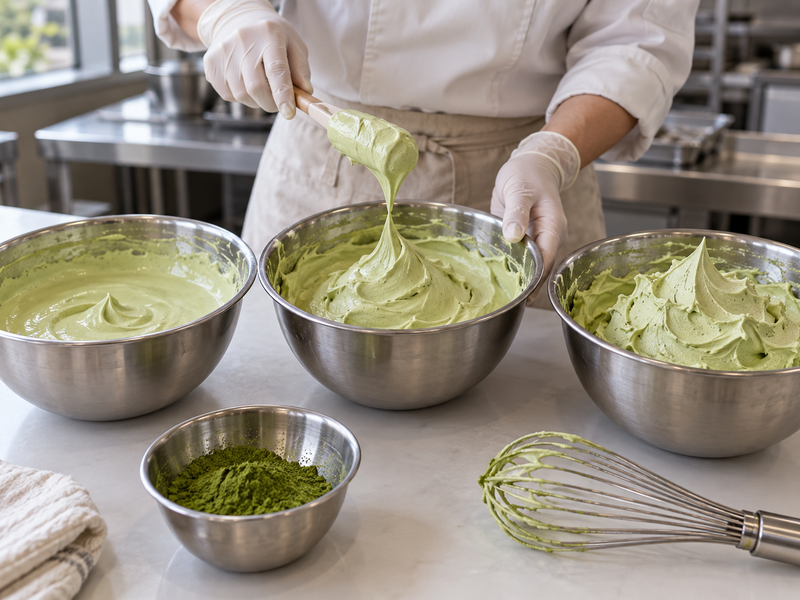
Matcha whipping cream has to taste like tea and keep its shape on the pastry or drink it was made for. A stable bowl on a cold bench can collapse after piping, packing or display. Bakery teams should test texture, color and the full selling window before locking the recipe.
Contents
- 1. What should matcha whipping cream promise in a finished portion?
- 2. Which matcha survives this pastry process?
- 3. How should the dough, cream or layers be set?
- 4. Which production steps change color or texture?
- 5. How does the complete serving taste?
- 6. What happens through the sale window?
- 7. Can the box protect the finished product?
- 8. How many saleable portions does a pilot make?
- 9. Which ingredient records and allergen checks apply?
- 10. What sample should guide the next production run?
1. What should matcha whipping cream promise in a finished portion?
Define the product before approving a sample
Choose the job of the cream: cake filling, piped topping or drink cap. Each needs a different balance of flavor, stiffness and mouthfeel. The tea dose that tastes good in a spoonful may dominate a whole slice.
Piped topping, cake filling and drink foam are three different uses for matcha cream. Write the intended geometry and serving temperature before choosing a stabilizer or tea dose. A firm cream that holds a tall swirl may feel heavy between cake layers; a soft drink cap may collapse on a takeaway pastry. The product brief should name the vessel, portion weight and how long the finished serving needs to look and taste acceptable.
For baked goods and pastries, the target must include cut face, texture and portion yield. Surface color alone is a weak release standard.
2. Which matcha survives this pastry process?
Choose powder against the finished application
Disperse matcha before adding it to chilled cream. Dry powder tipped into partially whipped cream can leave dark specks and force overwhipping. Compare a small matcha slurry with a sifted dry addition using the same cream lot.
Make one base cream and compare measured matcha additions at the same whipping endpoint. Pipe equal portions onto the intended cake or drink. Taste a complete serving, since cream on its own can make the tea seem stronger than it will under fruit or chocolate. If the higher tea dose weakens the structure, test dispersion and stabilizer decisions before accepting a pale, flavorless result.
Heat, fat and sugar can change matcha perception. Compare powders in the cooled pastry, not only as a straight-water cup.
For a related production decision, see our matcha buttercream tests guide.
| Candidate | Specific check | Keep if |
|---|---|---|
| Powder | Disperse matcha before adding it to chilled cream | Tea fits the finished application |
| Formula | Track cream temperature, fat content and mixing endpoint in the pilot | Dose stays practical |
| Tasting | Taste the cream with its cake, fruit or drink base | Flavor remains clear |
3. How should the dough, cream or layers be set?
Change one variable at a time
Track cream temperature, fat content and mixing endpoint in the pilot. Stop at the texture needed for the product rather than at a fixed timer setting. A stiff display swirl can feel heavy in a delicate pastry.
Make a small dose series with the same cream lot and mixing equipment. Disperse matcha before whipping and stop each sample at the same visible peak. If a powder requires more liquid to blend smoothly, include that liquid in the formula rather than treating it as free. Test a finished slice as well as a spoonful of cream; chocolate, fruit and sponge can shift the perceived tea level.
Keep portion or pan weights constant during trials. Otherwise one test may seem richer simply because it contains more filling or dough.
4. Which production steps change color or texture?
Write a method another operator can repeat
Pipe identical portions from the beginning and end of the bag. If the final portions look denser or greener, the mixture may be separating or warming. Photograph side profiles at production and after the intended display interval.
Have the bakery pipe portions from a full bag at the beginning and near the end of normal production. Record cream temperature, bag residence time and whether staff rewhip or discard a warming batch. Photograph the peak height and the edge of each swirl. A test with a half-filled bag in a cold room can miss the pressure and warming behavior that makes commercial portions uneven.
A production instruction should name mixing endpoint, product temperature and finishing sequence. Bakery time alone rarely describes the result.
| Process point | Specific check | Record |
|---|---|---|
| Preparation | Track cream temperature, fat content and mixing endpoint in the pilot | Tool and dose |
| Production | Pipe identical portions from the beginning and end of the bag | Start and end samples |
| Finished unit | Taste the cream with its cake, fruit or drink base | Sensory result |
5. How does the complete serving taste?
Taste the portion a customer receives
Taste the cream with its cake, fruit or drink base. A neutral spoon test can exaggerate bitterness. In the full dessert, note whether tea remains distinct after sugar, cocoa or fruit are added.
Taste the cream after it rests on the intended product. A light matcha aroma in a cold bowl can disappear when paired with a sweet base. Check whether bitterness grows at the edges as the cream warms. Ask a panelist to compare the center and outer ridges of a piped swirl. If the cream tastes uneven, look at dispersion and bag hold time before increasing the overall dose.
Taste a normal serving after cooling. Hot samples can make sweetness and aroma seem different from a product sold hours later.
6. What happens through the sale window?
Use the real shelf or counter conditions
Run a refrigerated hold test under the actual service routine. Inspect weeping, collapse, color and off-odors at agreed points. Do not infer food safety from a visual check; use the site's validated time and temperature controls.
Hold finished pastries under the actual display lights and refrigeration routine. Note weeping at the contact point, color shift on the outer ridges and whether the cream softens into the base. Open a boxed sample after normal delivery handling. If the swirl touches the lid, a taller box may solve appearance without changing a successful cream formula. Food safety time and temperature limits still need separate validation.
Display, refrigeration and travel can alter crumb, cream or crust in different ways. Test the selling routine rather than a quiet bench.
| Observation | Specific check | Action |
|---|---|---|
| Storage | Run a refrigerated hold test under the actual service routine | Compare with control |
| Pack | Test the proposed box or cup lid | Inspect opened unit |
| Customer portion | Taste the cream with its cake, fruit or drink base | Taste again |
7. Can the box protect the finished product?
Test the actual selling format
Test the proposed box or cup lid. A cream that holds shape on an open tray may smear against a low lid in delivery. Use the normal travel time and handling, then inspect the product as a buyer would open it.
Choose a box or cup with enough clearance for the piped height. Run a short travel test and open it as a customer would. If the cream smears against a lid, package geometry may be the issue; if it slumps without touching, revisit the formula or cold chain. Record where condensation forms. A display case photograph made before packing cannot predict the condition of a delivery portion.
The box needs to protect the tallest or most fragile part of the pastry. Inspect a sample after the customer's likely trip.
8. How many saleable portions does a pilot make?
Measure yield and repeatability
Measure yield as saleable piped portions, including material left in the bag and pieces rejected for poor shape. A higher matcha dose can raise ingredient cost without improving the finished bite.
Count saleable decorations from a measured batch of cream. Include residue in the bowl and piping bag, damaged pastries and any chilled cream discarded after the approved hold. A richer matcha dose may allow a smaller swirl, but only if customers still see and taste the intended product. Price the finished pastry with its actual decoration weight, not a spoonful estimated in development.
Count slices or units a store can actually sell. Trim, breakage and late-day waste belong in recipe cost.
| Pilot measure | Specific check | Commercial use |
|---|---|---|
| Yield | Measure yield as saleable piped portions, including material left in the bag and pieces rejected for poor… | Cost per saleable unit |
| Loss | Run a refrigerated hold test under the actual service routine | Set acceptance limit |
| Supply | Milk allergen declaration and cold-chain procedures belong in the production file | Confirm lot evidence |
9. Which ingredient records and allergen checks apply?
Link claims and batches to documents
Milk allergen declaration and cold-chain procedures belong in the production file. Keep lot numbers for cream and matcha together, and document any stabilizer or sweetener added to the final formula.
A supplier file is useful only when it refers to the material delivered. Match ingredient statement, specification and test report to the purchase code and lot on the cartons. Ask for an agreed notice before changes in source, formula or manufacturing site. The finished product team should separately review market-specific ingredient and allergen wording. Test a trace request. Pick one pilot pack and ask where its matcha came from and which finished units received it.
The full bakery ingredient list may bring milk, egg, wheat, soy or nuts into label review. Track matcha and base lots together.
10. What sample should guide the next production run?
Release against a written reference
Release the recipe only after an ordinary baker repeats it from the written method. Save a photograph of the accepted peak and a finished pastry sample as training references.
The approved version needs a name and a date. Store the physical sample, recipe revision, process sheet, pack artwork and reason for selecting the supplier. State what would trigger a new test: a tea lot change, a different milk or fat, a new sealing film or a shift in serving size. Make approval repeatable. A future buyer should be able to compare a new shipment with the reference rather than reopening the entire concept from memory.
Save a cooled and packed reference with a cut photograph. Later shifts can compare their product with an approved slice or unit.
| Release item | Specific check | Owner |
|---|---|---|
| Formula | Release the recipe only after an ordinary baker repeats it from the written method | Development |
| Supplier | Milk allergen declaration and cold-chain procedures belong in the production file | Purchasing |
| Pack | Test the proposed box or cup lid | Quality |
A final production check
At the end of the trial, hand the recipe to the baker who will work the busiest shift. They should mix and pipe a full bag using standard cold storage and the planned pastry or cup. Compare the first and last decorations after the display interval. If one fails, measure cream temperature and portion weight before changing the tea. Retain a photograph of an accepted swirl and its packed version.
Further reading
Use ISO/TR 21380:2022 on matcha identity for matcha identity and FDA food allergen labeling guidance if the final drink or topping contains milk, cereal allergens or another covered ingredient. Set wet-product holding rules with the operating site's food safety team.
FAQ
Q1: What is matcha whipping cream in a commercial product?
Choose the job of the cream: cake filling, piped topping or drink cap. Each needs a different balance of flavor, stiffness and mouthfeel.
Q2: How should a buyer compare matcha for this use?
Disperse matcha before adding it to chilled cream. Dry powder tipped into partially whipped cream can leave dark specks and force overwhipping.
Q3: What usually causes the first quality failure?
Run a refrigerated hold test under the actual service routine. Inspect weeping, collapse, color and off-odors at agreed points.
Q4: Which documents should the supplier provide?
Milk allergen declaration and cold-chain procedures belong in the production file. Keep lot numbers for cream and matcha together, and document any stabilizer or sweetener added to the final formula.
Q5: When should the formula be approved?
Release the recipe only after an ordinary baker repeats it from the written method. Save a photograph of the accepted peak and a finished pastry sample as training references.