
Matcha vegan ice cream uses a plant-based frozen dessert base with powdered green tea. Brands must balance tea flavor with fat, sugar, solids, air, and frozen storage behavior. A simple kitchen mix can taste pleasant straight from the churn yet harden or separate in a retail tub. This guide turns the concept into a pilot brief for food manufacturers, scoop shops, and private-label buyers.
Search-intent reference: “5-Ingredient Vegan Matcha Ice Cream”. That title reflects demand for a short ingredient list; this article covers the additional controls needed for commercial production.
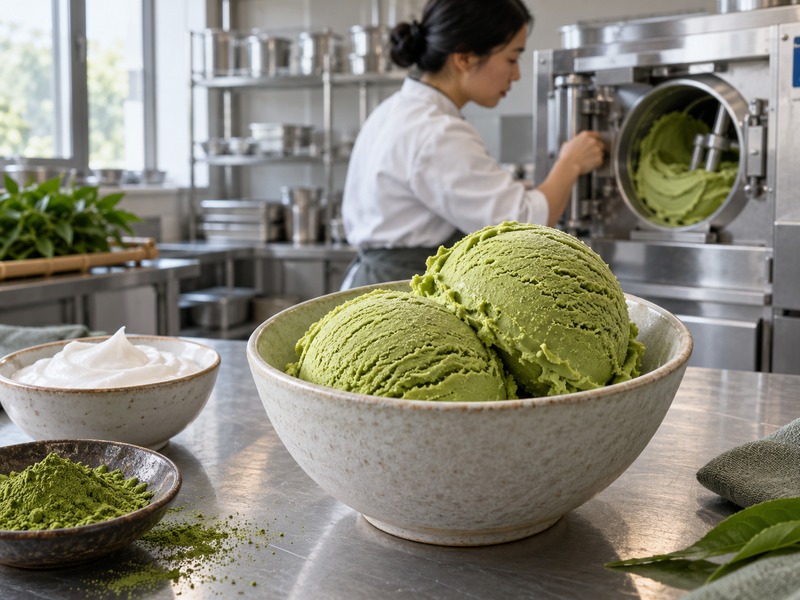
1. What product should the development team specify?
Define format and eating conditions
A scoop-shop pan, retail tub, and coated bar need different texture targets. A pan must scoop repeatedly during service; a tub may move through distribution before it reaches a home freezer; a bar needs shape retention and coating compatibility. Set serving temperature, target tea intensity, sweetness, color, ingredient restrictions, allergen policy, and price position before selecting a base. Picture the scoop: the spoon should cut a usable portion at the intended service condition without leaving a gritty or icy bite.
Confirm how “vegan” will be checked across the complete ingredient chain, including stabilizer carriers, flavors, inclusions, and processing aids. Plant-based wording does not by itself resolve allergen issues: soy, tree nuts, and other ingredients may require specific controls and labels. Set a sensory reference for tea aroma and bitterness, then test it after hardening. A mix tasted liquid will seem sweeter and more aromatic than the frozen product. Keep the finished pack in view during formulation so a bench prototype does not win approval under conditions customers will never encounter.
2. Which plant base supports matcha flavor?
Compare fat, protein, and background taste
Coconut can provide body but its aroma may dominate tea. Oat often gives a familiar cereal note, while soy can contribute protein and a different mouthfeel. Almond brings nut flavor and an allergen declaration. Commercial plant bases also vary in solids, oils, gums, and sugar, so the category name is too broad for a formula decision. Test exact supplier products at the planned mix composition. Read the carton: a sweetened beverage and a neutral culinary base will change both sweetness and freezing behavior.
Use a mix worksheet for total solids, fat, sugar sources, and water rather than treating a plant drink as a single opaque input. Check whether a base produces oily coating, chalkiness, or weak tea definition after frozen storage. A blended base may work better than one source, but it adds supply and labeling complexity. Ask suppliers for consistent specifications and change notices. If a formulation relies on a specific oat or coconut material, an unreviewed substitution can alter viscosity and air incorporation on the line. Procurement needs to know which properties are critical before accepting an apparently equivalent product.
| Base route | Potential advantage | Trial watchpoint |
|---|---|---|
| Coconut-led | Rich body | Coconut note masks matcha |
| Oat-led | Rounded cereal profile | Variable sweetness and starch feel |
| Soy-led | Protein contribution | Beany note and soy labeling |
| Blended base | Flavor and texture adjustment | More supplier controls |
3. How should matcha be chosen for frozen dessert?
Screen the powder after hardening
Cold temperature suppresses flavor perception. A tea powder that tastes balanced in a warm liquid may seem muted in ice cream, while a harsh grade can leave bitterness as the portion melts. Screen candidate grades in one base at equal dosage. Compare color after mix processing, after hardening, and after the intended storage period. A bright dry powder may not produce an appealing frozen shade once mixed with an ivory or brown plant base. Use the final matrix: tea tasting in water is useful for characterization but cannot select a commercial ice cream grade alone.
Request identity, origin, lot code, ingredient declaration, storage advice, applicable contaminant and microbiological records, and any certifications required for the target market. Check dispersion and particle feel. Very fine powder can still clump if dumped into a wet tank without an appropriate mixing step. Store matcha under controlled conditions and avoid leaving open bags near steam or strong odors. Matcha Village lists bulk matcha supply on its homepage; an ice cream buyer should request samples for the exact plant base and processing route.
4. What pilot formula can start a trial?
Make the variables visible by mass
The illustrative mix below totals 100% before freezing and is a bench development starting point, not a validated manufacturing recipe. Its plant base is a defined commercial ingredient that must be specified further in real trials. Sugar system, fat level, stabilizer, and tea dose should be adjusted from measured solids and sensory results. Keep one baseline while changing a single variable so the cause of an icy or gummy result remains clear. Log actual inputs: a formulation sheet that says only “oat milk” cannot be reproduced if its supplier or solids change.
After mixing, measure viscosity at a fixed temperature and observe whether tea particles settle before freezing. Taste the base, then taste hardened samples after equal storage. Calculate ingredient cost using actual quantities and batch yield. If the project requires a short ingredient list, decide which texture compromise the customer will accept and test it; removing stabilizer from a successful formula can change meltdown and storage behavior. A claim of “five ingredients” must be based on the complete ingredients and labels of compound materials, not only five lines on an internal recipe sheet.
| Mix component | Illustrative % | Trial purpose |
|---|---|---|
| Defined unsweetened plant base | 72 | Water and background flavor |
| Plant fat component | 10 | Body and melt |
| Sugar system | 15 | Sweetness and freeze behavior |
| Matcha | 2 | Tea flavor and color |
| Stabilizer system | 1 | Texture trial variable |
5. How can matcha be dispersed without green specks?
Choose a repeatable addition method
Premixing tea with a small portion of dry sugar can help distribute powder before it meets liquid. A controlled slurry may work better in another plant. Either way, include premix ingredients in the full formula and confirm that the mixer reaches the tank’s edges and base. Add tea under conditions suited to the selected powder and process, then inspect samples from more than one tank location. Check the pipework: clumps can lodge in screens or valves, changing both color and dose later in a run.
Heat treatment, homogenization, and aging steps must be developed for the complete mix under the plant’s food safety plan. Matcha color and aroma may shift during processing, so sample before and after each step. A low-shear kitchen blender result does not predict industrial line performance. Document order of addition, mixing time, mix temperature, and any filtration used. If a strainer removes green material, weigh or inspect the residue rather than assuming it had no effect on tea dosage. Operators need a clear way to distinguish harmless fine tea particles from visible agglomerates.
6. What controls matter during freezing and hardening?
Watch air, draw texture, and cold storage
Freezer settings influence air incorporation, ice crystal formation, and draw texture. A formula that leaves one machine smooth may run too soft or too dense on another. Record mix temperature entering the freezer, draw condition, filled weight, and actual overrun as measured by the plant’s method. Use finished density and visual structure to compare runs. Sample across the run: the opening tubs and later tubs can differ when mix temperature or feed rate drifts.
Move filled packs into the planned hardening system promptly under the site’s food safety procedure. Then evaluate the product after storage at the conditions it will face in distribution and retail. Temperature cycling can enlarge ice crystals and alter scoopability, so a steady laboratory freezer is only part of a useful study. The development team should define how long a consumer pack is expected to sit before serving and how the product behaves after a short tempering period. Do not publish a shelf life before the final mix, package, process, and distribution route have been studied.
| Process checkpoint | What to record | Possible defect |
|---|---|---|
| Mix feed | Temperature and viscosity | Unstable air uptake |
| Freezer draw | Density and texture | Weak body |
| Hardening | Pack timing and conditions | Large ice crystals |
| Distribution | Temperature record | Texture damage |
7. How should texture and melt be assessed?
Use tests tied to eating conditions
Scoopability, iciness, chew, fat coating, and meltdown describe different properties. Test them separately at a controlled serving temperature. A sample can scoop well but melt into a watery layer, or hold shape while leaving a waxy mouthfeel. Compare a fresh batch with stored samples in the same pack. Matcha particles may become more noticeable as the frozen portion melts. Watch the last spoonful: sediment and bitterness can appear after much of the base has softened.
Set a simple panel method with coded samples, identical portion size, and a defined tempering time. Record descriptive notes rather than asking only which sample people prefer. For a scoop shop, include repeated opening of the service cabinet and serving by different staff. For a tub, include home-style scooping after frozen storage. Instrumental measures such as viscosity and overrun can explain differences, but they do not replace tasting. When texture fails, check mix solids, fat, stabilizer, processing, and temperature history before assuming the tea grade caused the defect.
8. Which quality and labeling checks are needed?
Build a release specification for the full product
Incoming checks cover matcha, plant bases, sugar system, stabilizers, packaging, and any inclusions. Finished-product checks may include weight, color, texture, microbiological criteria, packaging seal, and sensory reference under the plant’s quality plan. Keep supplier lots linked to each batch. If color varies, investigate tea lot, base color, thermal process, and storage exposure. Use a reference tub: checking powder alone will not catch a shift caused by another ingredient.
“Vegan” must be supported by ingredient sourcing and controls appropriate to the market and brand standard. Allergen statements need review of compound ingredients and cross-contact practice. “Ice cream” may have a legal definition in some markets, so legal naming should be checked before packaging is printed. Nutrition values and serving sizes should reflect the finished commercial formula. Do not copy claims from a kitchen recipe or competing label. A qualified regulatory reviewer should approve final copy, including organic or free-from statements if used.
| Release item | Evidence | Owner |
|---|---|---|
| Tea identity | Lot and specification | Procurement and QA |
| Vegan claim | Ingredient and process review | Regulatory and QA |
| Frozen texture | Stored reference sample | Product development |
| Pack integrity | Seal and weight checks | Production |
9. How do packaging and distribution shape the formula?
Test the pack in the actual cold chain
A paper tub, plastic cup, and bar wrapper create different barriers, sealing methods, and visual expectations. A green dessert visible through clear packaging may lose appeal if surface frost forms. Opaque packaging hides color until opening but gives more room for consistent branding and label information. Evaluate fill weight, headspace, lid seal, scuffing, and ease of opening. Run a route trial: a product that survives the plant freezer may be damaged by loading delays or retail cabinet cycling.
Track temperature exposure through representative distribution and inspect the product after the full route. Ice crystals, shrinkage, off-color surfaces, and lid contamination should be logged with pack codes. Shelf-life studies need the final package, not a laboratory cup. A bar needs additional checks for stick release, coating cracks, and shape loss. Packaging changes can alter cost per unit and fill speed, so engineering and finance should review them with product development. A cheaper container is not a saving if it raises leakage, damage, or customer returns.
10. How should a buyer source and cost the recipe?
Compare finished servings at equal quality
Calculate cost from measured matcha dose, plant base, fat, sweeteners, stabilizers, pack, labor, energy, storage, and distribution. Divide by accepted filled units, accounting for start-up loss and rejects. A higher-priced matcha could be economical if a lower dose gives the target tea note, but that must be shown in the frozen product. A cheaper grade can demand more powder or produce color rejects. Cost the tub on shelf: raw mix price misses freezing and cold-chain expenses.
Send suppliers the plant base, process route, target tea profile, trial dose, market, projected monthly volume, pack size, and documentation requirements. Request representative lots and written change-notice arrangements. Matcha Village offers a contact route for bulk tea inquiries at its website. Compare candidates after processing and storage before approving the buying specification. The strongest commercial version is the one that keeps its intended flavor, scoop, color, and unit economics through the real route to the customer.
| Cost line | Measure | Decision point |
|---|---|---|
| Matcha | Grams per accepted unit | Flavor and color target |
| Base | Solids and fat per mix | Texture and supplier stability |
| Factory | Yield and energy per batch | Scale economics |
| Cold chain | Storage, freight, returns | Market reach |
FAQ
Q1: Can a home recipe be scaled directly? A commercial product needs measured solids, process controls, packaging trials, and a product-specific shelf-life study.
Q2: Why does matcha taste weak after freezing? Cold reduces flavor perception; evaluate dose and grade in the hardened final base.
Q3: Is coconut required for vegan ice cream? No. Oat, soy, coconut, and blended systems can work after formula and sensory trials.
Q4: Why are green specks visible? Check powder addition order, premixing, mixer coverage, and any material trapped in screens.
Q5: Can the product be labeled ice cream everywhere? Naming rules vary by market; review the intended product name before printing retail packs.