
Matcha temperature advice often sounds absolute: never use boiling water, always use one precise number, or whisk only with cold water. A cup is more flexible than those rules suggest. The powder, water, bowl, and eventual serving all change what a guest tastes. A café needs a repeatable starting range and a simple way to test its own tea. The goal is an appealing drink, not a thermometer reading that looks impressive on a poster. These ten questions help turn temperature into a useful preparation standard.
1. Which temperature are you actually measuring?
Separate kettle, bowl, and serving temperatures
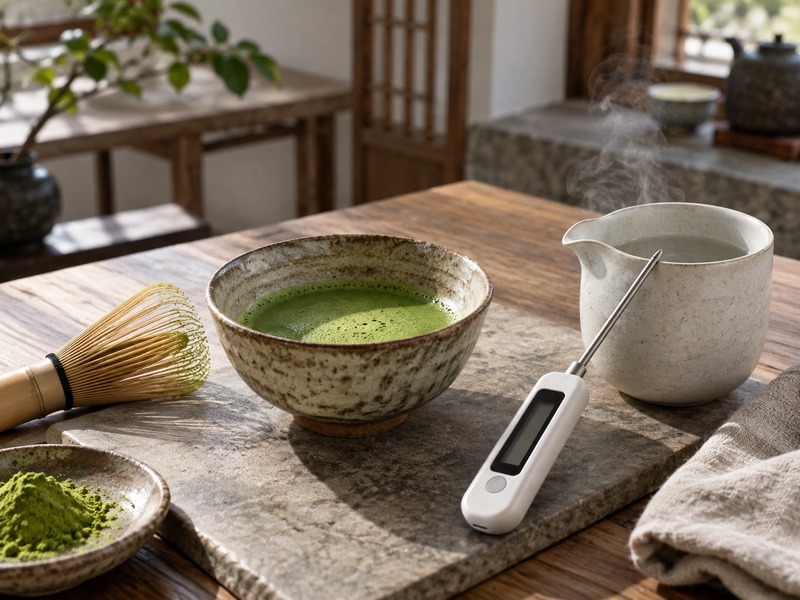
Water leaves a kettle, enters a pitcher or bowl, contacts powder, and may then be mixed with milk or ice. Each stage can have a different temperature. A recipe that says “80°C” without identifying the measurement point is difficult to repeat. Measure the water immediately before it reaches the matcha, and record the bowl and serving conditions separately. If the same kettle serves several stations, check the temperature at the last station rather than trusting the display on the kettle.
The ranked Jade Leaf article on water temperature suggests a preparation range of 140–175°F. Ippodo’s usucha recipe uses water at 80°C, or 176°F. Those are useful starting points from tea sellers, not proof that every matcha tastes best at one exact setting. A buyer should test the actual powder, dose, and drink format. Write the measurement location beside every temperature in the recipe.
| Measurement point | What it tells you | Common source of error |
|---|---|---|
| Kettle display | Set point | Water cools after pouring |
| Pitcher | Water before whisking | Vessel absorbs heat |
| Bowl | Mixing environment | Bowl starts cold or warm |
| Finished cup | Guest experience | Milk and ice alter temperature |
2. Is there one ideal water temperature for matcha?
Use a range before choosing a set point
No single number captures every tea and serving style. A delicate powder may taste smoother at a lower temperature; another may need a slightly warmer preparation for the aroma a café wants. A cold latte may need only enough water to make a smooth concentrate. Start with a reasonable test range, such as cool water, a moderate hot setting, and a hotter setting below boiling. Keep everything else identical. Taste blind once the cups reach comparable drinking temperatures.
A published matcha temperature study found that different components and sensory results respond differently to water temperature under its experimental conditions. That does not dictate a universal café recipe, and laboratory extraction of a berry blend is not the same as a quick whisked bowl. It does support a more careful claim: temperature changes the result. Choose the set point by taste, mixing, and workflow for the actual product rather than by a generalized “maximum antioxidants” slogan.
3. Why do very hot cups taste different?
Compare bitterness without dramatic claims
Near-boiling water can emphasize astringent or bitter impressions in some matcha and can make a fresh bowl uncomfortable to drink immediately. It may also alter the visual shade over time. It is more precise to describe what happens in your cup than to say the tea “burns” at a magic threshold. The effect depends on powder, contact time, dose, and how soon the drink is tasted. A simple sensory comparison can reveal whether the hotter sample actually disappoints your customers.
Make three cups from one lot, changing only water temperature. Label them with codes. Taste once at preparation and again when they reach similar serving temperatures. If the hottest cup tastes rougher, note the difference and set a lower operating range. If it tastes acceptable in a milk drink, there may be no reason to copy a ceremonial-bowl rule into that format. Treat color as one observation, not the sole test of quality; lighting and milk can make color judgments unreliable.
| Test cup | Water condition | Record |
|---|---|---|
| A | Cool | Mixing and aroma |
| B | Moderate hot | Foam and balance |
| C | Hotter, below boiling | Bitterness and color |
| Retest | Chosen condition | Consistency across staff |
4. Can cold water prepare matcha?
Test dispersion with the intended tool
Matcha is fine ground leaf suspended in liquid. Cold water can disperse it, especially with a shaker, whisk, or frother. It may require more time or create stubborn clumps if the powder is dumped into a full cup at once. Use a small water portion first, make a smooth slurry, then add the rest. For an iced latte, this can prevent a hot concentrate from melting ice and diluting the drink before handoff.
Run a cold-water test with the normal staff tool and a fixed mixing time. Inspect the bottom of the vessel for dry powder and taste the last sip after a short rest. A clear green surface can hide clumps. If a product only works with an electric frother, say so in the service card. For bottled applications, a quick café test is insufficient to establish stability; particle settling and microbiological safety need product-specific work. The benefit of cold preparation is operational fit, not a blanket promise of superior nutrition.
5. What does bowl temperature change?
Warm vessels consistently when needed
A thick ceramic bowl can pull heat from a small volume of water. A pre-warmed bowl behaves differently from one taken from a cold shelf. If a café serves whisked matcha in a bowl, include vessel condition in its training recipe. It can be as simple as a warm rinse, followed by draining and drying enough that the matcha dose remains known. Check that the handling step is safe and practical for staff.
For takeaway cups, the cup material and size also affect serving temperature. A large cold cup can cool a small shot quickly. In a latte, steamed milk temperature may dominate the final result, so perfect control of the matcha shot alone will not guarantee a consistent finished drink. Measure both during development. Aim for a cup guests can comfortably receive and drink, not just a visually appealing foam at the whisking station.
6. How should matcha be prepared for a hot latte?
Keep the tea shot and milk process separate
Prepare the tea with a measured small amount of water in the selected range, then add the intended milk. This lets staff disperse powder before it meets a full cup of dairy. The final temperature depends on the water, milk, cup, and hold time. A latte can taste more muted than a plain bowl, so a matcha temperature chosen for straight tea may not automatically produce the best latte. Compare the finished beverage rather than just the green shot.
Check whether a hotter water shot improves mixing but worsens taste, or whether a moderate setting performs as well. Make a few drinks at normal service speed. If the tea sits while milk is steamed, note whether sediment or color changes. An efficient sequence may matter more than adjusting the water a few degrees. Keep the matcha weight and liquid volume in the recipe; temperature cannot rescue an underdosed drink or a powder that is stale.
| Step | Record | Why |
|---|---|---|
| Sift | Powder grams | Controls clumps |
| Add water | Volume and temperature | Controls concentrate |
| Mix | Tool and seconds | Controls dispersion |
| Add milk | Volume and temperature | Controls final cup |
7. Does temperature determine matcha’s health value?
Avoid one-number nutrition claims
Research can measure specific compounds under specific extraction conditions, but a café cup is not a controlled laboratory extraction. Matcha is consumed as suspended leaf, and preparation varies in powder dose, water volume, time, and what else is added. The cited temperature study observed different responses among individual compounds. It would be misleading to convert that result into “this temperature makes matcha healthiest” for every consumer and recipe.
Choose a temperature for taste and safe, repeatable service. If a marketing claim about antioxidants or nutrients is contemplated, obtain evidence for the actual product and market. A higher tea dose can change the amount consumed more than a small change in whisking temperature, while a sugary latte changes the nutritional picture in another way. Separate sensory guidance from health claims in training and product copy. Guests can appreciate a better cup without a fragile scientific promise.
8. How can a team measure consistently?
Calibrate simple tools and document a tolerance
A temperature-controlled kettle is convenient, but a reliable handheld thermometer can work. Check the tool according to its instructions and use the same measurement point each time. A recipe needs an acceptable range rather than a number with false precision. Record who checks it, how often, and what happens if the reading is outside range. A staff member should not need to calculate heat loss during a rush; the operating procedure should have been tested beforehand.
Train by tasting cups made at the upper and lower ends of the chosen range. If nobody can detect a meaningful difference, a narrow one-degree target adds complexity without benefit. If the change is obvious, make the standard tighter. Recheck when a different kettle, bowl, powder, or portion size is introduced. A product specification and an equipment specification work together. A recipe copied from a different tea supplier may fail even when the temperature is identical.
| Tool | Strength | Check before service |
|---|---|---|
| Controlled kettle | Repeatable set point | Verify water at pour |
| Hand thermometer | Measures actual liquid | Clean and check accuracy |
| Pitcher | Helps cool hot water | Test cooling in your room |
| Recipe card | Keeps staff aligned | Update after equipment changes |
9. What should a supplier temperature test include?
Compare lots in the same setup
When sourcing matcha, request current-lot samples and prepare them at a common baseline temperature. Then test each candidate at a second setting to see whether its flavor holds up. A powder that tastes good only under a carefully managed demonstration may be less useful for a fast-moving café. Measure color, aroma, bitterness, foam, and sediment, but also ask staff whether the method is practical. Keep the water source, dose, tool, and milk constant.
The Matcha Village site can be a starting point for a supplier sample conversation; the decision should use the actual lot and menu test. Ask suppliers for recommended preparation guidance, then verify it. Their recommendations may reflect a particular serving style. Record the final recipe and the sample lot so a future purchase can be compared against it. If a later lot needs a different temperature to taste acceptable, investigate the change before silently adjusting the menu.
10. What temperature belongs on the recipe card?
Write an operating range staff can use
The final card should identify the temperature of water at the moment it meets the tea, along with matcha grams, water volume, mixing tool, time, vessel, and final beverage build. Include a separate line for iced preparation if it differs. State a tested range and a simple correction, such as waiting for water to cool or using the cold-water method. Avoid “boil and wait two minutes” unless that instruction has been checked in the actual kettle and vessel; timing alone is unreliable.
Validate the card with staff who did not design it. They should produce comparable cups without a developer standing beside them. Taste the first and later drinks in a normal shift and note whether temperature drifts as equipment cycles. Keep the standard that gives a repeatable, enjoyable drink. A measured range is useful because it supports consistency; it is not a scorecard for how seriously someone takes tea.
| Recipe item | Example of useful detail | Avoid |
|---|---|---|
| Water | Measured range at pour | Unspecified “warm” |
| Matcha | Grams per serving | Heaping spoon only |
| Tool | Whisk or shaker and time | “Mix well” |
| Final drink | Milk and ice quantities | Relying on shot alone |
FAQ
Should matcha be made with boiling water?
Many tea sellers recommend water below boiling for flavor. Test the actual powder and recipe; near-boiling water can create a harsher cup, but there is no universal single cutoff for every matcha.
Is 80°C good for matcha?
It is a practical starting point used by some tea makers, including Ippodo for usucha. Taste your own tea at nearby settings before making it a fixed café rule.
Can I whisk matcha with cold water?
Yes. Use an appropriate tool and check for clumps and last-sip sediment. Cold preparation can fit iced drinks particularly well.
Does water temperature change caffeine content?
The amount of matcha powder in the serving is a key input because the leaf is consumed. Do not make a precise caffeine promise from water temperature alone without product-specific evidence.
What should a café measure first?
Measure the water just before it contacts the powder. Then taste the finished serving with its normal milk, ice, and cup, because that is what the guest receives.