
A matcha tea set can be a compact retail product, a café’s training kit or an event service tool. Those buyers need different pieces. Suki Tea’s set guide outlines the familiar bowl, whisk and scoop, but a wholesale decision also needs fit tests, clear care instructions and a plan for replacement parts. Start with the user and the intended cup, then build the set around a preparation sequence that actually works.
Contents
- 1. Who will use this set and where?
- 2. Which pieces are essential?
- 3. Does the bowl work with the whisk?
- 4. What should the tea component promise?
- 5. How will users measure a portion?
- 6. Are the materials and care directions credible?
- 7. Does the first-bowl instruction work?
- 8. Can the set survive its delivery route?
- 9. How should a range of sets be priced?
- 10. What should be checked at reorder?
1. Who will use this set and where?
Describe a real preparation setting
Begin with an actual use case. A café training set may stay on one counter and be cleaned several times daily. A retail set might be opened once at home by someone who has never held a bamboo whisk. A corporate gift may spend days in transit before the recipient even reads the card. Those differences change the right bowl, packing protection and instructions. Write a one-sentence brief naming the user, drink format and sales channel before asking vendors for assortments.
Then observe the setting’s constraints. A narrow café bar may need stackable storage and replaceable whisks; a home user may value a bowl that is stable on a small table. If the buyer serves iced lattes, test the set with that sequence rather than assuming a ceremonial-looking arrangement is enough. A set is only coherent when each piece contributes to the same preparation path. Avoid including a fragile extra item merely because it makes a product photograph look fuller.
2. Which pieces are essential?
Build from the beverage backward
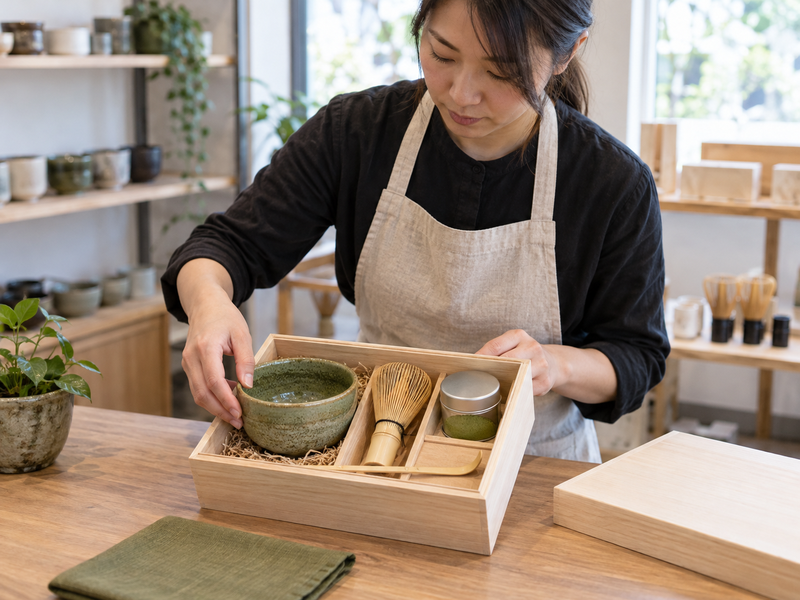
For a hand-whisked bowl, the core pieces are powder, a vessel with space to whisk, a whisk and a way to portion tea. A scoop can be included, though a scale is more reliable when a café must standardize doses. A sifter may improve dry clumps for some powders and workflows; it is useful when testing shows an actual need. A whisk holder helps a retail user store the whisk, but it is not required to make the first cup. Separate essentials from thoughtful extras in the quote.
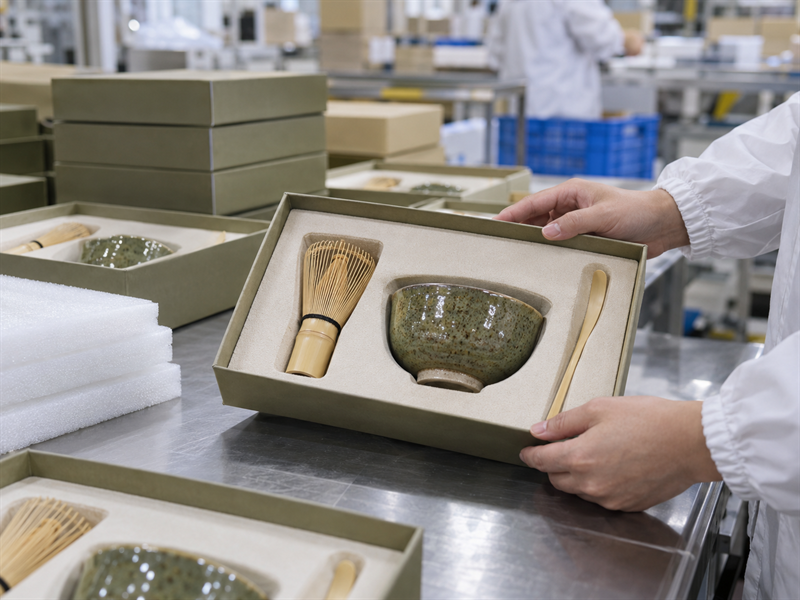
Test an assembled sample rather than purchasing components from separate catalog pages. The whisk must reach the bowl comfortably, the portioning tool must fit the tea container, and all items should fit back into the package after inspection. Ask whether the set can be replenished piece by piece. A gift box that becomes unusable when one whisk wears out creates a poor long-term experience for both café and customer.
| Component | Role in the set | Buyer check |
|---|---|---|
| Bowl | Room for the planned mixing motion | Whisk clearance and stable base |
| Whisk | Mixes powder and water | Tine condition and replacement availability |
| Scoop or measure | Helps portion powder | Calibrate against a scale |
| Sifter | Breaks dry clumps if needed | Powder flow and cleaning time |
| Holder | Stores whisk between uses | Fit with supplied whisk |
3. Does the bowl work with the whisk?
Test reach and movement together
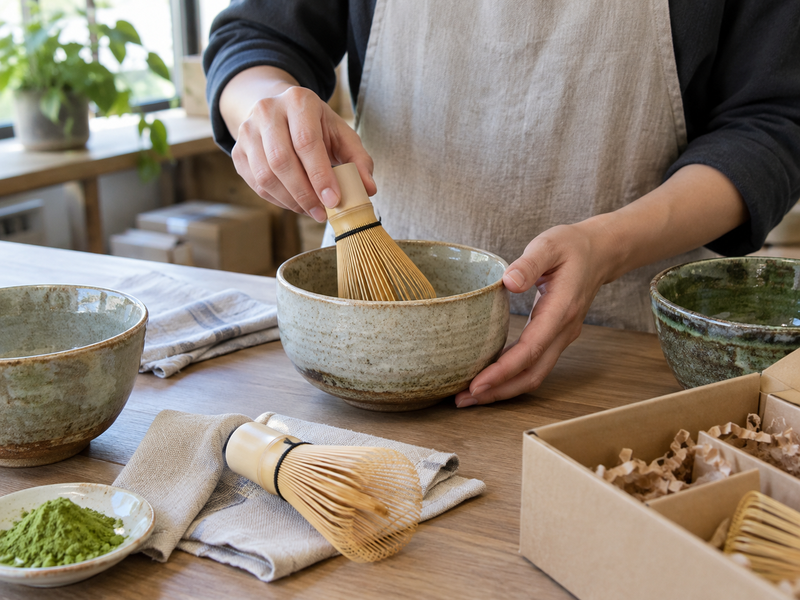
An attractive bowl can still be too narrow for the included whisk. Prepare the intended beverage using the sample set without changing technique to protect the bowl. The whisk should move freely, and its tips should be able to reach the powder without being crushed against a steep wall. Consider the liquid level for the proposed recipe. A bowl sized for a small concentrated preparation may be awkward for a much larger café drink.
Look at the foot, rim and interior finish. Does the bowl sit firmly on the preparation surface? Can the user pour out the whisked tea without dribbling down the outside? Are there sharp glaze irregularities or inaccessible crevices? These are handling and quality questions, not claims that one ceramic shape guarantees better foam. Keep the approved bowl and whisk samples together. A replacement bowl with an apparently similar outer diameter can have a different interior curve and change the set’s usability.
4. What should the tea component promise?
Specify product facts that can be checked
If the box includes matcha, list its net weight, packaging format, lot identification, shelf-life information and storage directions. Request the supplier documentation required for the destination market and check the label against the actual packed tea. Do not turn broad phrases such as “premium” or “ceremonial” into factual promises about harvest date or farming method unless evidence for the exact tea supports them. For sets sold in several markets, review each label version before artwork is printed.
Match the tea to the first cup the set teaches. A strong, unsweetened bowl and a sweetened latte place different demands on flavor and portion size. Ask for samples from the intended commercial lot where possible, and test them with the included tools and recipe. The supplier’s tea specification should be stable enough that a reorder does not quietly change the user experience. A set with a beautiful bowl and disappointing powder will be judged as a whole.
| Tea detail | Evidence or action | Why it matters |
|---|---|---|
| Pack format | Inspect sample seal and opening | Usable storage after first cup |
| Lot identity | Match box to tea records | Traceability and reorders |
| Recipe fit | Make the stated drink | Avoid mismatch between tea and instruction |
| Claims | Review supporting documents | Keep label wording defensible |
5. How will users measure a portion?
Make the instruction repeatable
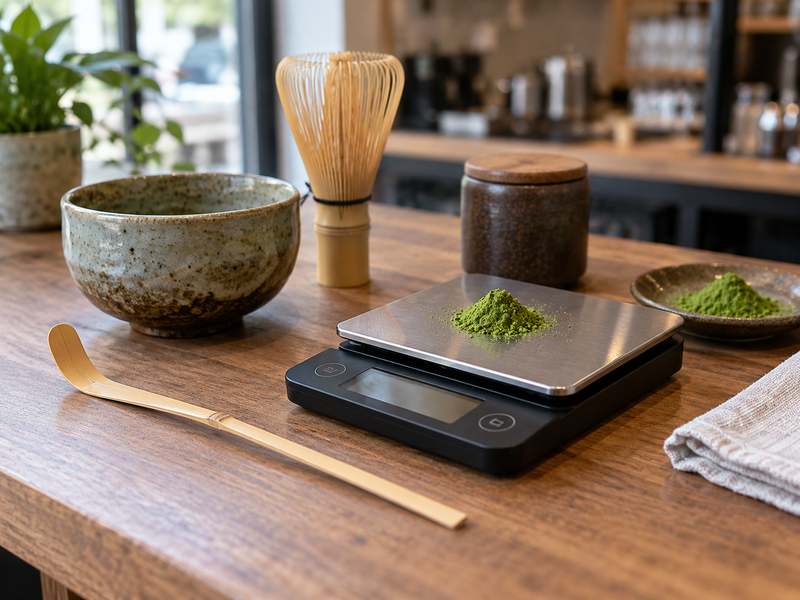
A bamboo scoop is easy to include and pleasant to use, but its contents vary with powder density, scoop shape and how it is filled. If the box offers a dose by “scoops,” test the supplied scoop against a scale with the supplied tea and state the measurement as an approximate aid. A café should set its recipe by weight and train staff to weigh powder at least during setup and periodic checks. The scoop can remain a convenient transfer tool.
Make sure the opening of the tea pack admits the scoop without spilling, and check whether the utensil can be stored cleanly. If a measuring spoon is included instead, validate the marked volume with the actual powder; volume is not a fixed mass. The preparation card should tell a beginner what to do when the cup tastes too strong or too weak without making unsupported health claims. A practical adjustment is to change the measured tea or water amount one variable at a time.
6. Are the materials and care directions credible?
Treat care as part of product design
Ask suppliers for material details and applicable food-contact records for the bowl, scoop, sifter and other surfaces that touch tea. Review care instructions for each item; one generic “dishwasher safe” line can be misleading when bamboo and ceramics share a box. A bamboo whisk is a consumable accessory that needs gentle handling and drying. A ceramic bowl may have maker-specific restrictions based on glaze or decoration. Do not infer the appropriate washing method from appearance.
For café use, align the care card with the site’s cleaning program. Staff should be able to inspect whisk tines and bowl surfaces after washing, and replace worn parts without purchasing an entire set. For retail use, give the customer a clear sequence: rinse or wash as instructed, dry thoroughly, and store the pieces so moisture is not trapped against tea packaging. Test the printed directions with someone who did not help write them.
| Item | Care question | Sample test |
|---|---|---|
| Whisk | How is it rinsed and dried? | Inspect tines after repeated use |
| Bowl | What wash method is approved? | Check glaze and decoration after cleaning |
| Scoop | Where is it stored dry? | Try the package layout |
| Sifter | Can all powder be removed? | Disassemble and inspect |
7. Does the first-bowl instruction work?
Watch a novice follow the card
Put the sample set and its draft instructions in front of a person unfamiliar with matcha preparation. Do not coach. Record where they pause: opening the tea pack, estimating a portion, adding water, moving the whisk or cleaning up. A concise visual sequence can solve more problems than another paragraph of brand story. If the set includes a sifter, show exactly when it enters the preparation flow; otherwise the extra tool becomes confusing clutter.
The card should distinguish the core recipe from optional adjustments. State the quantities the company has actually tested, using accessible units for the destination market. Explain that water temperature and powder amount affect taste, but avoid claiming there is one universally correct combination. For an iced drink, teach the user to make a small smooth matcha mixture before adding ice and milk, if that is the validated recipe. Retest whenever the included tea, bowl or whisk changes.
8. Can the set survive its delivery route?
Pack against real handling
A complete set mixes breakable ceramic, flexible bamboo and powder that must stay sealed. The inner tray should keep the bowl from striking the whisk and should prevent the tea pack from being crushed. Inspect how the package behaves after opening and repacking; retail staff may inspect a unit, and customers may store the set in its box. A molded insert that looks neat in a rendering can still leave the bowl foot exposed to impact.
Test packed samples on the route that matters: parcel delivery for online retail, carton handling for wholesale or repeated movement for event service. Record damage by component and location within the carton. Then revise the insert and repeat the test before committing to a larger order. Include the outer carton and its packing quantity in the specification. Breakage cost is part of the landed price, and replacement logistics should be discussed with the supplier before launch.
| Transit issue | Design response to test | Evidence to keep |
|---|---|---|
| Bowl chips | Separate rigid support | Post-route inspection |
| Whisk bends | Protected tine cavity | Unboxing photographs |
| Tea seal damage | No sharp adjacent edges | Seal check on arrival |
| Parts shift | Positive insert fit | Shake and route trial |
9. How should a range of sets be priced?
Give every tier a clear purpose
A retailer may offer a simple bowl-and-whisk starter, a tea-included gift set and a premium ceramic assortment. Price differences should correspond to useful changes: a better-specified bowl, a larger tea pack, a sifter when needed, or more protective packaging. Avoid adding low-value accessories only to make a higher tier look crowded. Prepare a bill of materials for each configuration, including assembly, inserts, labeling, freight, breakage allowance and replacement support.
Compare vendors using the same approved component list and packing requirement. A lower unit quote may omit the tea, claim review or shipping protection that another includes. Ask for sample charges, minimum order terms and lead times in writing rather than assuming they match an earlier project. If private-label presentation is important, confirm which box surfaces and care cards can be customized and what proof is required before print. Keep one customer-facing promise for each tier so staff can explain the choice quickly.
10. What should be checked at reorder?
Keep the set the same in use
Approve a master sample and a component list with specific item codes, dimensions, material descriptions, tea identification, pack layout and artwork revision. At reorder, check more than the outer box. A new whisk or bowl of similar appearance can alter fit; a new tea pack size can make the instruction card inaccurate. Ask the vendor to flag substitutions before production and test any changed component in a complete assembled set.
Incoming inspection should include tea lot and seal, bowl finish and stability, whisk tine condition, scoop fit, count of items and pack protection. Retain the approved sample and a short first-bowl test record. Those files help purchasing distinguish a harmless cosmetic variation from a change that affects preparation. When customer feedback repeatedly names one awkward component, revise the next version deliberately and update photographs, instructions and inventory identifiers together.
| Reorder item | Control document | Acceptance check |
|---|---|---|
| Components | Approved bill of materials | Correct count and item codes |
| Tea | Lot and label records | Seal and printed details |
| Artwork | Signed proof revision | Claims and instructions match contents |
| Packed unit | Master sample | Fit, protection and first-bowl test |
FAQ
Q1. Must a matcha tea set contain a sifter? No. Include one when the intended powder and preparation test show it helps, and explain how to use and clean it.
Q2. Is a scoop enough for café portion control? A scoop can transfer powder, but a scale gives a better reference for a repeatable recipe.
Q3. Should the box include tea? It depends on the channel. Tea makes a first-use gift complete, while a tool-only café kit may be easier to replenish.
Q4. What is the most important sample test? Prepare the advertised cup with only the supplied pieces and the printed instructions.
Q5. Can a whisk be replaced separately? Prefer a set with a known replacement whisk specification, especially for regular service.
A useful set is a working preparation system, not simply a collection of objects. Approve it by making the first cup, cleaning the pieces and opening a shipped sample; those three observations usually expose the decisions that matter.