
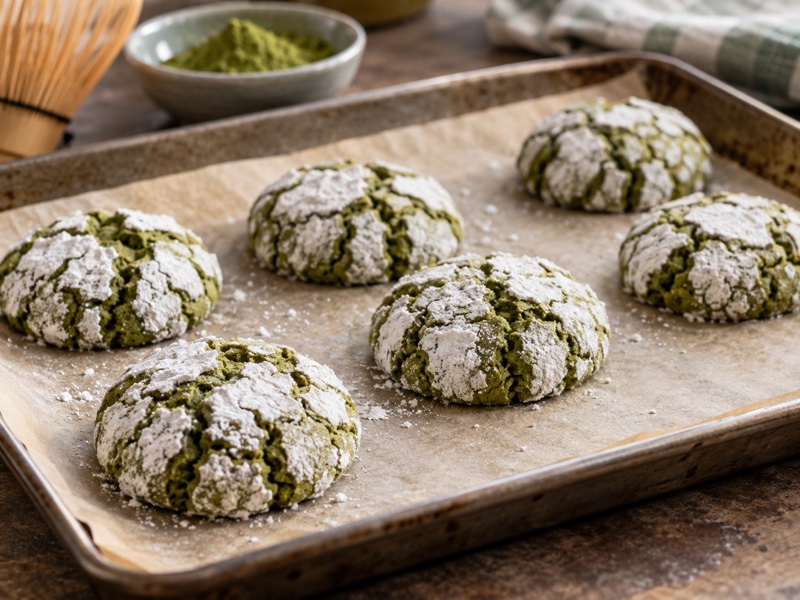
Matcha crinkle cookies sell on a sharp contrast: pale sugar cracks over a naturally green cookie. A good photograph is easy to make from one tray; a bakery needs the pattern to survive repeat baking, handling, and packing. The Teak & Thyme matcha crinkle cookies recipe shows the consumer format. This guide focuses on production controls: dough temperature, coating, spread, color, and the packaged bite. Judge the cookie after it cools and travels, because that is the version a customer pays for.
1. What counts as a successful crinkle cookie?
Define the crack pattern, thickness, bite, and matcha flavor. A crinkle should show clear pale areas and visible green fissures without looking like a fully white powdered ball. Its center may be soft or more cake-like, but the choice should be written down. A very thin cookie can create dramatic cracks yet turn brittle in a pack. A thick one may taste pleasant but form only a few narrow lines. Build a reference set showing acceptable and rejected examples.
Taste the cookie without judging its appearance first. Powdered sugar contributes sweetness at the surface, so a dough that tastes balanced plain may become too sweet once coated. Check tea flavor in the full bite. Photograph the top and side under fixed lighting, then weigh and measure cooled samples. A chain can use those references during training and incoming quality checks. “Crinkly enough” will produce inconsistent decisions across shifts.
| Attribute | Target to define | Common defect |
|---|---|---|
| Crack pattern | Pale lines with green gaps | Flat white coat |
| Spread | Consistent cooled diameter | Joined cookies |
| Center | Approved softness | Wet or dry interior |
| Tea flavor | Clear through surface sugar | Sweetness only |
2. Which dough behavior creates the crackle?
Crinkles appear as the outer surface sets and the cookie expands underneath. Formula, dough temperature, coating, and oven conditions all affect the pattern. Start with a control dough by weight and make one change per trial. Do not adjust matcha, leavening, fat, and chill time together; a better pattern would then have no clear cause. Record dough temperature after mixing and before portioning. Observe whether the dough can be rolled cleanly and whether balls flatten before baking.
A soft dough can produce attractive spread but be difficult to coat evenly. A stiff dough may keep a tall shape yet crack too little. Test the finished bite alongside the photograph. A dramatic shell that tastes dry will not satisfy a repeat customer. Keep a few plain uncoated cookies in each trial to distinguish a dough problem from a coating problem. If the plain control spreads correctly but the coated cookie does not, focus on the sugar layer and handling.
Record the first and last tray
Dough warms while staff portion and coat it. Compare cookies from the start and end of a normal batch. If the pattern drifts, smaller batches or a chilled holding step may be needed rather than a new ingredient.
3. How much matcha belongs in the dough?
Use weighed powder additions in the same base formula. Matcha contributes flavor, green color, and dry material, so increasing it can affect texture. Compare a low, standard, and high addition under the same bake conditions. Taste cooled cookies with their sugar coating, not just raw dough. A strong tea note in a plain cookie may be softened by the powdered sugar shell. More powder can also make the green areas darker or duller after heat.
Evaluate alternative matcha lots at equal mass, then at equal perceived tea strength. A cheaper powder may need a larger addition that changes spread or cost. Sift or blend the powder with flour to avoid dark spots. Keep a retained sample of the accepted lot and a packed cookie reference. When a replacement lot arrives, run a side-by-side bake. The powder name or grade alone cannot guarantee the same green fissures in the finished cookie.
| Tea trial | Hold constant | Decision |
|---|---|---|
| Lower dose | Dough and oven | Is tea detectable? |
| Standard dose | Coating method | Balance of flavor and color |
| Higher dose | Portion weight | Bitterness and spread |
| Replacement lot | Approved formula | Match to control |
4. How should the sugar coating be applied?
The surface layer must remain pale while the dough opens. Test coating mass per cookie and the method of application. A light roll may melt into the dough and leave little contrast; an excessively heavy coat may hide green color and shed powder into the pack. Some formulas use a granulated-sugar layer before powdered sugar to change the surface behavior. If tested, document both materials and their amounts. Do not assume that a method from a different dough will transfer unchanged.
Use the actual staff and equipment. Weigh several coated pieces, then inspect coverage on the underside and near the tray contact point. Check whether dough balls sit so long after coating that sugar absorbs moisture before entering the oven. A small delay can be unavoidable in production; include it in the trial. Photograph a tray immediately after baking and again after full cooling. A sharp fresh pattern that turns patchy an hour later needs a different coating process or packaging plan.
Account for loose sugar
Measure sugar left in the coating bowl and powder shed during packing. The amount affects cost, housekeeping, and the appearance of a clear bag. A coating that needs constant rework may not suit a fast bakery line.
5. How do chilling and portion size affect spread?
Dough temperature changes how quickly fat softens and the cookie expands. Test the planned chill method with real batch size and refrigerator capacity. A short bench chill for one bowl may not cool a large production tub evenly. Portion cookies at a controlled mass and compare the spread of small and large sizes. A heavier ball can create more surface tension and a different crack pattern, but it may also leave the center underbaked at the standard endpoint.
Measure raw ball diameter and cooled cookie diameter. Record tray spacing and whether cookies touch. If the last tray spreads further, check dough warming and oven recovery before increasing flour. A flour adjustment affects the bite and tea balance across all trays. For a chain, a scooping tool or depositor should be checked for mass variation at the start, middle, and end of a run. Uniform portions make both baking and cost more predictable.
| Variable | Practical check | Risk if uncontrolled |
|---|---|---|
| Dough temperature | Measure before each tray | Spread drift |
| Portion mass | Weigh sampled balls | Uneven centers |
| Tray spacing | Photo or guide | Joined edges |
| Coating delay | Time to oven | Sugar absorption |
6. What oven endpoint preserves green contrast?
Matcha’s green areas can turn dull as baking proceeds. Yet pulling a cookie early to protect color may leave an unsuitable center. Map the oven with identical trays and record top color, bottom color, crack pattern, and final texture. A darker underside may signal a hot tray or position even when the top looks acceptable. Test the actual oven load, liner, and rotation method. A single home-style tray does not represent a full production cycle.
Set an endpoint based on cooled texture as well as oven appearance. Let cookies rest and cool consistently before judging. A warm soft center may firm appropriately; an apparent green success may become a fragile cookie that collapses in the pack. Compare samples at the beginning and end of the bake window. Taste for toasted or bitter notes, not just visible green. If the target pattern demands underbaking, revise the formula or size instead of accepting an unsafe or unstable product.
Check natural color under real light
Use fixed-light photographs and a retained reference. Display lamps, phone filters, and white balance can exaggerate green. A bakery should approve the product in the light where customers will see it.
7. Will the crack pattern survive packaging?
Powdered sugar can rub off on film, migrate into the bottom of a pouch, or absorb moisture and become translucent. Pack cooled cookies in the intended wrapper and carry them through the real delivery route. Inspect the pattern, crumb, and loose powder after opening. A paper tray or divider may protect the surface but add cost and pack time. A window bag sells the design only if the window stays clean.
Set shelf life through tests of the actual formula, packaging, and distribution conditions. Follow texture, tea aroma, color, sugar appearance, and any applicable safety criteria. A home recipe’s storage period does not prove a bakery product will hold after transport or retail display. If the cookie is soft-centered, moisture movement may change both bite and coating. Compare several pack materials using the same bake lot so the result reflects packaging rather than batch differences.
| Pack option | Benefit | Defect to test |
|---|---|---|
| Single clear sleeve | Visible pattern | Sugar on film |
| Rigid tray | Less breakage | Extra cost and space |
| Opaque pouch | Light protection | Hidden quality |
| Shared box | Gift presentation | Surface rub between cookies |
8. What should labels and staff know?
The full recipe may contain wheat, eggs, and milk, while decorations can add further allergens. Review the actual ingredient list and shared equipment. For US packaged food, the FDA explains major-allergen labeling; other destination markets have their own rules. If the pack calls the cookie “matcha,” keep formula and purchasing records that support the tea ingredient. Avoid health claims based on the presence of tea in a sweet baked snack.
Train staff to distinguish acceptable irregular cracks from defects. An exact crack map is unrealistic, but a product with almost no visible green may miss the promise. Provide photographs of too little coating, too much coating, excessive spread, and a good reference. Store workers also need handling guidance: gripping a powdered top can erase the visual feature. For a seasonal gift product, align the sales photograph with what the boxed cookie looks like after shipping, not only what a fresh tray looks like.
9. Which powder and supply terms matter?
Request lot-linked samples, a specification, origin and traceability information, storage guidance, pack size, and market-relevant quality documentation. Bake candidate powders in the exact dough and coating system. Compare flavor and green color after cooling and after the intended pack hold. A powder that looks vivid in water may be muted by flour and oven heat. Price it per approved cookie at the dose required, including rejects from color or flavor variation.
Matcha Village offers pure matcha powder for bakery trials. Tell the supplier the oven process, expected volume, color target, and destination market. Ask how a new lot is communicated and whether a sample can arrive before the production switch. Keep approved powder sealed and labeled as a control. A bakery should qualify a replacement through one small bake before using it for a large gift-box order.
| Supplier item | Operational use |
|---|---|
| Lot-linked sample | Control bake |
| Specification | Ingredient approval |
| Pack and storage advice | Freshness management |
| Lead time and change notice | Production continuity |
10. When is the crinkle cookie ready to sell?
Run a timed pilot with the final mixer, scoop, coating station, oven load, cooling rack, and pack. Include the staff who will make the item. Count pieces lost to spread, weak patterns, broken edges, and sugar smear. Taste the first and last trays after the same holding time. Send a box through the intended route and judge it against the photo standard. Calculate cost per saleable cookie rather than dividing ingredients by theoretical dough pieces.
Approve dough temperature and portion controls, coating method, oven endpoint, pack, and a shelf-life plan. Link each batch to matcha and other ingredient lots. Begin with one size and one package, then add variants only when the base product is stable. Ask suppliers for powder samples tied to a real lot and compare finished, packed cookies. The visual crackle draws attention; the tea flavor and intact bite give a buyer a reason to reorder.
FAQs
Q1: Why did the powdered sugar disappear? It may have absorbed moisture before baking or during storage. Test coating method, delay to oven, and pack conditions.
Q2: Why are cracks too narrow? Dough stiffness, portion size, chilling, coating, or oven behavior may contribute. Change one variable per trial.
Q3: Can matcha be added to a standard chocolate crinkle formula? It needs a full test; removing cocoa changes the dry mix and flavor balance.
Q4: How should bakeries compare green color? Use baked, cooled, and packed samples under fixed lighting with a retained control.
Q5: Does a crackle pattern guarantee a good cookie? No. Approve tea flavor, center texture, packaging performance, and saleable yield as well.