
A matcha spritz combines powdered green tea with an acidic, sparkling base. It looks simple until the drink sits on a counter: foam disappears, powder settles, ice dilutes the citrus, and a bright layer becomes muddy. A café needs a formula that still tastes deliberate when the guest takes the last sip. Golde’s matcha citrus spritz shows the consumer idea. The development task is to make that idea repeatable with the café’s own matcha, carbonated ingredient, cup and service window.
For: café operators, beverage developers, ingredient buyers and distributors. Decision: whether a tea-and-bubbles drink can meet flavor, appearance, speed and margin targets without complicated service steps.
1. What should a matcha spritz taste like after the bubbles settle?
Define the finished drink before its layers
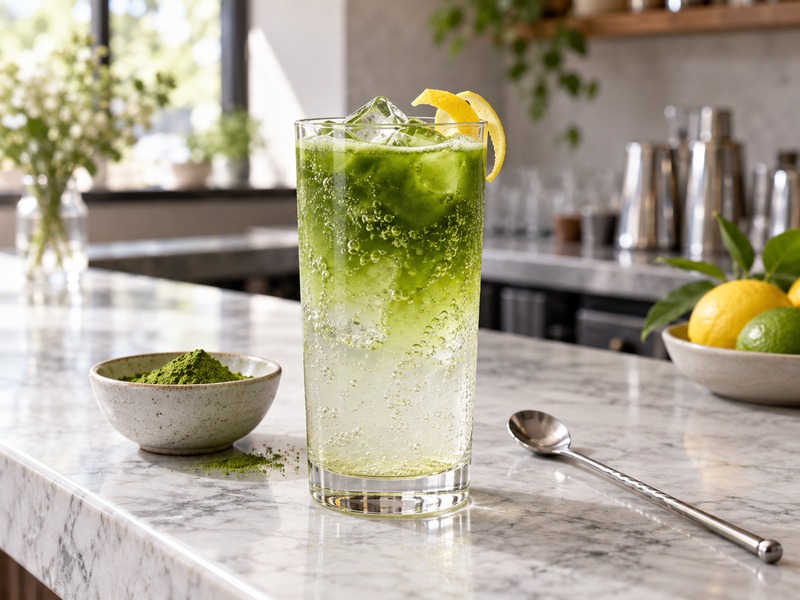
A fresh spritz can sell itself through contrast: green tea above a clear citrus base, small bubbles moving around the ice, and a clean aroma. That is only the first minute. Matcha contributes vegetal flavor and slight bitterness; citrus brings acidity; syrup or juice may add sweetness. If the citrus is too sharp, matcha can taste harsher than it did in a latte. If sugar is heavy, the drink loses the light character implied by “spritz.” Write a sensory target that covers the first sip, the drink after gentle stirring, and the nearly flat final third.
Taste the whole cup. Use the intended lid and straw during trials, because a straw may pull the citrus base before the tea layer. Decide whether guests are expected to stir. A layered version can photograph well yet drink unevenly; a fully mixed version may be less striking but more consistent. Run a timed tasting with several cups at realistic service temperature. Record acidity perception, tea presence, sweetness and sediment rather than a single verdict of “refreshing.”
| Service moment | Useful question | Possible correction |
|---|---|---|
| Handoff | Is the tea visible and aromatic? | Adjust matcha dose or mixing |
| After stirring | Do citrus and tea work together? | Change acid or sweetener balance |
| Final third | Is sediment or sourness dominant? | Improve dispersion or dilution control |
2. Which matcha belongs in a sparkling acidic drink?
Test in the actual base
Powders that work in milk do not automatically work with citrus and carbonation. Milk softens rough edges; a clear sparkling drink exposes them. Begin with unsweetened matcha so the team can set the sweetness independently. Compare candidate powders at the same grams per serving, using the same water and citrus base. Look for a recognizable tea note without coarse bitterness, a green shade that survives mixing, and a powder that does not leave a gritty bottom. The price per kilogram matters less than the dose needed for an acceptable cup.
Ask for a repeatable lot. Supplier samples should be tied to a product specification and traceable lot. Request the documents your purchasing program requires, a stated pack size, storage guidance and a realistic replenishment plan. Keep an approved powder sample and prepare it alongside incoming lots in the finished spritz. A change that is subtle in a hot tea bowl can become obvious against a bright lemon base. Do not approve a powder from its dry color alone; its behavior in the acidic drink is the evidence.
3. How should the tea be dispersed before carbonation?
Make a small smooth base
Matcha is a fine suspended powder, not a soluble green syrup. Dumping it directly onto ice and soda invites dry clumps and uneven color. Disperse a measured dose in a small quantity of water first. Sift only if the selected powder needs it; then mix with a whisk, frother or approved shaker until no dry pockets remain. Use a consistent water amount and temperature, and taste the concentrate before it enters the carbonated base. Hot water can help dispersion but may slow cold service and shift flavor, so a cold-water method deserves a separate timed trial.
Control the hold. If a café wants to prepare matcha concentrate ahead, test how fast it settles and whether gentle re-mixing restores a uniform pour. Mark the maximum holding interval based on a real trial, not a guess. Train staff to discard a concentrate that cannot be brought back to the approved appearance. Pouring a pre-mixed tea shot over soda can cause a dramatic plume; test the contact point and speed to avoid excessive foaming and spill loss.
| Mixing choice | Operational advantage | Trial risk |
|---|---|---|
| Whisked single shot | Direct control per order | Slower at peak demand |
| Frother single shot | Fast, small footprint | Too much foam or splashing |
| Short held concentrate | Fast assembly | Settling and uneven dose |
4. What should provide the citrus and sweetness?
Separate acidity from sugar during trials
Fresh juice, a prepared citrus syrup and a ready sparkling citrus drink each bring different acidity, sweetness and solids. A syrup can improve speed and consistency, but it may obscure the tea if the flavor is strong. Fresh juice can taste vivid, yet fruit lots vary and the station needs safe preparation and cold handling. A canned sparkling base simplifies service but can make the drink dependent on a particular vendor and sweetener profile. Choose the base after testing it with matcha, not by judging the citrus ingredient on its own.
Build a small matrix. Hold the matcha dose steady. Compare two acidity levels and two sweetness levels in the same cup size, then repeat with the planned ice and carbonation. Ask tasters to identify the tea, not merely to choose the sweetest cup. Record the exact ingredient and supplier for each candidate. If a flavored syrup carries a strong aroma, trial a lighter dose; a spritz should not smell like a candy version of citrus while the tea disappears.
5. How can the café keep useful carbonation through service?
Protect bubbles after opening
Carbonation begins to leave as soon as a bottle is opened, and agitation speeds the loss. Matcha concentrate can also trigger foam when it meets soda. Chill the sparkling ingredient, use a measured pour and keep unnecessary shaking out of the assembly route. Try both tea-first and soda-first builds. One may give cleaner layers, while the other may preserve a more even taste. The best sequence depends on the cup, ice and carbonation level, so a bench photo cannot decide it.
Time the customer interval. Build drinks during a simulated rush and taste them immediately, at handoff and after the time a guest normally takes to collect the order. A sip lid, open glass and sealed takeaway cup each change bubble retention. Decide whether the spritz is made only to order; batching the carbonated final drink is unlikely to preserve the same experience. Keep concentrate and sparkling base separate until service if the trial shows rapid flattening.
| Assembly variable | What to record | Release question |
|---|---|---|
| Ingredient temperature | Beverage temperature at pour | Does it stay cold enough? |
| Pour order | Foam height and visual layer | Is handoff repeatable? |
| Wait time | Bubbles and taste after hold | Does it still drink as a spritz? |
6. Which ice and cup preserve the drink’s intended balance?
Treat ice as part of the recipe
Large ice, small ice and crushed ice create different dilution and visual effects. Crushed ice can chill quickly but may turn a carefully measured base into a thin drink before the guest finishes. Large cubes hold longer, but a cup packed with them may leave too little liquid for the tea to be perceptible. Measure the actual ice mass or fill level during development. A recipe that says “fill with ice” is not enough for multiple stores using different scoops.
Use the sale cup. A narrow highball makes layers visible; a wide takeaway cup may make the same volumes look low. Test headspace under the planned lid so foam does not escape. Confirm that the straw reaches the drink comfortably and that a clear cup does not make ordinary matcha sediment look like a defect. Photograph the approved cup under store lighting at handoff and after a short hold. These images are training references, not promises that every cup will be identical.
7. What process prevents sediment and uneven color?
Look at the bottom, not only the top
Some settling is natural in a drink containing suspended tea. The question is whether the last sip remains pleasant. Run a clear-cup observation at fixed intervals, then taste from top to bottom. If a coarse ring appears quickly, check powder particle behavior and the mixing method before adding stabilizers. If a fine green haze remains but taste is even, that may be acceptable for a made-to-order café drink. A bottled spritz needs a different stability and safety program; do not transfer café results to a packaged product.
Set a practical limit. Decide how much visible settling is acceptable at handoff and after the usual consumption interval. Train staff on a simple re-mix or remake rule. Avoid describing the drink as “fully dissolved” when the powder is suspended. A truthful menu description and consistent service give customers a better expectation than an impossible promise of a perfectly clear sparkling tea.
| Observed defect | Variable to check first | Next trial |
|---|---|---|
| Dry green dots | Pre-dispersion and sifting | Mix a measured tea shot |
| Heavy bottom layer | Powder choice and hold | Compare lots side by side |
| Dull green color | Acidity and light exposure | Photograph timed cups |
| Sudden foam overflow | Pour order and headspace | Slow the contact pour |
8. Can staff build it quickly without losing control?
Write a station recipe
The service method should specify powder mass, water volume, mixing tool, citrus base, sparkling volume, ice and pour order. It should also say what may be prepared ahead and how long each component may be held. A small café can measure every drink with a scale during training, then move to verified scoops and marked vessels if those deliver the same dose. Count rinsing and restocking time in the service trial. A drink that takes a minute at a quiet bench can interrupt a morning queue when the frother and glassware need cleaning.
Train the failure points. Give staff one approved finished-drink image and examples of clumps, overflow and a flat cup. Run several orders back to back, with a different person building the second round. Record variance in pour volume and total time. If the product depends on an unusually careful barista, simplify the formula before launch. A clear station standard is more valuable than a fragile photo-friendly flourish.
9. How should cost and supply be evaluated?
Calculate the cost of the served cup
Matcha, citrus, soda, cup, lid, ice, labor and occasional remakes all affect margin. A powder with a lower price per kilogram can cost more per accepted drink if it needs a larger dose. A bottled mixer with a higher unit price may save labor and waste. Build the cost sheet from a tested recipe, then model a conservative peak service period with normal remakes. Do not assume a fixed beverage yield from a supplier’s marketing recipe.
Check continuity. Confirm minimum order, lead time and lot-to-lot consistency for matcha and the sparkling base. If the chosen citrus ingredient is seasonal, identify an approved substitute and test it before a shortage. Keep the menu name and description broad enough that a minor approved ingredient switch does not make the customer promise false. Retain an approved drink specification with both sensory and operational targets.
| Cost line | Measure from the trial | Often missed |
|---|---|---|
| Matcha | Grams per accepted cup | Extra dose needed for weak powder |
| Citrus base | Milliliters and yield | Fruit waste or opened bottles |
| Sparkling base | Milliliters per cup | Flat leftovers after opening |
| Service | Minutes and remakes | Rinse time and overflow |
10. What would a launch-ready pilot prove?
Run the drink in the real service environment
The final test should use the production powder, chosen citrus, sale cup, ice, tools and staff. Build a short series of drinks, then assess immediate taste, appearance and a realistic customer hold. Review the last sip, not only the first. Record the number of remakes, average service time and ingredient use. Ask a buyer to compare the incoming matcha lot with the approved reference in the finished drink. If any ingredient changes, repeat the comparison rather than assuming the old approval still holds.
Make one decision at a time. If the drink tastes sharp, adjust acidity or sweetness while holding matcha steady. If it settles too quickly, inspect mixing and powder. If service is slow, simplify the station route. After the pilot meets the agreed taste, presentation, speed and cost targets, release a recipe card and retain a reference sample specification. That gives the café a workable launch standard and a clear way to investigate future drift.
Reference
Ahrefs listed Golde, “The Spritz of The Summer: Matcha Citrus Spritz” as an Article at rank 4 in the US Google SERP for “matcha spritz” on 2026-09-28. This article uses the title as topic context and does not copy its recipe or claims.
FAQ
Q1: Should a matcha spritz be layered or mixed?
Choose the method that tastes balanced through the full cup and can be repeated during service; test both.
Q2: Can the final drink be batched?
Keep tea concentrate and sparkling base separate until service unless a separate packaged-product trial proves stability.
Q3: Does any café matcha work with citrus?
No. Compare candidate powders in the acidic finished drink, not only in milk or water.
Q4: What is the fastest way to reduce clumps?
Make a measured smooth tea shot before it meets ice and carbonation.
Q5: What should a buyer approve before launch?
Approve the actual powder lot, serving formula, component hold limits, cup, sensory target and service time.