
A matcha advent calendar turns a sequence of small tea experiences into a seasonal product. The idea is attractive to retailers, but twenty-four compartments create twenty-four opportunities for a damaged sachet, confusing preparation instruction or disappointing cup. The product has to survive shipping, make sense to a newcomer and leave enough margin after packaging and fulfillment. The Ahrefs SERP includes Bird & Blend’s “Unwrapping the 2026 Matcha Advent Calendar”; its title confirms current consumer interest. Its page content was not accessible during this check, so the planning guidance below is based on product-development reasoning rather than claims about that calendar.
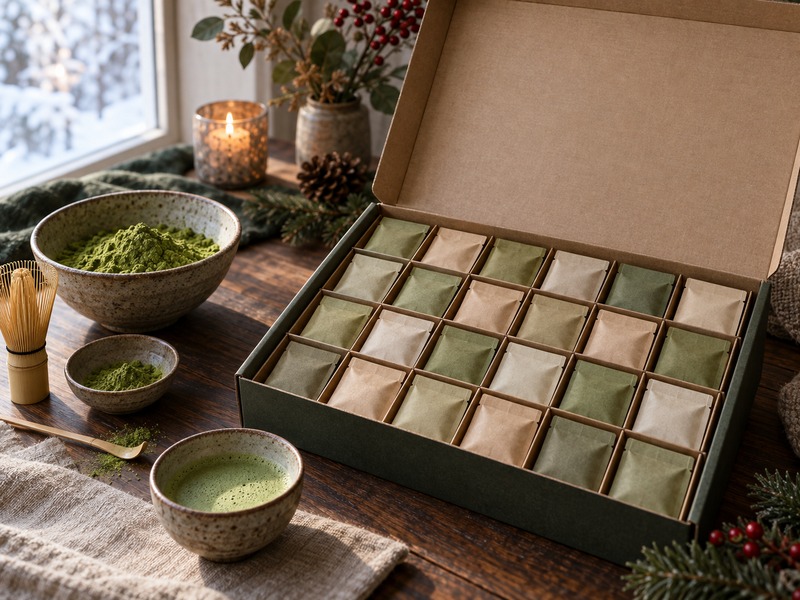
For: tea brands, private-label buyers, gift retailers and distributors planning a limited seasonal run. The aim is to define a useful assortment and test the complete pack before committing to a holiday order.
1. What does the buyer actually receive each day?
Define a full serving, not a tiny green sample
An advent calendar promises repeated discovery. Each compartment should contain enough product for the preparation suggested on its card or pack. A powder portion that barely colors a large cup will teach the customer that the tea is weak, even if the powder itself is sound. Specify grams per compartment, intended cup size, water or milk guidance and whether one compartment makes one drink or multiple small tastings. The answer drives the total tea purchase and the physical depth of each cavity.
Start with the daily experience. A calendar can feature twenty-four different products, several repeats arranged as a tasting journey, or a smaller core assortment with accessories. Every choice has operational consequences. Twenty-four unique stock-keeping units complicate picking and traceability. Repeats are easier to fill but need a clear reason in the customer journey. Write a map showing what the customer opens on each date and how the sequence builds familiarity. That map becomes the packing checklist, not merely a design mockup.
| Assortment model | Customer benefit | Operating cost |
|---|---|---|
| Many unique teas | Broad discovery | More supplier and packing controls |
| Few repeated teas | Easier comparison | Needs a deliberate sequence |
| Tea plus tools | Beginner-friendly | More cavity sizes and materials |
2. Which matcha products belong in the assortment?
Let the preparation method shape the range
Straight matcha, latte-ready blends and flavored powders answer different customer needs. They should not be presented as interchangeable green teas. A straight matcha portion may require a whisk and careful water addition. A sweetened latte blend may dissolve differently and have a different ingredient statement. A calendar for existing tea enthusiasts can include more nuanced powder comparisons; a mass retail gift may need approachable preparations and clear instructions. Choose the target user before deciding how many variants to buy.
Test every cup in context. Prepare each selection with the exact serving size and method printed for that day. Taste it after a normal consumer’s likely mixing effort, not only after a trained tea specialist’s ideal whisking. If one flavored product masks the tea while another tastes sharp in water, adjust the sequence or the instruction. Avoid unsupported language such as “ceremonial quality” as a stand-in for a sensory description. Ask the supplier for lot samples and relevant documentation, then approve the powder inside the proposed sachet and after its intended storage period.
3. How should the daily portions be packed?
Protect powder before decorating the outer box
Matcha powder’s color, aroma and flow can suffer when the primary pack admits moisture, light or air. The outer advent box attracts the buyer, but the sachet or other direct-contact container carries the tea through fulfillment and several weeks of household opening. Select a food-contact pack appropriate to the product and destination market, and test seal strength and opening ease. A beautiful envelope that tears unpredictably can spill powder into a drawer or onto a gift recipient’s clothes.
Build a handling sample. Fill real portions on the planned equipment, place them in the production board and shake the assembled pack through a realistic transport simulation. Open compartments in date order and check whether removing one sachet disturbs the next. Inspect seals, powder leakage, aroma transfer between flavored variants and readability of the serving identifier. Keep a retained sample from the same lot for later comparison. The design should permit the packing team to detect a missing or doubled portion before cartons close.
| Pack test | What to inspect | Release decision |
|---|---|---|
| Seal check | Leaks or trapped powder | Adjust fill and seal settings |
| Opening check | Tear path and powder spill | Revise sachet notch or material |
| Transit check | Dislodged daily portions | Change cavity fit or board |
| Storage check | Color and aroma change | Review barrier and shelf life |
4. What should the customer know before opening day one?
Make preparation possible without guesswork
Many gift buyers purchase for someone who has never made matcha. A calendar can avoid a disappointing first cup by stating what equipment is needed, what is included and what must be supplied at home. A short preparation card can show one straightforward method for straight matcha and another for latte blends. Do not promise that every sachet works the same way. If a product contains milk powder, sugar or another ingredient, the customer needs the correct list and allergen information at the point required by local rules.
Keep the card usable. Test instructions with someone outside the development team. Give them a sachet, the stated tools and no coaching. Watch where they hesitate: water amount, temperature, mixing order, milk choice or disposal. Revise the wording for that specific failure. A QR code may offer longer recipes, but the essential preparation and safety information should not depend on a phone connection. Small print hidden behind a compartment door will be missed during an ordinary unboxing.
5. How should tea, flavorings and allergens be labeled?
Review the entire assortment as one retail unit
Twenty-four portions can include multiple formulations and multiple suppliers. Build a master ingredient matrix before final artwork. For each date, record product name, formulation version, lot code, net weight, allergens where applicable, storage instruction and country-specific declarations. Have a qualified regulatory reviewer confirm how that information must appear on the outer pack and inner portions in every selling market. A label that works in one country may not meet requirements elsewhere.
Control change after proofing. Seasonal projects often swap a flavor late when supply runs short. That can invalidate printed ingredient panels, nutritional information or allergen statements. Lock the approved bill of materials before printing, and make substitutions a formal review rather than a buyer’s informal fix. Keep the final artwork file, production specification and packed sample tied to the same version. A calendar should not reach a warehouse with a green tea blend inside that the printed list describes as plain matcha.
| Record | Why it matters | Who signs off |
|---|---|---|
| Ingredient matrix | Matches each day to a formula | Product and quality teams |
| Allergen review | Prevents ambiguous declarations | Regulatory team |
| Artwork proof | Aligns dates, names and net weights | Brand and quality teams |
| Packed sample | Shows what is actually shipped | Operations |
6. How early must the buying plan be fixed?
Count backward from the shelf date
Holiday products arrive on shelves well before the first compartment is opened. Work backward from the retailer’s receiving window, allowing time for tea approval, packaging tooling, print proofing, packing, transit and a buffer for rework. A supplier may have matcha available while printed sachets or the rigid board take longer. Build one schedule for all components instead of treating tea procurement as the whole project. Confirm lead times in writing for the actual order quantity and delivery destination.
Reserve an approval gate. Do not schedule full production immediately after the first attractive design mockup. Order a pilot quantity, fill and assemble it, then inspect it after shipment to a test location. That packed sample can reveal date misalignment, sachets that catch in the board, or an outer box that collapses under case stacking. Set a clear decision date for the retailer and supplier. Once holiday transport starts, there is little room to correct a fundamental package failure.
7. How can the calendar survive fulfillment and display?
Test the case as carefully as the gift box
The sales unit may travel through a fulfillment center, a parcel network or a pallet to stores. Each route puts different pressure on the outer box. Test the shipper case, internal cushioning and retail display orientation. A calendar designed to stand upright may slump when stacked flat for weeks. Windows and perforated doors can weaken the board. If the pack contains a whisk or ceramic accessory, it needs its own protection and breakage criteria.
Inspect several positions. Sample boxes from the top, middle and bottom of a packed case after a trial shipment. Check crushed corners, popped doors, loose sachets, scuffed print and powder leaks. Open the sample the way a customer would. Photograph failures with the case location and production lot. A single pristine design-room sample does not show how the first customer delivery will look. Define an acceptable defect threshold before testing so the team cannot rationalize damage after the fact.
8. What should the supplier contract and quality brief cover?
Tie every purchase line to an approved sample
Ask tea suppliers for specifications, lot-linked analysis and traceability records appropriate to your program. Ask pack suppliers for material and food-contact information where relevant. The packing partner needs a dated map of which portion goes into each cavity, acceptable fill weights and a method for reconciling used materials against finished units. If different partners supply powder, sachets and boxes, name the party responsible for final pack release and any repacking.
Make changes visible. A substituted matcha lot can alter shade; a new sachet film can change seal behavior; a board revision can make compartments too tight. The purchase brief should list which changes require a fresh finished-pack trial and who can approve them. Request a pre-production sample built with the real materials, not a digitally rendered box. Retain one approved unit and one unit from the first production run. Those samples help resolve disputes about whether later shipments match the signed-off product.
| Supplier input | Acceptance evidence | Change trigger |
|---|---|---|
| Matcha powder | Specification and tasting sample | New lot or blend |
| Sachet film | Seal and barrier test | Material or converter change |
| Advent board | Filled-pack fit test | Die-line or board change |
| Packing service | Reconciliation and sample audit | Line or site change |
9. How should price and quantity be calculated?
Account for the pack’s unusual labor
A calendar carries more cost than twenty-four ordinary single serves in a bag. There is the display box, numbered cavities, possible inserts, extra assembly time, proofing, breakage and seasonal freight. Calculate cost per accepted finished unit. The matcha purchase is one line, not the whole margin. If the product includes accessories, consider their customs, breakage and space costs. A low-cost powder may still be poor value if it disappoints customers on the first three days and creates returns.
Model a conservative sell-through. Seasonal stock has a short selling window. Agree on the order quantity after checking retailer commitments, fulfillment capacity and the cost of leftover units. Avoid unsupported demand forecasts. Use small, transparent scenarios based on the retailer’s own history or committed orders. A calendar with a higher unit cost but a reliable opening experience can be preferable to a cheaper pack that arrives damaged or needs customer-service replacement.
| Cost line | Use the real pilot to measure | Common omission |
|---|---|---|
| Tea portions | Grams in accepted packs | Fill loss and retained samples |
| Printed pack | Finished boards and inserts | Proofing and spoilage |
| Assembly | Minutes per accepted unit | Rework after mispacks |
| Shipping | Landed cost by channel | Gift-box damage replacements |
10. What would a launch-ready pilot prove?
Open, brew and ship the real calendar
The pilot should use production tea, sachets, board, artwork and shipper case. Have people unfamiliar with the project open several dates, brew the drinks and report where instructions fail. Send packed units through the planned shipping route. Check dates, fill, seals, display strength, sensory quality and documentation against one signed release sheet. Record the time required to pack each unit and the number rejected. The pilot is successful only when the customer experience and production yield meet the targets set in advance.
Keep the next decision small. If brewing instructions fail, revise the card and retest. If powder leaks, inspect the sachet process before changing the outer box. If the assortment tastes repetitive, adjust the daily sequence before ordering twenty-four new teas. Once the complete pack passes, approve a controlled production order with a retained reference unit for incoming and finished-goods checks. The buyer should be able to point to a real opened calendar, not a rendering, when authorizing the holiday run.
For the tea inside the gift pack, start with the lot and document checks in our organic matcha powder buying guide.
Reference
Ahrefs listed Bird & Blend Tea, “Unwrapping the 2026 Matcha Advent Calendar” as an Article in the US Google SERP at rank 7 on 2026-09-27. The page text was not available during the source check, so no product details from it are asserted here.
FAQ
Q1: Must a matcha advent calendar contain twenty-four different teas?
No. A smaller assortment can work when the daily sequence gives a reason to revisit each selection.
Q2: Should every portion use the same preparation instruction?
Only if the products genuinely prepare the same way; straight matcha and latte blends often need different directions.
Q3: Can the outer carton replace labels on inner packs?
Have a qualified regulatory reviewer decide for each market and sales format before artwork is printed.
Q4: What is the most revealing pilot test?
Ship and open a fully packed production-material sample, then brew several dates without coaching the tester.
Q5: How can a buyer avoid a repeat calendar failure next year?
Retain the approved pack, defect log, actual yield and customer-service data as the next season’s starting brief.