
Matcha sifter weights can help move powder through the screen of a closed canister, but their usefulness depends on the whole device. A ball that works in one chamber may jam, shed material or simply sit still in another. Nio Teas describes the basic weight mechanism; a café buyer needs to test it with actual powder, doses and cleaning practice. The checks below treat the weights as service components rather than decorative accessories.
Contents
- 1. What job should the weights perform?
- 2. Will the weights fit the canister?
- 3. Does the mechanism improve powder flow?
- 4. What material evidence should a buyer request?
- 5. How many weights belong in the chamber?
- 6. Can staff clean and inspect them fully?
- 7. How do weights behave through a shift?
- 8. What failure signs should trigger replacement?
- 9. Are they worth the added service work?
- 10. What belongs in the purchase specification?
1. What job should the weights perform?
Name the problem before buying a component
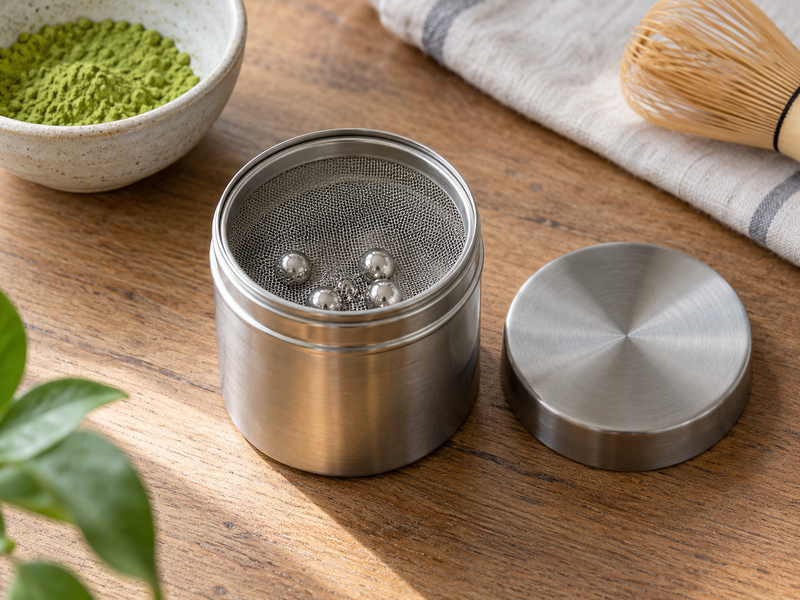
In a canister sifter, loose weights move as the operator shakes or turns the vessel. Their contact with the screen and powder may reduce the hand tapping needed to pass a portion through. That is a narrow task. Weights do not improve stale powder, fix a damp chamber or replace careful dosing. First observe the current station: does dry matcha stay on the mesh after the planned number of shakes, and does clearing it interrupt orders?
Run a small comparison with the canister empty of weights, then with the supplier’s proposed set. Keep the powder lot, dose, operator motion and screen unchanged. Weigh powder loaded and powder delivered. Note remaining residue and visible clumps in the bowl. If the difference is trivial, simpler equipment may be easier to run. If it matters, write down the exact canister and weight pairing. Buying a bag of generic balls without this baseline makes it difficult to know whether an apparent improvement came from the mechanism or a different handling style.
2. Will the weights fit the canister?
Check the chamber, not just the listing
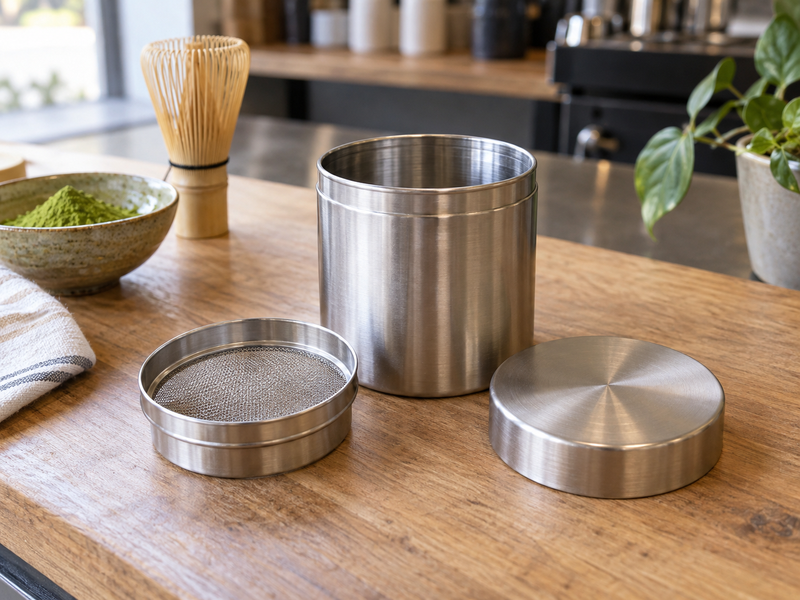
The useful dimensions are the internal chamber diameter, clearance above the mesh, outlet geometry and the space occupied by the lid or agitator. A weight must move freely without getting caught under a lip or blocking the powder path. Ask for the maker’s compatibility list and request a drawing when sourcing a replacement for an existing canister. Product photos rarely show the internal clearance well enough to order confidently.
Test assembly and disassembly with dry hands and with the protective gloves staff actually use. The operator must be able to remove every weight for cleaning and count them back into the chamber. If two models appear interchangeable, verify the same screen is fitted. A narrower opening, even with an identical outer body, can change the weight motion. Record item codes for canister, screen and weights together so a later purchasing team cannot quietly substitute one part.
| Fit point | Sample check | Reason to reject |
|---|---|---|
| Chamber clearance | Shake an assembled dry canister | Weight jams at lid or rim |
| Screen opening | Observe motion over the full mesh | Weight repeatedly blocks one spot |
| Removal access | Take out and count all pieces | Pieces cannot be reached or seen |
| Part identity | Match codes to supplier drawing | Replacement specification is ambiguous |
3. Does the mechanism improve powder flow?
Test the full beverage step
A short demonstration with an empty canister is not a powder-flow test. Matcha can contain compacted portions that behave differently from a fine, freshly opened sample. Compare the proposed weights using the same tea intended for service. Measure the time from loading to a usable bowl, the mass left behind and the cleanup required at the station. Repeat across several portions, because a single lucky shake can make a weak design look effective.
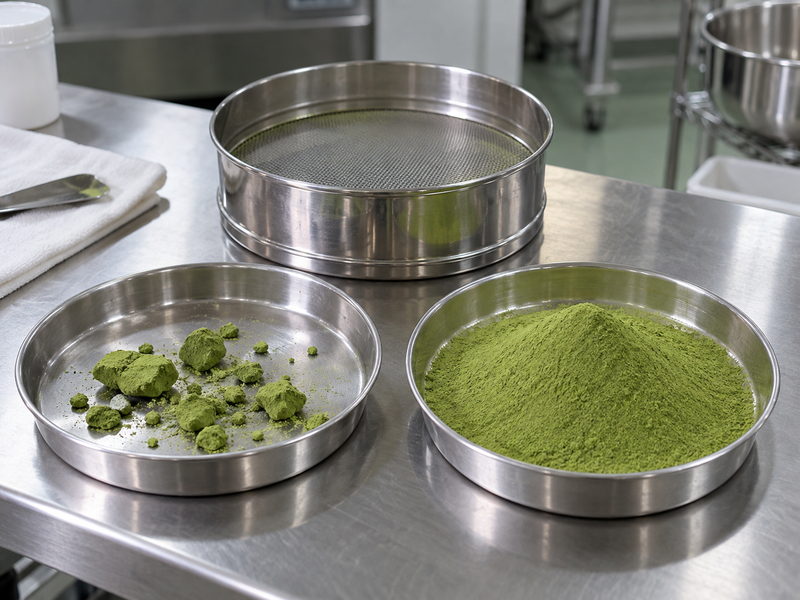
Watch what happens to the screen after repeated cycles. If powder forms a ring around the edge or the weights merely chase a clump without breaking it, consider whether a simpler handheld sieve and spoon would be more reliable. Avoid forcing powder through a damaged screen with extra vigorous shaking. In a café, the mechanism should shorten a predictable task without creating a new scattering problem. Record the movement that worked so training describes an action staff can reproduce rather than a promise that the weights automatically sift any matcha.
4. What material evidence should a buyer request?
Specify every food-contact surface
Ask the vendor to identify the material and surface finish of each weight for the exact product code. If there is a coating, seam or hollow construction, ask how it is made and cleaned. Request applicable food-contact documentation for the market where the tool will be used or sold. A description such as “steel balls” is too vague to establish the supplied item or its care instructions. Do not infer that a shiny object is corrosion resistant under your wash routine.
Inspect received samples for burrs, pits, cracks and visible finish transfer after a controlled dry test. Wash them by the maker’s instructions and inspect again. These checks reveal defects but are not a substitute for supplier material records. For a private-label set, any package claim about material, dishwasher use or safety needs support from the actual component vendor. Keep the supporting file with the purchase order and change control record, since a later substitution may look identical in a photo.
| Question | Document or observation | Buyer decision |
|---|---|---|
| What touches powder? | Part-level material list | Confirm the quoted assembly |
| Are there coatings? | Finish specification | Verify cleaning compatibility |
| What market applies? | Relevant food-contact records | Review before sale or service |
| What can change? | Supplier change notification terms | Retest altered components |
5. How many weights belong in the chamber?
Optimize motion instead of filling space
The correct number is a property of a particular canister design and operating dose. Too few weights may leave powder on the mesh; too many may crowd the chamber, dampen movement or make it difficult to remove all pieces. Ask the supplier for the intended count and arrangement, then compare that configuration with a small controlled trial. Do not publish a universal count based on one demonstration.
The first operating question is whether staff can reliably count and recover the pieces. A weight lost into the wash sink changes the next shift’s device. A missing piece in a packaged set also becomes a customer complaint. Consider a parts checklist with a diagram of the assembled chamber. If a larger venue uses several canisters, label replacement packs by device model. That avoids the common practice of borrowing pieces from a nearby tool until no one knows which configuration was validated. Treat the count as a specification, not as a casual preference.

6. Can staff clean and inspect them fully?
Look for trapped powder and difficult retrieval
Any part that repeatedly contacts powdered tea must fit the site’s documented cleaning routine. Remove the weights after a test shift and look closely at seams, scratches and the point where each piece touches the screen. Powder that collects in a joint may become harder to remove if it gets wet. Follow the maker’s cleaning instructions and the operation’s food-safety procedures; do not assume a dishwasher is suitable from a product photo.
The closure should allow a supervisor to see that every piece is present after cleaning. A canister whose parts are hard to retrieve may save seconds during sifting while costing minutes at close. Include drying and reassembly in the trial, because putting damp pieces back with matcha can promote clumping. For retail sets, care instructions should distinguish the reusable accessory from the tea and explain how to disassemble it without damaging the mesh.
| Stage | Practical inspection | Record if it fails |
|---|---|---|
| Disassemble | All weights removed without tools | Count or access problem |
| Wash | No visible powder remains in joints | Cleaning limitation |
| Dry | All surfaces can be checked | Moisture trap |
| Reassemble | Count and screen position verified | Training or design issue |
7. How do weights behave through a shift?
Test repeated portions, not one ideal bowl
Throughput changes when the chamber accumulates residue or staff refill it in a hurry. Run the device across a realistic sequence of orders, using the same powder packaging and portion size planned for service. Measure a sample of early and late portions. Does the dose delivered to the bowl remain close to the amount loaded? Does the operator begin shaking harder to compensate for a screen that is coating over? These are more useful observations than a single peak-speed result.
Also listen for changes in sound and feel. A rattle is expected in some designs, but scraping or sticking after only a few cycles may indicate contact with a rim or a poor fit. Ask staff whether the tool is comfortable and easy to control over a bowl without spilling. If the weight mechanism requires a special motion, document it on the station card and train the backup operator. Service consistency depends on a repeatable method, not on one experienced barista who knows the trick.
8. What failure signs should trigger replacement?
Set an inspection threshold before rollout
Loose components need a visible condition standard. Retire a weight if it develops a burr, crack, flaking finish, corrosion mark or shape change that could damage the screen. Replace a torn screen immediately rather than adding more weights to push powder through. Review the vendor’s replacement guidance and set the site’s own inspection interval based on use and cleaning. It is safer to state observable signs than to invent a universal service life.
Keep replacement pieces under a known item code and from the approved source. If a vendor changes material or diameter, the new item deserves the same fit and flow test as the original. For a retail product, provide customers with a contact route for lost or damaged components; an apparently minor piece may determine whether the entire canister remains usable. The maintenance plan belongs in the procurement decision because recurring replacements affect cost and availability.
| Sign | Likely operational effect | Immediate action |
|---|---|---|
| Burr or rough edge | Screen wear or difficult cleaning | Remove component |
| Discoloration or flaking | Uncertain surface condition | Quarantine and ask supplier |
| Repeated jamming | Slower service and uneven flow | Check compatibility |
| Missing weight | Unvalidated configuration | Recount and replace to spec |
9. Are they worth the added service work?
Compare total station effort
Calculate the operational value with a complete station trial: loading, sifting, residual powder handling, washing, drying, parts counting and reassembly. A component that cuts sifting time may still increase total labor if it is awkward to clean. Compare it with the existing handheld sieve or a simple canister without weights under the same order pattern. Include replacement parts and the possibility of lost pieces in the cost estimate, using vendor quotes rather than generic online prices.
For a retailer, the value equation also includes how easily a customer understands and maintains the product. A novice may prefer a straightforward sieve; an enthusiast making repeated bowls may appreciate a closed canister. Keep the promise specific: the weights help move powder through a compatible screen under a tested routine. They do not guarantee a smoother cup regardless of powder, water or mixing method. A small user trial can reveal whether the extra mechanism is genuinely appreciated after the first week.
10. What belongs in the purchase specification?
Make the approved configuration reorderable
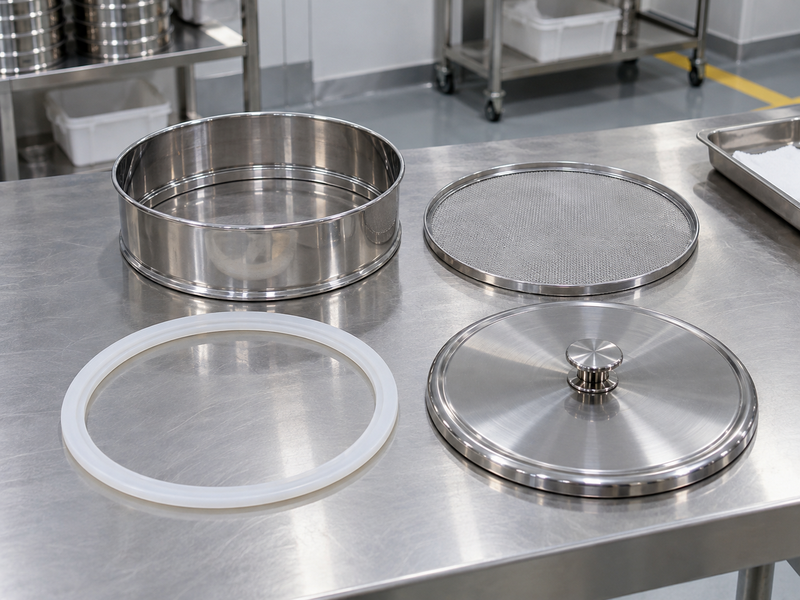
The order should name the canister model, screen, weight material, diameter or maker’s part code, number of pieces, finish, packaging and care instructions. Include the current sample or photographs of critical fit details. Ask how the supplier handles component changes and replacement pieces. A quotation for “matcha sifter weights” alone leaves room for a different diameter or surface finish at reorder, even when the outside of the kit looks the same.
Record acceptance criteria drawn from the pilot: no jamming, no visible damage after the specified cleaning method, the intended part count, and an acceptable delivered-powder range under your dose test. Keep the range as an internal purchasing standard rather than marketing it as a universal performance figure. On arrival, inspect a sample of each lot before mixing it with older stock. This closes the loop between the trial and what staff actually receive.
| Purchase field | Why it matters | Evidence to retain |
|---|---|---|
| Paired canister and screen | Prevents incompatible substitutes | Approved item codes |
| Weight count and finish | Keeps motion repeatable | Sample and specification |
| Care instructions | Sets cleaning practice | Supplier document |
| Change notice | Triggers retest | Written supply term |
FAQ
Q1. Do all matcha sifters need weights? No. A handheld sieve and many canisters work without them. Test whether weights solve a real flow problem in the chosen device.
Q2. Can weights replace a scale? No. They move powder; they do not measure the dose delivered to a cup. Use a scale where portion consistency matters.
Q3. Can any metal balls be used as replacements? Do not assume so. Fit, material documentation and cleanability should match the approved component.
Q4. How should a café clean them? Use the maker’s instructions and the site’s food-contact cleaning procedure, with complete disassembly, inspection and drying.
Q5. What is the first sample test? Compare matched portions with and without the proposed weights in the actual canister, then inspect residue and component condition.
The best purchase is a documented combination of screen, chamber and weights that staff can operate and maintain. Keep the trial record beside the item codes; it will be useful when the first replacement order arrives.