
A matcha Basque cheesecake asks a bakery to brown the top aggressively while preserving a creamy green center. That visual contrast is attractive but fragile: too much heat dulls the tea; too little set makes slices collapse at service. The No Recipes matcha Basque cheesecake is a useful consumer reference. For commercial production, the cake needs a defined center, a repeatable pan and bake profile, and a cost based on saleable slices. Work backward from the slice guests will receive after chilling and display.
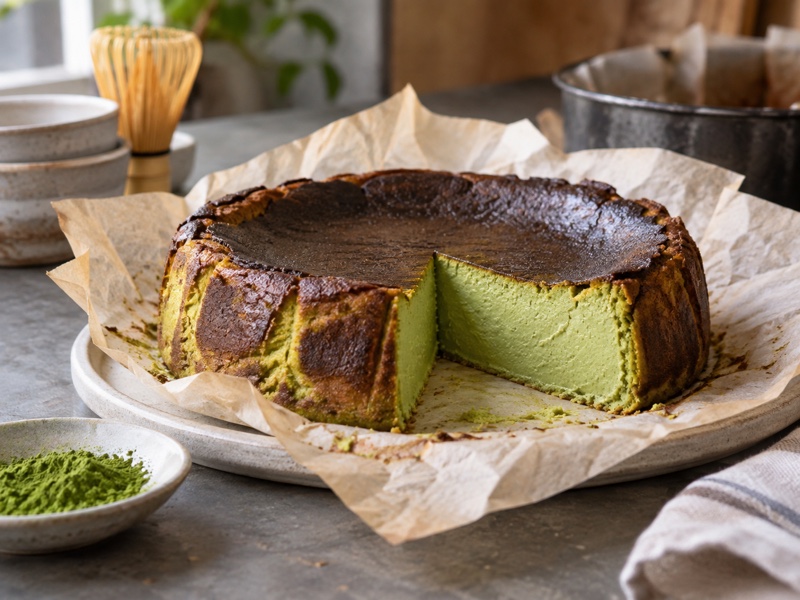
1. What finished slice should the bakery approve?
Describe the top, center, edge, and flavor separately. The top may be dark brown and aromatic without tasting burnt. The center may be creamy yet stable enough to stand after cutting. A green interior should look natural rather than fluorescent. The tea must remain noticeable against cream cheese, cream, sugar, and browned notes. Build a reference slice from a small pilot and photograph its cut face under fixed light after full chilling. That becomes the standard for production, not the appearance of warm cake in the oven.
Choose a serving temperature and portion geometry. A slightly tempered slice may show a softer center than a cold slice straight from the display. If the café serves both, test both. Record cake diameter, height, target number of portions, and whether a topping will be used. A thick sauce may obscure the tea; a plain slice exposes quality more honestly. Let a panel taste top, center, and edge together so no one approves a center that only tastes good without the dark crust.
| Slice element | Acceptance question | Failure to watch |
|---|---|---|
| Dark top | Aromatic rather than acrid? | Bitter char |
| Green center | Natural, even color? | Dull or streaked cut face |
| Texture | Creamy yet sliceable? | Runny or chalky middle |
| Tea flavor | Clear through dairy? | Only sugar and cheese |
2. How should matcha enter the batter?
Dry matcha can clump in a dense cream cheese mixture. Sift or pre-disperse it in a measured portion of liquid before mixing into the larger batch. Test the method with the actual mixer, bowl size, and batch load. Stop and scrape the bowl during development; a green ribbon near the wall can create marbled slices unintentionally. If the bakery wants a marbled product, write a separate visual standard rather than accepting random streaks as variation.
Avoid overmixing merely to erase specks. Excess air can change rise, cracking, and the eventual center texture. Record ingredient temperature, mixing speed, scrape points, and batter temperature. Compare batter from the top and bottom of the bowl before filling. If they differ, the process is not ready to scale. A fine screen can remove lumps, but test what it retains. Throwing away tea-rich material through a sieve changes dose and cost unless the loss is measured and designed into the formula.
Taste after baking, not only before
A smooth raw batter does not predict tea flavor after a hot bake. Compare several powder options at equal addition in baked, chilled slices. Then adjust the winning candidate to the preferred flavor level. Keep the cream cheese and other ingredients identical so the powder comparison means something.
3. Which pan and parchment setup works at scale?
Pan diameter, fill depth, material, and liner folds change heat transfer and the silhouette of a Basque cheesecake. Choose the production pan before finalizing bake time. A deeper fill may preserve a creamy center but can take longer to set; a shallow pan may produce too much dark edge for the desired slice. Weigh batter into each pan. A visual fill line is useful but cannot correct for inconsistent batter density or pan dimensions.
Crumpled parchment creates the characteristic irregular edge but can fold into the batter or leave a torn rim. Test the liner with staff who will produce many cakes, including removal after chilling. Some folds may trap moisture and leave pale patches. Record the liner size, placement, and whether the paper is trimmed for safe oven use. A premium appearance should still be practical to cut and pack. If several pan formats are used, develop separate bake specifications rather than assuming one timing applies to all.
| Pan variable | Record | Effect to inspect |
|---|---|---|
| Diameter and depth | Actual dimensions | Center-to-edge ratio |
| Batter weight | Weight per pan | Bake consistency |
| Pan material | Type and finish | Browning pattern |
| Parchment fold | Photo standard | Edge appearance and release |
4. How dark should the top become?
The top color is a design target, not a license to burn. Create a small photo scale with underbrowned, target, and overbrowned cakes under one light source. Taste slices from each. A dramatic top can give a bitter finish that overwhelms matcha. Conversely, a pale top may leave the dessert tasting like ordinary baked cheesecake. Watch the actual oven load: a single center-rack trial may not represent a full production cycle.
Map the oven by placing comparable pans in different positions. Record top color, side browning, and center set for each. If one zone darkens early, rotate pans only if the rotation itself does not disturb the soft center. Calibrate oven readings and avoid assuming the dial equals the product environment. The endpoint should combine a visual top standard with a center observation and a post-chill slice test. A timer alone cannot judge variations in pan depth or initial batter temperature.
Preserve tea beneath the crust
Cut and taste the cooled cake. If the top is attractive but the interior looks brown-green, test powder choice, batter process, pan depth, and exposure before adding color. More matcha can intensify bitterness without restoring a natural shade after heat.
5. How can the center be creamy without collapsing?
Define the intended center with a cooled slice, then work backward to a baking endpoint. A warm cake may wobble and still set as it cools; a fully rigid cake straight from the oven may become dense after refrigeration. Record the movement at oven exit, cake weight, cooling curve, and the final cut face. Use a consistent observation method and let several staff members describe the same cake. “Slight jiggle” can mean different things across a kitchen.
Test a narrow band of bake endpoints using identical pans and batter weights. Chill all samples the same way, then cut them at the intended service age. Judge structure at the center and at the edge. If the center slumps when the slice stands, adjust the formula or bake, but do not use a garnish to hide a loose puddle. A cake that slices beautifully cold but becomes fluid after a short café wait may also fail the service brief. Test at the actual plate temperature.
| Endpoint trial | Warm observation | Chilled decision |
|---|---|---|
| Shorter bake | Larger center movement | Does slice stand? |
| Target bake | Defined wobble | Creamy center? |
| Longer bake | Less movement | Has texture become dense? |
| Full oven load | Mixed positions | Are all pans within range? |
6. What cooling and food safety controls apply?
Cheesecake contains ingredients that need careful handling. Plan cooling with actual pan size, rack spacing, and refrigeration capacity. Measure product temperature through the process; a refrigerator’s display temperature does not prove the center of a deep cake cooled on schedule. The FDA Food Code offers a US model for cooling and cold holding, while the local adopted rules and product-specific safety plan govern an operation. Do not take a home recipe’s storage note as a commercial shelf-life result.
A warm cake placed in a sealed box can create condensation and damage the browned top. A cake left exposed too long may dry at the edge or face contamination. Design a clean cooling route, then test whether the parchment can be removed without tearing a soft rim. Keep records for a representative full batch. If a bakery sells whole cakes and slices, validate both routes; the cut surface adds handling and exposure that an intact cake does not have.
Keep allergens tied to the real formula
Milk and eggs commonly appear in this product, and crust or decorations may add wheat or nuts. For US packaged foods, the FDA food allergen guidance explains major-allergen labeling. Review the actual recipe, shared equipment, and market requirements before printing labels.
7. How should a bakery cut and display slices?
Cut yield determines the selling cost. Chill the cake to a repeatable cutting condition, use a documented blade method, and weigh portions from different positions. A center slice may carry more soft filling while an edge slice has more dark crust. Decide whether all pieces can be sold at one price and whether the final narrow wedge meets the visual standard. Record trim and damaged slices, not only the mathematical number of cuts.
Display tests should include the actual case light and the planned number of hours on show. Observe whether the green interior dulls, the crust softens, or the cut face dries. A clear wrap protects the cake from contact but may trap moisture; an open plate may dry at the edge. Photograph at opening and closing under the same conditions. If a topping is applied at service, time that step and include it in labor cost. The best slice format is one staff can serve consistently during a rush.
| Display check | Observe | Action if weak |
|---|---|---|
| Cut face | Dryness and color | Change cover or rotation |
| Top crust | Softening or condensation | Revisit pack timing |
| Portion mass | Range across cake | Adjust cut guide |
| Plate stability | Slump after service wait | Revise set or temperature |
8. What does the actual portion cost include?
Cream cheese and cream often dominate ingredient cost, but matcha choice, egg loss, parchment, labor, and rejected slices still matter. Cost the approved production cake, not a neat ingredient spreadsheet. Weigh baked cake, count saleable slices, and record any center collapse or trimming. A powder with a higher price per kilogram can be cheaper per acceptable slice if it provides the desired tea note at a lower addition. Compare at equal finished flavor, not just equal powder mass.
Include refrigeration space and labor if the production schedule is tight. A cake that must chill overnight occupies racks and pushes serving into another shift. Whole-cake orders may yield differently from slices sold over several days. Price each channel with its own pack and waste assumptions. If a new pan yields more slices but a thinner center, the extra portions may damage the reason customers bought a Basque-style cheesecake. Keep the sensory target in the cost discussion.
9. Which matcha specification should the buyer request?
Ask for a lot-linked sample, product specification, origin and traceability information, storage guidance, and quality documents required in the destination market. Bake candidate powders in the same cream cheese base at the same dose. Compare the interior color and tea finish after full chilling and a display hold. The word “ceremonial” or “culinary” is not a substitute for a finished-cake test. Request pack sizes that fit the bakery’s use rate so powder does not sit open in a hot room.
Matcha Village offers pure matcha powder for application trials. Give the supplier the recipe type, desired baked color, expected volume, market, and lead-time requirement. Keep a retained sample of approved powder and a photo of the approved slice. A replacement lot should earn approval in the same pan and oven. This is particularly useful when a chain wants a uniform interior shade across several sites.
| Supplier document | Why it matters |
|---|---|
| Lot-linked sample | Comparable bake test |
| Specification | Ingredient approval |
| Storage and pack details | Freshness planning |
| Change notice | Avoid surprise color shift |
10. What should the final pilot prove?
Run a full oven load with normal staff, pans, parchment, and cooling capacity. Keep samples from different oven positions. Cut at the planned service age and taste each position blind. Measure saleable slice yield and judge the top and center against the photo standard. Send a cake or slices through the actual delivery route if distribution is planned. If the crust softens or the center slumps on arrival, fix the process before publishing a menu photograph.
Approve one formula version, one pan specification, a bake endpoint, cooling procedure, portion guide, and rejection rules. Link the matcha lot and other major ingredients to each batch. Put shelf life, allergen wording, and label claims through the responsible specialists. Begin with a limited service trial and collect comments on tea flavor and texture. Ask suppliers for lot-linked powder options, then commit to volume only after the green interior and creamy bite survive a normal production day.
FAQs
Q1: Should the center be liquid? The center can be creamy, but the approved slice should stand under the intended service conditions.
Q2: Why does the interior look dull? Heat, powder choice, processing, and display exposure can affect color. Compare controlled bake and holding samples.
Q3: Can one bake time serve every pan? No. Pan depth, material, batter weight, and oven load require their own validation.
Q4: Is a dark top always burnt? No. Taste it alongside the center. Reject a harsh, acrid finish rather than judging by color alone.
Q5: How should powders be compared? Bake lot-linked samples in the same formula and evaluate chilled slices for flavor, color, and cost per saleable portion.