
A buyer needs a best-before period for a new matcha pouch, but a supplier’s date for another pack cannot answer how this pouch will perform after shipping and retail storage. Matcha shelf life validation links the actual product, sealed package, storage conditions, and measurable quality limits before anyone prints a date. A published matcha storage study measured declining greenness and sensory quality at different temperatures. Its findings give useful endpoints, while your own trial must establish the period for your own formula and pack. The plan below separates proposed trial settings from evidence that can support a commercial decision.
Contents
- 1. What decision must matcha shelf life validation support?
- 2. Which products and packages need separate trials?
- 3. Which storage conditions should the trial represent?
- 4. How should a real-time sampling calendar work?
- 5. Can accelerated storage help set a date?
- 6. Which endpoints reveal declining matcha quality?
- 7. How should acceptance criteria be set?
- 8. What controls keep comparisons credible?
- 9. How should a failed interval be investigated?
- 10. What evidence is needed before printing a date?
1. What decision must matcha shelf life validation support?
Define the claim before opening samples
Write the proposed label statement, intended market, package size, and storage instruction at the top of the protocol. A 30 g consumer tin sold online raises different questions from a 1 kg foodservice bag opened repeatedly at a café. This trial concerns quality of an unopened pack under its stated conditions. Once opened, handling, humidity, and repeated air exposure form a separate use study. Keep those claims apart on the label and in customer guidance.
The FDA’s discussion of food dates describes “Best if Used By” as a quality expression in the United States. Other markets may use different date language and obligations, so a local label review belongs in the release process. For this project, define success as product meeting a written color, aroma, flavor, moisture, and package integrity specification through the proposed date. A date borrowed from another matcha SKU, even from the same supplier, is a starting hypothesis rather than evidence. Name one person who owns the protocol and one who approves the label decision.
2. Which products and packages need separate trials?
Make a matrix of variables that could change exposure
Trial the commercial pack, not loose powder in a lab bottle. Record powder grade, blend, processing lot, fill weight, headspace approach, seal method, film or tin structure, and any desiccant or oxygen-control component. Changing from a small heat-sealed pouch to a wide-mouth tin changes both barrier and headspace. A recipe change may also change the powder’s moisture behavior or color trajectory. Use separate cells unless a documented bracketing rationale supports grouping them.
Select at least more than one production lot where practical, because one unusually green lot can give an over-optimistic impression. For a proposed design trial, compare a small pouch and a large pouch under the same storage condition while keeping the matcha lot constant. Later repeat the chosen pack across production lots. Keep retain samples of packaging components and finished units, plus the sealing record. The ASTM packaging conditioning practice explains why temperature and relative humidity can change packaging properties; it does not prescribe a matcha date.
| Trial cell | Keep fixed | Change deliberately | Record |
|---|---|---|---|
| Powder comparison | Pack and storage | Matcha lot or blend | Lot code and baseline data |
| Pack comparison | Powder lot | Film, closure or size | Material and seal record |
| Storage comparison | Finished batch | Temperature and humidity | Logger trace |
3. Which storage conditions should the trial represent?
Record what the supply chain actually does
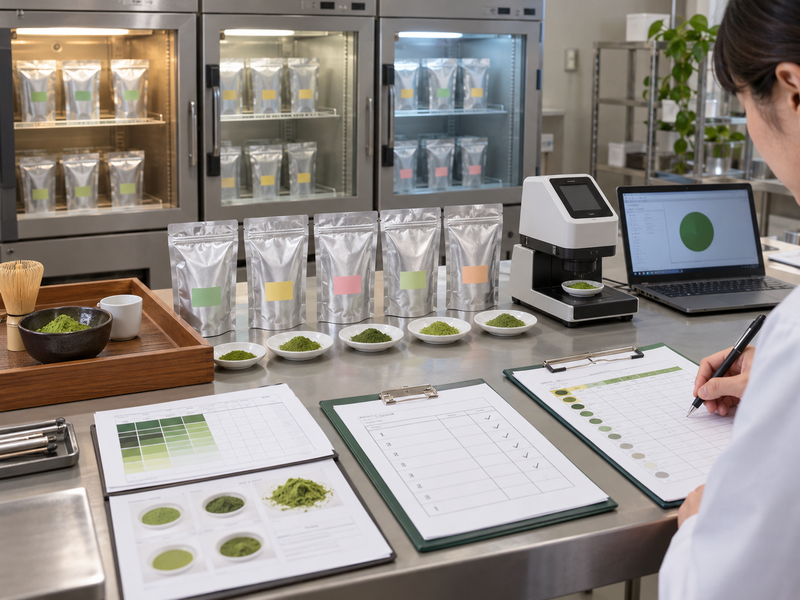
Map the expected route from packing through warehouse, cross-border transit, distributor storage, and retail shelf. Use temperature and relative-humidity loggers on a pilot shipment if the route is uncertain. A label that says “store cool and dry” has little value unless the team can describe a practical range and check whether normal distribution fits it. Include the most demanding plausible market condition in the study or narrow the label and distribution plan accordingly.
The matcha storage paper compared −18, 4, 25, and 37 °C; chlorophyll, greenness, and sensory scores declined while moisture rose. Those conditions belong to that study, not every pack design. A proposed commercial trial might use a controlled room representing expected storage and a warmer stress condition for diagnosis. Document actual averages and excursions instead of calling a nominal set point the exposure. Light exposure needs attention if the pack is transparent or a clear window is planned. Keep one set of packs in the intended retail display configuration rather than assuming a closed carton represents shelf presentation.
4. How should a real-time sampling calendar work?
Put samples aside before the launch date
Plan intervals backward from the proposed best-before period. If the team hopes to print twelve months, set baseline and multiple points before and at twelve months, with additional samples beyond that period where resources allow. A proposed schedule of 0, 1, 3, 6, 9, 12, and 15 months is a planning example, not a validated universal interval. The shorter early gaps help detect rapid color change or seal problems; later points show whether deterioration continues gradually.
At each interval, open previously untouched retail units. Do not repeatedly open one pouch and call its measurements unopened shelf life. Allocate enough units for analytical repeats, sensory panel work, packaging checks, and retained material. Name the test lab, sample transport method, and maximum delay between removal and testing. If a sample is lost or a chamber drifts outside its agreed range, document it rather than silently substituting a unit from another condition. A trial calendar should be a stock reservation as well as a laboratory schedule; depleted samples cannot be recreated after the date passes.
| Proposed point | Main question | Pack handling |
|---|---|---|
| Baseline | What did production release? | Test fresh sealed units |
| Early points | Is change unexpectedly fast? | Open independent units |
| Proposed date | Are limits still met? | Test full endpoint set |
| Beyond date | Is a margin visible? | Retain independent units |
5. Can accelerated storage help set a date?
Use heat as a screening tool with limits
Accelerated storage can help rank packaging candidates and identify sensitive endpoints before a real-time trial matures. It cannot automatically turn one month in heat into twelve months on a shelf. Matcha may change through several mechanisms; elevated temperature could alter their relative speeds or expose a package weakness not seen in normal storage. If using a predictive model, show the fit, residuals, and real-time confirmation before relying on an extrapolated date.
The published matcha study built a temperature-based prediction from moisture and chlorophyll measurements and compared predictions with observed shelf life for its materials. A buyer can use that paper to choose variables to measure, then build a model only from its own pack data. For an initial trial, put matched units at expected storage and at one or two higher temperatures. Evaluate the same endpoints at each condition. If higher-temperature samples clump while real-time samples only fade, the accelerated failure mechanism may have shifted. Label that result as a screening finding and continue the real-time series.
6. Which endpoints reveal declining matcha quality?
Measure what a buyer will notice and what explains it
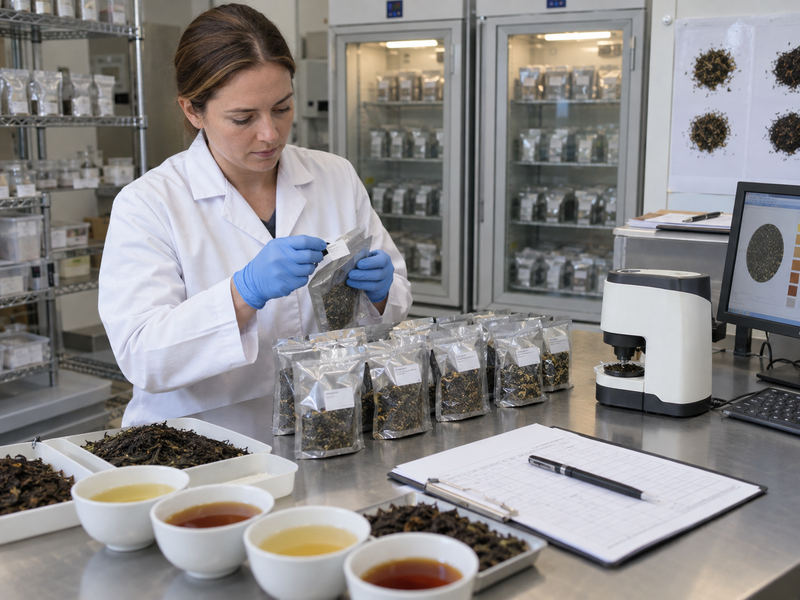
Start with appearance, aroma, flavor, powder flow, and performance in the intended application. Standardize lighting, preparation dose, water or milk, serving temperature, and panel instructions. A color instrument can record Lab* values under a fixed method; a photograph alone depends too heavily on light and camera settings. Moisture and water activity can help interpret clumping, though they answer different questions and need suitable validated methods. Ask a laboratory which measurements are appropriate for your formulation and market requirements.
Record package seal condition, leaks, dents, and any oxygen or humidity indicator used in the design. The published paper found moisture and chlorophyll strongly associated with sensory evaluation in its study, which supports testing both as potential indicators. It does not mean one chlorophyll number can replace a buyer’s cup test. If powder is destined for milk drinks, test it in that recipe too: bitterness and green color can read differently in milk than in water. Keep sensory samples coded so panelists do not know age or condition.
| Endpoint | Proposed method | Commercial question |
|---|---|---|
| Color | Fixed instrument setup and visual panel | Does it still look like approved matcha? |
| Aroma and flavor | Blind coded cup test | Does it match release profile? |
| Moisture or water activity | Validated laboratory method | Is powder changing or clumping? |
| Package integrity | Seal and visual checks | Did protection remain intact? |

7. How should acceptance criteria be set?
Fix limits before looking at aged results
Use the released product specification, customer needs, and baseline variation to propose acceptance criteria. For example, a brand can agree on a sensory scorecard with defined descriptors and a minimum approval score, plus an instrument color range established from acceptable reference lots. These are product-specific trial choices. Do not publish arbitrary universal thresholds for “green enough” or claim one percentage of moisture guarantees safety. Include microbiological and contaminant requirements separately where the product, jurisdiction, and risk assessment call for them.
Set rules for disagreement. If three panelists differ, decide beforehand whether a second panel, reference sample, or quality manager review resolves the result. If one unit has an obvious seal defect, record the defect and investigate the packaging process; do not average it away with intact units. Define both a routine quality limit and a serious fault that triggers immediate hold. A useful criterion says what happens next: accept the interval, repeat a method, investigate a lot, shorten the proposed date, or change the package. Criteria written after seeing the trajectory tend to rationalize a preferred launch date.
8. What controls keep comparisons credible?
Preserve baseline and chain of custody
Assign a unique code to every trial pack and record lot, fill line, sealing shift, storage chamber, position, and opening date. Randomize placement within a chamber where possible, since a shelf near a door may see different conditions. Keep calibrated logger records and note outages or excursions. Store a baseline reference under a defined condition and use the same analytical methods throughout the study. If an instrument or sensory recipe changes midway, run an overlap comparison before interpreting a trend.
Use a written sample handoff to the lab. The team should be able to trace one result back to the actual sealed unit, its exposure history, and the report version. An unexplained color jump might come from a packaging defect, a different tea lot, or a changed light source in the measurement setup. Before drawing a line: inspect raw records and replicate values. The point of controls is to separate product aging from testing noise. A tidy chart with missing unit identities is weaker evidence than a plain table with complete traceability.
| Control record | Evidence retained | Failure it helps explain |
|---|---|---|
| Unit identity | Pack code and lot | Mixed samples |
| Chamber history | Temperature and humidity trace | Exposure excursion |
| Method version | SOP and calibration | Apparent analytical shift |
| Sensory reference | Coded benchmark | Panel drift |

9. How should a failed interval be investigated?
Separate a product trend from a single damaged unit
When an endpoint crosses its limit, quarantine the related trial units and examine the raw data. Check whether the result appears in multiple packs, lots, or conditions. Review instrument calibration, preparation recipe, chamber logs, and package seals. If one pouch leaked, determine whether it was an isolated handling incident or a recurring seal problem. Repeat testing only under a predefined investigation process; endless retesting until a pass appears makes the date indefensible.
Compare the failure with customer-visible performance. A small numerical color shift may be noticeable in an open powder photograph but not in a milk drink; the agreed criterion still governs until the team formally changes its commercial specification. Conversely, a chemical endpoint may remain stable while aroma becomes unacceptable. Record the earliest confirmed failing interval and the latest passing interval. A proposed shorter date should leave a reasoned margin, accounting for variation between lots and shipments. If a transport simulation or market sample fails earlier than the chamber set, investigate the distribution route instead of assuming the laboratory clock alone describes shelf life.
10. What evidence is needed before printing a date?
Turn the trial into a release file
The release file should contain the signed protocol, commercial pack specification, production lots, sample inventory, chamber histories, laboratory reports, sensory sheets, deviations, analysis, and the proposed label wording. A graph by itself does not show whether every sampled unit was from the intended package. Have quality, product, packaging, and market-label owners review the same file. If launch timing precedes full real-time data, identify that gap explicitly and apply a controlled provisional decision process rather than describing a prediction as completed validation.
Before placing an order, ask the supplier for lot-specific specifications, pack structure, seal information, and samples that match the planned sale unit. Matcha Village describes supply and packaging options in its company context, but a buyer should confirm the exact deliverables for the chosen SKU. The practical next step is a small, documented pilot with fixed acceptance limits and enough unopened units to finish the calendar. Keep the real-time trial running after launch so returns and retained samples can be compared with laboratory results.
| Release item | Reviewer question | Status to record |
|---|---|---|
| Protocol and deviations | Was trial run as planned? | Approved or open |
| Endpoint results | Did all agreed limits pass? | Pass, fail, investigate |
| Pack and lot match | Is evidence for the sale SKU? | Matched or changed |
| Label review | Is date wording suitable for market? | Approved or pending |
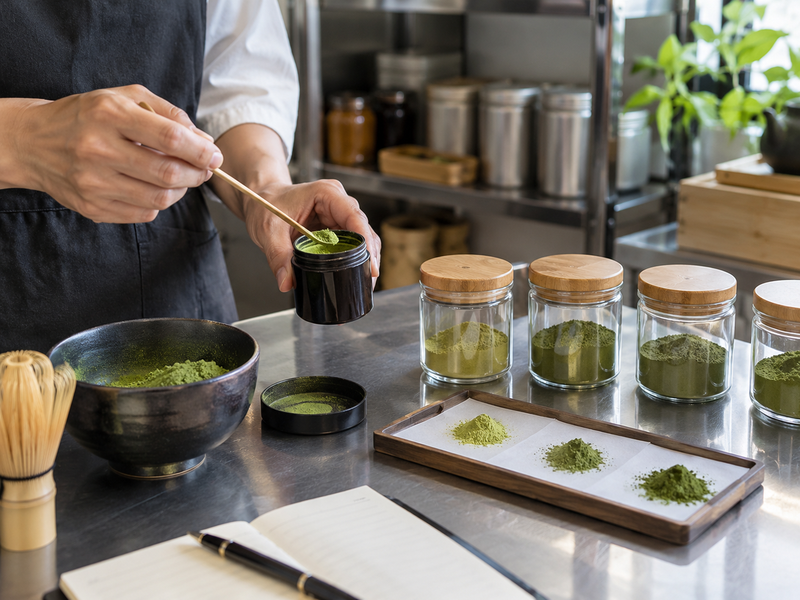
The matcha shelf life guide gives storage context; validate any printed date for the exact sale pack.
FAQ
Q1. Can a supplier’s existing date replace matcha shelf life validation? No. It can inform planning, but the buyer should establish how the specified powder and commercial pack behave under the intended route and storage instruction.
Q2. Is a warm storage trial enough? No. Warm conditions help screen risks and build a model, while real-time observations check whether that model describes normal storage.
Q3. Which measurement matters most? The one tied to a stated customer quality requirement. Color, sensory results, moisture, and package integrity each answer a different question.
Q4. Should an opened pack use the same date? No. Opening changes exposure. Study and communicate an in-use period separately if one will be stated.
Q5. What should a buyer request before approving print? Ask for the protocol, lot and pack match, full results, deviations, decision record, and market-specific label review.