
A matcha shaker bottle has to disperse powder without leaking into a bag or creating a cleaning problem. Published comparisons often emphasize size and a mixing insert; buyers also need closure, material and replacement evidence for a specific SKU. Define whether the bottle serves a café, a retail kit or a travel program, then test it with your matcha and drink method. MatchaWhat’s bottle guide provides consumer context; it does not validate your supplier’s production batch.
Contents
- 1. What drink should the shaker make?
- 2. How much usable capacity is required?
- 3. Which mixing insert works with your powder?
- 4. How should the lid and spout be tested?
- 5. What bottle shape helps pouring and grip?
- 6. Which material and use limits need proof?
- 7. Can every part be cleaned and dried?
- 8. How should a buyer compare finished drinks?
- 9. What fails during transport and repeated use?
- 10. When is the shaker ready for an order?
1. What drink should the shaker make?
Define the recipe and setting
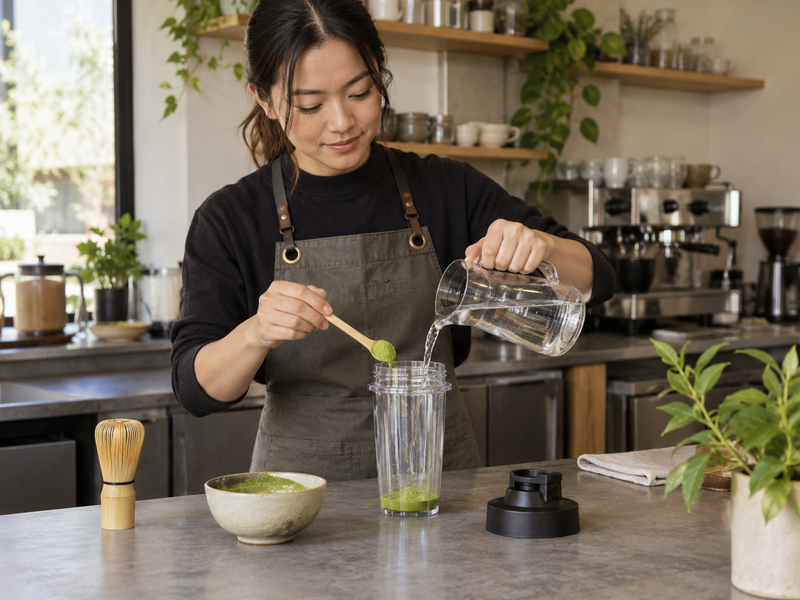
A small concentrate shaken with cool water differs from a full milk latte. Powder dose, liquid volume, ice and any other ingredient change the space and mixing action needed. State whether the bottle is a preparation tool poured into another cup or the vessel the customer drinks from. A café may prioritize quick rinse and controlled pour; a retail kit may prioritize portability and an intuitive lid.
Test one named recipe. Use the actual matcha lot and liquid options. Record how long staff shake, whether visible clumps remain and what settles after the normal service interval. Do not assume a bottle proven with protein powder will behave the same way with fine tea. If the menu uses sweetened matcha blend, test that formula separately from pure matcha. The procurement brief should identify the product, preparation method and user before comparing bottle designs.
For a café chain, test whether the bottle fits the existing rinse station, drying rack and storage shelf before ordering by the carton. Measure its height with the lid open and closed. A bottle that makes a good drink but cannot sit in a standard rack may require a different cleaning plan or extra counter space. Include the labor needed to dismantle an insert and gasket. Those operational constraints can outweigh a small difference in foam or a lower unit price.
2. How much usable capacity is required?
Leave room for movement
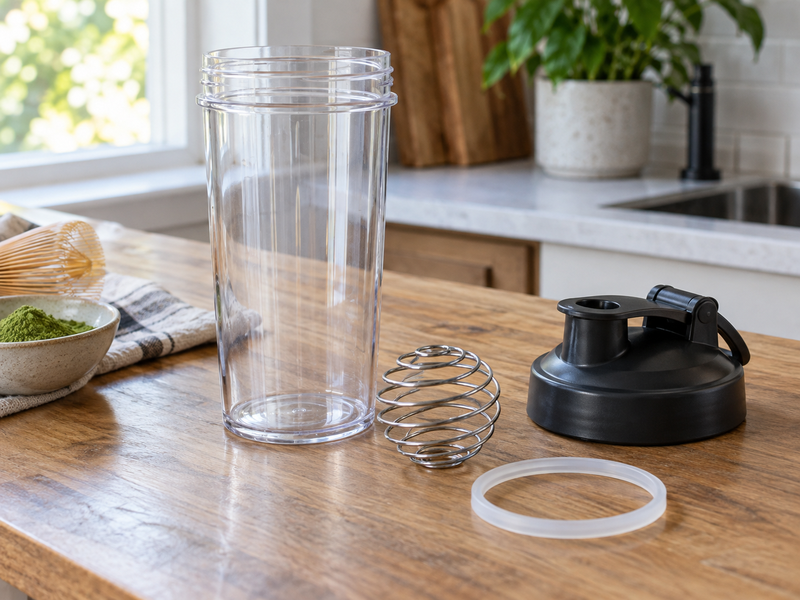
A bottle’s printed volume may describe brimful capacity rather than a practical shaking fill. Measure the liquid, powder and any ice used in your recipe, then leave headspace for agitation according to the maker’s instructions. Mark a working fill line in the trial. A very large bottle can be awkward for a small matcha dose; a small bottle may splash when filled near its lid.
Check both low and high fills. Prepare your smallest and largest proposed serving. Observe how the mixing insert moves, how easily the user grips the bottle and whether the contents pour cleanly. If the bottle includes measurement markings, check their legibility and accuracy against a measuring vessel. A custom print may cover those markings. For retail programs, make clear whether the advertised capacity is total vessel volume or recommended mixing volume. The right size is defined by the drink and carry need, not a general claim that larger is better.
| Capacity measure | Trial | Decision |
|---|---|---|
| Brimful volume | Manufacturer specification | Do not use as recipe fill |
| Working fill | Shaken recipe | No splash at lid |
| Headspace | Lowest and highest dose | Insert moves freely |
3. Which mixing insert works with your powder?
Compare mesh, ball and fixed screen
Shakers may contain a wire ball, plastic grid, mesh insert or no separate part. The insert should reduce clumps without trapping a large share of the dose. Test candidate designs with the same powder, liquid and motion. Weigh or visually inspect residue left on the insert, then prepare a second serving after cleaning. A screen that mixes well once but retains paste in inaccessible corners may not fit daily use.
Separate mixing from filtration. Matcha remains a fine suspended powder; an insert need not remove all particles. Ask what the design is supposed to do and judge the drink against your own sensory target. Sencha Naturals’ mini-shaker instructions describe a bottle with a built-in mixing element and cool-water use for that product. Do not transfer its fill or temperature directions to a different shaker. Keep spare inserts in the quote if they can be lost during washing.
4. How should the lid and spout be tested?
Challenge the closure after handling
Inspect the main lid, drinking spout, gasket and thread. Have several users close the bottle without coaching, then check whether each closure is seated. Fill it to the working line, invert it over a dry towel and carry it in a bag under the intended use. Repeat after a series of open-close cycles and washes. This is a buyer trial, not a certified leak standard.
Observe failure location. A wet rim may come from a poorly seated gasket, a spout that opens in a bag or an overfilled bottle. Record the cause rather than labeling the entire design “leaky.” Check whether powder paste builds up in the thread and changes closure feel. Ask the maker whether replacement gaskets are available and whether a revised lid will remain compatible. For a café that pours into cups, test the spout’s stream and drip after pouring. A strong closure matters only if staff and customers can use it correctly.
| Closure point | Test | Buyer concern |
|---|---|---|
| Main thread | Repeated close and invert | Leakage |
| Spout | Bag movement | Accidental opening |
| Gasket | Remove and reinstall | Incorrect seating |
5. What bottle shape helps pouring and grip?
Test hands in motion
A tall, narrow bottle can fit a bag pocket but may be hard to wash or balance during filling. A wide bottle may be easy to clean while occupying too much counter or cup-holder space. Check diameter, grip texture, weight and the point where staff can hold it while shaking. Observe users with wet hands under normal service conditions without assuming one ergonomic form suits everyone.
Pour the actual drink. A preparation bottle should transfer matcha cleanly into a final cup, including the last part of a serving. Watch whether liquid runs down the side or the mixing insert blocks the opening. If the bottle is also a drinking vessel, check whether the spout is comfortable and whether the cap stays out of the way. Record stability on the counter when staff add powder. A smooth exterior may support branding, but it should not sacrifice secure handling during a vigorous shake.
6. Which material and use limits need proof?
Review the assembled product
Request material details for the body, lid, insert, seals, colorants and printed surfaces. Ask for food-contact documentation appropriate to your destination market from the actual maker. Confirm the maker’s permitted liquids, temperatures and cleaning methods. A claim about one plastic resin does not automatically cover gaskets, coatings or the finished printed bottle.
Keep instructions product-specific. Some matcha shakers are designed for cool liquid and should not receive hot water. Sencha Naturals explicitly directs cool or room-temperature water for its mini shaker. Another design may have different limits, but obtain them in writing. Do not market a bottle as suitable for hot tea, microwave use or dishwasher cleaning without its maker’s support. Inspect finished samples for odor, sharp seams and print wear after normal washing. The selected material must serve the drink and the venue’s handling routine, not merely meet an attractive color brief.
| Component | Request | Review reason |
|---|---|---|
| Bottle body | Material and temperature use | Liquid contact |
| Lid and gasket | Material and spare source | Seal integrity |
| Care limit | Legibility and wear |
7. Can every part be cleaned and dried?
Disassemble the sample
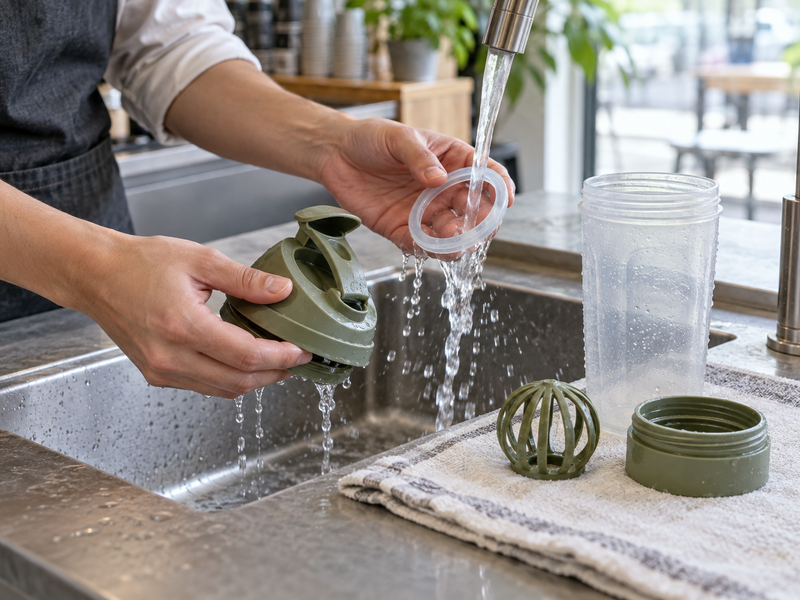
Powder and milk can collect under seals, inside a spout and around a grid. Ask a user unfamiliar with the product to take it apart under the maker’s instructions. Count removable parts and observe whether each can be reached with the approved washing tools. A small hidden cavity may create more work than a whole extra utensil.
Run a dirty-bottle trial. Prepare several drinks, allow the normal interval before washing and clean the bottle as staff or customers will. Inspect the cap underside, thread, gasket groove and insert. Record wash time and whether parts dry before storage or repacking. If a brush is required, list it as part of the program. A shaker that performs well in the cup but cannot be cleaned consistently should not advance to a chain rollout. For a retail kit, care instructions must show how parts are removed and reassembled without damaging the seal.
8. How should a buyer compare finished drinks?
Blind the bottle brand
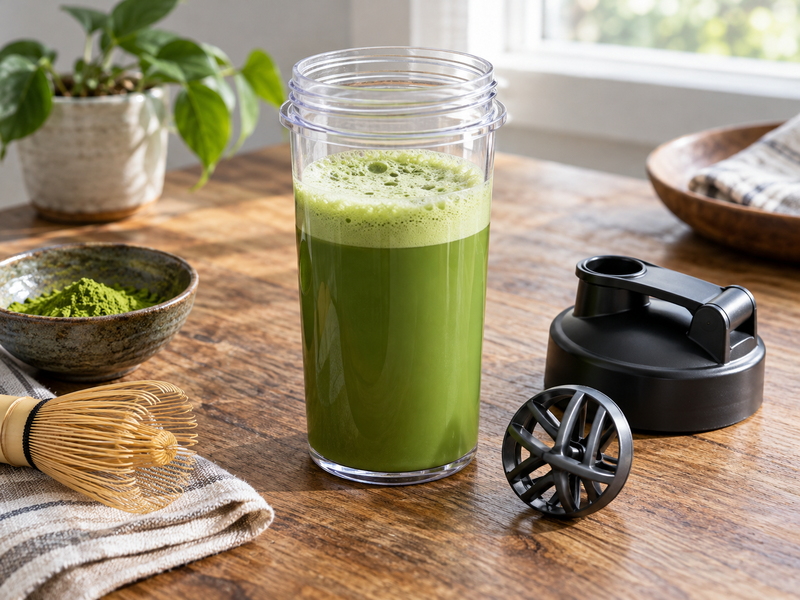
Use one powder lot, dose, liquid volume and service temperature across candidates. Standardize the shake motion and duration for the initial comparison, then allow several users to follow the same written instruction. Pour into identical clear cups and record visible clumps, foam, sediment and flavor at serving and after the normal hold period. An attractive froth right after shaking should not outweigh poor texture a few minutes later.
Count dose left behind. Rinse and inspect each bottle to see whether powder remains in corners or the insert. If a product has a special preparation method, test that method as a separate condition and disclose it in any customer instruction. Compare cleaning and leak results alongside the drink. The best shaker is not necessarily the one that makes the most foam; it is the one that makes the intended drink reliably and fits the full use cycle.
| Outcome | Observation | Record time |
|---|---|---|
| Clumps | Count or photograph | Immediately |
| Settling | Inspect cup | Normal handoff |
| Hold-up | Residue in bottle | After pouring |
9. What fails during transport and repeated use?
Test after normal wear
Trial several production samples rather than a single show piece. Put bottles through repeated opening, washing, carrying and pouring cycles based on the intended use. Inspect threads, hinges, seals, inserts and printed markings. A failure after a few cycles may point to a design or manufacturing issue. Record the sample identifier and failure mode so the supplier can respond with evidence.
Check shipment too. Inspect packed cartons for cracked lids, scuffed bodies and missing inserts after representative transport. Agree what counts as cosmetic damage versus a functional defect. Ask whether replacement lids and gaskets can be ordered separately. A chain that buys hundreds of bottles needs a way to replace one worn component without changing its whole recipe instruction. If the supplier changes a lid mold or insert, require notification and a repeat compatibility trial.
10. When is the shaker ready for an order?
Approve one defined configuration
The order should specify body size, material, lid, gasket, insert, markings, color and package. Attach a signed production sample and maker instructions. Record the drink trial, working fill, leak test, cleaning result and transport check. If matcha is bundled with the bottle, approve powder quality and labeling separately. Matcha Village’s materials describe tea and gift-set cooperation, but a specific shaker design and its manufacturer documentation require confirmation.
Set the replacement rule. Ask how long the maker will supply compatible lids, seals and inserts under current terms. State which design changes trigger another trial. Receiving staff should inspect a sample across cartons for closure fit and missing pieces. A purchase is ready when the vessel makes the promised drink, survives its intended handling and has a practical route for cleaning and spare parts. Brand color alone is not enough.
| Gate | Evidence | Owner |
|---|---|---|
| Drink | Standardized comparison | Product team |
| Closure | Filled-bag trial | Quality |
| Continuity | Spares and change terms | Procurement |
Ask the vendor for a small run of production-equivalent units before approving a large branded order. Test bottles selected across cartons, not only samples supplied by sales. Compare gasket fit, fill markings and insert seating, then run the same drink and bag trial on each. If results vary, request the maker’s inspection criteria and corrective action. A design can be good while a particular production run is inconsistent; procurement needs evidence about both.
FAQ
Q1. Does every matcha shaker bottle need a metal ball? No. Compare inserts with your powder and cleaning routine.
Q2. Can the bottle be filled to its rim? Use the maker’s working-fill guidance and leave room for mixing.
Q3. Is a “leakproof” listing enough? Test the final lid and gasket after repeated use.
Q4. Can hot water go into any shaker? No. Follow the selected maker’s temperature limits.
Q5. What should wholesalers ask about spares? Confirm replacement lids, gaskets and mixing inserts.
Send bottle makers the intended recipe, fill level and carry scenario. Trial several finished samples through mixing, leak and wash cycles before approving branded stock. A shaker that performs well throughout that cycle will earn repeat use rather than remain a novelty.