
Matcha scoop size is often described as “one serving,” yet a curved bamboo chashaku does not hold a fixed mass of powder. A rounded scoop, a level scoop, and a different matcha lot can all weigh differently. For a café, the defensible recipe begins in grams. The scoop can then help staff portion cleanly and present tea, as long as it is calibrated against the recipe. These ten checks turn a traditional utensil into a practical part of training and purchasing.
Contents
- 1. What job will the scoop do?
- 2. How much matcha does your recipe use?
- 3. Why is one scoop not a fixed gram amount?
- 4. How do you calibrate a chashaku?
- 5. Which length and curve work at the station?
- 6. What material and finish are suitable?
- 7. How should staff portion during service?
- 8. What should a retail kit explain?
- 9. How do you manage batch variation?
- 10. What belongs in the purchasing brief?
1. What job will the scoop do?
Separate display, transfer, and measurement
A chashaku can transfer powder from a tea container, form part of a traditional presentation, or help portion a recipe. Those jobs are related but not identical. A café making lattes may need a small clean transfer tool beside a scale. A tea-service venue may present a bamboo scoop to guests. A retailer may include one in a kit as a way to handle powder. Decide which job matters before choosing length, curvature, material, and quantity.
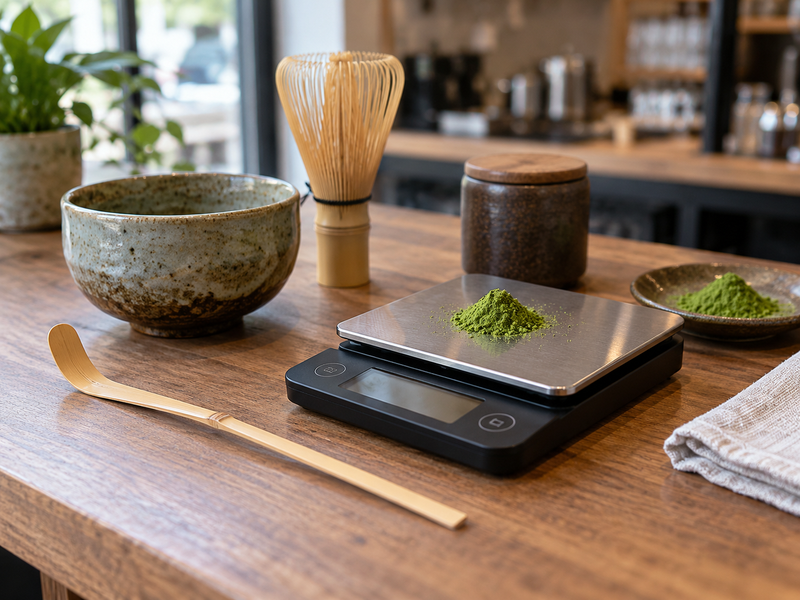
The Nio Teas chashaku guide discusses customary scoop amounts. Treat any stated spoon-to-gram conversion as an approximation until checked with the matcha and scoop in use. If the recipe’s quality or cost depends on dose, weigh powder. The scoop should make that operation neat and repeatable, not replace the scale because its handle looks traditional. Watch how staff actually reach into the tin and deposit powder before buying a large set.
2. How much matcha does your recipe use?
Set a mass target before choosing a scoop
Write each recipe’s matcha dose in grams with a tolerance the kitchen can achieve. A bowl of straight tea, a short concentrate for a latte, and a larger blended drink may have different targets. The scoop should be chosen around the number of comfortable transfers needed to reach each target. If a recipe needs several awkwardly heaped passes, a different tool may be more suitable. If it needs less than one partial scoop, staff may struggle to reproduce the shape of that partial amount.
Use a scale that is appropriate for the small doses in the recipe, and check its resolution and calibration according to the manufacturer’s instructions. Record powder and water together in a station card. A scoop count can be added as a training cue once tested, but grams remain the reference. When matcha grade, packing density, or supplier changes, recheck the cue. A written dose protects consistency better than telling each employee to use “a generous spoonful.”
| Recipe field | Specify | Why it matters |
|---|---|---|
| Matcha mass | Target grams and tolerance | Flavor and cost control |
| Water volume | Measured amount | Dispersion consistency |
| Scoop method | Level, rounded, or weighed transfer | Staff training |
| Finished drink | Cup and milk/ice specification | Validates dose in context |
3. Why is one scoop not a fixed gram amount?
Powder and operator both change the load
Matcha powder can sit loosely or compact under handling. Different lots may differ in particle characteristics and how they settle in a container. A scoop’s curvature, width, and the angle at which it enters powder also change the amount collected. Staff may call one scoop “level” while leaving quite different mounds on top. This is why a traditional count of scoops is a useful preparation convention but a weak procurement specification for a gram-controlled café recipe.
Demonstrate the variation with a small trial: have several staff members make ten ordinary scoops each, weigh every transfer, and compare the range. Do not tell them to copy an ideal mound first; observe natural behavior. Then give a defined technique and repeat. The difference shows whether training can make the scoop a practical cue. It does not turn it into a laboratory measure. Use the scale for recipe validation and cost accounting.
4. How do you calibrate a chashaku?
Measure repeated normal transfers
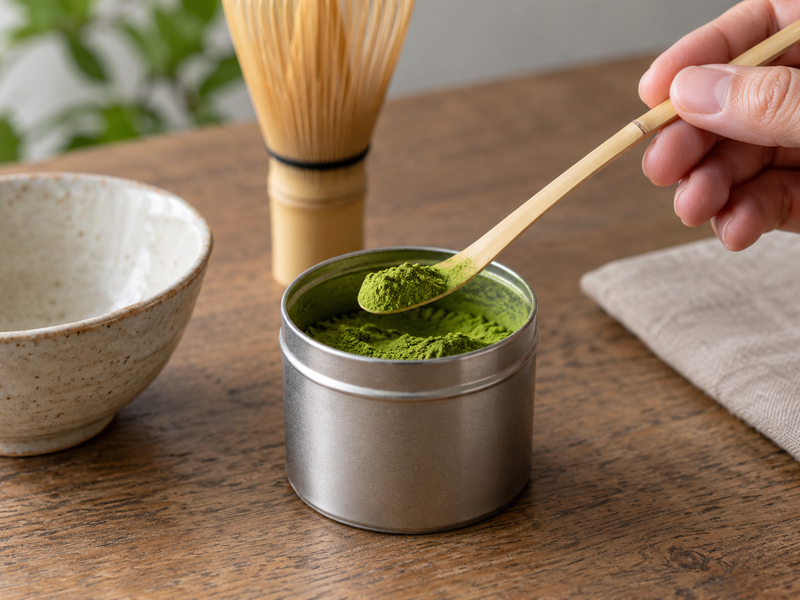
Use the scoop, powder lot, container, and technique that staff will use. Tare a small receiving dish, transfer one scoop, and record its mass. Repeat enough times to see the spread, with more than one operator. Calculate the average and the lowest and highest ordinary values. Compare those with the recipe target. If a two-scoop cue usually lands near the target but varies too widely, keep weighing or change the transfer tool. Do not round one measured scoop into a permanent product claim.
For illustration only, if ten trial scoops average 0.8 g, two average 1.6 g; an individual pair could be above or below that. These numbers are an arithmetic example, not a claim about chashaku capacity. Recalibrate when the scoop model, matcha lot, or staff technique changes. Keep the record in the recipe file so a trainer can show why the station card says “two scoops, then check weight” rather than “two scoops equals 1.6 g.”
| Calibration step | Record | Decision |
|---|---|---|
| Define scoop style | Level or rounded example photo | Shared technique |
| Weigh repeated transfers | Each result in grams | See variation |
| Compare with recipe | Target and tolerance | Use cue or scale |
| Recheck triggers | New lot or scoop model | Prevent drift |
5. Which length and curve work at the station?
Match the utensil to the container
A long chashaku may reach comfortably into a deep tea caddy but be awkward in a shallow wide tin. A short scoop may keep hands close to powder as the container empties. Test the tool with the actual pack at full and near-empty levels. Staff should transfer powder without scraping knuckles on the rim or spilling across the counter. Also observe where the powder falls into the bowl or sieve; a narrow curved tip may help controlled placement for one operator and feel fiddly to another.
Measure the length and width of an approved scoop and record the container opening. If the café changes from tins to bulk refill bags, the transfer method may need to change. A traditional chashaku can remain part of guest-facing tea service while a separate food-safe measure handles high-volume production. Do not force one utensil to solve every workflow for the sake of visual consistency.
6. What material and finish are suitable?
Inspect the surface that touches powder
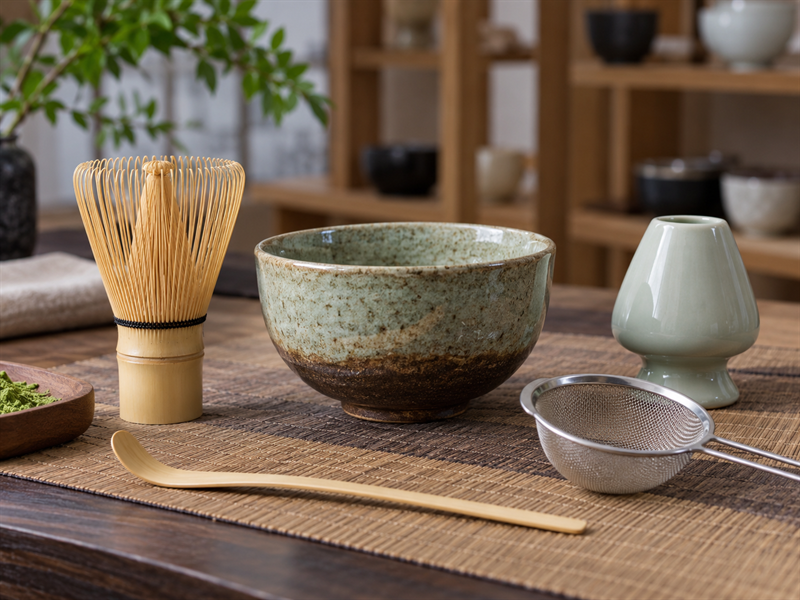
Bamboo chashaku are common, but other materials and finishes exist. Ask the maker what touches the powder, how it is finished, and how it should be cleaned and dried. Inspect the tip and underside for splinters, rough edges, coating damage, or joints that could trap powder. A decorative lacquer or colored finish should not be assumed suitable for food contact without documentation for the actual product and destination market. Keep the chosen tool in good condition.
Matcha is a fine powder, so a scoop can accumulate residue even when it looks clean from above. Follow the maker’s instructions and the operation’s applicable hygiene process. The FDA Food Code provides a US model for food-contact utensils, while local requirements govern the café. If a product’s care restrictions cannot be reconciled with the approved process, choose another transfer tool. Do not invent a claim that bamboo is naturally antibacterial or self-cleaning.
| Material check | Ask or inspect | Why |
|---|---|---|
| Food-contact surface | Material and finish | Suitability review |
| Tip condition | Splits or roughness | Powder contamination and handling |
| Care method | Written maker instructions | Cleaning feasibility |
| Batch consistency | Several units | Repeatable portioning cue |
7. How should staff portion during service?
Build a short, observable sequence
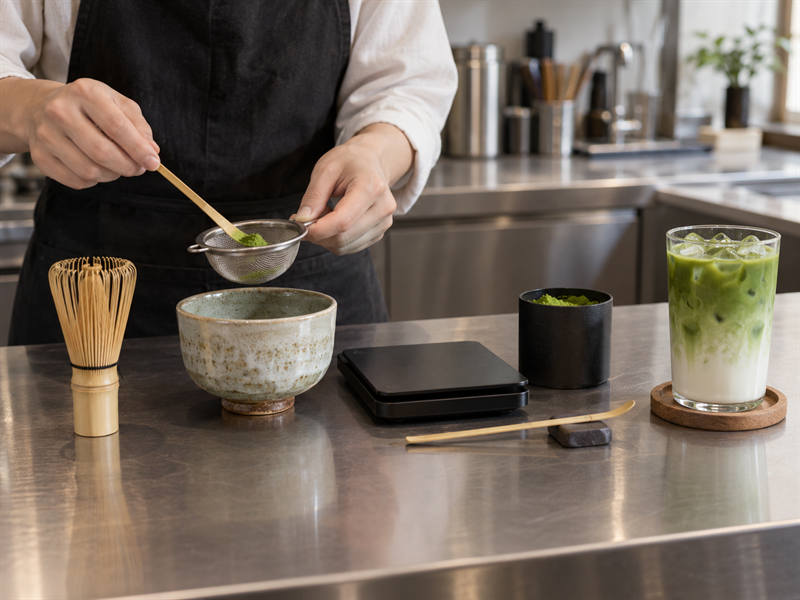
At a gram-controlled station, place a clean bowl or dish on the scale, tare it, use the scoop to transfer powder, and adjust to the target mass. Then add measured water and whisk. This avoids guessing how much powder clings to the scoop or container wall. If the venue uses a traditional scoop count for guest-facing service, train the visual mound and periodically weigh a sample preparation to monitor drift. The method should suit the product promise and the operation’s quality standard.
Keep the scoop dry and dedicated to matcha as required by your local process; dipping a damp tool into powder can make clumps and complicate cleaning. Assign a rest location away from wet cups. Teach staff what to do when a scoop is damaged or falls onto an unclean surface. A station card should be specific enough for a new employee to prepare a drink, but short enough to read while the queue is moving.
8. What should a retail kit explain?
Give a recipe, not a false conversion
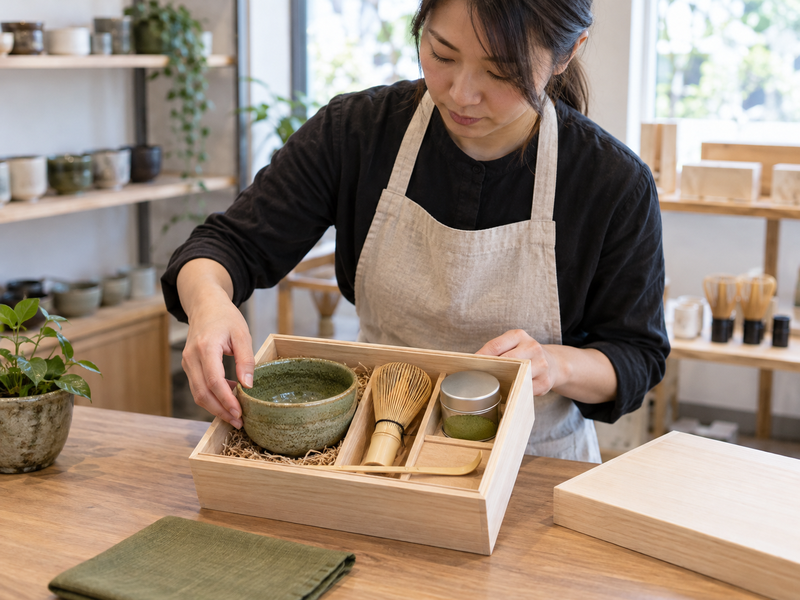
If a kit includes a scoop, describe it as a transfer utensil and provide a starting recipe in grams and water volume. You may add an approximate scoop cue if it was measured with the included scoop and powder, while explaining that actual mass varies. Avoid saying “one scoop equals one gram” as a universal fact. Show the scoop beside the bowl and whisk so customers understand what is included, and provide care instructions from the maker.
A retailer selling powder and tools together can demonstrate a simple home check: weigh several scoopfuls once to learn how that set behaves. If no scale is available to the customer, describe the visual technique honestly as an approximation and encourage adjustment by taste. Do not claim precise caffeine or nutrition per scoop from an unweighed portion. Product claims should follow measured serving size and the powder’s own data where relevant.
| Kit information | Good practice | Avoid |
|---|---|---|
| Included scoop | Name material and dimensions | Ambiguous photo only |
| Recipe | Grams plus water volume | Fixed universal scoop conversion |
| Care | Maker-approved method | “Self-cleaning” claim |
| Dose claims | Based on weighed portion | Unmeasured caffeine amount |
9. How do you manage batch variation?
Recheck a new scoop and a new powder lot
Hand-shaped bamboo scoops can vary in width and curvature. Inspect several units from normal production and measure how each transfers the current matcha. If the variation matters for a scoop-count method, set a functional range or continue weighing each dose. Compare the next shipment with an approved sample. A different glaze or finish on a decorative scoop may also require renewed food-contact review. Do not assume that the same product name means the same capacity forever.
Powder changes deserve their own check. A new matcha lot may settle differently, so a scoop cue calibrated on the previous tin can drift. Run a short weighing exercise at the start of each new lot and update the station note if needed. A café using a scale every time still benefits from checking whether the new powder disperses and tastes as expected. Calibration is a small operation, not an attempt to make bamboo behave like a precision measuring spoon.
10. What belongs in the purchasing brief?
Specify the tool and the method
Record the scoop’s intended job, material and finish, overall length, tip width or shape, care instructions, packaging, and allowed variation. Attach a photograph beside a ruler and the matcha container in which it passed. If food-contact documentation is needed for the market, link it to the exact finish ordered. Define unacceptable defects such as splits, sharp edges, loose coating, or a shape that fails the transfer task. A supplier can act on those details; “standard matcha scoop” is too vague.
For a café, attach the recipe’s gram target and whether the scoop is a transfer tool or an approximate count cue. For wholesale retail, include kit contents and honest dosing language. Calculate total cost with breakage, packing, and staff time rather than comparing only unit price. Retain an approved sample so the next buyer can distinguish a legitimate handmade variation from a tool that no longer fits the work.
| Purchase field | Record | Reason |
|---|---|---|
| Geometry | Length, tip shape, accepted range | Container and transfer fit |
| Material | Body and finish | Care and food-contact review |
| Use | Transfer or approximate cue | Training clarity |
| Packaging | Protection in shipment | Avoid split bamboo |
| Approval | Sample and defect photos | Reorder consistency |
FAQ
Q1. How many grams are in one chashaku scoop? There is no fixed answer. Weigh repeated scoops of the actual matcha with the actual utensil and technique.
Q2. Can a café use scoops instead of a scale? It can use scoop counts as a cue, but a gram-based recipe and periodic weighing give better control over dose and cost.
Q3. Does a bigger scoop improve service speed? Only if it transfers the target dose neatly and fits the container. Test the full portioning sequence.
Q4. Should a retail kit state a scoop-to-gram conversion? State it only as an approximation measured for that set, with a clear note that powder and technique change the amount.
Q5. When should calibration be repeated? After a new scoop model, a new matcha lot, a changed staff technique, or a recipe revision.
Keep grams as the anchor
Choose matcha scoop size by the container and recipe it must serve. Calibrate the actual tool, describe it honestly, and keep weighing where precision matters. That gives staff a graceful way to handle powder without asking a curved piece of bamboo to be a laboratory measure.