
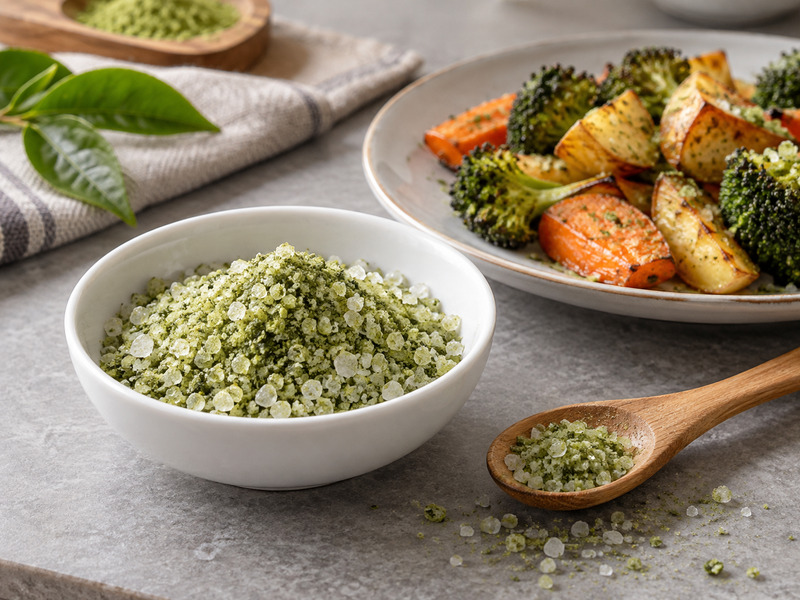
Matcha salt is a blend of edible salt and matcha powder used as a finishing seasoning or formulated ingredient. Its simplicity makes weak decisions visible. The wrong crystal size can separate from fine tea; moisture can form clumps; a pleasing dry taste can disappear on hot food. A food brand or restaurant group needs to test the blend on the dish it will season, then prove that the pack keeps it usable. This guide covers ingredient choice, mixing, shelf behavior, label claims, and commercial yield.
1. What job should matcha salt do?
A matcha salt might finish fries, season popcorn, rim a savory drink, or add contrast to chocolate and caramel. Each application asks for a different dose and particle feel. A coarse finishing crystal gives visible sparkle but may carry tea unevenly. A fine salt can disperse quickly but become dusty or over-salt a product if staff use the same spoonful. Define whether the matcha should lead, support umami, or simply provide color. The product should have a clear role before the team buys either ingredient.
Start with a named application
Write a brief for the food, serving size, use stage, and expected tea impression. Test the seasoning on a warm and a cooled version if the food is served across that range. A hot fried item may change the tea aroma; a sweet item can alter perceived saltiness. Ask tasters to score the seasoned food, not a fingertip of blend alone. If a brand plans a retail shaker, identify the likely consumer use and show a realistic serving suggestion. One blend may work across several foods, but that needs evidence from those foods rather than a broad marketing line.
2. Which salt crystal is suitable?
Salt format affects visual appeal, mouthfeel, mixing, and dose. Fine salt has a different bulk density and surface area from flakes or coarse crystals. Fine matcha powder may settle among larger crystals during transport, leaving the first shaker portion salt-heavy and the last tea-heavy. A flaky salt can carry the powder on its surface, but handling may break flakes. The selection should follow the intended pack and application.
Test the first and last portions
Blend small batches using the candidate salts at a fixed matcha percentage by weight. Fill the proposed shaker, pouch, or sachet, then handle it as distribution and consumers will. Compare color and tea flavor from the first, middle, and last dispenses. Record grams delivered per shake or spoon measure. An attractive large crystal is less useful if it cannot leave the shaker opening. If foodservice staff pinch the blend by hand, test with gloves and under a normal rush. The chosen salt should give consistent seasoning without requiring an impractical mixing ritual at every use.
| Salt form | Possible advantage | Trial risk |
|---|---|---|
| Fine | Even dusting | Caking or over-dosing |
| Flake | Visible finish | Breakage and uneven tea coating |
| Coarse | Texture | Separation from fine matcha |
3. Which matcha powder belongs in a seasoning?
Plain-bowl quality and seasoning quality overlap but are not identical. A fine grind supports even blending; a clean, recognizable tea note must survive the food’s fat, heat, and salt. A bitter powder can become harsh at a high seasoning dose. Color matters, yet a green dry blend may look muted once sprinkled on an oily surface. Screen pure matcha powder candidates in the actual salt ratio and on the intended dish. Supplier labels should be translated into testable sensory criteria.
Compare cost per seasoned serving
Make coded blends with each powder at equal tea percentage. Have tasters compare the seasoned product after a normal hold, not only immediately after sprinkling. Record aroma, tea presence, salt balance, texture, and any dusty aftertaste. If a stronger powder allows a lower inclusion rate, calculate the new cost per serving and recheck appearance. A more expensive kilogram may be workable when only a small amount enters each dish. Keep a sample tied to the offered production lot and define what change in color or aroma requires a new application test.
4. How should the blend ratio be developed?
A percentage on paper does not predict what a customer tastes. Salt intensity depends on crystal size and application, while matcha concentration affects bitterness, color, and cost. Start with a small trial matrix that changes the tea-to-salt ratio while holding the food, seasoning mass, and service time steady. If a new ratio appears better, check whether tasters are responding to less salt rather than more tea. A control seasoned with plain salt helps reveal that difference.
Record two doses for each candidate
Test a modest and a generous dose within the range staff or consumers might use. The blend should not become unpleasant at a plausible heavy hand. Weigh the amount applied to each serving and compare it with an ordinary spoon or shaker action. A retail pack may need a flow insert or clear directions to keep portions reasonable. If the team adds sugar, citrus, or other flavorings, treat the product as a wider seasoning blend and review its identity, shelf behavior, and label anew. The approved ratio should belong to a defined use rather than a vague “premium matcha salt” concept.
| Trial variable | Keep fixed | Judge |
|---|---|---|
| Matcha percentage | Salt and food | Tea flavor and color |
| Seasoning dose | Blend and food | Salt balance |
| Application timing | Recipe and amount | Aroma after service hold |
5. Which mixing method keeps the blend even?
Different particle sizes and densities can separate in a blender, hopper, or filled pack. Overmixing may create fines or break salt flakes; undermixing leaves green and white pockets. The plant needs a method that produces uniform portions from the beginning to the end of a batch. A small jar shaken by a developer is not proof that a ribbon mixer or hand-blending station will perform the same way at scale.
Sample across the production vessel
Define loading order, batch size, mixing time, and any screening step. Draw samples from several locations and compare their color and, where practical, composition. Then fill the intended package and test again after movement. If the blend separates after transport, modifying only the initial mixing time may not solve it. Particle-size selection, pack size, or a different process may be needed. Record blend loss left in equipment, since matcha dust can remain on walls and change actual yield. Operators should have a simple check that identifies an uneven batch before it is packed.
6. What can moisture do to matcha salt?
Salt and fine tea powder can react differently to humid handling. Clumps may block a shaker, and repeated opening can expose the blend to kitchen steam. Green color and tea aroma can also change over the intended shelf period. A dry-looking sample at filling is only the starting point. Packaging and storage instructions should reflect the actual route, including warm kitchens, retail shelves, and opened consumer use.
Stress the final pack under realistic conditions
Fill the selected pack, then observe flow, clumping, aroma, color, and first-to-last dose at planned intervals. Include repeated opening for a foodservice container and a transport trial for retail packs. Do not promise a long shelf life based on salt alone; matcha is an additional ingredient whose sensory performance must be checked. Food safety and quality staff should set the validated study and any moisture limits. If a desiccant or barrier liner is proposed, test the complete packaged article and confirm that consumer directions and material choices are suitable for the market.
| Storage observation | Customer impact | Check |
|---|---|---|
| Caking | Shaker stops flowing | Dispense test |
| Color shift | Product looks old | Standard-light photo |
| Aroma loss | Matcha claim weakens | Blind food tasting |
7. How should savory and sweet uses be validated?
A seasoning that succeeds on popcorn may not suit chocolate. Fat, heat, moisture, and sugar change the way salt and matcha are perceived. Build a primary application before claiming broad versatility. For a restaurant, the seasoning might be applied at the pass; for a snack manufacturer, it may enter a tumbler and face distribution. Those two routes need different tests for adhesion and even coating. A small recipe demonstration cannot validate a manufacturing process.
Test the intended food at line conditions
Measure seasoning pickup, visible coverage, flavor after packaging, and waste left in the applicator. On hot food, check tea aroma after the time between kitchen and diner. On a dry snack, inspect the bottom of the bag for separated green powder. On a sweet product, compare whether salt enhances or overwhelms the matcha note. Keep a plain-salt control and a non-matcha seasoning control where useful. If the blend is sold to multiple customers, provide application-specific guidance rather than one exaggerated promise. The buyer should know what the blend did in a real pilot, not what it might do in every recipe.
8. What should the label and claims say?
A two-ingredient blend still needs an accurate ingredient declaration, net content, appropriate nutrition information, and any market-specific requirements. “Japanese matcha,” “organic,” or other provenance statements require documents for the supplied lot and finished product as applicable. Salt-containing products also raise questions about sodium claims. Avoid presenting a seasoning as a health product or suggesting that the small amount of matcha in a pinch delivers a health outcome. Regulatory staff should review the final pack and selling market.
Check artwork against the approved formula
If the blend contains salt and matcha only, keep the description straightforward. If flavorings, anti-caking agents, or other ingredients are added, update the declaration and the product name as needed. Keep supplier specifications and origin records with the print file. A window showing bright powder can help retail appeal but may create light-exposure questions for shelf life. Test the actual pack and labeling through the planned sales route. For foodservice bags, instructions should tell staff how to close and store the product after opening, based on the validated study rather than habit.
| Claim or label element | Evidence to retain | Review point |
|---|---|---|
| Ingredient order | Final formula | Every recipe change |
| Origin statement | Lot records | Supplier substitution |
| Storage direction | Pack study | Material or size change |
9. How should a buyer cost the seasoning?
Cost per kilogram is useful for quoting but not for menu decisions. The business needs grams of blend applied per accepted serving, loss in the mixer or shaker, broken packs, labor, and freight. Matcha percentage can change the purchase cost sharply while making little difference to a heavily seasoned dish. Conversely, a lower dose of a more flavorful powder may reduce total cost. Compare only blends that deliver the approved eating experience.
Include distribution and waste
For a snack line, measure seasoning pickup and residual powder in the drum and package. For a restaurant, observe how much staff shake onto a plate during a normal shift. A broad-mouth shaker can raise waste even when the formula is sound. If the product is sold as a retail jar, calculate label, closure, and carton costs and assess whether the chosen fill weight suits repeat purchase. Pilot the final price in the intended channel. A small premium finishing salt may sell on a different value proposition from a large pantry seasoning; the pack and application brief should reflect that distinction.
10. What belongs in a release and sourcing specification?
The final file should identify salt type and particle range, matcha lot and inclusion level, mixing method, uniformity checks, pack material, shelf-life basis, label, and intended uses. Ask suppliers for current ingredient specifications, relevant testing, and change notification. Bulk matcha supply can be evaluated once the food application is defined. A seller’s claim that its powder is “culinary grade” does not prove uniformity in a shaker or flavor on the target dish.
Approve the packed blend and the food it seasons
Retain a reference pack and a reference application result. When a new tea lot or salt crystal arrives, repeat a small blend and food test before approving a large order. Recheck after a new mixer, jar opening, or shipping route. Train quality staff on acceptable color range, flow, and taste. The final decision is not whether the blend looks green on a white table. It is whether a normal portion gives the promised matcha seasoning reliably, from the first customer use to the last.
| Release item | Practical evidence | Reapproval trigger |
|---|---|---|
| Ingredient pairing | Lot specs and food tasting | Salt or matcha change |
| Blend uniformity | Vessel and pack samples | Mixer or pack change |
| Shelf behavior | Final-pack study | Storage route change |
FAQ
Q1: Is matcha salt just matcha mixed with salt?
It can be, but a saleable blend also needs controlled particle behavior, flavor, pack stability, and accurate labeling.
Q2: Which salt crystal is best?
Choose by the intended food and dispensing method. Test uniformity and first-to-last portion before approving a crystal size.
Q3: Can matcha salt be used on sweet food?
Yes, if a finished-food trial confirms balance and the application method delivers a consistent dose.
Q4: Why does matcha salt clump?
Humidity, ingredient particle behavior, and repeated opening can affect flow. Test the final pack through its intended route.
Q5: What should be retested when matcha changes?
Check blend uniformity, color, flow, and flavor on the approved application using the proposed new lot.