
Matcha salad dressing uses powdered green tea in a vinaigrette or creamy dressing. The tea can add a subtle vegetal note, but a green color is not enough: acid can sharpen bitterness, oil can mute aroma, and particles can settle in a bottle. Whole Food Bellies’ light and creamy matcha salad dressing is a consumer example. A restaurant or food brand needs to test the dressing with the actual greens, portion and holding route before adding it to a menu.
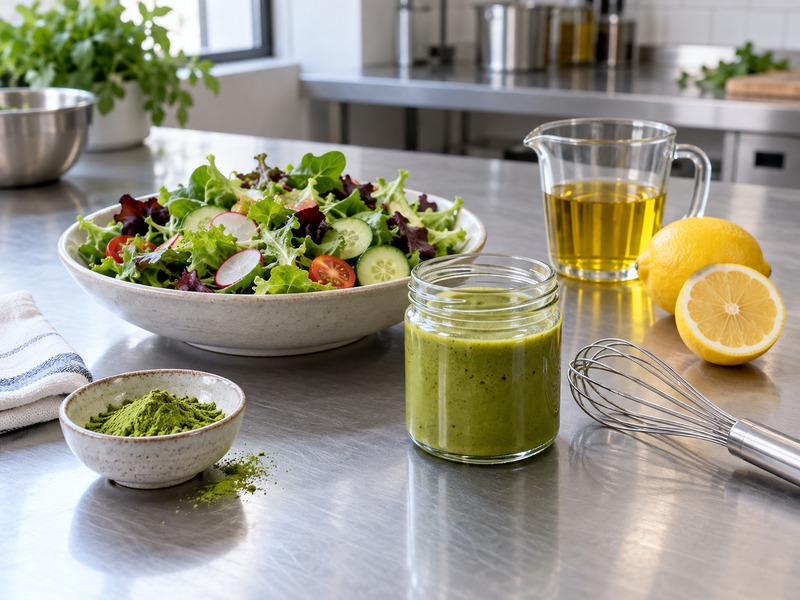
For: chefs, prepared-food developers, foodservice buyers and tea suppliers. Decision: whether matcha contributes a useful flavor and appearance in a dressing that can be made and held consistently.
1. What role should matcha play in the dressing?
Write the flavor target
The dressing may be a light tea-led vinaigrette, a creamy herb sauce with matcha as a supporting note, or a green visual concept. Those choices need different tea doses and different menu descriptions. Decide the target salad, portion size and expected customer. A bitter edge can work against rich avocado or grains but feel harsh on delicate lettuce. Taste the dressing alone, then on the intended salad at the serving temperature.
Check the whole bite. A teaspoon of dressing can seem strong on its own yet vanish once it coats a large bowl of greens. Conversely, a pleasant sauce may become heavy when over-applied. Measure the dressing mass per salad and ask tasters to identify tea without being told the ingredient. If they only taste herbs and lemon, matcha may be a visual cue rather than the lead flavor; the copy should reflect that.
| Dressing route | Likely benefit | First risk |
|---|---|---|
| Vinaigrette | Light finish | Acid sharpens tea |
| Yogurt or creamy | Rounded taste | Tea hidden by dairy |
| Herb-based | Fresh green profile | Herbs dominate matcha |
2. Which matcha should be tested?
Taste it with acid and oil
A powder that is smooth in water can taste different in a lemon or vinegar dressing. Request identified samples and prepare equal-dose dressings with the same acid, oil, sweetener and salt. Taste on the same greens after a standard hold. Compare tea clarity, bitterness, color and any grainy sensation. A more assertive tea may survive the fat phase; a harsh one may become harder to balance when acid is added. Buy for the finished dressing, not for a dry-powder shade.
Keep a buying standard. Record lot identity, specification, pack size, storage guidance and required supplier documents. Retain an approved sample and a reference dressing formula. When a new lot arrives, make a small comparison batch. A powder that needs much more to register on the salad can increase cost and create sediment.
3. How should the powder be dispersed?
Prevent green specks
Matcha can clump when added dry to an oily or thick mixture. Disperse a measured amount into a compatible water-based part of the formula before emulsifying with oil, or compare another route suited to the recipe. If sifting helps, make it a documented step. Check a thin smear on a white plate for dark particles, then taste the dressing after it has stood. A blender may make a smooth fresh sauce while incorporating air that changes bottle fill or color.
Sample the bottom. Powder may settle even when the emulsion still looks acceptable. Take portions from the top and bottom of a held bottle. If the last serving is intensely green or bitter, adjust mixing and holding instructions before increasing stabilizers. A foodservice squeeze bottle needs a clear shake or re-mix rule that staff can follow during rush service.
| Dispersion defect | First check | Trial |
|---|---|---|
| Dark flecks | Powder pre-mix | Small water phase |
| Bitter bottom | Sediment | Re-mix and hold test |
| Foamy bottle | Blender speed | Lower agitation |
4. How should acid and sweetness be balanced?
Change one variable at a time
Lemon, rice vinegar and other acids bring different flavor. Hold matcha and oil constant while comparing two acid levels, then vary sweetness separately. Tea bitterness can seem stronger in a sharper dressing. Honey or another sweetener may round it, but too much turns a salad sauce into a sweet glaze. Taste with the intended greens and toppings, because salted nuts or fruit can alter the balance. Record weights, not just “a squeeze of lemon.”
Watch color through the hold. Acid and time may change how the green appears, while herbs or avocado can create their own color shifts. Photograph the dressing in its serving vessel at production and after the proposed chilled hold. If a bright green menu image matters, test the plated salad after the normal time between dressing and eating. The product should not depend on a freshly blended moment that customers never see.
5. What controls the emulsion and pour?
Match viscosity to service
A vinaigrette can be intentionally shakeable; a creamy dressing may need a stable, spoonable body. Define how it is dispensed: bottle, ladle, pouch or retail jar. Then assess pour rate, coating on greens and separation during the intended hold. Too thin a dressing collects at the bottom of the bowl. Too thick a dressing sits in blobs and can make matcha taste uneven. Measure the amount delivered by the actual squeeze bottle or pump.
Do not chase visual smoothness alone. A dressing that remains opaque may still lose tea to sediment, while a separated vinaigrette can return to a consistent serving after a defined shake. Test the full experience. If a stabilizer is considered, treat it as a new formula with label and sensory consequences. Start by controlling the oil-water balance and mixing route.
| Service tool | Desired behavior | Check |
|---|---|---|
| Squeeze bottle | Measured, even stream | First and last pour |
| Ladle | Consistent coating | Portion mass |
| Retail jar | Re-mixable texture | Consumer instruction |
6. Which salad ingredients suit the dressing?
Build a plate, not a bottle
Peppery greens, cucumber, grains, herbs, fruit and dairy toppings can all change the matcha impression. A dressing with a modest tea note may work on mild lettuce but vanish against roasted vegetables or a strongly flavored cheese. Trial the intended salad with its real portion of dressing. Ask tasters to judge whether the tea adds a coherent note and whether the plate remains pleasant through the final bites. If the dressing dominates, reduce dose or use it on a sturdier base.
Consider visual contrast. Green dressing on green leaves may disappear in a menu photo. A contrasting ingredient can help customers see the sauce without adding unsupported color claims. The plate should still be easy to produce. A fragile garnish that falls off during delivery is less useful than a reliable salad with a clear flavor balance.
7. How should food safety and holding be evaluated?
Treat the full formula as a new food
Fresh herbs, avocado, yogurt and other ingredients bring distinct handling requirements. The producer’s food-safety plan should define preparation, cooling, storage, service and discard rules. Do not assume acidity makes a dressing shelf-stable; product-specific measurements and validation are needed for that claim. A home recipe’s refrigerator suggestion does not establish a commercial sale period. Run quality and safety reviews for the final formulation and package.
Observe held quality. Store samples under the planned conditions and check odor, color, separation, sediment, pour and flavor at scheduled intervals. If a creamy dressing thickens overnight, the portion tool may deliver too much. If a vinaigrette separates rapidly, train staff on a repeatable shake. Define the maximum hold from tested performance and the applicable safety controls.
| Hold check | Evidence | Decision |
|---|---|---|
| Separation | Timed bottle photos | Re-mix rule |
| Sediment | Top and bottom samples | Dose consistency |
| Color | Fixed-light images | Sale appearance |
| Flavor | Blind held comparison | Quality limit |
8. What packaging fits the route?
Test dispensing and transport
A café squeeze bottle, single-serve cup and retail bottle need different closures and fill controls. Test leakage, headspace, cleaning or disposal, and the amount left behind. A narrow nozzle may clog if herbs or matcha clumps remain. A clear bottle shows green color but also sediment and light exposure. For delivery salad, decide whether dressing is packed separately to protect the greens, then check whether the customer can mix it easily.
Label the actual ingredients. Dairy, sesame, soy and other allergens may enter through the creamy base or toppings. Review the complete salad and dressing under the intended market’s labeling requirements. A “matcha” name should describe a real ingredient at a meaningful level. Avoid wellness claims inferred from the tea in an otherwise ordinary dressing.
9. How should cost and supplier continuity be planned?
Cost per dressed salad
Include matcha, acid, oil, herbs or creamy base, pack, labor and dressing lost in bottles or bowls. Measure the actual portion applied to a sale salad. Compare matcha samples by the dose needed for a recognizable tea note, not merely by kilogram price. A powder that is inexpensive but settles heavily may increase waste and remake risk. Fresh herb or avocado yield can matter more than the tea price in a creamy formula.
Prepare for changes. Ask tea and other core suppliers for specifications, pack sizes, lead times and notice of ingredient changes. Trial a backup tea in the complete dressing before approving it. If a vinegar or yogurt supplier changes, recheck acid balance, texture and tea flavor. Keep a reference product so purchasing decisions are tied to the customer-facing salad.
| Cost input | Pilot measure | Why it matters |
|---|---|---|
| Tea | Grams per dressed salad | Accepted flavor cost |
| Oil and base | Weight per batch | Main ingredient spend |
| Prep labor | Minutes and yield | Daily production capacity |
| Bottle loss | Residue at discard | True saleable yield |
Make a cost sheet for one complete salad, not for a bottle of sauce in isolation. A large batch might lower labor per portion but increase discarded dressing if demand is uncertain. Run a quiet-day and busy-day scenario using actual sales patterns. If the team makes small batches, count the repeated washing and labeling work. If it makes large ones, count what remains at the end of the approved hold. This comparison can determine whether the dressing belongs on a permanent menu, a limited special or a prepared-food line.
10. What pilot makes the menu decision clear?
Produce and serve at real pace
Make a batch with normal kitchen equipment, fill the intended container and serve several salads during a simulated rush. Record preparation time, portion mass, first and last pours, waste and any clogged tools. Taste the salad at assembly and after the expected customer interval. Compare samples made by different staff members. If the dressing only works when a developer measures each spoon carefully, the method needs simpler controls.
Approve the sale standard. Record tea SKU and dose, acid and oil weights, mixing order, hold and re-mix instructions, serving portion and food-safety controls. The useful next step is a short service trial on the exact salad named on the menu. It will show whether matcha salad dressing is an appealing, repeatable product rather than a green laboratory sample in isolation. The launch sheet should name the specific greens and topping portion used in the trial, because a different salad can alter acidity, sweetness and how much dressing customers actually need. Retaste before applying the same label to a new menu item.
Reference: Light and Creamy Matcha Salad Dressing is a consumer recipe reference. The foodservice checks above are independent.
FAQ
Q1: Can matcha go into a vinaigrette? Yes, but test bitterness, dispersion, sediment and flavor on the finished salad.
Q2: Why does a green layer settle in the bottle? Matcha is suspended powder; check mixing, dose and the holding route.
Q3: Does lemon make the dressing shelf-stable? Acidity alone is not proof; the final formula needs applicable product-specific validation.
Q4: Can a creamy home recipe be sold in jars? Retail sale requires a separate process, package, label and shelf-life review.
Q5: How should the dressing be costed? Use the measured amount per sale salad, including prep labor and bottle loss.