
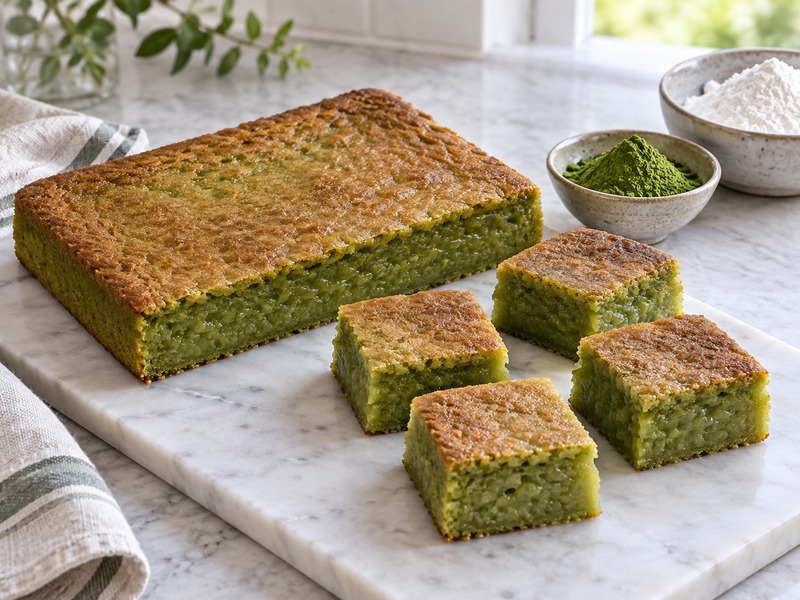
Matcha mochi cake is a baked dessert that uses glutinous rice flour for a springy, chewy crumb and matcha for tea flavor. Its texture is the selling point, yet that same chew can turn gummy in the center, hard at the edge or sticky in the pack. Snixy Kitchen’s matcha mochi cake shows the home-baking format. A bakery or packaged-dessert team needs to define the bite it wants, then test the formula after cooling, cutting and holding rather than approving it straight from the oven.
For: bakers, dessert developers, café teams and ingredient buyers. Decision: how to make a tea-flavored chewy cake that cuts, packs and eats consistently.
1. What texture should the cake have?
Describe the chew precisely
“Chewy” can mean elastic, dense, sticky or underbaked. Set a target that the team can recognize: resistance on the first bite, a moist but set center, clean release from the teeth and no raw-flour sensation. Decide whether the cake is a tray bake, individual square or plated dessert. Each shape changes heat flow and portion handling. A warm sample may feel soft and appealing while the chilled or next-day square becomes firm. Judge it at the actual sale temperature.
Make a reference cut. Photograph a slice under fixed light and record its height, mass and cut-face appearance. Taste center and edge pieces separately. The edges may become crisp, which can be desirable, but the difference should be intentional. If the pack mixes edge and center pieces, customers should still receive a comparable eating experience.
| Format | Texture opportunity | First risk |
|---|---|---|
| Tray square | Simple portioning | Center–edge variation |
| Individual mold | Uniform appearance | Overbaked perimeter |
| Plated warm slice | Fresh chew | Service hold changes |
2. Which rice flour and base ingredients matter?
Specify the flour
Glutinous rice flour gives the characteristic elastic structure; the name refers to the rice’s sticky properties and does not mean wheat gluten. Brands and milling can differ in absorption and texture. Keep flour identity constant during early tests, then challenge the approved formula with another lot or source. Other ingredients—milk or plant drink, eggs, fat, sugar and leavening—change moisture and set. Record them by weight. A recipe copied into volume cups is a weak basis for production scaling.
Check substitutions deliberately. A dairy-free version may need adjustments beyond swapping the liquid. Changes to fat, protein and sugar can alter the chew and tea perception. If the product is positioned as gluten-free, verify every ingredient, line and label under the applicable control program rather than inferring the claim from rice flour alone. A distinct formulation deserves its own shelf and safety test.
3. How should matcha be chosen for this bake?
Taste it in the crumb
The bake and sweet rice base can soften delicate tea aroma. Screen identified matcha samples at the same measured dose in one cake formula. Compare color, tea clarity and bitter aftertaste after cooling and again after the intended hold. A very bright powder may not remain as bright after baking. Another may retain flavor but look muted in the crumb. Choose the supplier based on the finished cake’s priorities, not dry-powder color alone.
Document the purchase standard. Ask for a product description, lot traceability, storage guidance, pack size and food-safety documents required by the buyer. Keep an approved sample and record how it performs in a standard bake. If a new lot requires a higher dose to reach the same flavor, its lower kilogram price may not save money per square.
| Tea check | Sample condition | Decision |
|---|---|---|
| Color | Cut cake after cooling | Visual standard |
| Flavor | Plain cake at sale temperature | Dose and lot |
| Texture | Chew beside control | Powder load |
| Continuity | Supplier documents | Reorder confidence |
4. How should powder be mixed into the batter?
Remove dry pockets
Matcha can gather in small clumps and leave dark flecks in a pale green cake. Sift or thoroughly dry-blend it with a compatible flour fraction, then mix into the batter with a consistent method. Another route is a small liquid dispersion, provided the added liquid is included in the formula’s total. Compare both in a pilot if specks remain. Watch the bottom and corners of a large mixer bowl; a uniform top surface does not prove the entire batch is even.
Limit extra mixing. More agitation can remove green specks but also change batter aeration and texture. Record mixing tool, speed, time and batter temperature. Fill the first and last pans from a batch and compare their color and crumb. If one pan is darker, the issue may be poor dispersion or settling during a long filling period. Correct the process before adding more tea.
5. What matcha dose is useful after baking?
Test a measured ladder
Set tea doses as grams per kilogram of finished batter and bake equal pan sizes under the same conditions. Taste blind after cooling. Identify the first dose with a recognizable tea note and the point where bitterness or dryness becomes distracting. The chewy rice base and sweetness may require a different dose than a sponge cake. A topping can alter the perceived tea intensity; choose the base dose before adding glaze or cream.
Record cost by portion. Divide tea mass by the number of sellable squares, accounting for trimmed edges. If a tea sample needs substantially more powder to taste clear, calculate its cost at that accepted dose. Do not use a fixed “culinary grade” label as a substitute for this trial. The finished bite, appearance and unit cost should determine the purchase.
6. Which bake endpoint gives a set center?
Observe more than surface color
A green top can brown while the center remains under-set. Use the same pan material, batter depth and oven position during comparative trials. Record baking time, oven setting and an appropriate product temperature or other validated endpoint. Cut center and edge samples after a fixed cooling period. A sticky center that pulls into strands may be part of the intended mochi character, but a wet, floury center is a defect. The distinction must be described in the release standard.
Watch carryover. Cake continues to set as it cools. Cutting too early can make an otherwise sound batch appear gummy and can leave ragged edges. Define a cooling interval and handling method. A larger tray does not necessarily need a simple proportional increase in time; validate it as a separate bake. If the line uses multiple racks, sample more than one position.
| Observation | First question | Next trial |
|---|---|---|
| Wet center | Was depth or heat inadequate? | Check pan and endpoint |
| Hard edge | Was bake too long? | Change depth or time |
| Ragged slice | Was cake cut warm? | Standardize cooling |
| Brown top | Is oven too aggressive? | Compare rack and shield |
7. How can the team cut and serve it cleanly?
Treat portioning as production
Sticky cake can cling to knives and deform as it is lifted. Choose a cut size based on target weight and the pan’s usable area. Test a clean, appropriately prepared blade and a consistent cutting temperature. Count edge trim and damaged pieces. A tiny difference in square size can change price, nutrition information and customer perception. If a café warms each slice, trial the exact warming method and time; reheating may make the center pleasant while drying the edges.
Test toppings in the final service. Cream, fruit or a dusting can improve the plate, but they may hide the tea or transfer moisture into a packed cake. Evaluate the assembled portion after the normal wait from preparation to eating. If the cake is sold plain, its cut face and color must carry the product without garnish. Do not let a styled photograph set an unrealistic standard for normal service.
8. What happens during storage and packaging?
Assess texture over time
Mochi-style cakes can change chew as they cool and hold. Pack samples in the intended material and assess them at release, after the normal selling interval and near the proposed end of sale. Record hardness, stickiness, surface moisture, aroma and tea flavor. Test both center and edge pieces. A pack that prevents drying may trap condensation; a loose wrap may leave the cake firm. Choose packaging based on the opened product, not only its shelf appearance.
Use product-specific safety work. Moist cake can require carefully controlled handling and shelf-life validation. Refrigeration or ambient sale should be selected through the applicable food-safety program, with the final formula and pack. Do not borrow storage guidance from a household recipe. If the cake is frozen for distribution, run a freeze–thaw trial and inspect texture after serving.
| Hold defect | Possible cause | Evidence |
|---|---|---|
| Hard bite | Moisture loss or temperature | Timed texture comparison |
| Wet pack | Condensation | Pack photos |
| Faded tea | Light, time or tea lot | Fixed-light color record |
| Weak aroma | Heat or hold | Blind tasting |
9. How should buyers plan cost and supply?
Cost the sellable square
Include rice flour, matcha, milk or plant base, fat, sugar, pan liners, packaging, labor and trim. A high matcha dose may be justified if the customer perceives tea, but the calculation should show cost per sellable portion. Ask suppliers for lead times, minimum order, pack sizes and lot-change practices. A second rice-flour or matcha source should be trialed in the complete cake before it becomes an approved substitute.
Keep claims grounded. Rice flour does not automatically make the finished product gluten-free under every production condition. Matcha does not establish a health benefit. Origin and certification claims need documents suited to the selling market. A product page can be persuasive by describing the actual chew and tea flavor instead of promising untested benefits.
| Purchase item | Approval evidence | What can change in the cake |
|---|---|---|
| Glutinous rice flour | Identified sample and specification | Hydration and chew |
| Matcha | Lot sample and sensory standard | Flavor and green color |
| Milk or plant base | Full ingredient specification | Sweetness and moisture |
| Retail pack | Material and seal trial | Drying or condensation |
Run a cost scenario using the actual number of saleable squares from a pan rather than the theoretical count from its dimensions. Include the strips lost at the edges and pieces damaged while cutting. If a new flour produces a higher yield but a less attractive chew, the cheaper unit cost may be misleading. Purchasing and development should sign off on the same reference cake, because a supplier quote cannot show how it eats after a day in its pack.
10. What pilot makes launch readiness clear?
Bake the real pan and pack
Use the intended equipment, batch size, pans and package. Sample the first and last pans, center and edge portions, and pieces from different oven positions. Weigh sellable units and trim. Taste at the actual sale temperature after the expected hold. Ask multiple people to describe chew, tea flavor and appearance. If the cake only works warm out of the oven, decide whether the operation can deliver that reliably.
Record a release standard. Specify the rice flour and tea lots, batter weights, pan depth, bake endpoint, cooling interval, cut size and pack. Define when a lot change or pan substitution triggers retesting. The useful next step is a small full-route batch sold or sampled through ordinary service. It will show whether the cake’s chew remains appealing beyond the test kitchen.
Reference: Matcha Mochi Cake is a consumer recipe reference. The bakery controls above are independent recommendations.
FAQ
Q1: Why is matcha mochi cake chewy? Glutinous rice flour supplies the characteristic elastic structure; the full formula and bake determine the final bite.
Q2: Can regular rice flour be swapped in directly? A direct swap changes texture and needs a fresh formulation trial.
Q3: Why is the center gummy? Check pan depth, bake endpoint and cooling before assuming the tea is responsible.
Q4: Can the cake be sold the next day? Assess the final formula and pack for texture, flavor and applicable food-safety requirements.
Q5: How is matcha dose compared? Use measured grams per kilogram of batter, then taste after baking and holding.